
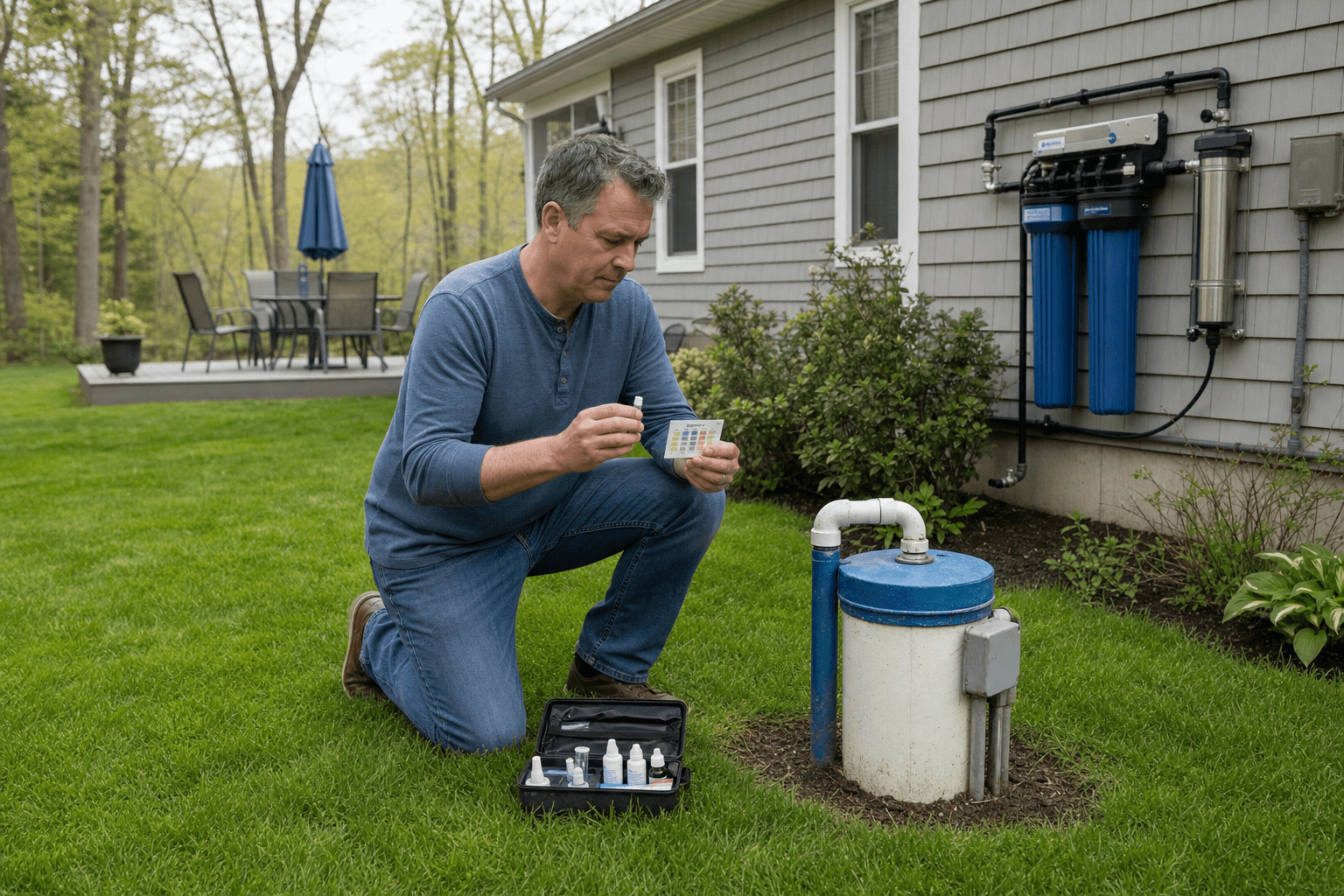
Calverton homeowners with private wells are asking more and more about PFAS contamination and what the new Calverton PFAS testing by the U.S. Navy actually means for their drinking water.
This post walks through what’s happening near the former Grumman / Naval Weapons Industrial Reserve Plant (NWIRP) site, why PFAS are a concern for private wells, and how local, whole-home filtration can fit alongside official testing.
1. Current Developments in Calverton’s PFAS Well Testing
The U.S. Navy has agreed to provide PFAS testing for private wells near the former Grumman plant at EPCAL in Calverton after years of advocacy by residents and local officials.¹
According to Riverhead Town announcements:
- Private wells near the site can be sampled for PFAS by the Navy
- Residents can check whether their property lies inside the sampling area and schedule testing at public meetings and open houses¹
- Preliminary lab results are expected within about 30 days of sampling
- Final results are mailed within roughly 3 months and posted online by the Department of Defense¹
Soil and water contamination at the Calverton site has been under review for more than four decades, and contaminants have migrated down into groundwater in a plume that extends offsite.¹ That is why nearby private wells are getting closer attention now.
> Callout: If your home is near the former Grumman / NWIRP Calverton property and you rely on a private well, it’s worth confirming whether you qualify for Navy PFAS sampling and considering your own independent testing as a second data point.
2. Why PFAS Are Dangerous and What They Mean for Calverton Residents
2.1 Defining PFAS: Persistence and Impact
PFAS (per- and polyfluoroalkyl substances) are a large family of man‑made chemicals used since the 1950s in stain‑ and water‑repellent products, firefighting foams and many industrial applications.¹
Key characteristics:
- Extremely persistent: PFAS break down very slowly and are now found almost everywhere in the world because of extensive production and use.¹
- Highly mobile in water: Once released, many PFAS compounds can move through soil and groundwater, traveling with water plumes away from their original source.¹
- Difficult to treat at scale: Regional experts on Long Island have highlighted PFAS as one of the most challenging emerging contaminants to manage in drinking water systems.²
2.2 The Broader PFAS Situation Across Long Island Groundwater
Long Island’s sole‑source aquifer is already under pressure from multiple contaminants. At a recent Clean Water Symposium hosted by Stony Brook University’s Center for Clean Water Technology, scientists and policymakers pointed to PFAS as an emerging groundwater issue across the region, alongside nitrogen and other pollutants.²
Speakers emphasized:
- PFAS “forever chemicals” are now being detected in groundwater supplies around Long Island²
- Translating advanced PFAS treatment technologies from the lab into real-world systems is complex and resource‑intensive²
- Long-term solutions will require local, site‑specific strategies, not just one generalized fix²
For Calverton homeowners, that means PFAS concerns are not isolated to one property line. They are part of a broader groundwater challenge that will likely be addressed over many years.
3. Understanding Regulatory Standards That Influence Calverton Well Water
3.1 Differences Between Public Water and Private Well Regulations
The U.S. Environmental Protection Agency (EPA) has set a 4 parts per trillion (ppt) limit for six PFAS compounds in public drinking water systems as of April 2024.¹
However:
- That federal standard does not apply directly to private wells
- The U.S. Department of Defense has its own internal action level of 12 ppt for PFAS associated with its facilities¹
- New York State’s Department of Health focuses primarily on public water systems, but also offers guidance to homeowners on maintaining and safeguarding private wells³
In other words, if you are on a private well in Calverton, you are not automatically covered by the same regulatory protections as residents on public water. You are largely responsible for monitoring and managing your own water quality, with support from state and local programs.
3.2 Resources and Guidance Provided by New York State Officials
The New York State Department of Health:
- Oversees the operation, design and quality of public water supplies and bottled water providers³
- Provides tools to view public water data, maps and annual drinking water reports³
- Offers resources for homeowners on helping reduce exposure to contaminants and maintaining private wells and septic systems³
For a Calverton homeowner with a private well, those resources can help you understand best practices, but you still need:
- Targeted testing for PFAS and other contaminants
- A plan for treatment or filtration at the household level if contaminants are detected
4. Insights Into the Navy’s PFAS Testing Program and Its Implications
4.1 What You Need to Know About the Navy’s Sampling Process
The Navy’s testing initiative near NWIRP Calverton is focused on sampling private wells in a defined area around the former facility.¹ At public meetings and open houses, residents can:
- Learn whether their property is within the sample boundary
- Schedule an appointment to have their well sampled
- Ask questions one‑on‑one with representatives from the Navy, NYS Department of Environmental Conservation and NYS Department of Health¹
The timeline for results is roughly:
| Step in Navy Process | Approximate Timing | Who Gets the Information |
|---|---|---|
| Sample collection at your well | Scheduled appointment | Navy and contracted lab |
| Preliminary lab results | Within ~30 days of sampling | Property owners and tenants notified by phone¹ |
| Final validated results | Within ~3 months | Mailed to owners/tenants and posted online¹ |
This program is a significant step forward in documenting PFAS levels near the site, but it has limitations:
- It applies only to properties within the Navy’s designated sampling zone
- It is focused on PFAS related to the former facility, not every possible contaminant in your well
- Results are a snapshot in time, not continuous monitoring
4.2 Reasons to Consider Additional Independent Water Testing
Even if you are inside the Navy’s sampling area, you may decide to pursue additional, independent testing, because:
- Private labs or local water specialists can test for a broader panel of contaminants, including metals, bacteria, and other industrial chemicals
- You may want a second opinion or more frequent testing than the Navy provides
- Some homeowners prefer to work directly with a company that can both test and design filtration tailored to their home
pHountain Water Filters offers water quality testing and analysis for Long Island homeowners, including those on private wells in Suffolk County. That testing can be used to design a customised water filtration system for your home.
If you’d like a local perspective beyond the federal testing program, you can request a Free In-Home Water Test from pHountain Water Filters.
5. Recommended Steps for Protecting Your Calverton Well From PFAS
If you rely on a private well in Calverton, here is a practical, sequential approach:
5.1 Verify Your Location Relative to the PFAS Sampling Boundary
- Locate your home relative to NWIRP Calverton: Check maps and notices related to the former Grumman / Navy site and the Navy’s sampling program.¹
- Contact program representatives: At public open houses or via the Navy’s online information, ask whether your address is inside the sampling area.¹
- Sign up for sampling if eligible: If your property qualifies, schedule a PFAS sampling appointment at your well.
5.2 Pursue Comprehensive Testing If Outside Official Zones
If your home is outside the Navy’s designated zone, or you want a more comprehensive picture:
- Review New York State well guidance: The state’s Drinking Water Protection Program provides general advice on private wells and contamination concerns.³
- Order independent well testing: Work with a qualified lab or local water quality company to test for:
- PFAS compounds
- Bacteria and microorganisms
- Heavy metals
- Sediment and other environmental contaminants
- Schedule a local consultation: pHountain Water Filters can visit homes across Suffolk County, including Calverton, to evaluate well conditions and test water quality as part of a Whole-Home Water Filtration for Suffolk County solution.
5.3 Evaluate Temporary Measures Versus Permanent Solutions
Once you have test results, you will need to decide how to respond:
- Short‑term measures might include:
- Using bottled water for drinking and cooking
- Installing small point‑of‑use filters at a single tap
- Long‑term measures typically focus on:
- Whole‑home filtration at the main water entry point
- Systems designed to address PFAS, chlorine, heavy metals, sediment and other contaminants simultaneously
- Professional installation and ongoing support
If you are weighing bottled water against a permanent solution, pHountain Water Filters has a dedicated resource comparing Water Filters vs Bottled Water to help with that decision.
6. How Whole-Home Water Filtration Protects Calverton Well Owners
6.1 Benefits of Installing a Whole-Home Filter System
For private well owners on Long Island, whole‑home filtration offers several advantages:
- House‑wide coverage: Every faucet, shower and appliance receives filtered water, not just a single sink
- Consistent performance: Professionally installed systems are designed to handle higher flow rates and variable well conditions
- Reduced reliance on bottled water: Many households find they can significantly cut monthly bottled water purchases once they trust their tap again
- Customized contaminant targeting: Systems can be configured to address PFAS, industrial chemicals, metals and sediment based on your specific test results
pHountain Water Filters specialises in customised whole‑house systems for Long Island and NYC‑area homeowners, pairing water testing and analysis with professional installation.
6.2 Real-World Example: Calverton Homeowner’s Filtration Success Story
In a representative Calverton‑area case:
- The concern: A homeowner on a private well was worried about PFAS contamination after hearing about the Navy testing program and learning that PFAS were present in the local groundwater plume.
- Testing: Qualitative testing indicated PFAS compounds at levels that justified a filtration response, along with other common well contaminants.
- The solution: pHountain Water Filters recommended and installed a pHountain pHresh Filtration System, configured for:
- PFAS‑focused contaminant targeting
- Chlorine, heavy metals, sediment and industrial chemicals
- The specific flow demands of the home’s plumbing
- Impact on daily life: The homeowner reported:
- Confidence using tap water for drinking and cooking after installation
- Reduced need for bottled water, saving an estimated $30–$70 per month compared with their previous bottled water spending
- Peace of mind knowing a professionally installed system was working continuously in the background
While every home and well profile is different, this scenario illustrates how Calverton PFAS testing can be combined with whole‑home filtration to create a practical, long‑term strategy.
> Callout: Navy testing can tell you what’s in your water today. A whole‑home filtration system is about how your water will be treated tomorrow, next year and beyond.
7. Working With pHountain Water Filters: What to Expect in Calverton
If you decide to explore a filtration solution with pHountain Water Filters, the process typically follows these steps:
- Initial consultation: You share your well location, concerns and any existing test results. This can include Navy PFAS data or independent lab reports.
- Water quality evaluation: A pHountain Water Filters specialist conducts water testing and analysis to confirm contaminant levels and overall water conditions.
- System recommendation: Based on the findings, they propose a customised filtration configuration, often centered around the pHountain pHresh Filtration System for whole‑home coverage.
- Professional installation: Certified technicians handle all aspects of plumbing integration, ensuring the system is correctly sized and connected for your home.
- System verification: After installation, the system is tested and fine‑tuned to confirm proper operation.
- Homeowner orientation: You learn how the system works, what it is designed to address and how basic maintenance will be handled.
- Ongoing support: pHountain Water Filters provides long‑term assistance, including maintenance guidance and potential upgrades if your water conditions change.
To see how this approach applies across Long Island, you can review pHountain Water Filters’ broader Water Filtration Long Island NY service area.
8. Answers to Frequent Queries from Calverton Well Owners About PFAS
Does the Navy’s PFAS testing cover every private well in Calverton?
No. The Navy testing program is focused on private wells within a defined sampling area near the former Grumman / NWIRP Calverton site.¹ If your home is outside that boundary, your well may not be automatically included. You can still pursue independent testing through a private lab or a local water filtration company.
If my Navy PFAS test comes back below 12 ppt, do I still need filtration?
The 12 ppt level referenced in Navy documents is an internal U.S. Department of Defense action threshold, not a definitive standard for private wells.¹ The EPA has established limits for certain PFAS in public systems, and New York State provides broader guidance on helping reduce exposure to contaminants for all residents.³ Many Calverton homeowners choose whole‑home filtration as an added layer of protection, even when test results are below a specific action level.
How often should I test my Calverton private well for PFAS?
There is no single rule that fits every well. Because PFAS are persistent and mobile in groundwater, and because groundwater plumes can shift over time, many experts recommend periodic testing, especially near known contamination sites.¹ Combining official sampling (such as the Navy’s program) with regular independent testing can give you a more complete picture.
Will a whole-home system also help with non‑PFAS issues in my Calverton well?
Yes. A properly designed whole‑home filtration system can be configured to address multiple contaminant categories at once, including:
- PFAS compounds
- Chlorine and disinfection byproducts
- Heavy metals
- Sediment and other environmental contaminants
pHountain Water Filters designs systems specifically for Long Island groundwater conditions, so Calverton homeowners can address both PFAS and other well‑water challenges in a single solution.
Is this issue unique to Calverton, or should other Suffolk County well owners also be concerned?
While the Navy’s PFAS testing is specific to Calverton and the former Grumman / NWIRP site, PFAS and other contaminants have been identified in groundwater across Long Island.² Any Suffolk County homeowner on a private well may want to consider periodic testing and, if needed, whole‑home filtration. pHountain Water Filters serves Suffolk County communities broadly through its Whole-Home Water Filtration for Suffolk County services.
For Calverton homeowners, the combination of official Calverton PFAS testing, independent well analysis and professionally installed filtration can create a clear, practical path forward.
If you’d like to understand your own water better and explore filtration options tailored to your home, you can request a Free In-Home Water Test from pHountain Water Filters.
This content is for informational purposes only and is not intended as health, medical, or regulatory advice. Always consult appropriate government agencies and qualified professionals for guidance specific to your situation.
Water quality varies by location. Municipal water provided by SCWA achieved EPA compliance in June 2025. Private well owners should have water tested regularly. pHountain provides free water testing for Nassau and Suffolk County.