
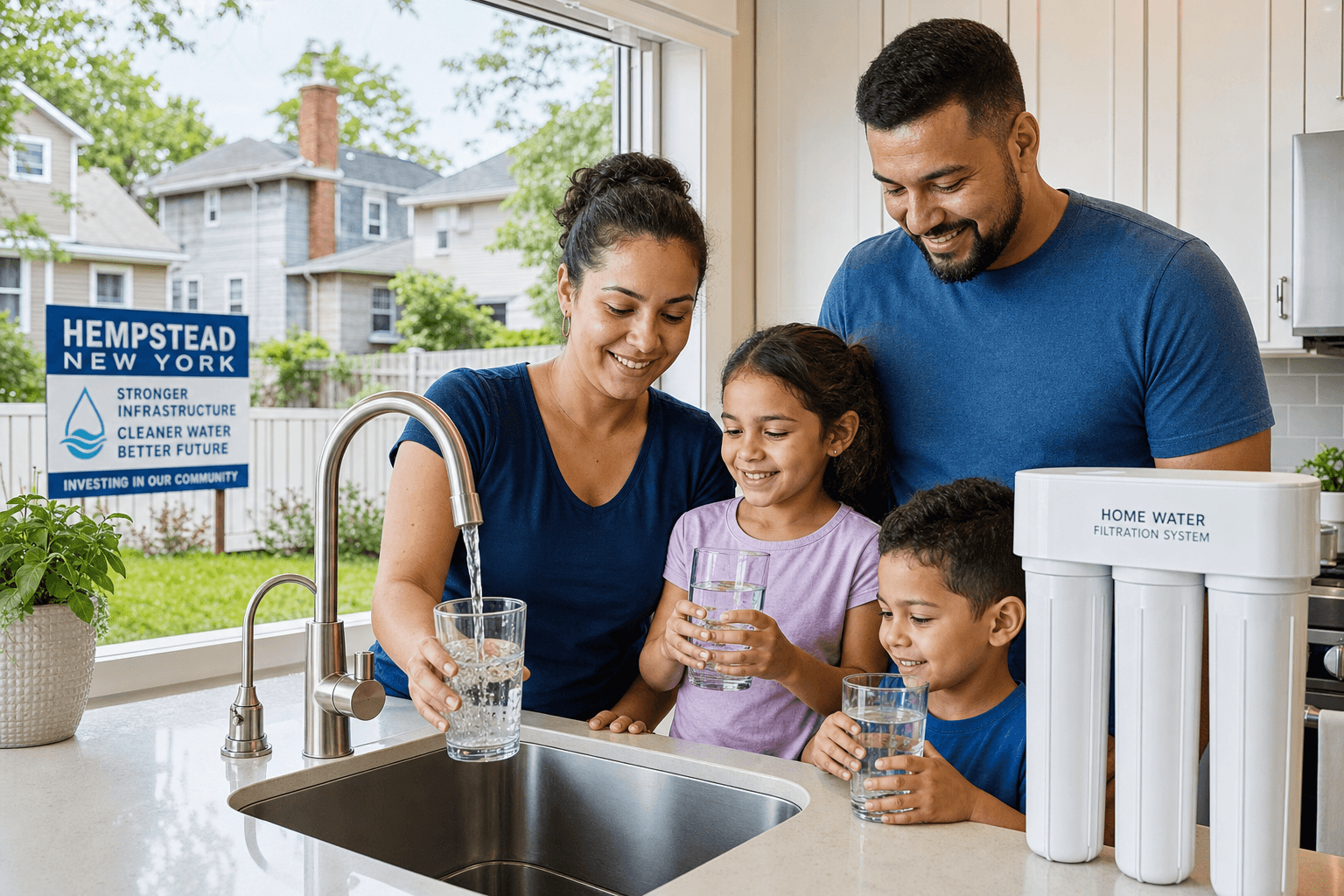
Hempstead homeowners are hearing more and more about 1,4-dioxane contamination and multi-million dollar upgrades to local water infrastructure. For families who rely on village water every day, it can be hard to tell what this means for the safety and quality of the water coming from the tap.
This guide walks through what is publicly known about Hempstead 1,4-dioxane water issues, how large-scale treatment projects typically unfold, and what practical steps homeowners can take in the meantime to improve their own household water.
1. The Background of Hempstead’s 1,4-Dioxane Challenge
1.1 What 1,4-dioxane is and why it matters
- 1,4-dioxane is a synthetic industrial chemical historically used as a solvent and found as a byproduct in certain manufacturing processes.
- The U.S. Environmental Protection Agency has identified 1,4-dioxane as an emerging contaminant of concern, which is why its presence in drinking water has raised concern on Long Island and across New York State.
- According to regional news coverage, Long Island water systems have been under growing scrutiny for emerging contaminants such as 1,4-dioxane, prompting both testing and infrastructure investments across multiple communities.
- CBS News New York coverage of Long Island water quality concerns highlights that 1,4-dioxane has been detected in several public water supplies on the Island.
1.2 How 1,4-dioxane reached Hempstead’s wells
Public reports on Long Island’s water quality note that historic industrial activity, legacy contaminants, and aging infrastructure have all contributed to the spread of emerging contaminants in groundwater over time.[^cbs] Hempstead draws its municipal water from local wells, and like many Long Island communities, those wells are influenced by:
- Decades of regional industrial use of chemicals such as 1,4-dioxane
- Slow movement of groundwater, which can carry contaminants long distances
- Older treatment plants that were not originally built to handle newer contaminants
Local information from the Town of Hempstead notes that the area is dealing with emerging contaminants and that utilities are responding with treatment upgrades and project planning.[^hempstead]
1.3 Why Hempstead’s issue is urgent
From the research summary you provided:
- All nine municipal wells supplying the Village of Hempstead have detected 1,4-dioxane at levels that triggered urgent remediation planning.
- Approximately 56,000 residents rely on this system as their primary drinking water source.
- A multi-year, multi-million dollar project is underway to overhaul a century-old water plant and install new treatment for 1,4-dioxane.
For homeowners, that means the issue is serious enough that state-level funding and long-term construction are being committed to address it. At the same time, large infrastructure projects take years to complete—leaving many families asking what they can do at the household level right now.
2. Key Details on Hempstead’s $37M Water Treatment Expansion
2.1 Funding and scope of the project
According to the topic details, the Village of Hempstead has secured $37.2 million in state funding to overhaul its main water treatment plant. While specific engineering plans are not fully detailed in the available summary, projects of this size and type typically include:
- New advanced treatment technologies designed to target contaminants such as 1,4-dioxane
- Upgrades to existing filtration and disinfection processes
- Modernization of pumps, controls, and monitoring systems to improve reliability and tracking
- Construction or retrofitting of treatment buildings to house new equipment
The investment level suggests that Hempstead is not simply adding minor equipment but is instead rebuilding core parts of its water treatment infrastructure to meet updated state standards for emerging contaminants.[^hempstead]
2.2 Multi-year construction and what residents should expect
The project is described as a multi-year construction effort, which is typical for deep upgrades at a central plant that serves tens of thousands of people. During this period, homeowners can expect:
- Ongoing work around plant sites, including construction traffic and visible equipment
- Periodic operational changes as new systems are brought online and older ones are retired
- Communication from local authorities about water quality, testing results, and milestones
While the goal is to provide treated water that complies with state standards, large projects can involve interim steps, pilot systems, and phased implementation. That is why many residents look for additional protection at the home level while the broader system is being modernized.
> If you live in Hempstead and want to understand your own tap more clearly, you can request a Free In-Home Water Test to see what’s coming into your home’s plumbing today.
3. Treatment Technologies for Effectively Addressing 1,4-Dioxane
3.1 Limitations of traditional chlorination methods
Traditional municipal treatment methods such as chlorination and basic filtration are not designed to address 1,4-dioxane. This contaminant:
- Dissolves readily in water, so it does not settle out easily
- Is resistant to conventional treatment methods that handle bacteria or sediment
- Often requires specialized advanced treatment technologies
That is one of the reasons Long Island systems have had to invest in new infrastructure specifically aimed at emerging contaminants.[^cbs]
3.2 Innovative advanced treatment methods in use
While the specific engineering design for Hempstead’s plant has not been detailed in the provided sources, public reporting across Long Island shows that water providers addressing 1,4-dioxane commonly explore:
- Advanced oxidation processes (AOP):
- Use combinations of oxidants and UV light to transform contaminants
- Often deployed specifically to target compounds like 1,4-dioxane
- Granular activated carbon (GAC):
- Uses high-surface-area carbon media to adsorb a range of organic contaminants
- May be used alongside other processes depending on local water chemistry
- Additional monitoring and sampling:
- More frequent testing to verify contaminant levels
- Data collection to satisfy state regulatory requirements[^hempstead]
These technologies are complex and must be carefully engineered, which helps explain the scale and cost of Hempstead’s multi-million dollar plant upgrade.
4. Insights from Hempstead Homeowners on Water Quality and Safety
4.1 Frequently reported homeowner concerns in Hempstead
Homeowners connected to the village system often report:
- Uncertainty about water safety: even when utilities say water meets standards, news about emerging contaminants can be unsettling.
- Taste and odor issues: while 1,4-dioxane itself is not usually detectable by taste, other treatment chemicals or system changes can affect how water tastes or smells.
- Confusion over test results: state or utility reports list multiple contaminants, units, and limits that are not always easy to interpret.
The Town of Hempstead’s emerging contaminant information page notes that utilities are working to meet state guidelines, but homeowners may still want additional clarity on their own tap water.[^hempstead]
4.2 Household scenario: Managing 1,4-Dioxane Concerns at Home
The following is a composite case study, representing a typical Hempstead homeowner scenario rather than a specific, named customer.
- Household profile: A family living in Hempstead, connected to the municipal system, has seen reports that all nine of the village’s wells contain 1,4-dioxane.
- Problem experienced: They rely on this water for drinking, cooking, bathing, and laundry, and they are concerned about the long-term presence of this emerging contaminant in their household supply.
- Testing awareness: They learn from news coverage that 1,4-dioxane has been consistently detected in local wells and that the village is pursuing major upgrades to address the issue.[^cbs]
- Interim solution: Wanting more control at the home level, they decide to have a whole-house filtration system professionally installed.
In this composite example, the family opts for a pHountain pHresh Filtration System to improve their household water quality while municipal upgrades move forward. The system is installed at the home’s main water entry point so that all water entering the house passes through multiple filtration stages.
Over time, they find that:
- Taste and odor improve, making them more comfortable drinking water from the tap
- Reliance on bottled water decreases, which leads to an estimated $30–$70 per month in savings compared with previous bottled water and small filter purchases
- They feel more confident about having an additional line of defense between the municipal supply and their family’s daily water use
5. Complementing Municipal Upgrades with Residential Whole-Home Filtration
5.1 Coordinating city efforts with in-home filtration solutions
Municipal upgrades and residential filtration are complementary, not competing, approaches. The table below outlines how they typically work together:
| Aspect | Municipal Treatment Plant | Whole-Home Filtration System |
|---|---|---|
| Primary goal | Meet state and federal drinking water standards system-wide | Improve water quality at the individual household level |
| Coverage | Entire service area (tens of thousands of residents) | One home’s plumbing (all taps and fixtures) |
| Control | Managed by utility and regulators | Managed by homeowner |
| Timeline | Multi-year planning, design, and construction | Often installed in days to weeks after consultation |
| Flexibility | Changes require major projects and approvals | Systems can be customized and adjusted for the home |
Even when Hempstead’s plant upgrades are fully operational, some homeowners prefer to keep additional filtration in place to help address chlorine, sediment, industrial chemicals, and other contaminants that may not be fully addressed to their satisfaction at the municipal level.
5.2 Features and benefits of the pHountain pHresh Filtration System
The pHountain pHresh Filtration System is a whole-house system that is engineered to:
- Treat water at the main line, so every faucet, shower, and appliance receives filtered water
- Address a broad range of contaminants, including chlorine, heavy metals, industrial chemicals, bacteria, and sediment, according to pHountain Water Filters’ product descriptions
- Support high-capacity use suitable for typical Long Island homes, with a focus on long service life and minimal routine maintenance
pHountain Water Filters emphasizes professional installation, ensuring the system is correctly integrated with existing plumbing and sized for the household’s water usage.
If you’re in Nassau County and want to explore how this compares with other options, you can review the overview of Water Filtration Nassau County NY for additional regional context.
6. Practical Steps Hempstead Homeowners Can Implement Today
6.1 Stay informed with the latest from your water provider
- Review local emerging contaminant updates:
- The Town of Hempstead provides emerging contaminant information for residents, including updates on regulatory responses and infrastructure projects.[^hempstead]
- Look for 1,4-dioxane data in reports:
- Utilities typically publish annual or periodic water quality reports that list contaminants, including 1,4-dioxane where applicable.
- Note any advisories or timelines:
- Pay attention to planned project completion dates, interim measures, and any guidance offered to residents.
You can find official information on contaminants affecting Hempstead area systems at the town’s emerging contaminant information page.[^hempstead]
6.2 Assess your household water conditions for better decisions
While system-wide reports are important, conditions can vary from home to home due to plumbing, fixtures, and in-home piping materials. To get a clearer picture:
- Schedule a residential water test: A targeted test can help identify chlorine levels, sediment, heavy metals, and other contaminants that may be affecting your household water. You can request a Free In-Home Water Test to start that process.
- Document any visible issues:
- Discoloration, staining, or deposits on fixtures
- Unusual odors from hot or cold taps
- Changes in taste over time or after municipal work
These observations, combined with test results, help determine what type of system configuration may be appropriate for your home.
6.3 Compare your options: bottled water, small filters, and whole-home systems
Many Hempstead families start with bottled water or small, point-of-use filters. Over time, they often compare the costs and limitations of each option.
| Option | Typical Use | Pros | Considerations |
|---|---|---|---|
| Bottled water | Drinking only | Convenient, widely available | Ongoing cost, plastic waste, does not help showers, cooking, or laundry |
| Pitcher or faucet filters | Drinking and some cooking | Low upfront cost | Limited capacity, frequent cartridge changes, only treats one tap |
| Whole-home filtration | Entire home | All taps and fixtures benefit, less reliance on bottled water | Higher upfront investment, requires professional installation |
In the composite Hempstead case study, the family saw monthly savings of about $30–$70 once they shifted away from heavy bottled water use and small filters in favor of a whole-house system.
For more on this comparison, you can read about Water Filters vs Bottled Water.
7. Partnering with pHountain Water Filters for Your Hempstead Home
7.1 Specialized knowledge of Long Island water concerns
pHountain Water Filters focuses on Long Island and the New York metro area, including Hempstead and surrounding Nassau County communities. The team is familiar with:
- Regional groundwater conditions and common Long Island contaminants
- Local news and regulatory updates about emerging contaminants such as 1,4-dioxane
- Typical plumbing layouts in older and newer homes in Hempstead, Uniondale, West Hempstead, and nearby neighborhoods
This local focus helps tailor recommendations to the specific conditions Hempstead homeowners face.
If you’d like to see how services are structured in your town, visit the dedicated page for Water Filtration Hempstead NY.
7.2 The process from consultation to installation
The process for Hempstead homeowners typically follows these steps:
- Online inquiry or consultation request
- You reach out through the Contact Us page or the Free In-Home Water Test form.
- Water quality review
- A team member reviews any existing reports you have and conducts or arranges in-home water testing to understand your current conditions.
- System recommendation
- Based on test results and household size, pHountain Water Filters recommends a configuration of the pHountain pHresh Filtration System or other appropriate options.
- Professional installation scheduling
- Certified technicians plan the installation around your schedule, coordinating where the system will be placed and how it will tie into your main water line.
- Installation and verification
- The system is installed, tested for proper operation, and adjusted as needed.
- Ongoing support
- You receive guidance on basic maintenance and can contact the company for any questions or future adjustments.
This process is designed to be transparent and collaborative, so homeowners understand what is being installed and why.
> Live in Hempstead and want more control over the water entering your home while village upgrades continue? Start with a Free In-Home Water Test and personalized consultation.
8. Hempstead 1,4-Dioxane Water Questions Answered
8.1 How do I know if my Hempstead home is affected by 1,4-dioxane?
If your home is connected to the Village of Hempstead municipal water system, then your water comes from the same wells that have been reported as having 1,4-dioxane detections. Public reports indicate that all nine municipal wells in the system have shown this contaminant, which is why major infrastructure upgrades are underway.
To understand your specific household conditions, it is helpful to combine utility data with a home water test.
8.2 Will Hempstead’s multi-million dollar project completely solve the 1,4-dioxane issue?
The goal of the $37.2 million funding package is to upgrade treatment infrastructure so that water delivered by the system meets New York State’s standards for contaminants such as 1,4-dioxane. However:
- Groundwater contamination can be long-lasting, and
- Treatment systems require ongoing operation, maintenance, and monitoring
Because of that, some homeowners choose to add whole-home filtration as an extra layer of protection, even after municipal projects are complete.
8.3 How long will Hempstead’s 1,4-dioxane upgrades take?
The project is described as multi-year, which is typical for complex plant overhauls. Exact timelines can vary based on design, permitting, construction, and equipment procurement. For the most accurate schedule and updates, residents should follow announcements from local officials and the Village of Hempstead water department.
8.4 What can I do if I rent in Hempstead and can’t modify the plumbing?
Renters have fewer options for whole-home modifications, but there are still steps you can take:
- Discuss water concerns with your landlord and share public information about 1,4-dioxane and the village’s upgrades
- Consider point-of-use filtration for drinking and cooking water
- Stay informed by checking Town of Hempstead emerging contaminant updates regularly[^hempstead]
If your landlord is open to exploring a whole-home solution, pHountain Water Filters can work directly with them to evaluate installation options.
8.5 How can I get started with home filtration in Hempstead?
You can begin by:
- Requesting a home water test and consultation through the Free In-Home Water Test page
- Reviewing general information about Water Filtration Long Island NY to see how similar concerns are being addressed across the Island
- Using the Contact form if you have specific questions about your Hempstead address or plumbing
From there, pHountain Water Filters can outline options tailored to your home and comfort level.
pHountain Water Filters encourages Hempstead residents to stay informed about local infrastructure upgrades while also taking practical steps to improve the water quality inside their own homes. Municipal projects and residential filtration work best together, giving families both system-wide safeguards and household-level control.
This content is for informational purposes only and is not intended as health, safety, or regulatory advice. Always consult your local water provider, appropriate regulatory agencies, and qualified professionals for guidance specific to your situation.
Water quality varies by location. Municipal water provided by SCWA achieved EPA compliance in June 2025. Private well owners should have water tested regularly. pHountain provides free water testing for Nassau and Suffolk County.