
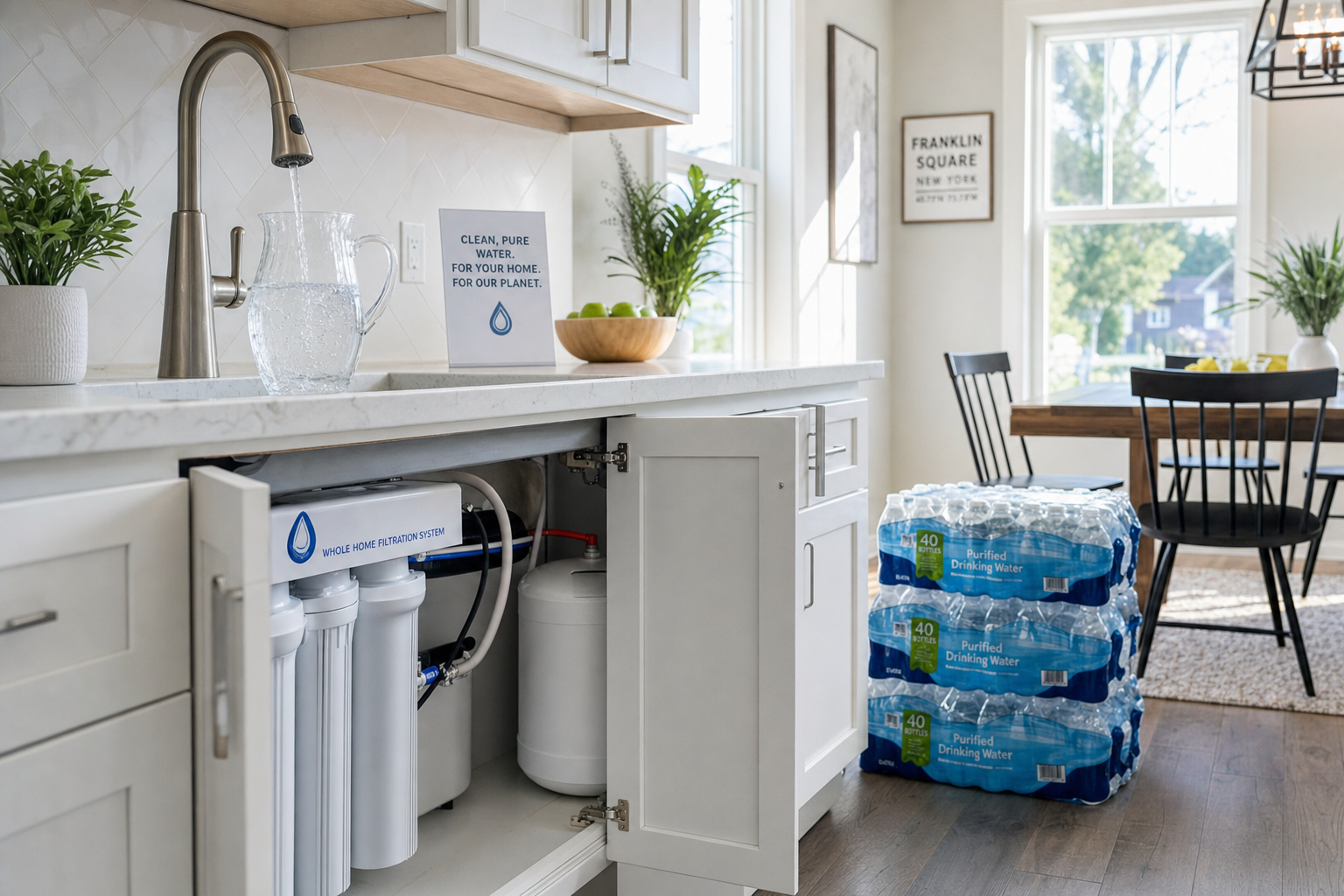
Franklin Square homeowners are hearing more about PFOS and PFAS contamination in Western Nassau’s water and wondering what it means for their budget as well as their tap. Municipal suppliers are working under New York State oversight to manage emerging contaminants in public drinking water systems, but many families are already spending extra money trying to feel safer at home.[^nysdoh]
This guide focuses on the real-world costs of living with ongoing Franklin Square water contamination concerns—and what it typically costs to rely on bottled water, small filters, or a whole-home system over time.
1. Current Expenses Franklin Square Residents Face
New York State’s Department of Health regulates public water systems and sets rules around emerging contaminants to help protect residents.[^nysdoh] But even when water providers are working toward compliance, homeowners often take their own precautions, which come with ongoing costs.
Common spending patterns in Franklin Square include:
- Bulk bottled water for drinking and sometimes cooking
- Pitcher or faucet-mounted filters as a quick add-on
- Under-sink units for the kitchen only
- Whole-home filtration systems installed on the main line
Before looking at specific options, it helps to understand why PFOS and similar contaminants are driving these choices.
2. Why PFOS and Emerging Contaminants Increase Household Water Costs
2.1 New York’s Regulatory Perspective on PFOS and PFAS
New York’s Drinking Water Protection Program highlights how emerging contaminants like PFAS are an active focus for regulators and the Drinking Water Quality Council.[^nysdoh] The state:
- Oversees public systems to help ensure water is suitable for drinking
- Develops regulations for new and emerging contaminants
- Provides tools and reports so residents can review local water quality data
When PFOS or related compounds are detected, utilities may plan or build treatment upgrades. During that transition period, many homeowners turn to stop-gap solutions—and that is where the real cost comparison begins.
2.2 The Costs of Delaying Infrastructure Improvements
Even if your local water provider is addressing contaminants under state guidance, it can take time for infrastructure projects to be fully online.[^nysdoh] Meanwhile, Franklin Square households often:
- Buy bottled water weekly, sometimes indefinitely
- Replace small filters frequently, often without tracking the annual cost
- Layer multiple products (pitcher plus fridge filter plus bottled water)
All of these steps add up—often to more than a professionally installed system would cost when spread over several years.
3. Comparing Costs: Bottled Water, Small Filters, and Whole-Home Filtration Systems
The numbers below are illustrative ranges, based on typical household behavior and the composite Franklin Square case study in this brief. Actual costs depend on your usage, family size, and specific products.
3.1 Cost Comparison Table for Common Solutions
| Option | Typical Use in Franklin Square | Ongoing Cost Pattern | Key Limitation |
|---|---|---|---|
| Bottled water | Drinking (sometimes cooking) | Weekly or monthly store spend | Does not help showers or laundry |
| Pitcher / faucet filters | Drinking and coffee/tea | Filter cartridges every 1–3 months | Limited capacity and flow rate |
| Under-sink drinking system | Kitchen tap only | Annual cartridge changes | No coverage for baths or other taps |
| Whole-home filtration system | Every faucet and shower in the home | Periodic media service/changes | Higher upfront investment |
4. Evaluating the True Cost of Bottled Water in Franklin Square
4.1 Bottled Water Usage Patterns Among Households
Many Franklin Square families concerned about PFOS contamination choose bottled water as the first line of defense. A common pattern is:
- Cases of single-serve bottles for school, work, and home
- 3–5 gallon jugs for dispensers
- Occasional emergency stockpiles during local water news or advisories
While New York State also regulates commercial bottled water suppliers,[^nysdoh] relying on bottles as your main strategy can be expensive.
4.2 Five-Year Spend Outlook: Bottled Water vs Filtration System
For a family of 3–4 using bottled water for most drinking and some cooking, it’s common to spend:
- $60–$120 per month on bottled water, depending on brand and volume
- That can total $3,600–$7,200 over five years
By comparison, the composite Franklin Square homeowner who installed a pHountain pHresh Filtration System reported saving about $30–$60 per month versus their previous bottled water and small-filter routine.
5. Small Filters: Examining the True Long-Term Expense
5.1 Upfront Savings vs Recurring Costs
Pitcher and faucet-mounted filters often look like the most budget-friendly solution. The initial purchase is low, but:
- Cartridge replacements stack up year after year
- Multiple devices (kitchen, fridge, bathroom) multiply that cost
- Some households still buy bottled water for peace of mind
Over 3–5 years, that can rival or exceed the cost of a more robust system.
5.2 Gaps in Protection with Small-Scale Filters
Small filters typically only treat one faucet or a single pitcher at a time. That means:
- Showers and baths are still using unfiltered tap
- Bathroom sinks, laundry, and dishwashers are untreated
- Any concern about PFOS exposure beyond drinking remains unaddressed
Because New York’s guidance on protecting your family from potentially contaminated drinking water emphasizes taking thoughtful steps and seeking local health department input during any “Do Not Use” situation,[^nysdoh] many residents eventually look for broader coverage.
6. Whole-Home Filtration Systems: Assessing Value and Performance
6.1 Financial Benefits and Overall Coverage of Whole-Home Systems
A whole-home filtration system is installed where water enters the house, so every tap is treated. The upfront investment is higher, but:
- Operating costs are typically spread over years
- It can replace or lower spending on bottled water and multiple small filters
- It offers consistent coverage for drinking, cooking, bathing, and cleaning
In the Franklin Square composite case, the household’s monthly savings of about $30–$60 came from:
- Buying far less bottled water
- Retiring several small countertop and pitcher units
- Consolidating into a single professionally installed system
6.2 Why Choosing Professional Installation Makes a Difference
Because the New York State Department of Health regulates the operation and design of public water supplies and emphasizes proper system operation,[^nysdoh] Franklin Square homeowners often prefer professional installation for in-home systems as well. With pHountain Water Filters, that means:
- Water quality evaluation to understand your specific conditions
- System recommendation tailored to your Franklin Square home
- Professional installation integrated into your plumbing
- Follow-up support to help keep the system performing as intended
7. A Franklin Square Homeowner’s Experience: Addressing PFOS and Saving Costs
A composite Franklin Square homeowner recently faced elevated PFOS levels in their residential water supply, above recommended thresholds. Concerned about chemical exposure and water safety, they had been:
- Purchasing multiple cases of bottled water each month
- Using small filters in the kitchen
After consultation and testing, they chose a pHountain pHresh Filtration System with professional installation to address PFOS and other contaminants throughout the home.
The result:
- Approximate savings: $30–$60 per month compared to their mix of bottled water and smaller filters
- Coverage: Every tap in the home now receives water that passes through their installed system
- Convenience: No more hauling bulk water or tracking several different filter schedules
While every home is different, this scenario shows how Franklin Square water contamination concerns can actually make a whole-home solution more cost-effective over time.
8. How to Calculate Your Own Water-Related Spending in Franklin Square
Use this simple process to see where your money is going today.
8.1 Step 1 – Tally Bottled Water and Filter Expenses
- Gather your last 3 months of receipts or bank statements.
- Highlight any water-related purchases, including bottles, jugs, and filter cartridges.
- Calculate an average monthly total for those three months.
8.2 Step 2 – Project Expenses Over Several Years
- Multiply your monthly average by 12 to estimate your yearly spend.
- Multiply again by 3 or 5 to see what that looks like over the medium term.
- Compare that figure to the idea of investing once in a whole-home system plus periodic maintenance.
8.3 Step 3 – Consider Intangible Costs
Beyond dollars, consider:
- Time spent shopping for and carrying bottled water
- Storage space taken up by cases and jugs
- Peace of mind from knowing all household water passes through a single system
9. Staying Updated: Franklin Square Water Quality Resources
New York State provides tools to view maps, graphs, and tables of public drinking water data, and to access annual drinking water quality reports.[^nysdoh] For Franklin Square homeowners, that means you can:
- Review your local water supplier’s annual report
- Check for information on PFOS, PFAS, and other emerging contaminants
- Contact your local health department if you have questions about advisories or “Do Not Use” notices[^nysdoh]
Because pHountain Water Filters focuses on Long Island and the broader NYC metro area, the team is familiar with Nassau County water issues and can help interpret how regional conditions may affect your home.
You can also explore broader regional context in this resource on Long Island PFAS concerns: Long Island Has a PFAS Problem. Here’s What You Need to Know.
10. Deciding Between Bottled Water, Filters, and Whole-Home Systems
Here’s a practical way to weigh your choices if PFOS is on your mind.
10.1 Bottled Water: When It Makes Sense and When It Doesn’t
Bottled water can play a role when:
- You need short-term coverage during a specific advisory
- You’re waiting on test results or system installation
- You want a backup supply for emergencies
But as a permanent solution, it tends to be the most expensive per gallon and the least convenient.
You can learn more about this tradeoff in depth here: Water Filters vs Bottled Water.
10.2 Can Small Filters Meet Your Needs?
Pitchers and faucet filters can be useful if:
- You live alone or have very low water usage
- You only want filtered drinking water at a single tap
- You’re renting and can’t modify plumbing
Just remember they do not address whole-house exposure, and the long-term filter replacement cost may surprise you.
10.3 Why Whole-Home Systems Are Often the Best Investment
A whole-home system is often the best fit when:
- You’re a homeowner in Franklin Square or nearby
- You’re concerned about PFOS exposure not just from drinking, but from bathing, brushing teeth, and washing dishes
- You’re already spending significant money on bottled water and small devices
- You want a single, professionally installed solution rather than a patchwork of products
For a broader view of how whole-home systems fit into Nassau County options, see: Water Filtration Nassau County NY and Water Filtration Hempstead NY.
> Concerned about PFOS or other contaminants in your Franklin Square water? > Start by scheduling a no-obligation water evaluation so you know what you’re dealing with.
You can request one here: Free In-Home Water Test.
11. How pHountain Water Filters Supports Franklin Square Residents
pHountain Water Filters focuses on residential water filtration for Long Island and the NYC metro area, with a strong emphasis on local water conditions.
11.1 Tailored Testing and Personalized Solutions
For Franklin Square and Western Nassau homeowners, the process typically includes:
- Water quality testing and analysis to identify contaminants and overall conditions
- Customized system design based on your home’s plumbing and water usage
- Professional installation of the recommended configuration
- Ongoing support and maintenance to help sustain performance
Because New York’s Drinking Water Protection Program stresses maintaining and safeguarding drinking water systems,[^nysdoh] this structured approach is designed to align with that mindset at the household scale.
11.2 The pHountain pHresh Filtration System’s Benefits
The pHountain pHresh Filtration System is a proprietary whole-house option engineered to address:
- Chlorine
- Heavy metals
- Industrial chemicals
- Bacteria and microorganisms
- Sediment and impurities
- Various environmental contaminants
For Franklin Square residents worried about PFOS and related compounds, this type of system provides comprehensive, point-of-entry treatment so that every tap receives water that has passed through the installed filtration stages.
To explore service in nearby communities, you can also review: Water Filtration Long Island NY and Water Filtration Levittown NY.
12. Actionable Advice for Franklin Square Homeowners
If you’re concerned about Franklin Square water contamination and want to get a handle on both safety and cost, here’s a straightforward path:
- Review your local water report using New York’s drinking water tools.[^nysdoh]
- Contact your local health department with any questions about notices or advisories.[^nysdoh]
- Audit your current spending on bottled water and small filters using the method in Section 8.
- Schedule a professional water test to understand your home’s specific conditions.
- Compare total 3–5 year costs of bottled water, small filters, and a whole-home system.
- Decide if a whole-home installation aligns with your budget and peace-of-mind goals.
When you’re ready to talk through options tailored to Franklin Square and Western Nassau, you can reach out here: Contact Us.
Frequently Asked Questions
How does PFOS in Franklin Square water affect my household budget?
PFOS itself does not directly change your water bill, but concern about PFOS often leads Franklin Square homeowners to spend more on bottled water and filters. Over several years, those extra purchases can add up to thousands of dollars, sometimes more than the cost of installing a whole-home system that treats all incoming water.
Are Franklin Square residents covered by New York’s drinking water protections?
Yes. Franklin Square is within New York State’s regulated public drinking water framework. The Department of Health works with county health departments to oversee the operation, design, and quality of public water supplies, and provides programs and financing to help maintain and upgrade systems.[^nysdoh] However, many homeowners still choose in-home filtration for an added layer of protection and control.
If my Franklin Square provider meets state standards, why consider a filter at all?
State standards and regulatory oversight are designed to help ensure water is suitable for drinking across the population.[^nysdoh] Some Franklin Square homeowners, especially those focused on PFOS and other emerging contaminants, prefer a household-level solution so they can:
- Tailor filtration to their specific comfort level
- Address all household uses (drinking, bathing, cooking)
- Potentially lower long-term bottled water spending
What’s the first step if I’m worried about PFOS in my Franklin Square home?
Start by:
- Reviewing your water provider’s annual report using New York’s online tools.[^nysdoh]
- Contacting your local health department if you see terms like PFOS, PFAS, or “emerging contaminants” and want clarification.[^nysdoh]
- Arranging a targeted water test at your home to understand your specific situation.
You can schedule a local evaluation here: Free In-Home Water Test.
> Ready to stop guessing about Franklin Square water contamination and what it’s costing you every month? > Take the next step and request your personalized water analysis and filtration consultation today: Free In-Home Water Test.
This blog is for informational purposes only and is not intended as health, safety, or regulatory advice. Always consult your local water provider, health department, or appropriate licensed professional for guidance specific to your situation.
Water quality varies by location. Municipal water provided by SCWA achieved EPA compliance in June 2025. Private well owners should have water tested regularly. pHountain provides free water testing for Nassau and Suffolk County.