The North Fork water main project is moving ahead with a revised route and an accelerated timeline, but Southold and Riverhead homeowners still face several years of aquifer vulnerability, saltwater intrusion risk, and water reliability concerns before the work is finished. Here’s a practical checklist to help you protect your home’s water in the meantime.
1. What the North Fork Water Main Project Means for Your Area
Before you decide what to do at home, it helps to know what this project will and will not address.
Key facts about the project
According to the Suffolk County Water Authority’s Draft Environmental Impact Statement and project announcement:
- Largest SCWA project: SCWA describes this as the largest single infrastructure project in its 75-year history, designed to support the long-term public water supply in Southold.
- Aquifer concerns: The North Fork has a thinner, shallower aquifer than other parts of Long Island, which makes it more susceptible to saltwater intrusion and surface-level contamination and limits its capacity to meet growing demand.
- New transmission line: The plan centers on a 7.5‑mile, 24‑inch transmission main that will bring water directly to the North Fork, bypassing the Riverhead Water District service area, where no connections are planned.
- Revised route and timing: After public input, SCWA revised the route to run only on state and county roads and away from Sound Avenue, shortening the line by about a mile and moving expected completion from 2030 to 2028.
- System reliability: A new booster station is part of the plan to stabilize pressure and improve overall reliability for customers served by SCWA on the North Fork.
SCWA currently operates 60 wells across 18 well fields on the North Fork, serving about 9,500 customers, and notes that most wells draw from the Upper Glacial Aquifer, which is vulnerable to pesticides, herbicides, rising chloride levels, and over‑pumping pressures.[^scwa]
What this means for your household
- Benefits are regional, not instant: The project is designed to relieve stress on the aquifer and improve regional reliability, but the benefits will phase in over time and not on a house‑by‑house schedule.
- Riverhead vs. Southold differences: The transmission main is intended to strengthen Southold’s supply while bypassing the Riverhead Water District service area.[^scwa] If you’re on Riverhead public water or a private well, your situation may differ from a Southold SCWA customer down the road.
- Construction and permitting are still in play: Riverhead’s Town Board has asserted that SCWA must comply with local zoning and land‑use rules for the Main Road route, including easements and permits.[^riverheadlocal] That can influence timing, but not your immediate tap quality today.
> While regional infrastructure moves forward, individual homes in Southold and Riverhead still need short‑term and long‑term strategies to manage water quality and reliability.
2. Why the North Fork’s Shallow Aquifer Influences Your Water Supply
The North Fork’s Upper Glacial Aquifer behaves differently from deeper, more buffered aquifers in other parts of Long Island.
How the local aquifer creates vulnerability
SCWA notes that the North Fork’s aquifer is:
- Thinner and shallower, which means there is less natural protection between surface activities and the water you use.
- Exposed to surface contamination, including pesticides and herbicides used in agriculture and landscaping.[^scwa]
- Strained by rising demand, as more homes and farms draw from the same limited resource.
- At risk of saltwater intrusion, particularly when wells are over‑pumped, pulling saltwater into freshwater zones.[^scwa]
In addition, concerns about PFAS and other emerging contaminants have driven many private well owners on the North Fork to seek public water connections.[^scwa] While the project aims to address the need for specialized treatment at wellheads, it does not replace the need for household‑level filtration for many families.
Signs your home might be affected by aquifer changes
You may notice:
- Pressure fluctuations: Short‑term drops during peak demand periods, especially in summer and early fall.
- Changes in taste or odor: A salty, metallic, or chemical note can indicate changing conditions in the aquifer or shifts in how water is blended or treated.
- Staining and residue: Brown, orange, or white scaling can suggest mineral or iron content that may vary as wells are cycled to manage demand.
If you’re unsure whether your home is on SCWA public water, Riverhead Water District, or a private well, that’s the first detail to confirm before you decide on next steps.
3. Tracking the North Fork Water Main Project: What Homeowners Should Know
Regional projects can seem abstract until they intersect with your street. A few key checkpoints help you stay oriented.
What has already happened
Based on SCWA and local reporting:
- Route revision and DEIS: In July 2026, SCWA announced a revised route for the North Fork transmission main and released its Draft Environmental Impact Statement (DEIS), moving the anticipated completion date to 2028.[^scwa]
- Public hearings: SCWA held three public hearings in August 2026—in Westhampton Beach, Peconic, and Riverhead—to present the plan and accept comments.[^scwa]
- Riverhead zoning stance: The Riverhead Town Board voted unanimously to require SCWA to obtain local approvals for the Main Road route, including easements, road‑opening permits, and a special permit for a booster station near Main Road and County Road 105.[^riverheadlocal]
Riverhead’s decision relied on the Monroe balancing test, a New York legal standard that weighs public interests to determine whether a project is exempt from local zoning.[^riverheadlocal] The town concluded that local review would not prohibit or unduly obstruct the pipeline.
What’s still evolving
- Permits and easements: Riverhead is asking for detailed surveys, engineering plans, and environmental information to fully review the route.[^riverheadlocal]
- Legal questions: SCWA has challenged Riverhead’s position in court, maintaining that it is exempt from local zoning as a public‑benefit corporation.[^riverheadlocal]
- Final routing details: SCWA’s environmental review is ongoing, and a final route through Riverhead has not been fully locked in.[^riverheadlocal]
For homeowners, these steps matter because they can affect construction timing, traffic impacts, and when regional reliability improvements reach your neighborhood.
> Mid‑article reminder: If you’d like a professional look at your home’s tap conditions before 2028, you can request a Free In-Home Water Test from pHountain Water Filters to see what’s actually coming out of your faucets.
4. How to Assess Your Home’s Water Quality Today
Regional reports tell one story; your kitchen sink tells another. Step four is to gather specific information on your home’s water.
Four practical checks for Southold and Riverhead homes
- Confirm your water source
- Public water (SCWA): Likely if you’re in much of Southold or parts of the North Fork served by SCWA’s 60 wells.[^scwa]
- Public water (Riverhead Water District): Common in central Riverhead; note that the SCWA transmission main is not expected to make connections in this service area.[^scwa][^riverheadlocal]
- Private well: More likely on larger lots or older homes away from central mains. Check your water bill or ask your town if you’re unsure.
- Review recent notices and reports
- Look for annual water quality reports or public notices about emerging contaminants.
- Pay special attention to references to PFAS, pesticides, herbicides, or chloride levels, which SCWA has highlighted as concerns for the Upper Glacial Aquifer.[^scwa]
- Schedule targeted water testing
- For private wells, periodic testing is essential. You can also learn more about common well issues in our guide on What Your Well Water Isn’t Telling You.
- For public water connections, in‑home testing can help identify household‑level factors such as plumbing, fixtures, and localized sediment.
- Document taste, odor, and reliability changes
- Keep a simple log of when you notice low pressure, cloudiness, or off‑tastes.
- Note whether issues align with peak summer demand or specific weather patterns, which can help you and any professional you work with interpret results.
5. Comparing Water Treatment Solutions: Bottled Water, Small Filters, and Whole‑Home Systems
While you wait for the North Fork water main project to be completed, you still need a strategy for daily water use.
Common approaches North Fork homeowners consider
The table below compares three broad categories many households weigh during this transition period.
| Option | Main Use | Key Advantages | Key Limitations |
|---|---|---|---|
| Bottled water | Drinking only | Convenient for short‑term use; no installation | Ongoing monthly cost, plastic waste, does nothing for showers, laundry, or cooking water |
| Pitcher / faucet filters | Drinking & some cooking | Low upfront price, easy to buy retail | Limited capacity, frequent filter changes, typically no coverage for whole‑house use |
| Whole‑house filtration | Entire home | Targets water at the entry point, so every faucet and fixture benefits; can address taste, odor, and many contaminants | Requires professional installation and planning; higher upfront investment |
You can explore this trade‑off further in our article on Water Filters vs Bottled Water.
How pHountain Water Filters fits into this picture
pHountain Water Filters focuses on whole‑house systems and professional installation for Long Island and the NYC metro area. Our flagship pHountain pHresh Filtration System is designed to:
- Target water at the main entry point, so every tap, shower, and appliance receives filtered water.
- Help improve taste and odor and help reduce exposure to categories of contaminants such as chlorine, heavy metals, industrial chemicals, sediment, and various environmental contaminants (based on the configuration recommended for your home).
- Support families who want to cut back on bottled water dependency and rely more on water straight from their taps.
We begin with water quality testing and analysis, then recommend a configuration tailored to your home’s conditions and plumbing layout, with professional installation as a standard part of the process.
6. A North Fork Homeowner’s Story: Tackling Water Quality and Cost Concerns
To make this more concrete, here’s a composite case study based on actual North Fork conditions.
The situation
A North Fork homeowner—served by local groundwater in an area prone to saltwater intrusion—was experiencing:
- Intermittent low pressure, especially during hot summer weekends.
- Concerns about aquifer vulnerability, after reading about the shallow Upper Glacial Aquifer and PFAS headlines.
- Noticeable changes in taste, with occasional slightly salty and metallic notes from the tap.
Water testing indicated the qualitative presence of contaminants and signs consistent with vulnerability to saltwater intrusion, affecting perceived taste and overall water quality.
The homeowner’s goals
They wanted to:
- Improve daily water quality for drinking, cooking, and bathing, not just one faucet.
- Lower bottled water spending, which had become a regular line item in the family budget.
- Put a plan in place before the North Fork water main project reached completion in 2028.
The solution
Working with pHountain Water Filters, the homeowner chose a pHountain pHresh Filtration System with:
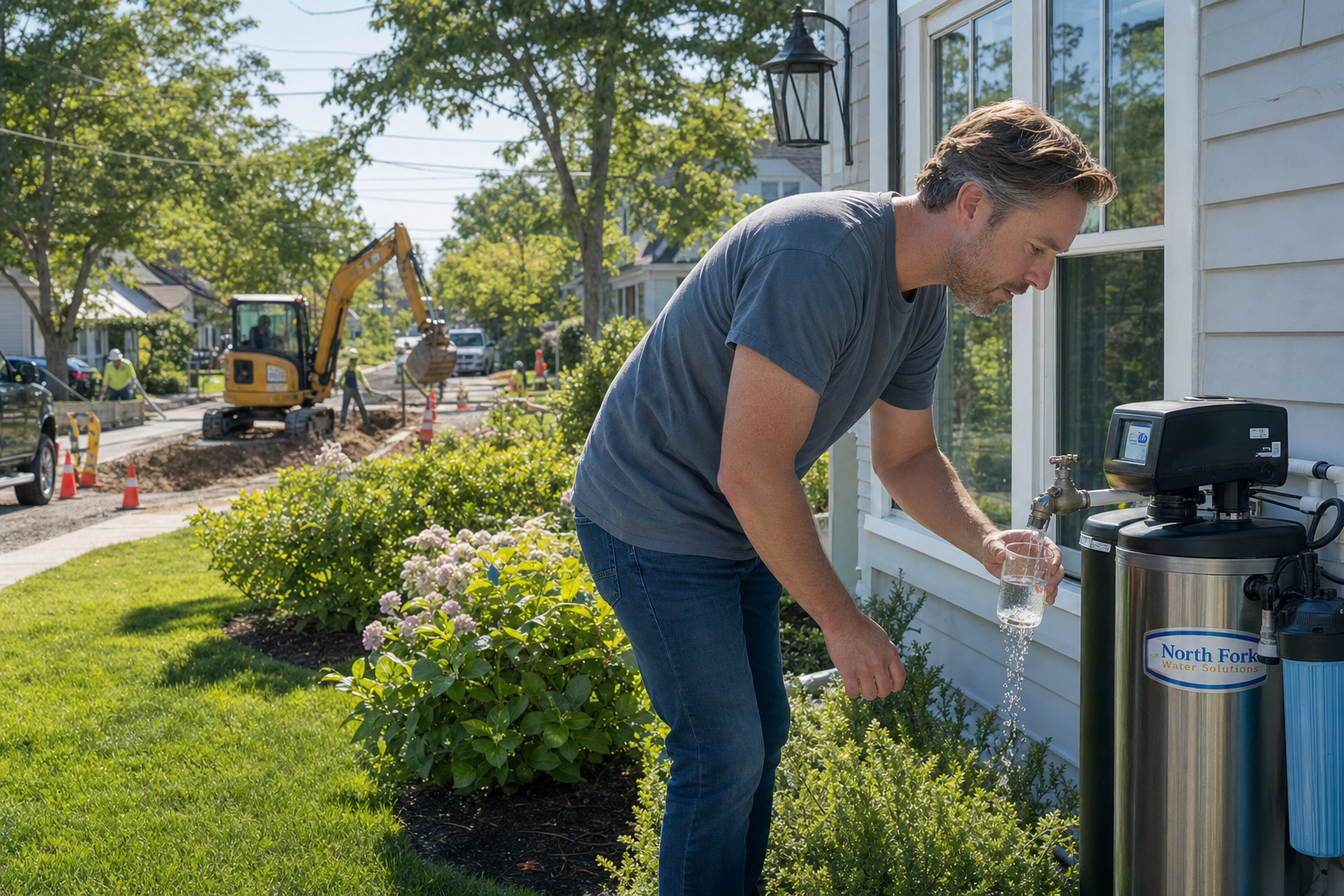
- Whole‑house coverage, installed at the main water entry point to address water for every fixture.
- A configuration designed to address taste and odor issues and help reduce exposure to broad contaminant categories, including sediment, chlorine, and certain industrial contaminants, based on the home’s test results.
- Professional installation, which integrated the system into existing plumbing with minimal disruption.
After installation, the homeowner reported:
- Improved taste and clarity of tap water throughout the home.
- Greater confidence in daily use, including showers and cooking water.
- An estimated $20–$50 per month in savings by cutting back significantly on bottled water purchases.
While regional projects like the SCWA transmission main aim to secure long‑term supply, this case shows how household‑level filtration can give families more control in the near term.
7. Planning Ahead: Developing Your North Fork Water Strategy for 2026–2028
The North Fork water main project is designed to help the region, but individual homes still need a personalized plan—especially between now and the expected 2028 completion.
A step‑by‑step action list for Southold and Riverhead homeowners
- Confirm your current water source and provider.
- Review recent water quality reports and any notices that mention PFAS, pesticides, or rising chloride levels.
- Schedule in‑home water testing to see what’s actually coming out of your taps. You can start with a Free In-Home Water Test from pHountain Water Filters.
- Log any reliability issues, such as pressure drops or seasonal changes in taste or odor.
- Compare options—from bottled water to whole‑house filtration—based on your household size, budget, and long‑term goals.
- Plan for professional installation if you choose a whole‑home system, to ensure proper sizing and integration with your plumbing.
- Revisit your plan annually, especially as SCWA and local towns update project milestones and environmental findings.
How pHountain Water Filters supports North Fork homeowners
pHountain Water Filters serves Long Island (Nassau and Suffolk Counties) and the broader NYC region, including Southold and Riverhead. For North Fork residents, we offer:
- Water quality testing and analysis, tailored to local aquifer conditions.
- Customised filtration system recommendations, including the pHountain pHresh Filtration System for whole‑house coverage.
- Professional installation by trained technicians familiar with Long Island’s plumbing and groundwater conditions.
- Ongoing support and maintenance, so your system continues to match your home’s needs as conditions evolve.
To learn more about regional service and system options, you can explore our page on Whole-Home Water Filtration for Suffolk County or our broader Water Filtration Long Island NY overview.
> Ready to take control of your tap water while the North Fork water main project continues? Start by scheduling a Free In-Home Water Test and get a personalised plan for your Southold or Riverhead home.
North Fork Water Main Project: Common Questions Answered for Homeowners
Will the North Fork water main project connect directly to my Riverhead home?
SCWA has stated that the new 7.5‑mile transmission line will bypass the Riverhead Water District service area and make no connections there.[^scwa][^riverheadlocal] If your home is on the Riverhead Water District, your supply will continue to come from that system, though regional aquifer stress may still be indirectly affected by the project.
How does the project help with saltwater intrusion on the North Fork?
By bringing in water through a large‑diameter transmission main and adding a booster station, SCWA aims to reduce daily pumping from local North Fork wells.[^scwa] Lowering that pumping burden gives the thin Upper Glacial Aquifer more opportunity to stabilize, which can help limit the risk of saltwater being drawn into freshwater zones.
I’m on a private well in Southold—should I still consider filtration if I plan to connect to public water later?
Many private well owners are exploring public water connections due to concerns about PFAS and other contaminants.[^scwa] However, connection timelines can vary, and regional projects like the North Fork water main have multi‑year schedules. In the meantime, whole‑house filtration can help improve taste, odor, and overall water quality at the tap. Our guide on What Your Well Water Isn’t Telling You explains common well issues and why many homeowners choose to install filtration before, during, or even after connecting to public water.
Will the revised route along state and county roads affect traffic near my home?
SCWA’s revised route shifts the main away from Sound Avenue and onto state and county roads, which shortens the line and is expected to reduce environmental and traffic impacts while accelerating the overall schedule.[^scwa] Riverhead’s Town Board has also raised concerns about construction traffic on Main Road and potential impacts on businesses, wetlands, and historic sites, which it aims to review through local permitting.[^riverheadlocal] For specific street‑level impacts, you’ll need to follow SCWA and town updates as detailed plans are released.
This content is for general informational purposes and is not legal, health, or regulatory advice. Always consult your local water provider, appropriate health professionals, and relevant regulators for guidance specific to your situation.
Water quality varies by location. Municipal water provided by SCWA achieved EPA compliance in June 2025. Private well owners should have water tested regularly. pHountain provides free water testing for Nassau and Suffolk County.
Sources
- https://www.scwa.com/suffolk-county-water-authority-issues-draft-environmental-impact-statement-for-north-fork-water-main-project-announces-revised-route/
- https://riverheadlocal.com/riverhead-demands-easements-permits-for-scwa-water-main-along-main-road/
- https://longislandlifeandpolitics.com/scwa-plans-to-change-route-to-north-fork-water-main-project/