
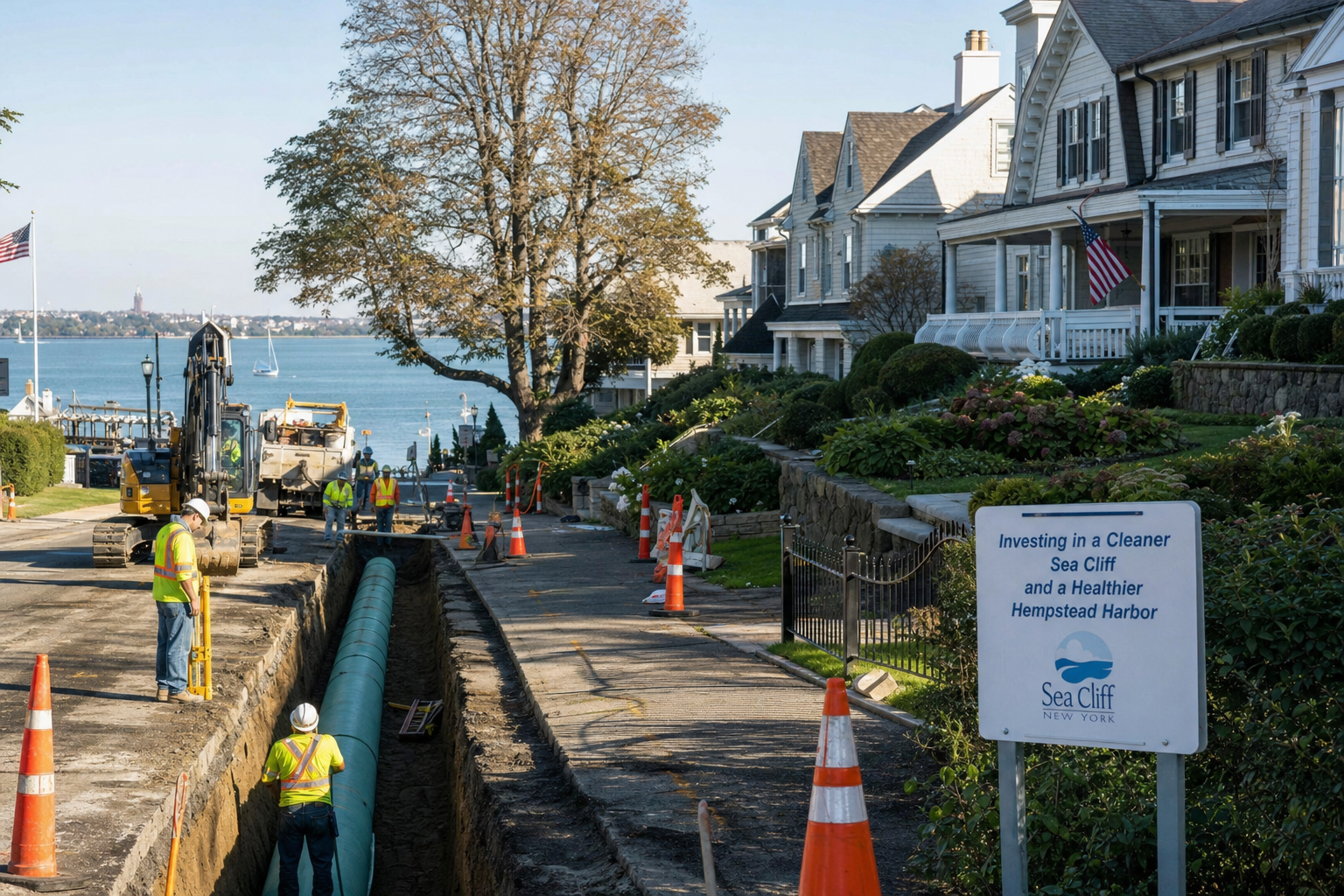
Sea Cliff’s sewer expansion project is one of the biggest local infrastructure moves aimed at protecting Hempstead Harbor in years. But if you live on or near Prospect Ave, Winding Way, The Drive, or Park Way, you may still be wondering what this actually means for your home’s tap water and whether you still need filtration once your cesspool is gone.
This guide walks Sea Cliff homeowners through the project, the benefits, the limits—and how to build a smart water plan for your house as the work wraps up in 2026.
1. Essential details about the Sea Cliff sewer upgrade
In September 2026, Sea Cliff completed a $6.5 million sewer expansion to connect more homes to the village’s sanitary sewer system and move away from aging cesspools that had been in place for generations.
According to a federal press release, the expansion is funded through a mix of federal Community Project Funding, Nassau County bond authorization, and local resources, with Congressman Tom Suozzi securing more than $1.1 million in federal support and Nassau County Minority Leader Delia DeRiggi‑Whitton backing $4 million in county bonds to advance the work in Sea Cliff.(source)
Streets and households impacted
The 2026 phase focuses on four streets in Sea Cliff, NY:
- Prospect Ave
- Winding Way
- The Drive
- Park Way
In total, about 45 households on these streets are slated to move from individual cesspools to the municipal sewer line as part of this phase.(source)
> Mid‑article callout: If your Sea Cliff home is not on these streets, you are likely still relying on a cesspool or septic system—and your water quality strategy should reflect that reality.
The project’s role in broader environmental efforts
This is not Sea Cliff’s first sewer upgrade. Earlier work completed in the summer of 2021 sewered portions of Prospect, Maple, 12th, Sea Cliff, Summit, Central, 8th, and 7th Avenues, plus all of Fairview Place.(source)
The 2026 expansion builds on that earlier “gravity line” and continues a long‑term plan to:
- Replace old cesspools that have limited capacity and can leak
- Protect Hempstead Harbor and ultimately the Long Island Sound from excessive nitrogen and other pollutants
- Modernize local infrastructure so both residents and businesses are less constrained by septic system limits
2. The environmental impact of cesspools on Hempstead Harbor and your home
Even if you’ve never had a failure, an aging cesspool is more than just an underground tank. It’s a direct pathway between household wastewater and the groundwater and coastal waters that define Sea Cliff’s environment.
The connection between cesspools and harbor pollution
Local and county leaders have been clear: cesspools are a major source of nitrogen pollution to coastal waters.(source)
When you flush or drain water from your home:
- Wastewater enters the cesspool
- Liquids seep into surrounding soil
- Nitrogen and other pollutants can move into groundwater
- Those contaminants eventually reach Hempstead Harbor and the Long Island Sound
Excess nitrogen in coastal waters is closely associated with:
- Algae blooms and murky water
- Low oxygen levels that stress marine life
- Long‑term ecosystem damage that’s difficult and expensive to reverse(source)
By connecting homes to a sewer system, wastewater is piped to a treatment facility instead of soaking into the soil around your property, which is why federal and county officials describe the Sea Cliff sewer project as “transformational” for water quality.(source)
Immediate household benefits of replacing cesspools
For homeowners, swapping a cesspool for a sewer connection can also affect:
- Yard conditions: fewer concerns about saturation or backups after storms
- Odors: less risk of sewage smells outdoors
- Maintenance: no more routine pumping or emergency cesspool service
But it’s important to separate wastewater management (sewer vs. cesspool) from tap water quality (what comes out of your faucets). The sewer project dramatically changes the first, but it does not automatically solve the second.
3. Distinguishing sewer impacts from your drinking water quality
Once your home is connected to the Sea Cliff sewer system, your wastewater flows to a central treatment plant instead of into a backyard cesspool. That is a big win for Hempstead Harbor and for long‑term groundwater conditions.
However, most Sea Cliff residents still receive drinking water from public water supplies or, in some cases, private wells. The sewer expansion affects where used water goes—not the quality of incoming tap water.
Improvements brought by sewer hookups
For the 45 homes on Prospect Ave, Winding Way, The Drive, and Park Way, the sewer project can:
- Cut the risk of cesspool leakage into near‑surface groundwater
- Lower nitrogen loading from your property into local waters
- Reduce septic‑related maintenance costs over time
- Support property value by aligning with modern infrastructure
Those benefits help the neighborhood and the harbor, and over the long term they can contribute to healthier aquifers that serve the region.
What remains unchanged at your taps
Even after the sewer connection, your household water may still contain:
- Chlorine and disinfection byproducts from municipal treatment
- Sediment and pipe‑related particles from aging distribution lines
- Taste and odor issues that are common across Long Island
- Emerging contaminants that are managed at the treatment plant but may still be present at low levels
If you are on a private well in or near Sea Cliff, your well draws from local groundwater, which has been influenced for decades by septic and cesspool use across the region—not just on your own property.
This is why many Sea Cliff and Nassau County homeowners look beyond infrastructure upgrades and add in‑home filtration as a second layer of protection. You can learn more about local options in our guide to Water Filtration Nassau County NY.
4. Real-world example: a Sea Cliff resident’s path from cesspool concerns to cleaner water
To illustrate how the sewer project and home filtration can work together, consider a composite example based on real water quality concerns in Sea Cliff.
Initial challenges faced by the homeowner
A homeowner in Sea Cliff lived on one of the streets served by aging cesspools. Over time, they became increasingly concerned about:
- News of nitrogen pollution in Hempstead Harbor
- Occasional odors near the yard after heavy rain
- Whether their tap water might be affected by local cesspool leakage
Water testing at the home showed elevated nitrogen indicators and signs of pollution consistent with long‑term cesspool influence on the local groundwater.
Homeowner’s priorities and hopes
They had three main priorities:
- Support Hempstead Harbor by moving away from a cesspool
- Gain confidence in the quality of water coming from every tap
- Control monthly costs compared with ongoing septic maintenance and buying bottled water
Steps taken to resolve water concerns
Once the Sea Cliff sewer project reached their street, the homeowner:
- Connected to the new municipal sewer line, permanently retiring their cesspool
- Worked with pHountain Water Filters to conduct a detailed water quality analysis
- Chose a pHountain pHresh Filtration System as a whole‑home solution to address tap water concerns
By combining the sewer connection with in‑home filtration, the homeowner now:
- Contributes less nitrogen to local waters
- Has filtered water at every faucet for drinking, cooking, and bathing
- Saves an estimated $30–$50 per month compared with prior septic maintenance and point‑of‑use treatment costs
Every home is different, but this kind of two‑part approach—infrastructure plus filtration—is increasingly common for Sea Cliff and Long Island families who want both environmental and household water benefits.
5. Scheduling your water decision-making alongside the Sea Cliff project
If your home is on Prospect Ave, Winding Way, The Drive, or Park Way, you may already be connected or preparing for connection as of the September 2026 completion date.
Here’s a simple way to think about next steps, whether you’re in this phase or still on a cesspool elsewhere in the village.
Coordinated action steps for managing water quality
- Confirm your status
- On a project street: Check with the Village of Sea Cliff for your connection schedule.
- Off the project streets: Assume you’ll remain on a cesspool or septic system for the foreseeable future.
- Document current issues
- Water taste or odor: chlorine smell, earthy flavors, or cloudiness
- Appliance scale or staining: mineral buildup on fixtures
- Cesspool concerns: backups, odors, or frequent pumping
- Schedule an independent water test
- Even with public water, a home‑level test gives you a picture of what’s actually coming from your taps.
- You can request a Free In‑Home Water Test from pHountain Water Filters to get a tailored analysis and recommendations: Free In-Home Water Test
- Align sewer connection and filtration plans
- Before connection: start with point‑of‑use or whole‑home filtration if your test shows issues you want to address now.
- After connection: revisit testing to see how conditions have changed and whether your filtration setup still fits your needs.
- Re‑evaluate costs annually
- Compare what you spend on bottled water, filter cartridges, and any remaining septic maintenance to the cost of a long‑life, whole‑home system.
- Many Sea Cliff homeowners find that a pHountain pHresh Filtration System plus sewer connection is more predictable and convenient over the long term.
6. Weighing your choices: sewers alone versus added filtration
The table below summarizes how different approaches stack up for a typical Sea Cliff home transitioning away from a cesspool.
| Option | Wastewater impact | Tap water quality control | Typical homeowner experience |
|---|---|---|---|
| Stay on cesspool, no filtration | High nitrogen and pollutant loading to local groundwater and harbor | No control beyond municipal treatment (if on public water) | Ongoing pumping, risk of backups, environmental concerns |
| Connect to sewer, no filtration | Major improvement for harbor and groundwater compared with cesspools | Relies entirely on public treatment and distribution system | Lower maintenance, better for environment, but taste/odor or contaminant concerns may remain |
| Connect to sewer + whole‑home filtration | Strong environmental benefit from sewer connection | House‑level control over contaminants, taste, and sediment | Stable maintenance, cleaner‑tasting water throughout the home, added peace of mind |
This is why many Sea Cliff residents view the sewer project as the environmental foundation—and filtration as the in‑home layer that directly affects daily life.
To explore your options beyond bottled water and small pitchers, see our overview of Water Filtration Long Island NY.
7. Tap water clues for Sea Cliff residents: when to consider testing and filtration
Whether or not your street is part of the Sea Cliff sewer project, it’s useful to pay attention to changes at the tap. These signs don’t prove a specific contaminant, but they can indicate that it’s time for testing and possibly upgraded filtration.
Typical water quality signals in Sea Cliff and Nassau County homes
- Chlorine smell: A strong pool‑like odor often points to higher chlorine levels used in disinfection. Municipal systems rely on chlorine to maintain water quality as it travels through pipes, but many homeowners prefer to address it at the tap for taste and comfort.
- Metallic or earthy taste: This can be related to pipe materials, minerals, or naturally occurring compounds. While not always dangerous, it can make water less appealing to drink.
- Cloudiness or particles: Visible sediment or cloudy water may stem from pipe disturbances, local construction, or aging infrastructure. A whole‑home system with sediment filtration can help address this at the point where water enters your house.
- Scale buildup and staining: White crust on fixtures or staining in toilets and tubs can signal hard water or mineral content that might be managed with appropriate treatment.
Why these signs remain relevant despite sewer improvements
The Sea Cliff sewer expansion deals with what happens after water leaves your home. But all of the issues above relate to water before it goes down the drain.
So even after:
- Your cesspool is abandoned
- Your home is fully tied into the sewer
- Local officials celebrate reduced nitrogen to Hempstead Harbor
you may still want in‑home filtration to improve taste, clarity, and your overall confidence in the water you and your family use every day.
If you’re curious how your tap compares to other Long Island communities, you can review our educational overview on Water Filtration Hempstead NY as a regional reference.
8. The pHountain Water Filters partnership: helping Sea Cliff households thrive
pHountain Water Filters focuses on Long Island and the NYC metro area, which means the team is familiar with:
- Sea Cliff’s coastal setting and its links to Hempstead Harbor
- Ongoing sewer expansion and septic‑to‑sewer transitions in Nassau County
- Local concerns about tap water taste, odor, and contaminant exposure
How pHountain Water Filters works with your home
- Water quality evaluation A specialist conducts a home‑level test to understand your tap water, whether you’re on public supply or a private well.
- Custom system recommendation Based on your results, they suggest options—often including the pHountain pHresh Filtration System for whole‑home coverage—tailored to Sea Cliff conditions and your household size.
- Professional installation Certified technicians install the system at your home’s main water entry point, so every faucet benefits from the filtration setup.
- Ongoing support You receive guidance on maintenance, replacement intervals, and any adjustments if your water conditions change, for example after your sewer connection is completed.
> Closing callout: If your Sea Cliff home is part of the sewer project—or still on a cesspool—this is an ideal moment to get clarity on your tap water. You can start by requesting a Free In-Home Water Test and building a plan that fits both your property and your budget.
Frequently Asked Questions
Will connecting my Sea Cliff home to the sewer system make my tap water “clean”?
Connecting to the Sea Cliff sewer system significantly improves how your wastewater is handled and helps protect Hempstead Harbor by limiting cesspool‑related nitrogen pollution.(source)
However, it does not directly change how your drinking water is treated. If you are on public water, that treatment is handled by your local water provider. A whole‑home filtration system can give you additional control over what comes out of your taps, independent of the sewer project.
My Sea Cliff street isn’t part of the 45 homes in this phase. Should I still think about filtration?
Yes. If your property is still on a cesspool or septic system, your wastewater continues to interact with local soil and groundwater. Even if future phases eventually reach your street, in‑home filtration is the only way to directly address what you and your family are using now. Many Nassau County homeowners choose filtration whether or not their street is sewered, particularly if they notice taste, odor, or staining issues.
I live on Prospect Ave and was recently connected. When is the best time to test my water?
A good approach is:
- Baseline test as soon as possible, to understand your current tap water profile.
- Follow‑up test after your sewer connection has been in place for a reasonable period, especially if you are on a private well or have noticed past issues.
This allows you to see how conditions evolve and to size a pHountain pHresh Filtration System or other solution appropriately. You can start this process by requesting a Free In-Home Water Test.
If I install a whole‑home system, do I still need bottled water in Sea Cliff?
Many homeowners who install a whole‑home filtration system find they can scale back their bottled water use significantly, relying instead on filtered tap water for drinking and cooking. The exact choice is personal, but a professionally installed system is designed to improve taste, odor, and clarity throughout your home, making bottled water less necessary for everyday use. For a deeper comparison of options, you can read our overview of Water Filters vs Bottled Water.
This blog is for informational purposes only and is not intended as health, legal, or regulatory advice. Always consult your local water provider, municipality, or appropriate professionals for guidance specific to your situation.
Water quality varies by location. Municipal water provided by SCWA achieved EPA compliance in June 2025. Private well owners should have water tested regularly. pHountain provides free water testing for Nassau and Suffolk County.