
Key Takeaways
- In its June 22, 2026 Emerging Contaminants Action Plan update, the Suffolk County Water Authority (SCWA) said work was complete on a major electrical reconstruction and upgrade at its Third Avenue well site in Brentwood, in preparation for an Advanced Oxidation Process (AOP) system, the treatment SCWA uses for 1,4-dioxane, and that a new system at Carrol Street Well #2 in Brentwood was being prepared for carbon loading.
- Water can still change between the well and your tap, in the street mains and in your home’s own plumbing.
- SCWA adds chlorine for disinfection before water leaves the pump station (SCWA 2026 report); some people notice its taste or smell.
- A whole-house filter treats water at the point it enters your home, after the distribution system.
Understanding What the SCWA Well Upgrade Actually Does
Well work in Brentwood is welcome news for the community. Investments in public water infrastructure matter: they are how a supplier keeps wells available, adds treatment where it is needed and maintains a reliable supply.
SCWA’s June 22, 2026 monthly update to its board describes two Brentwood sites:
- Third Avenue: Work is complete on a major electrical reconstruction and upgrade in preparation for an Advanced Oxidation Process (AOP) system for Well #3A. A new emergency generator that can power two wells and the future AOP is in service. Replacement Well #3A is in service on granular activated carbon (GAC) and is blended with Well #4.
- Carrol Street: A new system at Well #2 was being prepared for GAC loading, along with one at Ruth Boulevard in Commack.
Treatment in Brentwood has been in SCWA’s plans for several years. In April 2022, SCWA said $18.9 million in state grant funding would pay for new AOP treatment systems in Kings Park, Brentwood, Central Islip and other communities, and described AOP systems as designed to remove 1,4-dioxane from drinking water. In July 2025, SCWA said it had installed 57 GAC treatment systems that remove PFAS since 2020, and planned seven new systems in the following year, including a facility in Brentwood. Neither release names the Brentwood site.
Understanding what a well upgrade is designed to do, and what it isn’t, is just as important for homeowners who want confidence in their household water.
GAC and AOP: Two Kinds of Treatment
SCWA uses granular activated carbon to remove PFAS. In its June 10, 2025 announcement, SCWA explained that GAC filters remove PFAS by adsorbing the contaminants onto specially prepared carbon as water passes through large vessels, and said its testing shows GAC removes PFAS compounds to non-detectable levels.
Advanced oxidation is used for 1,4-dioxane. SCWA’s June 2026 update notes that carbon does remove 1,4-dioxane, but not well and only for a short period, and that wells with 1,4-dioxane above the limit are on treatment, out of service or blended with other wells so that levels entering distribution are below the limit.
What Municipal Treatment Is Built For
- Regulatory compliance: Public water suppliers must meet federal and state drinking water standards and publish an annual water quality report (EPA). The EPA finalized limits of 4.0 parts per trillion for PFOA and PFOS in April 2024, with public water systems required to comply by 2029 (EPA); New York’s limits, set in 2020, are 10 parts per trillion for PFOA and PFOS and 1 part per billion for 1,4-dioxane (NYSDOH). In its June 10, 2025 announcement, SCWA said its April 2025 testing confirmed that no treated water in its system contained PFOA or PFOS above 4 parts per trillion.
- Disinfection: Before water leaves the pump station, SCWA adds minute traces of chlorine, according to the specifications of the state health department, to prevent bacterial growth that could occur in its water mains and tanks (SCWA 2026 Drinking Water Quality Report, water treatment pages).
- System reliability: Infrastructure work goes beyond treatment: the Third Avenue upgrade included a new emergency generator that SCWA says can power two wells and the future AOP system (June 2026 update).
What a water utility controls ends at your property line. The plumbing inside your home is yours, and its condition affects what comes out of your tap.
What Can Change Between the Well and Your Tap
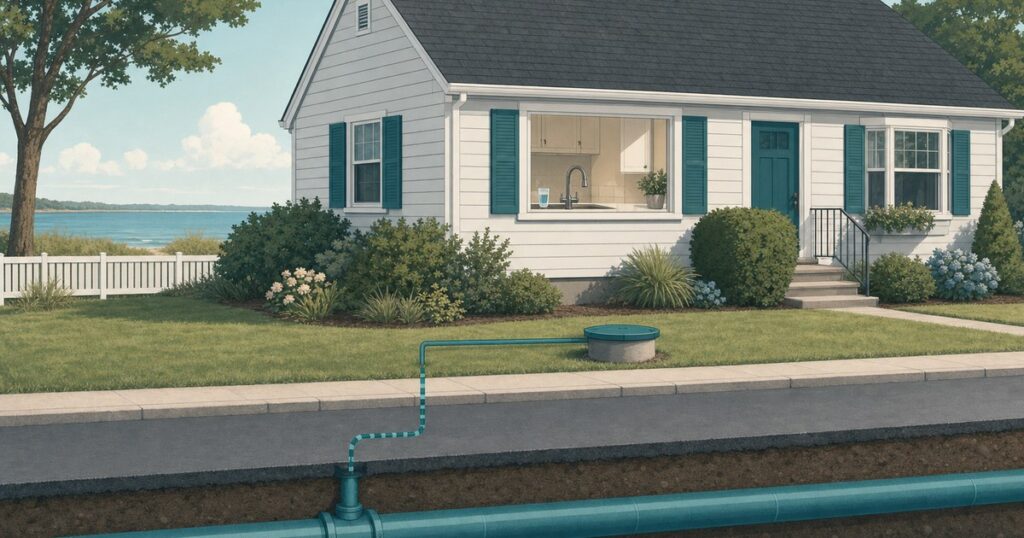
Even when water leaves a pump station meeting standards, it travels through SCWA’s mains before it reaches your home; SCWA reported 6,097 miles of main at the end of 2025 (2026 report, statistics page). That journey, and your home’s own pipes, can affect the water at your faucet.
The Reality of Distribution Systems
- Pipe corrosion: SCWA’s groundwater is naturally acidic, so SCWA adds a hydrated lime product (or sometimes soda ash) to raise the pH, which it says greatly reduces or eliminates the leaching of lead and copper from customers’ interior plumbing (2026 report, water treatment pages). Older homes can still have lead in pipes, solder or fixtures; see the EPA’s lead page. SCWA’s lead and copper page lets you look up the identified service line material for your property.
- Sediment disturbance: Main breaks, repairs and flushing can stir up settled particles and cause temporary cloudy or discolored water. SCWA also uses systematic flushing of water mains to reduce naturally occurring iron and manganese (2026 report, water treatment pages).
- Chlorine residual: The chlorine SCWA adds is there on purpose, to prevent bacterial growth in its mains and tanks (2026 report, water treatment pages). Some people notice its taste or smell at the tap.
- A changing mix of wells: SCWA turns wells on and off as required to meet demand, and a home near the boundary of a distribution area may receive water from the adjacent area on occasion, according to the distribution area map pages of SCWA’s 2026 report. Some wells are also blended with others, as at Third Avenue (June 2026 update).
A whole-house water filtration system installed at your home’s main water entry point treats water after it leaves the street main and before it reaches any faucet or appliance.
Wondering what is in your Brentwood tap water? Start with a free in-home water test, or call (631) 991-3995.
The pHountain Approach: Filtration at Every Tap
At pHountain Water Filters, we treat water at your home’s entry point, so every faucet receives filtered water. The pHountain Filtration System is a whole-home (point-of-entry) system with a cartridge-free media design intended to reduce common impurities in tap water. It is recommended after a free in-home water test, professionally installed and backed by a 10-year guarantee.
A whole-home system is configured around what testing finds. For any specific contaminant, ask for independent certification data (for example NSF/ANSI listings) for the exact system you are considering.
Comparison of Water Solutions
| Feature | Bottled Water | Pitcher Filter | pHountain Filtration System |
|---|---|---|---|
| Water covered | Drinking only | One pitcher at a time | Every tap, shower and appliance |
| Upfront cost | None | Low | System and installation |
| Ongoing effort | Buying, carrying and storing bottles | Refilling and replacing filters | Service as the system requires |
| Professional Installation | No | No | Yes |
What Long Island Customers Say
You can read reviews that customers have left for pHountain Water Filtration on Google on our testimonials page.
Who Pays for Treatment Upgrades
Treatment systems like the ones planned for Brentwood are expensive, and SCWA has sought outside money to pay for them:
- State grants: SCWA’s April 21, 2022 release said it would receive $18.9 million in state grant funding for water quality projects, including new AOP systems in Brentwood and other communities. The same release said SCWA was suing the manufacturers of PFAS to help pay the costs of its treatment systems.
- Settlements: In its July 9, 2025 announcement, SCWA said it was in line to receive $34 million from the national class action settlement with 3M and expected $170 million in total over the agreement, and that the funds represent only a fraction of the cost it expects to incur for PFAS treatment.
For your own home, the cost question is a different one: what, if anything, your water needs. That starts with information, not with a purchase.
Long Island’s Groundwater and Why Local Data Matters
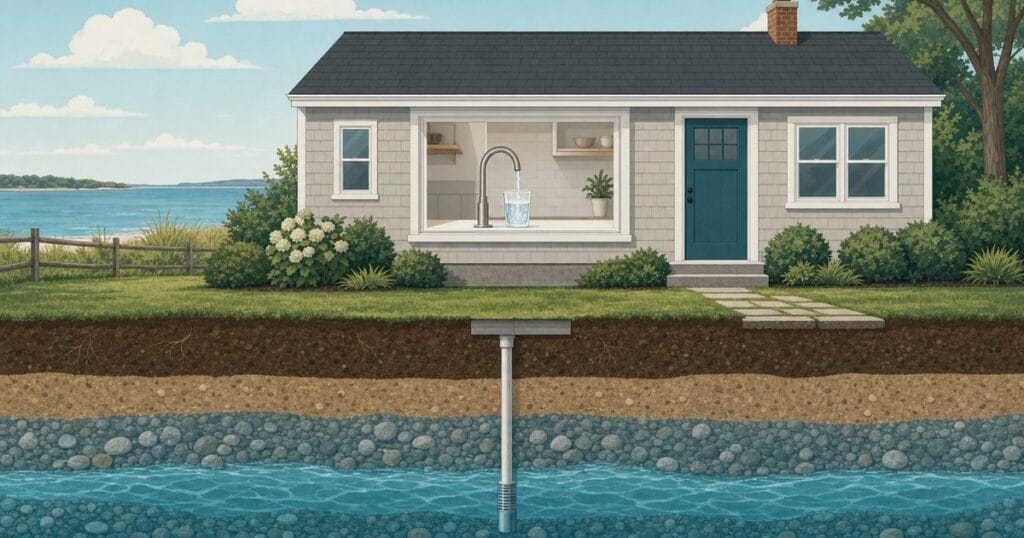
All of the water SCWA supplies is groundwater from the Long Island aquifer system, which SCWA refers to as Long Island’s sole source aquifer in its July 2025 announcement. According to the “Our Water Source” pages of SCWA’s 2026 report, SCWA has 279 wells in the shallow Upper Glacial aquifer, from which virtually all private wells draw, and 355 wells in the deeper Magothy aquifer, the largest formation.
The same pages summarize the state’s source water assessment for all Suffolk County community supply wells: most wells have high susceptibility for nitrate, medium susceptibility for pesticides, low susceptibility for microbials and very high susceptibility for volatile organic compounds. SCWA stresses that these ratings indicate only the potential for contamination, and that in most cases it has not resulted in actual contamination of the source water.
Because SCWA says customers typically receive water from a small group of nearby wells (April 14, 2025 announcement), the most useful data for a Brentwood home is local. SCWA’s My Water Quality map lets you search an address and view testing results from the nearest sample station, and its annual water quality reports cover all testing conducted during each calendar year.
pHountain Water Filters is based in Islip and serves Long Island, including Brentwood.
Whole-House Filtration: The Difference Goes Beyond Drinking Water
Point-of-use filters at a single sink address one small slice of your household’s water use. A whole-house system treats the water your home uses for:
- Showering and bathing
- Cooking and food prep
- Laundry, dishwashers and water heaters
- Drinking at every tap, which may reduce how much bottled water you buy; our post on Water Filters vs Bottled Water walks through the tradeoffs
Our Process: From Your Water Test to Installation
A recommendation is only as good as the information behind it, so every pHountain engagement follows the same path:
- Free in-home water test: A specialist tests your water on-site. Measuring PFAS and 1,4-dioxane at the levels regulators use (parts per trillion and parts per billion) requires analysis by a certified laboratory; a free in-home water test is a starting point for understanding your water and your options.
- Custom system recommendation: Based on the results, we recommend a configuration matched to your home’s water and plumbing layout.
- Professional installation: The system is installed at the main water line.
- 10-year guarantee: The installed system is backed by our 10-year guarantee.
Frequently Asked Questions
Does the Brentwood well upgrade mean my water is fully treated?
The Third Avenue and Carrol Street work prepares those sites for added treatment. SCWA’s June 2026 update says that all wells with PFAS above the New York State limit are either treated or removed from service until treatment is installed, and that wells above the new federal limits are treated, out of service or blended to maintain lower levels. What reaches your tap also depends on the mains and on your home’s plumbing, so check SCWA’s My Water Quality results for your address.
What contaminants show up in Suffolk County water?
For your home, the best answer is in SCWA’s annual report, which lists every detected compound by distribution area, with its likely source, the limit and the range of readings, plus a list of compounds tested for but not found (How to Read Your Water Quality Data). Countywide, the source water assessment ratings described above show which contaminants Suffolk’s supply wells are most susceptible to (2026 report, pages 37–38).
Is a whole-house system better than a faucet filter?
They do different jobs. A faucet or under-sink filter treats water at one point of use. A whole-house system treats every tap, shower and appliance, including the water you cook with, bathe in, and run through your dishwasher and washing machine. Which one makes sense depends on what testing finds and how your household uses water.
Is Brentwood on public water or private wells?
SCWA operates well sites in Brentwood, including Third Avenue and Carrol Street (June 2026 update), and supplies public water in the area; your water bill confirms your supplier. If your home uses a private well, testing it is your responsibility, because drinking water limits apply to public water systems; see the EPA’s private well guidance and the Suffolk County Department of Health Services private well testing page.
Do you offer free water testing?
Yes. pHountain offers a free in-home water test, in which a specialist tests your water on-site.
Putting the Brentwood Upgrade in Context
The Brentwood well work is part of a larger program. SCWA’s June 2026 update says it has substantially completed Phase 1 of its Emerging Contaminant Action Plan, has begun site work and equipment procurement for Phase 2, and is beginning to plan Phase 3, which is to eventually include all wells with detections of PFAS and 1,4-dioxane. Pairing that public information with a test of your own tap tells you what, if anything, your home needs.
For more on local coverage, see our Islip-area service page, which covers Brentwood, and our Suffolk County water filtration page.
Ready to find out what is in your water? Request a free in-home water test, and we will recommend a filtration configuration for your Long Island home based on the results.
This blog is for informational purposes only and is not endorsed by or affiliated with any public water supplier or government agency. Water conditions and regulations can change; always consult your local water provider and a qualified water treatment professional for advice tailored to your home.
Sources
- Suffolk County Water Authority — Emerging Contaminants Action Plan Monthly Update (June 22, 2026)
- Suffolk County Water Authority — SCWA To Receive Nearly $19 million in Grants for Key Water Quality Improvement Projects (April 21, 2022)
- Suffolk County Water Authority — Suffolk County Water Authority Achieves Full Compliance with Federal PFAS Standards (June 10, 2025)
- Suffolk County Water Authority — Suffolk County Water Authority to Receive First Award in PFAS Settlement with 3M (July 9, 2025)
- Suffolk County Water Authority — Suffolk County Water Authority Launches Innovative New Tool Offering Customers a Precise Look at Their Water Quality (April 14, 2025)
- Suffolk County Water Authority — Water Quality Reports
- SCWA 2026 Drinking Water Quality Report — Distribution Areas map (pages 2–3)
- SCWA 2026 Drinking Water Quality Report — How to Read Your Water Quality Data (pages 4–5)
- SCWA 2026 Drinking Water Quality Report — Our Water Source and Source Water Assessment Summary (pages 37–38)
- SCWA 2026 Drinking Water Quality Report — Statistics, Well Information and Water Treatment (pages 42–44)
- Suffolk County Water Authority — See My Water Quality
- Suffolk County Water Authority — Lead and Copper
- U.S. EPA — Per- and Polyfluoroalkyl Substances (PFAS)
- New York State Department of Health — Drinking Water Standards for PFAS and Other Emerging Contaminants
- U.S. EPA — Consumer Confidence Reports (annual water quality reports)
- U.S. EPA — Lead
- U.S. EPA — Private Drinking Water Wells
- Suffolk County Department of Health Services — Private Well Water Testing