Levittown Residents Face New PFAS Concerns After EPA Guidance: What Long Island Homeowners Should Know
Key Takeaways
- The EPA’s April 2024 PFAS ruling sets strict new maximum contaminant levels for “forever chemicals” in drinking water.
- PFAS compounds do not break down—they accumulate in groundwater, soil, and the human body over time.
- Long Island’s sole-source aquifer is particularly vulnerable to PFAS contamination from historical industrial and military activity.
- Only advanced whole-house filtration addresses PFAS across all household water uses, including cooking, bathing, and laundry.
What Are PFAS—and Why Are They Everywhere?
Per- and Polyfluoroalkyl Substances (PFAS) are a class of thousands of synthetic chemicals developed in the 1940s for their remarkable resistance to heat, oil, water, and grease. They’ve been used in everyday products for decades:
- Nonstick Cookware: The coating that makes pans easy to clean.
- Water-Repellent Fabrics: Jackets, carpets, and upholstery treatments.
- Food Packaging: Grease-resistant fast food wrappers and microwave popcorn bags.
- Firefighting Foams (AFFF): Used extensively at military bases and airports near Long Island communities.
Their chemical bonds are among the most stable ever created. That stability is the reason they’re called “forever chemicals”—they don’t break down in the environment, and they can accumulate in soil, groundwater, and the human body over time.
The EPA’s April 2024 PFAS Ruling: What Changed
In April 2024, the U.S. Environmental Protection Agency finalized the first-ever National Primary Drinking Water Regulation for PFAS, setting legally enforceable maximum contaminant levels (MCLs) for six PFAS compounds—including PFOA and PFOS—at levels as low as 4 parts per trillion. This was a landmark shift: for the first time, water utilities across the country are legally required to test for and reduce PFAS to these new limits.
For Long Island homeowners, the ruling signals what scientists have long understood: there is no “safe” level of PFAS exposure, and the previous absence of federal limits did not mean the water was clean.
Concerned about PFAS in your Levittown tap water? FREE in-home water testing. Call (631) 991-3995.
Why Levittown and Long Island Are Especially Vulnerable
Long Island depends entirely on its sole-source aquifer system for drinking water—there is no surface water alternative. Whatever enters the ground, stays in the ground. The region’s history of industrial activity, military installations, and suburban development has left a legacy of groundwater contamination that includes PFAS compounds from firefighting foam use and manufacturing.
Communities like Levittown sit atop an aquifer that has absorbed decades of these exposures. While municipal water authorities are now required to begin PFAS testing and remediation under the new EPA rules, that process will take years and significant investment to complete. In the interim, residential filtration is the most direct path homeowners have to reduce their exposure today.
Why Bottled Water and Basic Filters Fall Short
Many Levittown homeowners initially turn to bottled water when they hear about PFAS. It’s understandable—but it’s an incomplete answer:
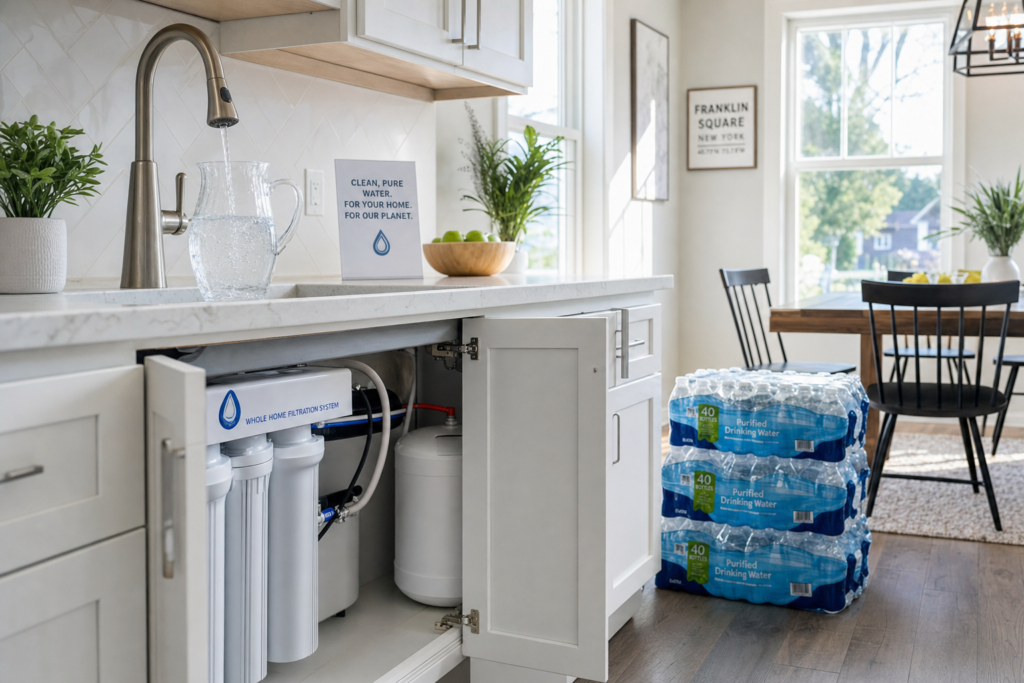
- Bottled Water Only Covers Drinking: PFAS exposure also occurs through cooking, brushing teeth, bathing, and washing produce.
- Regulation Gaps: Bottled water is subject to different—and in some cases less stringent—testing requirements than municipal tap water.
- Annual Cost: Most families spend $1,200–$1,800/year on bottled water—more than the cost of a permanent filtration system.
- Environmental Impact: Billions of plastic bottles end up in landfills annually, contributing to microplastic contamination.
Pitcher filters and faucet attachments are a step up, but they typically lack the capacity and filtration technology required to effectively reduce PFAS compounds. A permanently installed, professionally integrated whole-house system is the only approach that addresses PFAS at every point of use in your home.
The pHountain pHresh Approach: Whole-House PFAS Filtration
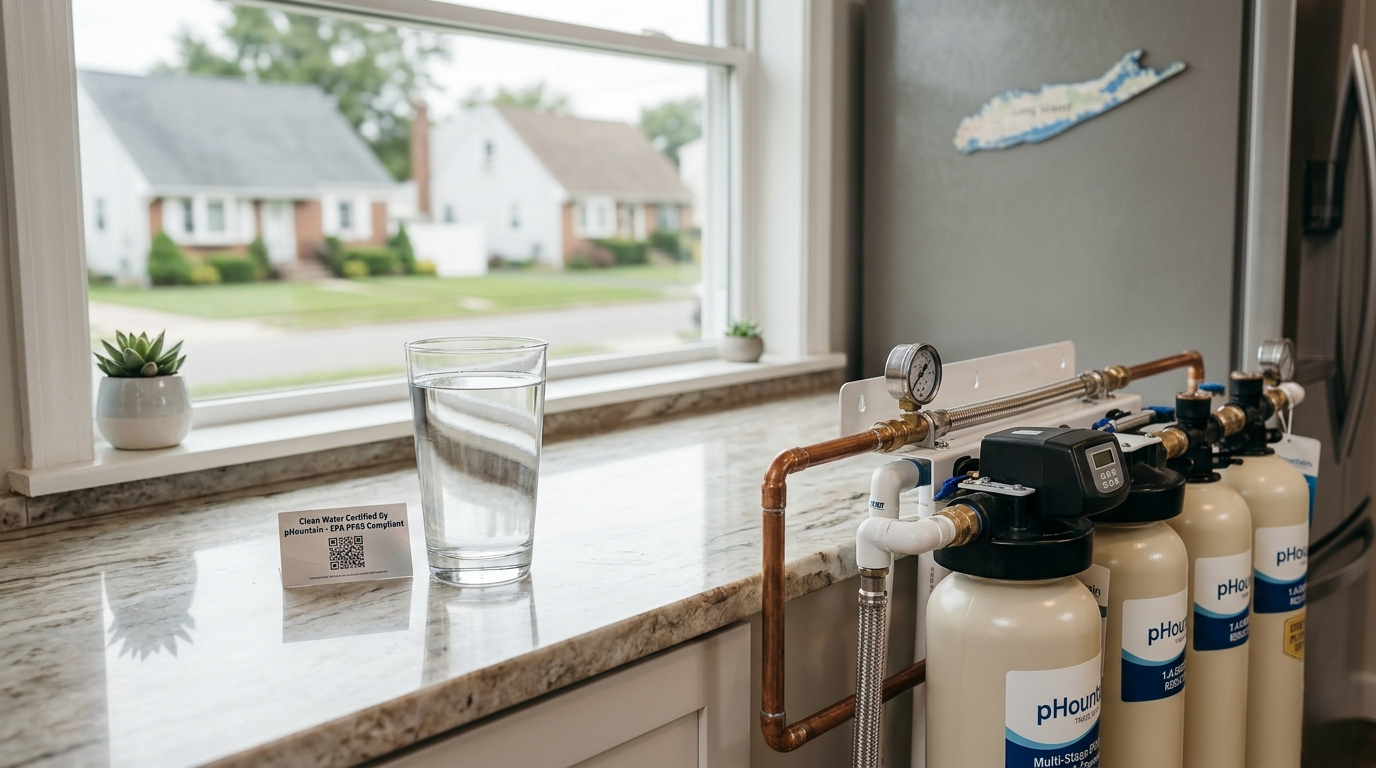
The pHountain pHresh Filtration System is installed at your home’s main water entry point. Every drop of water used for drinking, cooking, bathing, and laundry passes through advanced filtration before reaching any fixture or appliance. The system is engineered to significantly reduce or remove:
- PFAS and Industrial Chemicals: Targeting the core concern for Levittown homeowners under the new EPA guidance.
- Chlorine and Disinfection Byproducts: Improving taste, odor, and reducing skin irritation.
- Heavy Metals: Lead and mercury from aging pipes and infrastructure.
- Bacteria and Microorganisms: An additional biological safeguard beyond municipal treatment.
- Sediment and Particles: Protecting appliances and improving water clarity.
Comparison of Water Solutions
| Feature | Bottled Water | Faucet Filter | pHresh System |
|---|---|---|---|
| PFAS Removal | Varies | Limited | Yes |
| Whole-Home Coverage | No | No | Yes |
| Annual Cost | $1,200–$1,800 | Moderate | Low after install |
| Microplastics Risk | High | No | No |
| Convenience | Low | Low | High |
| Professional Installation | No | No | Yes |
Case Study: A Levittown Family Acts After the EPA Announcement
A Levittown family reached out to pHountain shortly after the April 2024 EPA PFAS ruling made local news. They had been using a pitcher filter for drinking water but were concerned about PFAS exposure through bathing, cooking with tap water, and their children’s daily use of the kitchen sink.
Our free in-home water test identified PFAS-related industrial chemical markers along with elevated chlorine byproducts. We installed a customized pHresh whole-house system at their main water line. The family immediately eliminated bottled water purchases—saving over $110 per month—and reported improved skin and hair quality within the first two weeks of use. They now have documented filtration coverage across every water use in their home.
Investing in Your Home’s ROI
- Eliminate bottled water costs—$1,200–$1,800 annually for most families
- 2–3 year payback period on system investment
- Whole-home PFAS protection covers drinking, cooking, bathing, and laundry
- High-capacity design means minimal maintenance and no frequent filter changes
- Peace of mind backed by professional installation and ongoing support
Frequently Asked Questions
What does the new EPA PFAS ruling mean for my tap water?
Water utilities are now legally required to test for and reduce six specific PFAS compounds to very low levels. However, compliance timelines extend several years. Residential filtration provides protection now, without waiting for municipal systems to meet the new standards.
Does a whole-house filter actually remove PFAS?
Advanced whole-house filtration systems using high-performance media are designed to significantly reduce PFAS compounds. Basic activated-carbon pitcher filters typically do not provide effective PFAS removal.
Is Levittown tap water safe to drink?
Levittown’s municipal water meets current regulatory standards. With the EPA’s new PFAS MCLs being phased in, compliance requirements will increase over time. Residential filtration provides an additional layer of protection beyond current regulatory requirements.
How do I know if PFAS is in my specific home’s water?
The only way to know for certain is to test your water. pHountain’s free in-home water analysis identifies what’s actually present in your tap—not what’s theoretically possible based on regional data.
Do you offer free water testing?
Yes. Free in-home water testing with no obligation. Call (631) 991-3995 to schedule.
Don’t wait on PFAS—get your water tested today. Call (631) 991-3995 for a FREE in-home analysis.
Sources