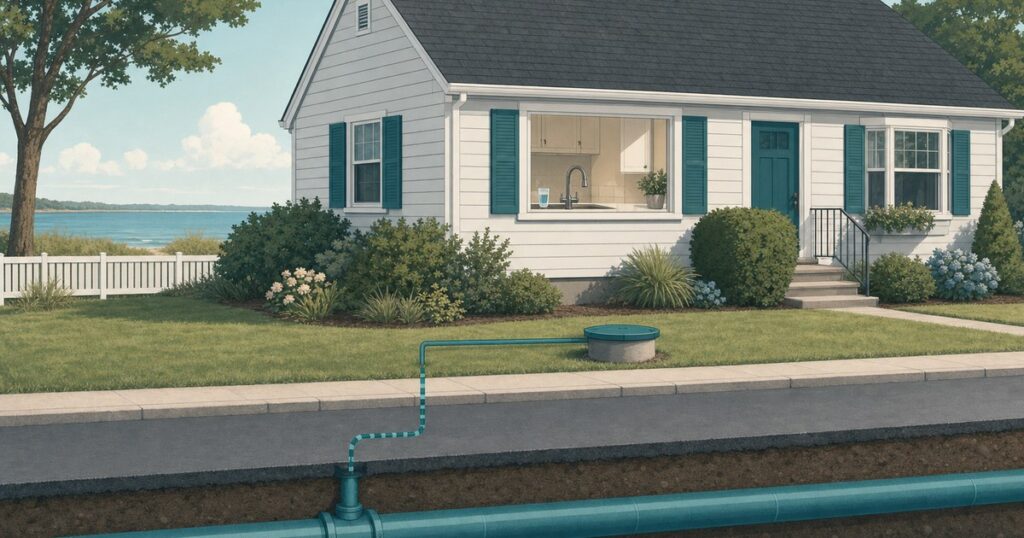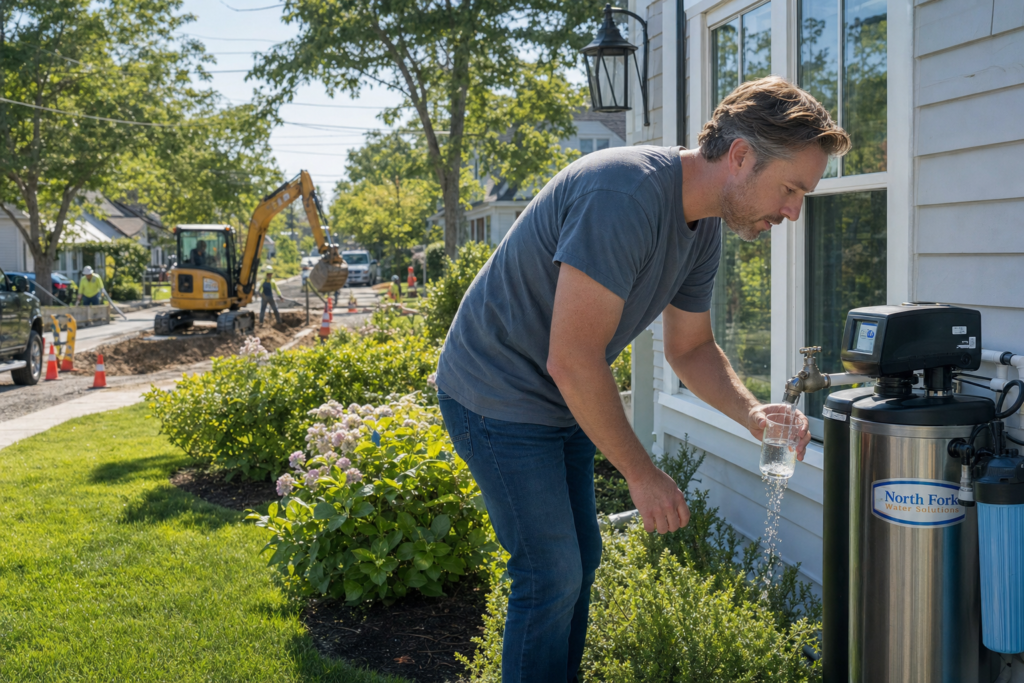
On August 6, 2026, the Suffolk County Water Authority (SCWA) announced that it “is partnering with County Executive Ed Romaine and Suffolk County” on a new water‑main proposal in Mattituck. (SCWA) SCWA said the partnership would “extend public water to up to 60 homes in Mattituck near Reeve Avenue” through a proposed main extension. (SCWA)
In explaining why this part of Mattituck is in focus, SCWA reported that county sampling found PFAS compounds in nearby private wells, noting that “Of 39 wells tested, 31 contained PFOA and/or PFOS” in the neighborhood around Reeve Avenue. (SCWA) SCWA also summarized that “22 wells exceeded the state drinking water limit of 10 parts per trillion” and that one measurement was “over 1,000 PPT, which is more than 100 times the state limit” for those compounds. (SCWA)
Earlier that summer, on July 24, 2026, SCWA said it had “issued the Draft Environmental Impact Statement (DEIS) and announced upcoming public meetings for the North Fork Water Main Project” covering Southold. (SCWA) In that same notice, the Authority explained that the North Fork project “aims to address the long-term sustainability of the public water supply in Southold” as part of a broader plan for the area. (SCWA)
Key points Mattituck homeowners should note
- SCWA says it has “applied for funding through the New York State Water Infrastructure Improvement (WIIA) program” and “applied for a federal grant,” and notes that WIIA “covers 70% of allowable project costs” for eligible water projects. (SCWA)
- The same announcement notes that without outside support, “connection costs could exceed $40,000 per home” for Reeve Avenue–area residents who connect to the new main. (SCWA)
Grant push for the Reeve Avenue main extension
In discussing why the federal piece matters, SCWA CEO Jeff Szabo said the goal includes “protecting these homeowners from bearing an extreme financial burden” if the project moves ahead. (SCWA)
The Authority also points back to earlier efforts in this area, stating that it “applied for funding through New York State in 2025, but the application was denied due to insufficient funding availability” for the Reeve Avenue neighborhood. (SCWA)
What county testing found in nearby private wells
In the same statement, Suffolk County Executive Ed Romaine said “The levels of contamination found in these private wells present a clear risk” (SCWA).
How the Mattituck extension fits into the North Fork project
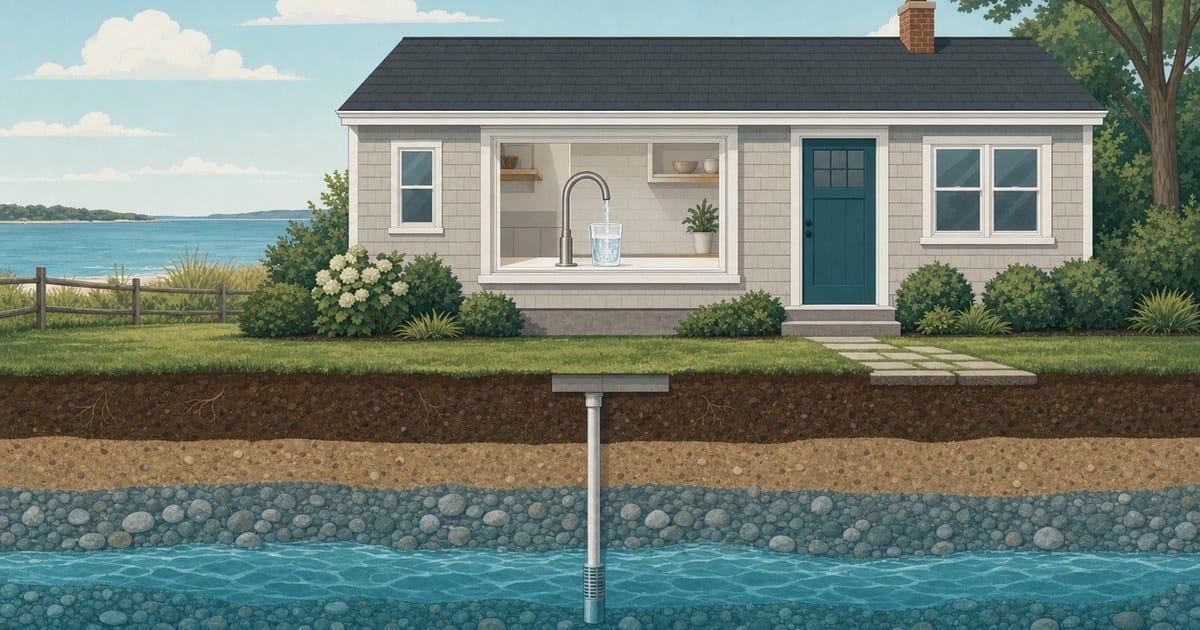
That same release noted that the area sits over a “thinner, shallower aquifer than in other parts of Long Island,” which makes it more vulnerable to stresses on the groundwater source. (SCWA)
To address this, SCWA’s plan “centers on a new 7.5-mile, 24-inch transmission line” that will move water directly to the North Fork. (SCWA) The Authority explains that this pipeline “will transport water directly to the North Fork, bypassing the Riverhead Water District service area where no connections will be made,” so its role is to move supply rather than add new customers along the route. (SCWA) The project also includes “a new booster station to stabilize water pressure and improve system reliability” once the new main is in service. (SCWA)
On February 9, 2026, SCWA stated that “The North Fork Water Main Project is the largest single infrastructure investment in Suffolk County Water Authority history and a once-in-a-generation opportunity to strengthen long-term water supply reliability in Southold,” and the same materials add that this added capacity “will obviate the need for advanced treatment systems, protect sensitive local aquifers and ensure we can meet peak demand during the region’s busiest months without stressing local wells.” (SCWA)
Environmental review and chances to comment
On February 9, 2026, SCWA said that it “held three environmental scoping sessions to gather direct input from residents, local leaders and environmental stakeholders,” and explained that “Their feedback shaped the Final Scope for the environmental impact statement (EIS).” (SCWA)
SCWA states that the EIS “will evaluate potential impacts on groundwater, traffic, wetlands, cultural resources and construction activity, and outline mitigation measures to avoid or minimize those impacts.” (SCWA) When it accepted the DEIS, SCWA also announced a revised main route, noting that it was “Developed in response to public comments gathered during scoping sessions in 2025” and that the revised line “will run exclusively on state and county roads, resulting in a route that is one mile shorter than the original proposal.” (SCWA) The same description says this change “reduces environmental and traffic impacts and accelerates the project schedule, moving the anticipated completion date from 2030 to 2028.” (SCWA)
SCWA says that “Construction is scheduled to take twelve months once all the final permits are in place,” and that “We will stage the work specifically to avoid traffic disruptions on the North Fork during the peak summer and fall months.” (SCWA)
SCWA also said on February 9, 2026, that “Once completed, the North Fork Main will give the region the system redundancy and water-quality flexibility it has never had-allowing us to better manage drought conditions, reduce stress on small well fields and maintain consistent, high-quality water for our customers year-round.” (SCWA)
North Fork water‑supply pressures behind the project
SCWA reports that it “operates 60 wells across 18 well fields on the North Fork, supplying 9,500 customers” through its public system. (SCWA) The Authority notes that “Despite conservation efforts, water demand on the North Fork continues to increase,” and that “Excessive demand strains infrastructure and negatively impacts our water source.” (SCWA)
SCWA notes that “Growing concerns over PFAS contamination are driving more private well users to seek public water.” (SCWA) SCWA warns that “Over-pumping risks saltwater entering the freshwater aquifer, limiting expansion.” (SCWA)
SCWA links these points back to its systemwide view, saying the project is aimed at “giving our customers access to a more robust and resilient water system.” (SCWA)
On February 9, 2026, SCWA wrote that “In 2025, the Suffolk County Water Authority achieved a milestone few water providers nationwide have reached-full compliance with the U.S. Environmental Protection Agency’s new 4 parts per trillion national drinking water standard for PFAS, six years before the 2031 regulatory deadline.” (SCWA)
PFAS in drinking water and private wells
pHountain’s PFAS guide quotes the New York State Department of Health as saying that “PFAS are commonly found in the environment and have been detected in public drinking water and in private wells.” (pHountain) The same source notes that “PFAS have been detected in drinking water near where these chemicals were manufactured, used, or disposed of in New York State and in the U.S.” (pHountain) New York’s health guidance also explains that “People are exposed to PFAS in water mainly through drinking and foods prepared with that water.” (pHountain)
On Long Island, pHountain’s PFAS guide quotes the U.S. Geological Survey’s statement that “Groundwater is the sole source of freshwater supply in Nassau and Suffolk Counties on Long Island.” (pHountain)
PFAS limits and testing rules for public water and private wells
pHountain’s private‑well guide quotes the New York State Department of Health as saying that “Public water systems in New York must monitor for more than 100 different contaminants on a regular schedule, including PFOA, PFOS and 1,4-dioxane,” and that “If standards are not being met, the public water suppliers are required to notify customers and take actions to come into compliance.” (pHountain) The same guidance notes that “In 2020, New York State set MCLs of 10 parts per trillion (10 ppt) for PFOA and PFOS, and 1 part per billion (1 ppb) for 1,4-dioxane.” (pHountain)
As of October 25, 2026, pHountain’s PFAS guide notes that state health officials explain that “Public drinking water with PFOA or PFOS above the MCLs must be treated to reduce the levels below the MCL,” and that “Until 2029, public water systems must still meet New York State maximum contaminant levels of 10 ppt for PFOA and PFOS.” (pHountain) They also state that New York “requires public water systems to test for several other commonly found PFAS compounds when PFOA or PFOS are detected.” (pHountain) At the federal level, pHountain’s PFAS guide notes that “On April 10, 2024, EPA announced the final NPDWR for six PFAS” and that this rule “established legally enforceable levels, called Maximum Contaminant Levels (MCLs), for six PFAS in drinking water.” (pHountain)
As of October 25, 2026, EPA guidance quoted in pHountain’s PFAS resource explains that under this rule “Public water systems must monitor for these PFAS and have three years to complete initial monitoring (by 2027), followed by ongoing compliance monitoring,” and “have five years (by 2029) to implement solutions that reduce these PFAS if monitoring shows that drinking water levels exceed these MCLs.” (pHountain) By contrast, pHountain’s private‑well guide notes that “Like many contaminants, New York State does not regulate PFAS in private wells” and that state PFOA and PFOS standards “are used as guidelines to recommend actions to reduce exposures in private wells.” (pHountain) The same description explains that “PFAS tests are performed by a small number of certified laboratories that have specialized equipment and quality control procedures.” (pHountain)
For private‑well owners generally, EPA says that “Private well owners are responsible for delivering safe drinking water to their households” and that “The quality and safety of drinking water from private domestic wells are not regulated by the Federal Government under the Safe Drinking Water Act nor by most state governments and laws.” (pHountain) New York’s health department emphasizes this difference by stating, “Unlike people who are connected to public water systems, it’s important for private well owners to regularly test their water for bacteria and test if there are noticeable changes in the water or the way the well operates.” (pHountain) It also advises that “Private well owners should test their tap water at least once a year for bacteria and every three to five years for other contaminants,” while EPA recommends annual tests for “total coliform bacteria, nitrates, total dissolved solids, and pH levels.” (pHountain)
EPA’s advice is to “Only use laboratories that are certified to do drinking water testing,” and Suffolk County’s health department notes that it “operates an extensive water testing program” for residents with private wells, and that “there is a charge for the service.” (pHountain)
5 checks for Mattituck and North Fork homeowners now
On February 9, 2026, SCWA said that a “final EIS is on track to be completed and released for formal public comment in 2026.” (SCWA)
Check 1: Gather and organize any water‑related paperwork you already have
Start by pulling together all the letters, notices and reports you already have about your water.
Check 2: Note exactly how your home gets its water today
Take a few minutes to write down whether your home uses a private well, a public water connection, or a combination of both.
Check 3: Read through any past water test results slowly and carefully
If you already have test results, set aside quiet time to read them line by line.
Check 4: Map out how you want to approach future testing or expert input
Decide whether you want to schedule new testing, get a second opinion on existing results, or both. Write down who you might contact, such as a local laboratory, your public water supplier, or a county office, and what you want to ask each of them.
Check 5: Sketch a simple household plan that lines up with the project timeline
On a single sheet of paper, draw a rough timeline for your household over the next few years and pencil in the possible stages of the water‑main project as you understand them.
As you work through these checks, you can use pHountain’s education pages—such as our guides on PFAS, Private Well Water, Water Quality & Safety, and Common Contaminants—to learn more about terms and concepts that show up in your reports.
If you’d like help thinking through your home’s water
Measuring PFAS and 1,4-dioxane at the levels regulators use (parts per trillion and parts per billion) requires analysis by a certified laboratory; a free in-home water test is a starting point for understanding your water and your options.
pHountain offers a free, no-obligation in-home water test; you can learn more on our Free In-Home Water Test page.
pHountain serves homes across Long Island, in Nassau and Suffolk Counties. pHountain’s specialists are trained for both well water and municipal supply. If you eventually decide to look at a whole‑home system, remember that a system is best chosen after you know what your water contains, and you can ask for independent certification information for any specific equipment you consider.
Information on our website about water quality, health benefits, or filtration performance is provided for general educational purposes only and does not constitute medical, legal, or engineering advice.
Works Cited
- Communications, SCWA. “Copy of Annual Report 2025 Draft.” Suffolk County Water Authority, 9 Feb. 2026, www.scwa.com/assets/1/6/Annual_Report_2025.pdf. Accessed 31 Oct. 2026.
- “PFAS in Drinking Water: Limits & What to Know.” pHountain Water Filtration, 25 Oct. 2026, phountainwaterfilters.com/pfas. Accessed 31 Oct. 2026.
- “Private Well Water: Testing & Treatment Guide.” pHountain Water Filtration, 25 Oct. 2026, phountainwaterfilters.com/well-water. Accessed 31 Oct. 2026.
- “Suffolk County Water Authority.” Suffolk County Water Authority, 19 Aug. 2026, www.scwa.com/nfp. Accessed 31 Oct. 2026.
- “Suffolk County Water Authority Issues Draft Environmental Impact Statement for North Fork Water Main Project, Announces Revised Route.” Suffolk County Water Authority, 24 July 2026, www.scwa.com/suffolk-county-water-authority-issues-draft-environmental-impact-statement-for-north-fork-water-main-project-announces-revised-route. Accessed 31 Oct. 2026.
- “Suffolk County Water Authority Partners with Suffolk County to Seek State and Federal Grants to Fund Mattituck Water Main Extension.” Suffolk County Water Authority, 6 Aug. 2026, www.scwa.com/suffolk-county-water-authority-partners-with-suffolk-county-to-seek-state-and-federal-grants-to-fund-mattituck-water-main-extension. Accessed 31 Oct. 2026.