On October 5, 2026, Suffolk County officials suspended operations at two NextEra battery energy storage facilities in East Hampton because of drinking water contamination concerns linked to PFAS chemicals in local groundwater. If you rely on a private well or draw from the aquifer near these sites, this isn’t just a headline — it’s a direct reason to look closely at your own water.
This guide walks East Hampton homeowners through:
- What the NextEra suspension means for local wells
- How PFPrA fits into the broader PFAS conversation
- When and how to schedule East Hampton well water testing
- What a whole-home filtration strategy can add on top of public actions
1. Key Events Behind the NextEra Energy Storage Facility Suspension
In early 2026, Suffolk County health officials confirmed perfluoropropanoic acid (PFPrA) — an ultra-short-chain PFAS chemical — in groundwater near a public wellfield serving the area. The contamination was traced back to fire suppression efforts at a 2023 battery storage facility fire upgradient of the Bridgehampton Road wellfield.
1.1 Timeline from Fire to Water Quality Concerns
According to the Suffolk County Department of Health Services:
- PFPrA detected: The Suffolk County Water Authority reported PFPrA in one of four public supply wells at the Bridgehampton Road wellfield above New York’s generic “unspecified organic contaminant” drinking water standard of 50 parts per billion.
- Well operations adjusted: County health officials encouraged the water authority to restrict pumping from the impacted well while an investigation moved forward.
- Groundwater investigation: Follow-up work confirmed PFPrA in area groundwater and linked it to the 2023 battery facility fire suppression activities.
- Private well survey: The county initiated a private well survey for homes that could be affected by the contaminated groundwater plume.
By October 5, 2026, ongoing concerns about drinking water led to suspension of operations at two NextEra energy storage sites in East Hampton while investigations and mitigation measures continue.
1.2 Populations Most Impacted by These Findings
Based on the county’s investigation and public updates:
- Nearby private well users in East Hampton located downgradient of the battery sites are of particular interest for testing.
- Public water users served by the affected wellfield benefit from active monitoring and operational changes (such as restricted pumping), but may still want household-level filtration for added resilience.
If you’re unsure whether your property is in the area of concern, Suffolk County’s PFAS information page and local coverage from East Hampton Press can help you track updates.
> If your East Hampton home uses a private well, this is an appropriate time to schedule independent East Hampton well water testing and review filtration options, even if you haven’t received a county letter.
2. Plain English Explanation of PFPrA and Related PFAS Issues
Most homeowners are now familiar with the term PFAS — a large family of synthetic “forever chemicals” used in firefighting foam, industrial processes, and consumer products. PFPrA is one of many PFAS compounds.
2.1 What Exactly is PFPrA?
- PFPrA (perfluoropropanoic acid) is described by Suffolk County as an ultra-short-chain PFAS chemical.
- Like other PFAS, it is persistent in the environment, meaning it does not readily break down once it enters groundwater.
- PFPrA is not among the best-known PFAS names (like PFOA or PFOS), but it falls within the same broader class that regulators and scientists are studying and managing closely.
Because PFPrA is part of the PFAS family, it raises similar questions about long-term exposure and drinking water quality, even when specific health guidelines for that compound are still evolving.
2.2 Why Fire Suppression at Battery Facilities Matters for Water Safety
The NextEra situation highlights a newer concern: energy storage sites and the fire suppression systems used to control battery fires.
- Firefighting foams and suppression agents have historically been a major PFAS source at airports, military bases, and industrial sites.
- In East Hampton, Suffolk County’s investigation concluded that PFPrA contamination in groundwater was caused by suppression of the 2023 battery fire at a facility near the Bridgehampton Road wellfield.
- As a result, the battery sites were suspended in 2026 pending further investigation into drinking water impacts.
For nearby homeowners, that means PFAS concerns are no longer abstract; they are tied to a specific, local incident with a documented groundwater impact.
3. Practical Guidance on Testing Your East Hampton Well Water in 2024–2026
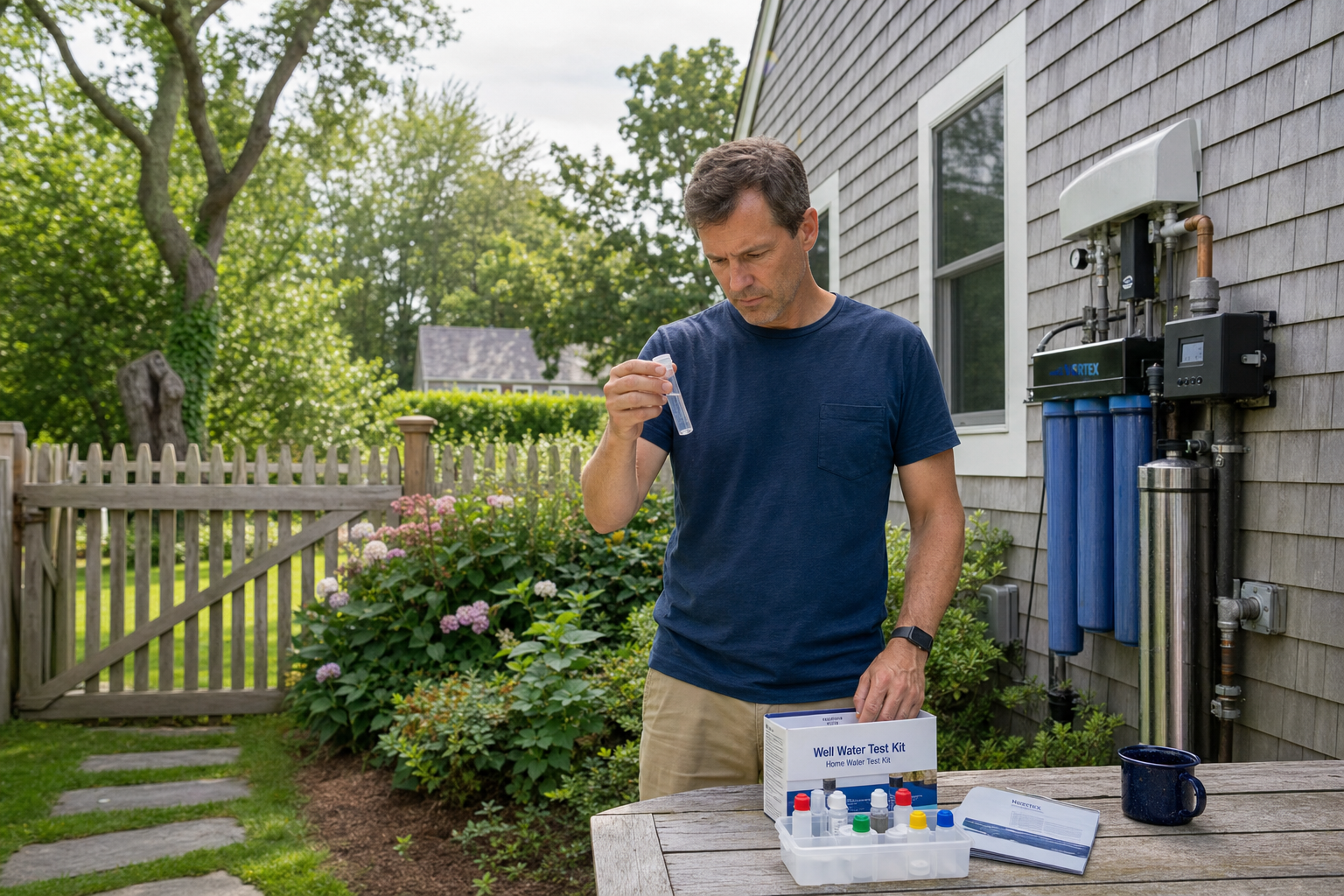
If your household uses a private well anywhere near the affected area, testing is the first practical step toward informed decisions.
3.1 When It’s Time to Arrange Water Testing
You should strongly consider PFAS-focused testing if:
- You rely on a private well within East Hampton or surrounding communities.
- Your home is down-gradient (lower in elevation or in the groundwater flow path) from the NextEra battery sites or the Bridgehampton Road wellfield.
- You have received letters or notices from Suffolk County or the Suffolk County Water Authority referencing PFAS, PFPrA, or private well surveys.
- You’ve noticed changes in taste or odor, or you simply want confirmation given the recent headlines.
Even if you haven’t experienced obvious signs, PFAS such as PFPrA are not visible, and they do not always cause noticeable taste or smell, so relying on sensory cues alone is not enough.
3.2 What Types of Testing Should You Request?
When you contact a lab or water quality professional, ask specifically about:
- PFAS panel testing: A laboratory analysis that looks for a range of PFAS compounds, potentially including PFPrA where available.
- Standard well panel: Iron, manganese, hardness, pH, and other common well issues that can affect plumbing and appliances.
- Bacteria and nitrates: Typical well safety checks that help provide a broader view of your water quality.
pHountain Water Filters can help you interpret test results and align them with customized filtration options, but PFAS lab testing itself will be handled by certified third-party laboratories.
For a starting point on common well issues and what they may mean, see What Your Well Water Isn’t Telling You.
4. Example Scenario: How an East Hampton Resident Addressed PFPrA Alerts
To illustrate what a response can look like, here is a composite case based on real conditions in East Hampton (no individual customer is identified).
4.1 Initial Warning Signs for the Homeowner
A homeowner in East Hampton lived within a few miles of a battery storage facility that experienced a fire and subsequent fire suppression system leak. In the months after the incident, they noticed:
- Unusual chemical-like taste in their well water
- Growing media coverage about PFAS and PFPrA detections in local groundwater
- Concern that their private well could be in the same groundwater flow path as the affected public wells
4.2 Well Water Testing and What It Revealed
The homeowner arranged for comprehensive well water testing, including a PFAS panel. Results showed:
- Detectable PFPrA, consistent with regional findings tied to the battery site incident
- Other routine parameters within typical ranges for the area
While local authorities were focused on public wells, the homeowner wanted an additional household-level barrier for peace of mind.
4.3 The Filtration Solution and Daily Benefits
Working with pHountain Water Filters, the homeowner chose to install a pHountain pHresh Filtration System with professional installation to address:
- PFAS-class contaminants such as PFPrA
- Chlorine, heavy metals, industrial chemicals, sediment, and other environmental contaminants that may be present in local water supplies
After installation, the family:
- Relied far less on purchased bottled water, saving an estimated $30–$60 per month
- Reported improved taste and odor at every tap
- Gained confidence that their showers, laundry, and cooking water were all being treated at the entry point to the home
> A whole-home system does not replace public health actions — it adds a personal layer of protection and consistency you control, regardless of future incidents or infrastructure changes.
5. Overview of Common Water Quality Protection Methods for East Hampton Homes
Local headlines often lead people to short-term choices like switching to bottled water or buying a basic pitcher filter. Those can play a role, but they don’t address whole-house exposure or all PFAS concerns.
5.1 Comparing Your Water Treatment Options Side-by-Side
Below is a general comparison of common approaches East Hampton homeowners consider. This table is for educational comparison only and does not represent performance testing or specific product ratings.
| Option | Scope of Water Treated | PFAS/PFPrA Consideration* | Practical Notes for East Hampton Homes |
|---|---|---|---|
| Bottled water | Drinking only | Varies by brand and source | Does not address showers, cooking, or dishes; creates ongoing cost and plastic waste. |
| Basic pitcher or fridge filter | Single tap / pitcher volume | Often not designed for PFAS | Helpful for taste/odor; typically not tested for PFAS-class contaminants. |
| Under-sink drinking water filter | One faucet (kitchen) | Depends on cartridge technology | Can improve drinking water; leaves bathrooms, laundry, and other taps untreated. |
| Whole-home filtration system | Every faucet, shower, and appliance | Can be configured for PFAS focus | Installed at main line; supports consistent water quality throughout the home. |
\*Always review third-party lab data and certifications for any system you consider. PFAS and PFPrA treatment capabilities depend on the specific technology used.
For a deeper look at why many Long Island households are re-evaluating bottled water, see Water Filters vs Bottled Water.
6. Developing Your Own Water Safety Plan for East Hampton Residences
You don’t need to become a water scientist to respond effectively. A structured approach can help you move from concern to action.
6.1 First Steps: Identify Your Water Supply Risk
- Confirm your supply type: Are you on a private well or a public water system? Your water bill or deed can clarify this.
- Locate your property relative to battery sites: Check local news maps and Suffolk County materials to see how close you are to the NextEra battery storage facilities and the Bridgehampton Road wellfield.
- Review county updates: The Suffolk County Department of Health Services maintains PFAS information related to East Hampton battery energy storage systems.
6.2 Next Step: Arrange Testing and Understand Your Results
- Schedule PFAS-focused testing: Request a PFAS panel that includes, where available, ultra-short-chain compounds such as PFPrA.
- Include standard well checks: Ask for bacteria, nitrates, metals, and basic chemistry to get a full picture of your water.
- Discuss results with professionals: Use the lab report to discuss filtration options with a water treatment specialist who understands Long Island groundwater patterns.
You can start this process by requesting a Free In-Home Water Test. pHountain Water Filters will review your concerns, discuss appropriate testing, and help interpret what the numbers mean for your home.
6.3 Final Step: Choose Filtration Options That Fit
Once you understand your water profile:
- Whole-home focus: Consider whether you want every tap — including showers and laundry — to benefit from improved water quality.
- PFAS-oriented configuration: Ask specifically about filtration media and configurations that are designed to address PFAS-class contaminants, alongside other local concerns like chlorine or industrial chemicals.
- Professional installation benefits: A properly installed system can help ensure flow rate, contact time, and plumbing integration are aligned with your home’s layout and usage patterns.
For East Hampton and the broader Suffolk region, you can explore regional options through Whole-Home Water Filtration for Suffolk County and Water Filtration Long Island NY.
7. Why the pHountain pHresh System Is a Smart Addition to Your Water Safety Approach
While public agencies manage wellfield operations and site investigations, many homeowners want a consistent line of defense within their own walls. That is where the pHountain pHresh Filtration System and professional installation come in.
7.1 What Distinguishes the pHresh Filtration System
The pHountain pHresh Filtration System is a whole-house solution installed at the main water entry point so that:
- Every faucet and shower in the home receives treated water
- Drinking, cooking, bathing, and laundry all benefit from the same filtration strategy
- The system is configured to address a broad set of contaminants, including:
- Chlorine and disinfection by-products
- Heavy metals
- Industrial chemicals
- Sediment and particulate matter
- Various environmental contaminants, including PFAS-class compounds
pHountain Water Filters works with each household to align system design with local water conditions, including PFAS-related findings in East Hampton and greater Suffolk County.
7.2 The Added Value of Professional Setup on Long Island
Local plumbing and groundwater conditions can vary significantly across East Hampton and the rest of Long Island. Professional installation helps ensure:
- Correct sizing for your home’s water use and plumbing configuration
- Appropriate media selection and system layout for your contaminant profile
- Proper integration with existing equipment such as softeners or point-of-use filters
This professional approach can be particularly valuable when dealing with emerging contaminants like PFPrA, where homeowners want an informed, locally grounded strategy instead of piecemeal fixes.
> Want a personalized plan for your East Hampton home? Start by requesting a Free In-Home Water Test and consultation to discuss your options with a local water filtration specialist.
8. Your Questions Answered About East Hampton Wells and the NextEra PFPrA Issue
Does the NextEra facility suspension mean my East Hampton well is unsafe?
Not automatically. The suspension of operations at the NextEra battery sites reflects precautionary actions taken while Suffolk County investigates PFPrA and PFAS impacts in local groundwater. Your individual well’s safety depends on:
- Location relative to the contamination plume
- Depth and construction of your well
- Test results from PFAS and general water quality panels
Because PFAS compounds are not visible or easily detected by taste, testing is the only reliable way to know your situation.
If I’m on public water in East Hampton, do I still need filtration?
Public water suppliers in Suffolk County work closely with the Department of Health to monitor wells, adjust pumping, and manage contamination events such as the PFPrA detection at Bridgehampton Road. Many homeowners, however, choose whole-home filtration to:
- Add a household-level barrier for PFAS-class and other contaminants
- Improve taste and odor at every tap
- Decrease reliance on bottled water for everyday use
Filtration is not a replacement for public oversight but a complementary step you control directly.
How are East Hampton homeowners typically responding to PFPrA news?
Responses vary, but common steps include:
- Reviewing county updates and local reporting from outlets like East Hampton Press
- Scheduling PFAS-inclusive well testing, especially for properties near the battery sites
- Installing or upgrading whole-home filtration systems configured with PFAS concerns in mind
- Decreasing bottled water purchases over time as they gain confidence in their in-home filtration strategy
Many homeowners see these steps as part of a broader effort to build resilience against current and future water quality events.
How often should I retest my East Hampton well once I install filtration?
Testing frequency depends on:
- Initial PFAS or PFPrA levels
- Changes in local infrastructure or land use, such as new facilities or remediation projects
- Your own comfort level with monitoring
Many well owners choose to retest annually or after any significant regional event (major spills, fires, or new contamination findings). A consultation with a water quality professional can help you set an appropriate schedule.
Looking ahead, East Hampton’s experience with PFPrA and the NextEra facility suspension is likely to shape how energy storage, fire suppression, and groundwater protection are managed across Long Island. For individual homeowners, the most practical response is clear:
- Stay informed through county and local news updates.
- Test your water, especially for PFAS compounds.
- Implement a whole-home filtration plan that reflects your specific test results and comfort level.
To explore options tailored to your home, start with a Free In-Home Water Test or connect through Contact Us to discuss your East Hampton water concerns.
This blog is for informational purposes only and does not constitute health, legal, or regulatory advice. Always consult your local water provider, health department, or appropriate professionals for guidance specific to your situation.
Water quality varies by location. Municipal water provided by SCWA achieved EPA compliance in June 2025. Private well owners should have water tested regularly. pHountain provides free water testing for Nassau and Suffolk County.
Sources
- — https://www.energy-storage.news/nextera-halts-long-island-bess-operations-over-drinking-water-contamination-concerns/
- — https://www.suffolkcountyny.gov/Departments/Health-Services/Environmental-Quality/Water-Quality-Information/PFAS-Information/East-Hampton-BESS
- — https://www.27east.com/east-hampton-press/