In its November 3, 2026, report, RiverheadLOCAL identified the board and gave the document’s acceptance date in these words: “The SCWA board accepted the document Oct. 29” (RiverheadLOCAL). The report described the proposed main as carrying water “through Riverhead to serve customers in Southold” (RiverheadLOCAL).
Quick answer
As of November 3, 2026, RiverheadLOCAL reported this possibility for a findings decision: the board “could adopt a formal findings statement as early as its November meeting” (RiverheadLOCAL). For route selection, the same report quoted the FEIS: “final route selection will be made through the findings process” (RiverheadLOCAL).
Key points from the final review
- Proposed connections: RiverheadLOCAL reported on November 3, 2026: “No customer connections would be made within the Riverhead Water District service area” (RiverheadLOCAL).
- Hearing comments: In its November 3, 2026, report, RiverheadLOCAL said the final statement “responds to comments submitted during three August hearings” (RiverheadLOCAL).
Hearing dates and the written-comment deadline
In its October 30, 2026, account of the draft hearings and their dates and locations, South Shore Press identified the first hearing this way: “Hearings on the draft were held Aug. 19 in Westhampton Beach” (South Shore Press). For the next hearing in that account of the draft-review process, the same South Shore Press report gave the date and location as “Aug. 20 in Peconic” (South Shore Press).
For the last hearing listed in its account of the draft environmental review, South Shore Press’s October 30, 2026, report gave the date and location as “Aug. 26 in Riverhead” (South Shore Press). For the written-comment deadline accompanying the hearing process, RiverheadLOCAL’s November 3, 2026, account of the final environmental statement described a “written comment period that ended Sept. 25” (RiverheadLOCAL).
- Open trenching: As of November 3, 2026, RiverheadLOCAL reported that the FEIS said the state Department of Transportation “has not yet determined where open trenching would be permitted along the state-road route” (RiverheadLOCAL).
What must happen before the findings decision
On November 3, 2026, RiverheadLOCAL described the required consideration period: “A public and agency consideration period of at least 10 calendar days must follow filing of the FEIS completion notice before SCWA issues its findings and makes its decision” (RiverheadLOCAL). For access to the final environmental statement and its supporting documents, the same report identified them as “available on SCWA’s project website” (RiverheadLOCAL).
Route and property details
In its November 3, 2026, account of SCWA’s preferred route, RiverheadLOCAL described the waterway crossing with the words “passes beneath the Peconic River” (RiverheadLOCAL). For the direction identified in that description of the preferred route, the same November 3, 2026, RiverheadLOCAL report used the words “toward Laurel” (RiverheadLOCAL).
For the proposed main’s length and diameter, RiverheadLOCAL’s November 3, 2026, account of the proposed transmission main described an “approximately 7.2-mile, 24-inch transmission main” (RiverheadLOCAL). For the landownership detail associated with the proposed booster-station site, the same November 3, 2026, report used the description “authority-owned property” in its account of the station proposal (RiverheadLOCAL).
What the final review says about construction oversight
Among the requests submitted in comments, RiverheadLOCAL’s November 3, 2026, report identified “independent construction oversight” (RiverheadLOCAL). Reporting the response, it stated: “SCWA declined a separate third-party monitor and instead committed to appointing a construction manager and environmental compliance liaison” (RiverheadLOCAL). The same report described the duties of those committed oversight roles as being to “oversee mitigation measures, document deficiencies and track corrective action” (RiverheadLOCAL).
Which construction details await final planning
RiverheadLOCAL described the status of schedules and traffic controls on November 3, 2026: “Detailed schedules and traffic controls would be developed through final construction planning and roadway permits” (RiverheadLOCAL). On final design and permitting, the same report said that “some field verification, utility locations and alignment adjustments would be addressed during final design and permitting” (RiverheadLOCAL). It also reported that SCWA “would coordinate with state and county road authorities before construction to determine whether additional traffic counts or observations were necessary” (RiverheadLOCAL).
Where the Riverhead zoning dispute stands
Reporting on the lawsuit on November 3, 2026, RiverheadLOCAL described SCWA as “seeking a ruling” about “the town’s zoning and land-use requirements” (RiverheadLOCAL). South Shore Press reported on October 30, 2026, that “On Oct. 6, the Town Board voted unanimously that the Main Road route falls under the town’s land use rules” (South Shore Press). The same report included “a special permit for the booster station” among those requirements (South Shore Press). As of November 3, 2026, RiverheadLOCAL reported that the pre-trial disclosure phase was “scheduled to be completed by Dec. 15, according to court records” (RiverheadLOCAL).
Other details in the town’s stated requirements
In its October 30, 2026, account of the Main Road route and the town’s position on land-use requirements, South Shore Press described the planned booster-station location as an “Aquebogue site where Main Road meets Cross River Drive” (South Shore Press). In the same report’s account of the October 6 Town Board vote, South Shore Press included “site plan review” among the requirements in the town’s stated position on the proposed Main Road route (South Shore Press). For the permit and property-access items listed in that account of the town’s position, the October 30, 2026, South Shore Press report also identified “road opening permits and easements” among the requirements (South Shore Press).
Supply context and household water records
SCWA’s stated supply concerns
In its August 19, 2026, statement, the Suffolk County Water Authority described demand this way: “Despite conservation efforts, water demand on the North Fork continues to increase” (SCWA). The authority also stated: “Over-pumping risks saltwater entering the freshwater aquifer, limiting expansion” (SCWA).
Existing wells, customers and aquifer background
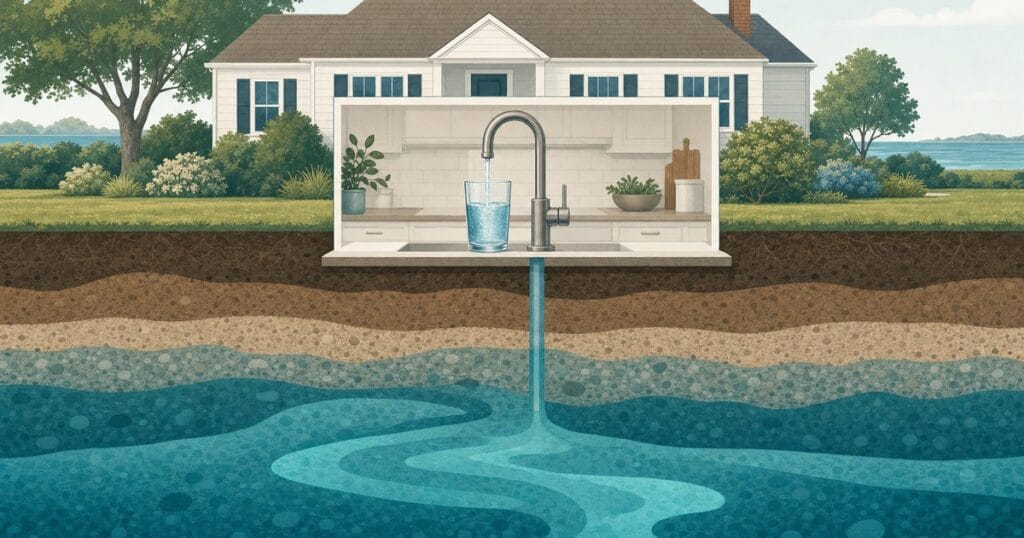
For the scale of its North Fork operations, the Suffolk County Water Authority’s August 19, 2026, statement described its existing supply infrastructure this way: “operates 60 wells across 18 well fields on the North Fork” (SCWA). In the same August 19, 2026, statement about its North Fork supply, the authority described the customer count associated with those operations using the words “supplying 9,500 customers” (SCWA).
For the groundwater source associated with the wells in that account, the Suffolk County Water Authority stated on August 19, 2026: “Most wells draw from the Upper Glacial Aquifer” (SCWA). For the vulnerability of the Upper Glacial Aquifer described in the same August 19 statement, the authority identified “contamination from pesticides, herbicides and rising chloride levels” in its explanation of the supply background (SCWA).
The lawn-watering proposal in the coverage
In its October 30, 2026, reporting on lawn watering, South Shore Press described the authority’s proposed schedule with the words “an odd and even day schedule for lawn watering” (South Shore Press). When asking about outdoor watering, request the wording of any applicable schedule rather than assuming the project update supplies it.
Annual reports and private-well testing
pHountain’s Water Quality & Safety guide, dated October 25, 2026, describes a “Consumer Confidence Report, also known as an annual drinking water quality report” (pHountain). The same guide quotes the annual delivery requirement: “Reports must be sent by your water supplier each year by July 1” (pHountain). On locating a report, the guide quotes the option to “Find and map a large public water system closest to you and view its Annual Drinking Water Quality Report” (pHountain).
Report delivery and requests for results
As of October 25, 2026, pHountain’s Water Quality & Safety guide quoted the federal report-delivery requirement for the supplier category with these words: “EPA requires community water systems to deliver a Consumer Confidence Report” (pHountain). For the recipients specified in that quoted delivery requirement, the same October 25, 2026, guide identified the destination of the reports with the words “to their customers” (pHountain). For another way to request results, pHountain’s Water Quality & Safety guide, dated October 25, 2026, quoted the state environmental and health departments’ suggestion to “contact your water supplier to view the latest results” (pHountain).
For private wells, the guide quotes the responsibility statement: “Private well owners are responsible for delivering safe drinking water to their households” (pHountain). On the testing schedule, it quotes the advice that “Private well owners should test their tap water at least once a year for bacteria and every three to five years for other contaminants” (pHountain).
Groundwater background and reporting requirements
Groundwater descriptions quoted in the guide
For the geographic scope of the groundwater background, pHountain’s Water Quality & Safety guide, dated October 25, 2026, quotes the U.S. Geological Survey: “Groundwater is the sole source of freshwater supply in Nassau and Suffolk Counties on Long Island” (pHountain). For the county-specific description alongside that Long Island background, the same guide quotes the Nassau County Department of Health: “Nassau County gets all its drinking water from the water stored in the porous soil beneath Long Island” (pHountain). For the number of aquifers in the county department’s drinking-water description, pHountain’s October 25, 2026, guide also quotes the department’s statement that “Nassau County uses three major aquifers for its drinking water” (pHountain).
Public-supply monitoring described in the guide
As of October 25, 2026, pHountain’s Water Quality & Safety guide quoted the department’s description of public-supply monitoring requirements: “Public water systems in New York must monitor for more than 100 different contaminants” (pHountain). For the timing specified in that description of public-system monitoring, the same October 25, 2026, guide quoted the department’s wording that the monitoring takes place “on a regular schedule” (pHountain).
Reporting changes described for 2027
As of October 25, 2026, pHountain’s Water Quality & Safety guide quoted the timing and readability provision of EPA’s revised reporting rule: “Starting in 2027, the final rule will ensure that these reports are easier to read” (pHountain). For the language-access provision in that same description of the revised rule, the October 25, 2026, guide quoted EPA’s wording that the rule would “support access to translations in appropriate languages” (pHountain).
For the drinking-water information specified in another part of that rule description, the same guide quoted EPA’s wording about “enhancing information about lead in drinking water” as part of the revised reporting provisions (pHountain). As of October 25, 2026, the guide also quoted the revised rule’s distribution requirement for larger systems: “systems serving over 10,000 customers will be required to distribute reports twice per year” (pHountain).
What to check in the next project update
When reviewing the next update, compare the underlying documents rather than relying on a headline. Keep these checks together in your notes:
- Check the publication date and any date attached to a quoted announcement.
- Look for a findings statement and permit notices; label a pending step as pending rather than completed.
- Distinguish a request for court relief from an issued ruling by checking the document type and the court’s wording.
- Keep project documents separate from your household water records when organizing your files.
For household-water questions, consult Water Quality & Safety and Private Well Water. For earlier project coverage, see the earlier North Fork water main post.
Questions about the remaining project steps
Where would the proposed main’s water come from?
In its November 3, 2026, account, RiverheadLOCAL identified the proposed main’s water source as “existing permitted capacity in Southampton, according to SCWA” (RiverheadLOCAL). The same report relayed the authority’s explanation that importing the water would “reduce pressure on North Fork wells and help protect the local aquifer” (RiverheadLOCAL).
How long is construction scheduled to take after final permits?
In its November 3, 2026, report, RiverheadLOCAL quoted SCWA’s Director of Construction Maintenance from an October 30 release: “Construction is scheduled to take twelve months once all the final permits are in place” (RiverheadLOCAL). The same report attributed the proposed staging to that official: “work would be staged to avoid traffic disruptions during peak summer and fall months” (RiverheadLOCAL).
What construction updates has SCWA committed to providing?
RiverheadLOCAL reported on November 3, 2026, that SCWA committed to updates covering “work locations, schedules, detours, access restrictions and progress” (RiverheadLOCAL). The same report also described a commitment to provide “a way for the public to submit questions, complaints and reports of possible violations” (RiverheadLOCAL).
Separate household-system questions
A whole-home system is configured around what testing finds; for any specific contaminant, ask for independent certification data (for example NSF/ANSI listings) for the exact system you are considering. pHountain’s specialists are trained for both well water and municipal supply.
Cost depends on the home’s size, whether it is on municipal or well water, and the contaminants involved, so there is no one-size-fits-all price. The systems are designed to be low-maintenance.
Ask about your household water
Consider writing down the household-water questions you want to ask before arranging a visit. pHountain offers a free, no-obligation in-home water test.
Information on our website about water quality, health benefits, or filtration performance is provided for general educational purposes only and does not constitute medical, legal, or engineering advice.
Works Cited
- Civiletti, Denise. “North Fork water main nears end of environmental review as SCWA issues final impact statement.” RiverheadLOCAL, 3 Nov. 2026, riverheadlocal.com/2026/11/03/north-fork-water-main-nears-end-of-environmental-review-as-scwa-issues-final-impact-statement. Accessed 12 Nov. 2026.
- “Drinking Water Safety & Quality Guide.” pHountain Water Filtration, 25 Oct. 2026, phountainwaterfilters.com/water-safety-quality. Accessed 12 Nov. 2026.
- “Suffolk County Water Authority.” Suffolk County Water Authority, 19 Aug. 2026, www.scwa.com/nfp. Accessed 12 Nov. 2026.
- “Water Authority accepts final review of North Fork pipeline.” South Shore Press, 30 Oct. 2026, www.southshorepress.com/local/water-authority-accepts-final-review-of-north-fork-pipeline-4d162fb8. Accessed 12 Nov. 2026.