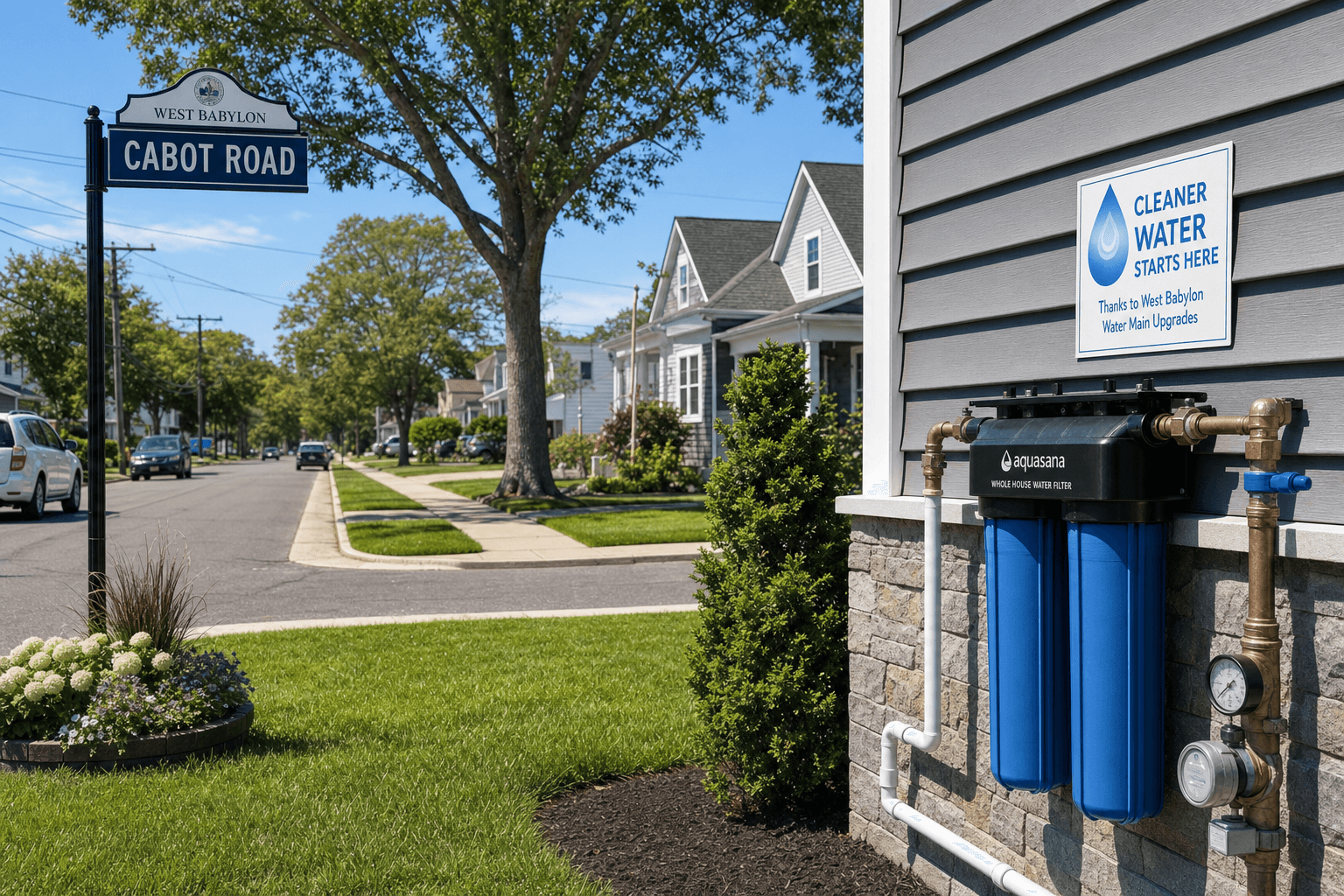
In June 2026, the Suffolk County Water Authority (SCWA) announced that it had completed a water main replacement on Cabot Road in West Babylon. According to SCWA, crews replaced about 2,400 feet of aging iron water main with new ductile iron main, and the older pipe had experienced numerous main breaks over the years.
Projects like this are built for the long term. But any time a water main is replaced, repaired or flushed, the water at nearby taps can change for a while. It may look cloudy, turn yellow or brown, carry fine grit, or taste and smell different. These effects are usually temporary, but they can be unsettling if you don’t know what causes them.
This article explains what the Cabot Road project involved, what water main work can do to tap water in West Babylon, what you can do at home in the short term, and when to contact your water supplier.
1. The Cabot Road Water Main Replacement
SCWA says the new ductile iron pipe is more durable and longer-lasting than the older cast iron it replaced, and that the upgrade improves system reliability and water service for local customers. SCWA expects replacing the aging main to reduce future breaks, and it describes the project as part of its ongoing program to modernize infrastructure across Suffolk County.
These are long-term benefits that matter for West Babylon homeowners, even if you never think about the pipes under the street.
Why water main work can change your tap water
Even when the water supply meets drinking water standards, the distribution system is a dynamic environment: water moves through miles of mains, valves and service lines before it reaches your home.
Over time, minerals and fine particles can settle inside pipes, especially in older mains or low-flow areas. When a main is replaced, repaired or flushed, the work can:
- Change flow direction in nearby mains
- Increase flow velocity during flushing and testing
- Shake loose deposits that were stuck to the pipe interior
That material doesn’t disappear — it can travel toward houses connected to the same network, causing temporary clarity issues at taps and fixtures. Because nearby streets share the same mains, homes a few blocks from the work can notice it too.
2. What You Might Notice at the Tap
If you live near water main work or flushing, you may notice the following, especially after a service interruption:
- Cloudy or milky water: Often caused by tiny air bubbles, which clear from the bottom of the glass up.
- Short-term discoloration: Yellow, brown or tea-coloured water, especially from cold taps.
- Sediment at the bottom of a glass: Fine particles that settle out after a few minutes.
- Taste or odour changes: Water that sat in household plumbing during a shut-off can taste or smell stale.
These effects are typically temporary. They don’t necessarily mean something is wrong with the water source, but they are a reminder that what happens in the street can show up in your glass.
Signs in your plumbing and fixtures
- Fine grit in aerators: Faucet screens clog sooner, or you feel a slight roughness when cleaning them.
- Toilet tank buildup: A visible layer of fine material at the bottom of tanks over time.
- Showerhead clogging: Spray patterns change or clog more quickly than before.
These are all signs that particulate material is moving through your plumbing, even if the water meets regulatory standards at the point of distribution.
3. What to Do in the Short Term
If you notice changes after main work near your home:
- Run cold water from a bathtub or outside spigot for several minutes to help flush your home’s lines.
- Check faucet aerators and clean them if you see particles or scale.
- Avoid washing light-coloured laundry until water runs clear to prevent staining.
- Check clarity in a clear glass after flushing; if it doesn’t clear, contact your supplier.
4. When to Contact Your Water Supplier
The Suffolk County Water Authority (SCWA), which carried out the Cabot Road project, supplies public water in West Babylon; your water bill confirms your supplier. SCWA posts news and maintenance announcements on its website.
Contact your supplier if cloudy or discoloured water doesn’t clear after you have flushed your cold lines, if it keeps coming back, or if there is no work nearby that would explain it. Describe what you see, when it started and which taps are affected.
Public water suppliers must meet federal and state drinking water standards, and each publishes an annual water quality report, also called a Consumer Confidence Report, showing what it tested for and what it found. If your home is on a private well, testing it is your responsibility; see the EPA’s guidance on private drinking water wells.
5. Waiting It Out vs. Filtering at Home
You may wonder whether to simply wait for water clarity to return or to add in-home filtration. Here’s a simplified comparison:
| Approach | Short-Term Impact | Long-Term Control | Typical Costs (Conceptual) |
|---|---|---|---|
| Do nothing / wait | Clarity may return, but sediment can reappear with future work | Limited; each new main project or flushing can affect water again | No direct system cost |
| Point-of-use filter (single tap) | Treats water at one sink | Drinking water only; showers, laundry and other taps unchanged | Lower upfront, but multiple filters needed for full coverage |
| Whole-house filtration | Treats water where it enters the home once installed | Depends on the system and on what testing finds | Upfront system and installation cost |
6. How pHountain Water Filters Can Help
The pHountain Filtration System is a whole-home (point-of-entry) system with a cartridge-free media design intended to reduce common impurities in tap water. It is installed at the main water entry point, so every tap, shower and appliance receives filtered water. A whole-home system is configured around what testing finds. For any specific contaminant, ask for independent certification data (for example NSF/ANSI listings) for the exact system you are considering.
- Free in-home water test: A specialist discusses the changes you have noticed (cloudiness, sediment, odour) and tests your water on-site.
- Tailored recommendation: Based on the results, we recommend a configuration sized to your home and water use.
- Professional installation: The system is installed at the main water entry point and backed by a 10-year guarantee.
You can request a free in-home water test. Residents of West Babylon and nearby communities can also review our Babylon service-area page and our Suffolk County water filtration page for more on local coverage.
7. Summary: What West Babylon Homeowners Should Know
- SCWA’s Cabot Road project replaced about 2,400 feet of aging, break-prone iron main with ductile iron, a long-term reliability upgrade for the area.
- Water main replacement and flushing can stir up sediment that has settled in the mains, even when the water meets drinking water standards.
- Cloudiness, discoloration, visible particles and taste or odour changes can show up after nearby work, and they are usually temporary.
- Flushing your cold lines and cleaning aerators can help; if problems persist or keep returning, contact your water supplier.
- Your supplier’s annual water quality report shows what it tested for and what it found.
- Whole-house filtration treats water where it enters your home; whether it suits your situation depends on what testing finds.
8. Frequently Asked Questions from West Babylon Residents
Is West Babylon tap water safe to drink after water main work?
Public water suppliers must meet federal and state drinking water standards, and your supplier’s annual water quality report shows what it tested for and what it found. Main replacement and flushing can temporarily affect clarity and sediment in your home’s lines; if the water doesn’t clear after flushing, contact your supplier. If your home uses a private well, testing it is your responsibility.
How long will cloudy or discolored water last after main work?
Temporary cloudiness or discoloration often improves as the supplier and homeowners flush lines. How long it lasts depends on system usage, distance from the work and your home’s plumbing. If your water hasn’t cleared after you flush your cold lines, or you see ongoing sediment build-up in fixtures, contact your water supplier.
Do I need a filter if my water supplier already treats the water?
Public suppliers treat and monitor water to meet drinking water standards. Between the treatment point and your tap, water travels through mains, valves and service lines, where it can pick up sediment and pipe scale, which is what shows up after main work. Whether a filter makes sense depends on what you notice and what testing finds.
I live a few blocks from water main work. Could it affect my water?
It can. Even if your home is not on the street being worked on, you may be connected to the same distribution network. Changes in flow direction or flushing can move sediment through interconnected mains and into nearby streets. If changes persist after you flush your lines, contact your water supplier.
If you’d like to understand your home’s water beyond what you can see in a glass, start by requesting a Free In-Home Water Test.
This blog is for informational purposes only and is not endorsed by or affiliated with any public water supplier or government agency. Water quality conditions can vary significantly from home to home, even within the same neighbourhood. Homeowners concerned about their water should consider independent testing and consult with qualified water treatment professionals before making installation decisions.