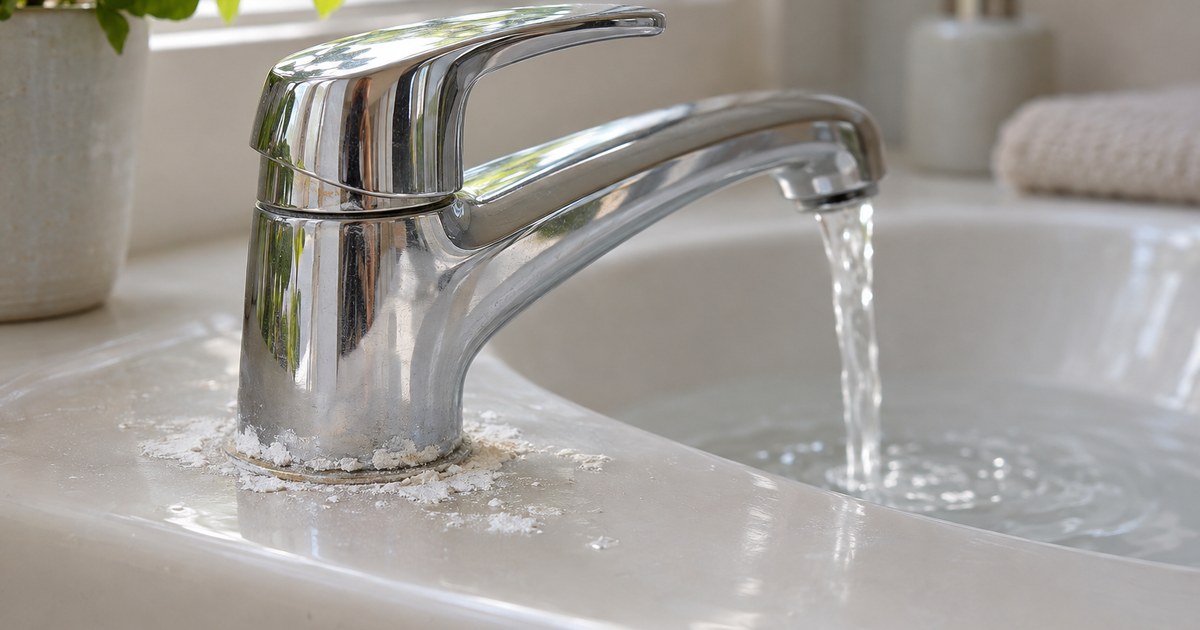
In its August 24, 2026, explanation of hard water, the U.S. Geological Survey (USGS) stated, “The simple definition of water hardness is the amount of dissolved calcium and magnesium in the water” (USGS). For local context, pHountain Water Filtration’s October 25, 2026, Water Quality & Safety guide quoted USGS: “Groundwater is the sole source of freshwater supply in Nassau and Suffolk Counties on Long Island” (pHountain Water Filtration).
Key points before you check
- USGS explained on August 24, 2026, that “as water moves through soil and rock it dissolves small amounts of naturally-occurring minerals and carries them into the groundwater supply” (USGS).
- In its May 26, 2026, explanation of secondary standards, EPA stated, “They are established as guidelines to assist public water systems in managing their drinking water for aesthetic considerations, such as taste, color, and odor” (EPA).
- Addressing its historical hardness data, the same USGS source cautioned that “the 1975 data are not designed to be used to make local decisions or decisions on the scale of individual homeowner property” (USGS).
1. Check the hardness number and its units
USGS published these hardness categories on August 24, 2026: “General guidelines for classification of waters are: 0 to 60 mg/L (milligrams per liter) as calcium carbonate is classified as soft; 61 to 120 mg/L as moderately hard; 121 to 180 mg/L as hard; and more than 180 mg/L as very hard” (USGS). The agency also explained the conditional connection to a water-supply well: “Water is a great solvent for calcium and magnesium, so if the minerals are present in the soil around a water-supply well, hard water may be delivered to homes” (USGS). For information at an individual location, USGS stated that “information that is directly relevant to water hardness and other chemical properties at a home or immediate locale should be provided by the local health agency or local water utility, or by the vendor of a local water-softening system” (USGS).
2. Separate soap deposits from heated-water scale
USGS explained on August 24, 2026, “In hard water, soap reacts with the calcium (which is relatively high in hard water) to form ‘soap scum'” (USGS). On washing, the same source stated, “When using hard water, more soap or detergent is needed to get things clean, be it your hands, hair, or your laundry” (USGS). Separately, USGS described what can happen during heating: “When hard water is heated, such as in a home water heater, solid deposits of calcium carbonate can form” (USGS).
3. Check the status of a secondary benchmark
As of May 26, 2026, EPA described the federal status this way: “In addition, EPA has established National Secondary Drinking Water Standards that set non-mandatory water quality standards for 15 contaminants” (EPA). On enforcement, the agency stated, “EPA does not enforce these ‘secondary maximum contaminant levels’ (SMCLs)” (EPA). In its separate explanation of federal monitoring and treatment requirements, EPA stated, “Although state health agencies and public water systems often decide to monitor and treat their supplies for secondary contaminants, federal regulations do not require them to do this” (EPA).
4. Ask your public water supplier about monitoring
EPA advised on May 26, 2026, “Inquire about your supplier’s monitoring for secondary contaminants” (EPA). For annual-report background, pHountain Water Filtration’s October 25, 2026, Water Quality & Safety guide quoted EPA: “EPA requires community water systems to deliver a Consumer Confidence Report, also known as an annual drinking water quality report, to their customers” (pHountain Water Filtration).
The guide also quoted EPA’s delivery schedule: “Reports must be sent by your water supplier each year by July 1” (pHountain Water Filtration). For locating a report, the same guide quoted the New York State Department of Health’s direction to “Find and map a large public water system closest to you and view its Annual Drinking Water Quality Report” (pHountain Water Filtration). The guide separately quoted the state’s environmental and health departments’ suggestion to “contact your water supplier to view the latest results” (pHountain Water Filtration).
5. Compare iron and manganese results with aesthetic benchmarks
For iron, pHountain Water Filtration’s October 25, 2026, Water Quality & Safety guide described EPA’s secondary standards as listing “noticeable effects above 0.3 mg/L of iron (‘rusty color; sediment; metallic taste; reddish or orange staining’)” (pHountain Water Filtration). For manganese, the same guide listed effects “above 0.05 mg/L of manganese (‘black to brown color; black staining; bitter metallic taste’)” (pHountain Water Filtration).
6. Match testing questions to your water source
pHountain Water Filtration’s October 25, 2026, Water Quality & Safety guide stated, “A water test can show how hard your own water is” (pHountain Water Filtration). Suffolk County Government states, “Generally, the owner of a private well is responsible for his own water supply” (Suffolk County). The New York State Department of Health advised on March 23, 2023, “Test your water if you notice changes in how your water looks, smells or tastes, after floods, changes in land use, or concerns about local contaminants” (NYSDOH).
Put your report and observations side by side
Gather your existing reports before preparing questions for your public water supplier or laboratory. Keep the Common Contaminants guide, Water Quality & Safety guide and Private Well Water page alongside your notes.
- Results: Copy the reported hardness number and its complete units, including any wording about calcium carbonate. Compare those units with the classification wording before comparing categories; if they differ, ask the supplier or laboratory how to compare the figures.
- Sample details: Note the sampling date and the tap or other location identified on each report. Record whether the report describes the sample as raw, unfiltered or something else, rather than filling in an assumption.
- Observations: Write down where deposits or staining appear and when you first noticed them. Keep observations about soap-contact surfaces separate from observations about hot-water fixtures, without assigning a cause from appearance alone.
- Questions: Ask which results are available for your water source and which additional questions would require another sample. For a proposed laboratory analysis, request the sampling instructions and the exact names of the measurements to be reported.
Keep the original reports with your notes rather than relying on a copied number alone. Put separate questions about taste, staining, deposits and sampling on your list so each can receive a specific answer.
Questions about minerals and testing
What can cause metallic taste or blue-green staining?
EPA stated on May 26, 2026, “Other effects of corrosive water, such as the corrosion of iron and copper, may stain household fixtures and impart objectionable metallic taste and red or blue-green color to the water supply” (EPA). In its separate explanation of corrosion control, the agency cautioned, “It should be noted that corrosion control is not used to remove metals from contaminated source waters” (EPA).
What is the difference between scale and sediment?
EPA defined scale on May 26, 2026: “Scale is a mineral deposit which builds up on the insides of hot water pipes, boilers, and heat exchangers, restricting or even blocking water flow” (EPA). The agency separately defined sediment: “Sediments are loose deposits in the distribution system or home plumbing” (EPA).
How often should I test private well water for bacteria?
For listed contaminants other than bacteria, the New York State Department of Health’s March 23, 2023, instruction specified testing “at the tap” and “every 3-5 years” (NYSDOH). The same instruction specified the frequency as “at least once a year for bacteria” (NYSDOH).
In its March 23, 2023, instructions, the New York State Department of Health also stated, “The best time to test your water is in the late spring or early summer” (NYSDOH). The department also advised, “Have a well contractor inspect your well at least once a year to stay ahead of maintenance issues” (NYSDOH).
Does Suffolk County offer private well water testing?
Suffolk County Government states, “To help residents with private wells determine the quality of their drinking water, the Suffolk County Department of Health Services operates an extensive water testing program” (Suffolk County). On the water sampled, the county states, “Usually the raw or unfiltered water will be tested unless the department or applicant has requested otherwise” (Suffolk County). On sample collection, the county states, “The sample must be collected by department personnel according to proper sampling protocol in specially prepared containers and in accordance with procedures established for quality control” (Suffolk County).
Suffolk County Government also specifies which well is eligible: “The county will test only your primary drinking water well, requests to test irrigation wells cannot be honored” (Suffolk County). For requesting an analysis, the county instructs residents to “carefully complete the form Request for Private Well Water Analysis (PDF, opens in new window), including your tax map location” (Suffolk County). On resale testing, the county states, “For homes involved in a resale, it is suggested that a commercial laboratory be used” (Suffolk County).
An optional next step
pHountain Water Filtration offers a free, no-obligation in-home water test. Have your existing reports available for the questions you want to discuss.
Information on our website about water quality, health benefits, or filtration performance is provided for general educational purposes only and does not constitute medical, legal, or engineering advice.
Works Cited
- Briggs, Authors John C, and John F Ficke. “Hardness of Water.” U.S. Geological Survey, 24 Aug. 2026, www.usgs.gov/water-science-school/science/hardness-water. Accessed 15 Nov. 2026.
- “Drinking Water Safety & Quality Guide.” pHountain Water Filtration, 25 Oct. 2026, phountainwaterfilters.com/water-safety-quality. Accessed 15 Nov. 2026.
- New York State Department of Health, 23 Mar. 2023, www.health.ny.gov/publications/6628.pdf. Accessed 15 Nov. 2026.
- “Private Well Water Testing Program.” Suffolk County Government, www.suffolkcountyny.gov/Departments/Health-Services/Environmental-Quality/Water-Resources/Private-Well-Water-Testing-Program. Accessed 15 Nov. 2026.
- “Secondary Drinking Water Standards: Guidance for Nuisance Chemicals.” U.S. Environmental Protection Agency, 26 May 2026, www.epa.gov/sdwa/secondary-drinking-water-standards-guidance-nuisance-chemicals. Accessed 15 Nov. 2026.