
Key Takeaways
- The Suffolk County Water Authority (SCWA) supplies public water in Bay Shore. In August 2025 it reported completing the replacement of about 4,300 feet of aging, break-prone water main along North Thompson Drive (SCWA).
- SCWA’s 2026 Drinking Water Quality Report says it installed 13 new granular activated carbon (GAC) treatment systems to remove PFAS in 2025 and now has 19 Advanced Oxidation Process (AOP) systems in service for 1,4-dioxane (SCWA).
- Main breaks, repairs and flushing can temporarily affect the clarity and taste of water at nearby taps.
- SCWA’s annual report and its My Water Quality map show what was found in the water that reaches your area.
Understanding Local Infrastructure Shifts
If you’ve noticed changes in your water recently, it helps to know what has been happening in the system that serves Bay Shore. SCWA has reported several projects and events in the area:
- North Thompson Drive: In its August 22, 2025 release, SCWA said it had completed work to replace approximately 4,300 feet of aging water main along North Thompson Drive. The existing pipe had experienced numerous breaks in recent years, so it was replaced with more durable ductile iron main. SCWA said the road had been temporarily restored, with permanent repaving to follow in the late fall or spring of 2026, depending on conditions.
- East Lakeland Street: In October 2023, SCWA said it had replaced more than 1,500 feet of outdated cast iron water main with ductile iron pipe on East Lakeland Street. SCWA said cast iron main becomes prone to breaks as it ages, and that breaks can disrupt water service and quality.
- Winter main breaks: In a January 29, 2026 update, SCWA said its crews had addressed 219 main breaks that season, with active breaks being monitored or repaired in Lindenhurst, West Islip, Bay Shore, Islip Terrace, Coram, Ridge and Sound Beach. SCWA said deep freezes put immense thermal stress on older cast iron pipes, and that it replaces approximately 20 miles of aging water main each year.
Work like this improves reliability over time, but breaks, repairs and flushing can stir up sediment that has settled in nearby mains. For a while afterwards, water may look cloudy or discolored or taste different. Your home’s own plumbing, especially in older homes, can also affect what comes out of the tap.
The Science Behind Current Treatment Efforts
For PFAS, SCWA uses granular activated carbon. In its June 10, 2025 announcement, SCWA explained that GAC filters remove PFAS by adsorbing the contaminants onto specially prepared carbon as water passes through large vessels, said its testing shows GAC removes PFAS compounds to non-detectable levels, and said its April 2025 testing confirmed that no treated water in its system contained PFOA or PFOS above 4 parts per trillion.
That 4 parts per trillion figure is the federal limit for PFOA and PFOS that the EPA finalized in April 2024, with public water systems required to comply by 2029 (EPA). New York’s limits, set in 2020, are 10 parts per trillion for PFOA and PFOS and 1 part per billion for 1,4-dioxane (NYSDOH).
According to the water treatment pages of SCWA’s 2026 report, approximately 36% of SCWA’s wells receive GAC filtration, and AOP and other methods are used as needed. Even after treatment, water travels a long way before it reaches your home: the same pages report 6,097 miles of SCWA water main.
The Reality of Modern Water Systems
- Source treatment: Before water leaves the pump station, SCWA adds minute traces of chlorine to prevent bacterial growth in its mains and tanks, and adjusts the naturally acidic groundwater’s pH, adding treatment such as GAC where a well needs it (2026 report, water treatment pages).
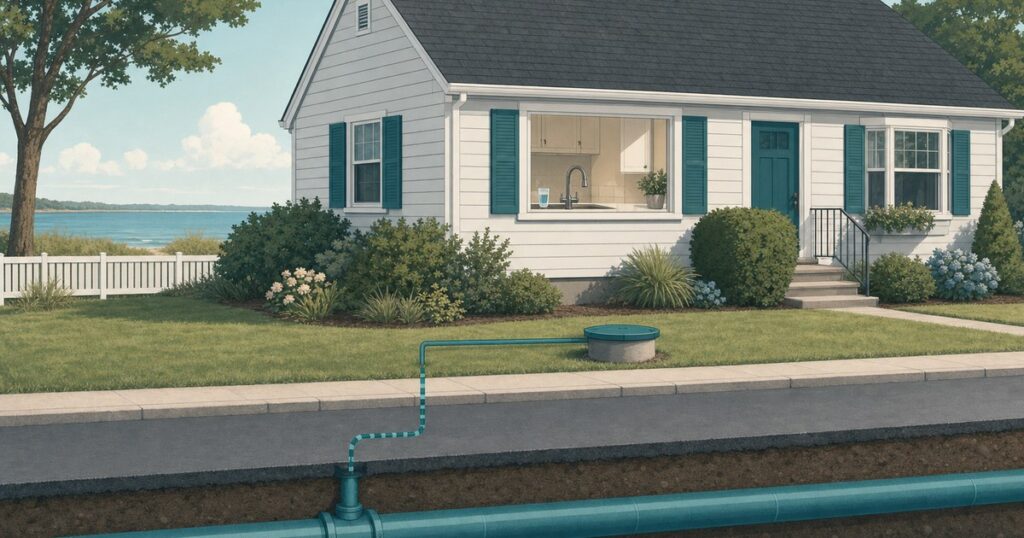
- Distribution transit: Water moves through mains, valves and service lines, where breaks and repairs can disturb sediment. SCWA’s distribution area map pages also note that a home near the boundary of a distribution area may receive water from the adjacent area on occasion.
- Home-level interaction: Your internal plumbing affects the final water at the tap. SCWA says its pH adjustment greatly reduces or eliminates the leaching of lead and copper from customers’ interior plumbing (2026 report, water treatment pages), but older homes can still have lead in pipes, solder or fixtures (EPA). SCWA’s lead and copper page lets you look up the identified service line material for your property.
How to Check Bay Shore’s Water
You don’t have to guess what is in Bay Shore’s public water. SCWA publishes the results:
- The annual report: Every public water supplier publishes an annual water quality report, also called a Consumer Confidence Report. SCWA’s 2026 report covers testing in 2025, when SCWA says it conducted 192,931 tests on 92,702 samples (letter to customers). Its “How to Read Your Water Quality Data” pages explain the tables: each detected compound, its likely source, the legal limit (MCL), the health goal (MCLG), and the low, high and average readings for the year. All reports are on SCWA’s water quality reports page.
- Your address: SCWA’s My Water Quality map lets you search an address and view testing results from the nearest sample station.
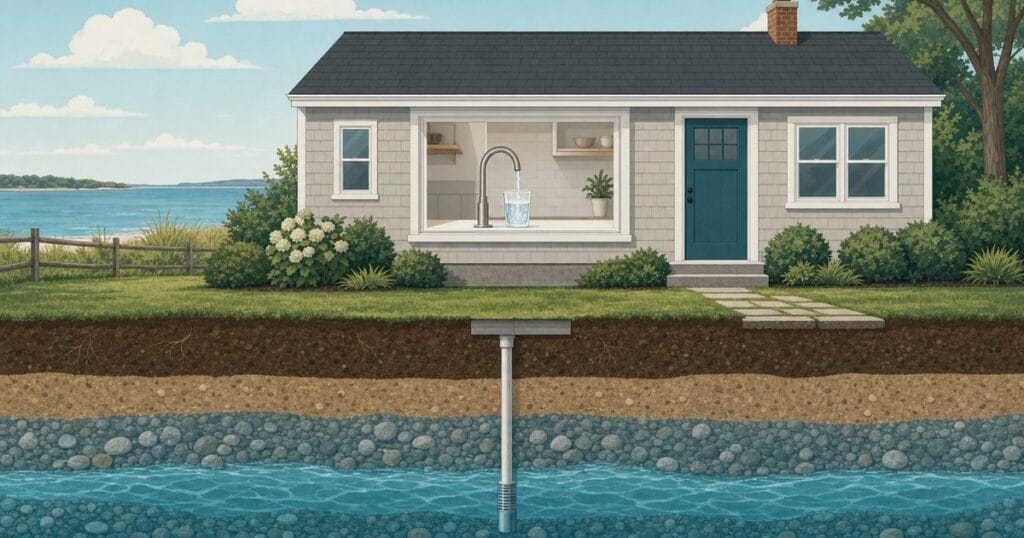
- Private wells: If your home uses a private well, testing it is your responsibility, because drinking water limits apply to public water systems; see the EPA’s private well guidance.
The Cost of Bottled Water Dependency
Bottled water can feel like a simple fix, but it covers only what you drink, the purchases add up over time, and single-use bottles add to plastic waste. It also does nothing for the water you shower, cook or wash with. Our post on Water Filters vs Bottled Water compares the options for Long Island homes.
Curious what’s in your water? Request a free in-home water test or call (631) 991-3995.
Our Approach: The pHountain Filtration System
- Whole-home coverage: The pHountain Filtration System is a whole-home (point-of-entry) system with a cartridge-free media design intended to reduce common impurities in tap water. It treats the water entering your home, so every tap is covered.
- Configured to your test: It is recommended after a free in-home water test. A whole-home system is configured around what testing finds. For any specific contaminant, ask for independent certification data (for example NSF/ANSI listings) for the exact system you are considering.
- Professional installation: The system is professionally installed at your main water entry point.
- 10-year guarantee: The installed system is backed by a 10-year guarantee.
Comparison of Water Solutions
| Feature | Bottled Water | Pitcher Filter | pHountain Filtration System |
|---|---|---|---|
| Cost | Ongoing purchases | Low upfront, plus replacement filters | Upfront system and installation |
| Whole-Home | No | No | Yes |
| Water covered | Drinking only | One pitcher at a time | Every tap, shower and appliance |
| Professional installation | No | No | Yes |
What Long Island Customers Say
You can read reviews that customers have left for pHountain Water Filtration on Google on our testimonials page.
Before You Invest in Filtration
- Read the latest SCWA report and look up your address on My Water Quality.
- Write down what you notice: taste, odor, cloudiness or staining, and when it happens.
- Test at your own tap. Measuring PFAS and 1,4-dioxane at the levels regulators use (parts per trillion and parts per billion) requires analysis by a certified laboratory; a free in-home water test is a starting point for understanding your water and your options.
- Get a quote for your home. Whole-home systems are quoted per home, after testing.
Frequently Asked Questions
How much does a whole house filter cost?
Costs vary with the home, the water and the configuration. pHountain quotes each whole-home installation after the free in-home water test, so the price reflects your home rather than a generic estimate.
How does SCWA treat its water for PFAS?
SCWA uses granular activated carbon filtration, described above; its 2026 report says it uses this GAC treatment to remove PFAS such as PFOA and PFOS, along with pesticides, herbicides and volatile organic compounds. SCWA’s June 22, 2026 Emerging Contaminants Action Plan update says that all wells with PFAS above the New York State limit are either treated or removed from service until treatment is installed, and that wells above the new federal limits are treated, out of service or blended to maintain lower levels.
Is Bay Shore tap water safe?
Public water suppliers such as SCWA must meet federal and state drinking water limits, and each publishes an annual water quality report showing what it tested for and what it found; the EPA explains how to find yours. SCWA’s report and its My Water Quality map show the results for the water that reaches your area. If your home is on a private well, testing it is your responsibility.
Do you offer free testing?
Yes. pHountain offers a free in-home water test, in which a specialist tests your water on-site.
For more on local coverage, see our Bay Shore service-area page. For SCWA’s treatment work in nearby Brentwood, see our post on the Brentwood SCWA well upgrade. When you’re ready, request a free in-home water test.
This blog is for informational purposes only and is not endorsed by or affiliated with any public water supplier or government agency. Water conditions and regulations can change; always consult your local water provider and a qualified water treatment professional for advice tailored to your home.
Sources
- Suffolk County Water Authority — Water Main Replacement Project Completed in Bay Shore (August 22, 2025)
- Suffolk County Water Authority — Major Water Main Replaced in Bay Shore to Reduce Main Breaks (October 31, 2023)
- Suffolk County Water Authority — As Deep Freeze Continues Across Long Island, Suffolk Water Authority Crews Repair More Than 200 Main Breaks Since December (January 29, 2026)
- Suffolk County Water Authority — Suffolk County Water Authority Achieves Full Compliance with Federal PFAS Standards (June 10, 2025)
- Suffolk County Water Authority — Emerging Contaminants Action Plan Monthly Update (June 22, 2026)
- Suffolk County Water Authority — Water Quality Reports
- SCWA 2026 Drinking Water Quality Report — letter to customers (page 1)
- SCWA 2026 Drinking Water Quality Report — Distribution Areas map (pages 2–3)
- SCWA 2026 Drinking Water Quality Report — How to Read Your Water Quality Data (pages 4–5)
- SCWA 2026 Drinking Water Quality Report — Statistics, Well Information and Water Treatment (pages 42–44)
- Suffolk County Water Authority — See My Water Quality
- Suffolk County Water Authority — Lead and Copper
- U.S. EPA — Per- and Polyfluoroalkyl Substances (PFAS)
- New York State Department of Health — Drinking Water Standards for PFAS and Other Emerging Contaminants
- U.S. EPA — Consumer Confidence Reports (annual water quality reports)
- U.S. EPA — Lead
- U.S. EPA — Private Drinking Water Wells