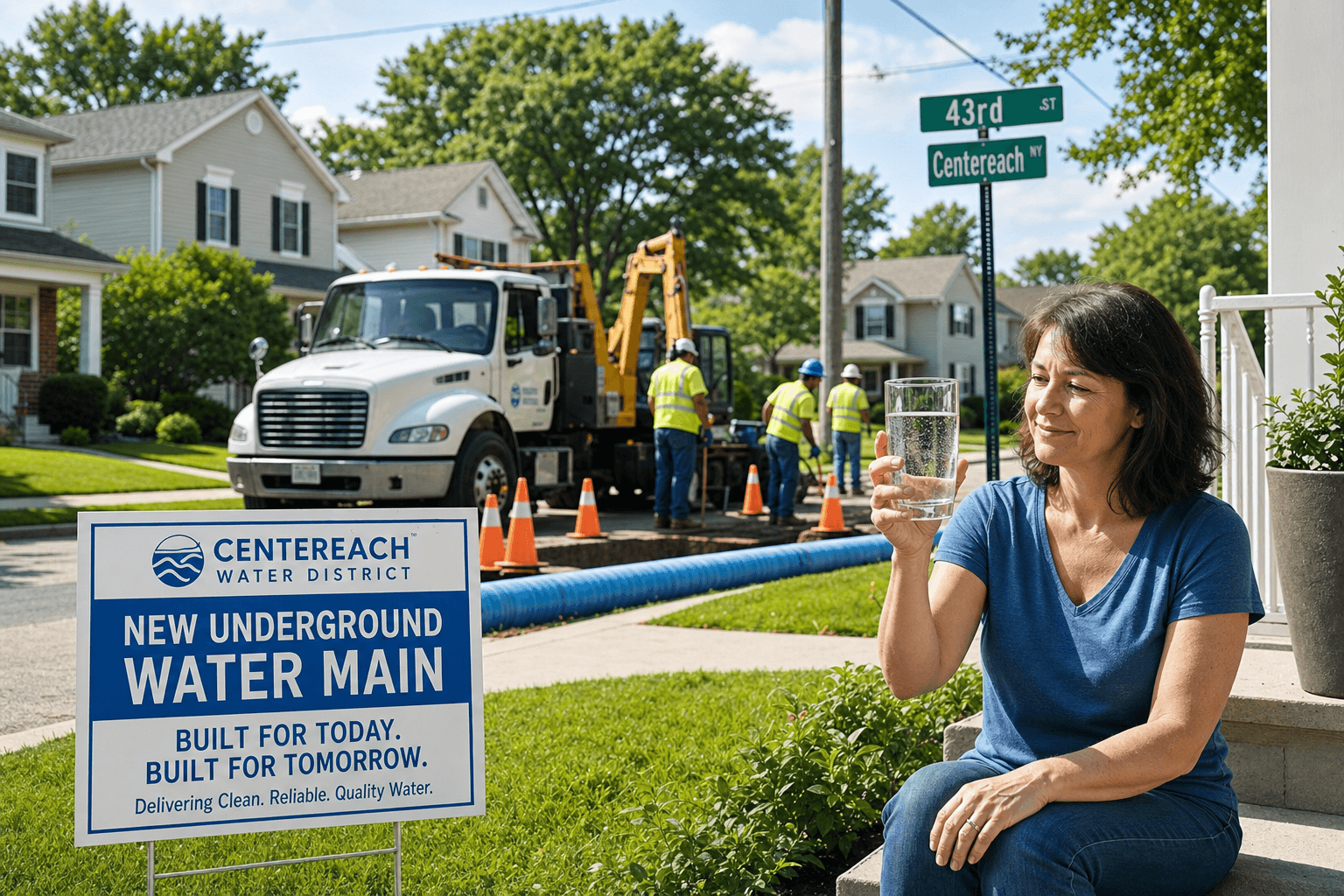
Centereach homeowners around 43rd Street and nearby blocks have been dealing with repeated water main breaks and, more recently, a water main replacement project. That combination naturally raises a big question:
Is your Centereach water quality still okay to drink, cook with, and bathe in?
This guide walks through what the recent main work means, how to check your home’s water step by step, and what options you have if you still feel uneasy about your tap water, even after repairs.
1. Implications of the 43rd Street Water Main Replacement on Centereach Water
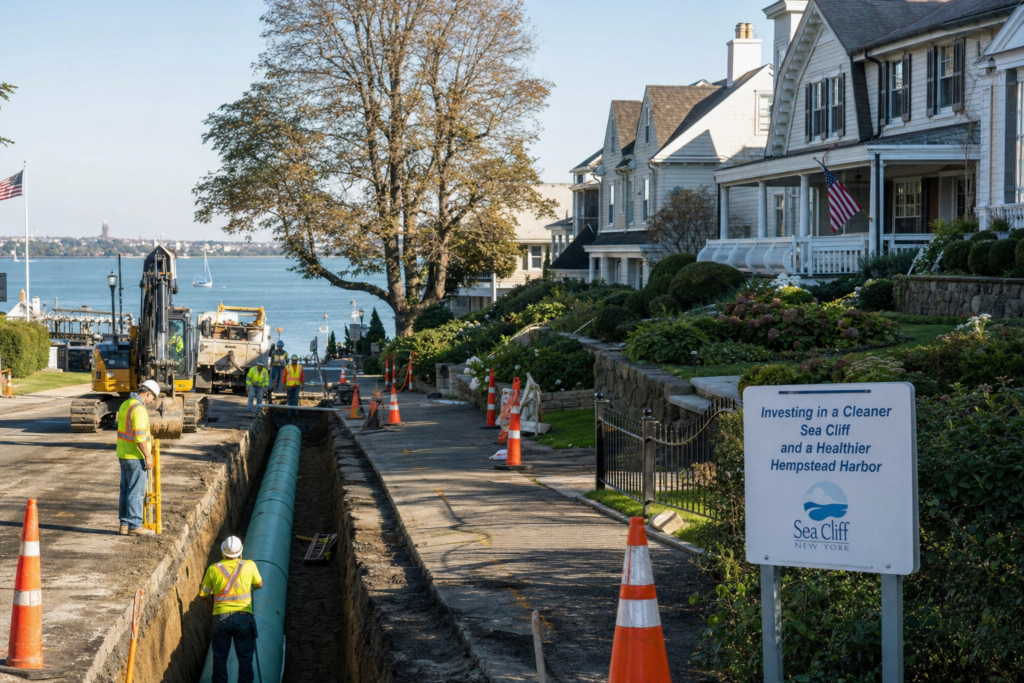
Local coverage reports that the aging water main in the Centereach area was replaced after experiencing numerous breaks along a several-thousand-foot stretch of pipe near 43rd Street and neighboring roads. Another article highlights that this upgrade is intended to improve reliability and modernize infrastructure for nearby homes.
Even without every technical detail, a few key points are clear.
1.1 The significance of multiple main breaks
When a water main breaks, several things can happen in the distribution system:
- Pressure drops: A sudden loss of pressure can allow outside water or soil to push toward the pipe opening before repairs are completed.
- Sediment disturbance: Rust, scale, and sediment inside older mains can be stirred up, leading to discoloration or particles at your tap once service is restored.
- Temporary advisories: Utilities sometimes issue boil-water advisories or flushing instructions after major breaks or repairs, depending on conditions and test results.
Local reporting notes that the Centereach main had multiple breaks before being replaced, which understandably led residents to worry about possible contamination risks associated with older infrastructure.(1)
1.2 Improvements targeted by the main replacement
According to coverage of the project, the new main was installed to replace an aging section that had been prone to breaks and service disruptions.(1)(2) While the articles do not list every specification, modern mains are generally designed to:
- Upgrade pipe materials compared with older cast-iron or aging lines
- Improve system reliability by lowering the likelihood of new breaks on that segment
- Support more consistent pressure for nearby homes
That said, distribution system upgrades do not change the fact that Centereach still relies on groundwater drawn from local aquifers, and that water can contain:
- Chlorine and treatment byproducts
- Sediment and minerals from pipes and plumbing
- Trace contaminants that meet regulatory limits but still concern many homeowners
So even after the main replacement, it’s reasonable to want a closer look at your home’s Centereach water quality.
2. Practical Steps to Assess Your Water After the Centereach Main Replacement
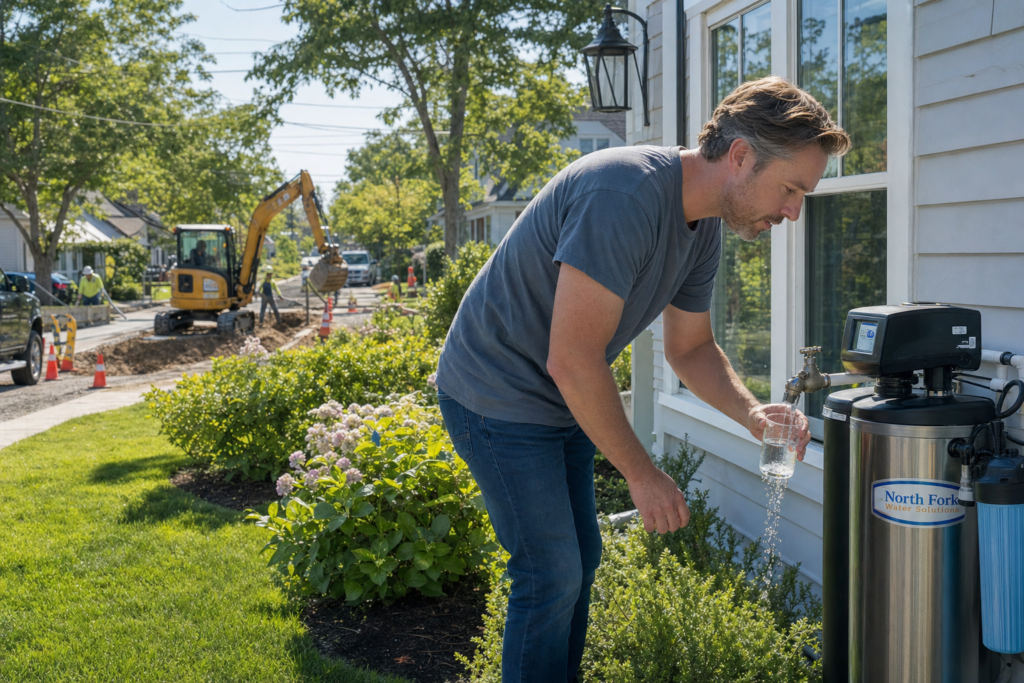
If you live near the Centereach main replacement zone, or if you experienced service interruptions during the project, you can walk through some practical checks at home.
2.1 Initial actions once water service resumes
Once water service is restored and any official advisories have been lifted, consider these steps:
- Run cold water taps:
- Start with a bathtub or laundry sink (no aerator) and run cold water for several minutes.
- This helps clear loose sediment and discolored water that may have collected in your service line.
- Check for discoloration:
- Look for brown, yellow, or orange water, especially at the start of flow.
- Mild discoloration that clears after a few minutes is often related to rust or sediment in the lines after work.
- Inspect aerators and screens:
- Unscrew faucet aerators and clean out grit or particles that can accumulate after line flushing.
- Sediment buildup can affect both flow and appearance.
- Smell the water:
- Note any strong chlorine odor, musty smell, or metallic scent.
- Changes in smell can indicate shifts in treatment levels or pipe deposits being disturbed.
If you see persistent discoloration, heavy sediment, or unusual smells that don’t clear after flushing, it’s worth digging deeper with more structured checks.
3. Common Visual and Sensory Signs of Water Quality Issues in Centereach Homes
While only lab testing can definitively characterize your water, there are common household signs that your Centereach water quality may not be where you want it.
3.1 What to observe at your faucets and fixtures
- Rusty or brown water:
- Often tied to iron or manganese from aging pipes or disturbed mains.
- You may see this after a main break or flushing event.
- Cloudy or milky water:
- Can be caused by air bubbles trapped in the system after repairs.
- If it clears from bottom to top in a glass within a minute or two, it’s usually air, not sediment.
- White or chalky buildup:
- Hard water deposits on faucets, shower doors, or glassware.
- Indicates mineral content that may be unaffected by main replacements.
- Persistent chlorine smell or taste:
- Utilities use disinfectants to safeguard against microbial contamination.
- Some homeowners find the taste and odor unpleasant, even when levels meet standards.
3.2 Notable changes observed following the 43rd Street main replacement
Because reports mention that numerous main breaks occurred before the Centereach main replacement, some residents noticed:
- Short-term discoloration after service came back
- Sediment in aerators or appliance filters
- Increased concern about what might have entered the system during breaks(1)(2)
If your water seemed fine before and suddenly looks, smells, or tastes different after the recent work, that’s a prompt to document what you’re seeing and consider testing.
4. Comparing Quick In-Home Checks with Laboratory Water Testing
There are two levels of evaluating Centereach water quality: DIY checks and professional or lab testing. Each serves a different purpose.
4.1 Insights you can gain from simple home observations
- Color and clarity:
- Fill a clear glass and hold it against a white background.
- Look for visible particles, haze, or color that persists after a few minutes.
- Odor after standing:
- Fill a glass and let it sit for 5–10 minutes.
- Some chlorine smell dissipates with time; persistent musty or chemical odors may warrant further investigation.
- Soap and cleaning performance:
- Hard water can make soap harder to lather and leave film on dishes or skin.
- Changes in how your water behaves can signal shifts in mineral content.
These checks are helpful for spotting obvious issues, but they do not quantify contaminants.
4.2 What you can discover through formal testing
A structured water test can screen for categories such as:
- Basic parameters: pH, hardness, iron, manganese, total dissolved solids
- Disinfectant and byproducts: Chlorine levels and certain regulated byproducts
- Metals and other contaminants: Depending on the panel, may include heavy metals and other substances of concern
pHountain Water Filters offers water quality testing and analysis for local homeowners, with results used to recommend customised water filtration systems when appropriate. If you’d like a professional to evaluate your Centereach tap, you can schedule a Free In-Home Water Test to gain a clearer picture of what’s in your water.
5. Real-Life Example: Handling Water Quality Concerns After Repeated Mains Breaks in Centereach
To illustrate how this can play out in real life, here’s a composite example based on situations our team encounters in Suffolk County.
5.1 The challenge: ongoing breaks and homeowner worry
A Centereach household located near the aging main that was replaced experienced:
- Repeated service interruptions as breaks occurred and repairs were made
- Brown, rusty water after some of those events
- Growing worry about possible contamination from older pipes and main breaks, even when official communication indicated the water met regulatory standards
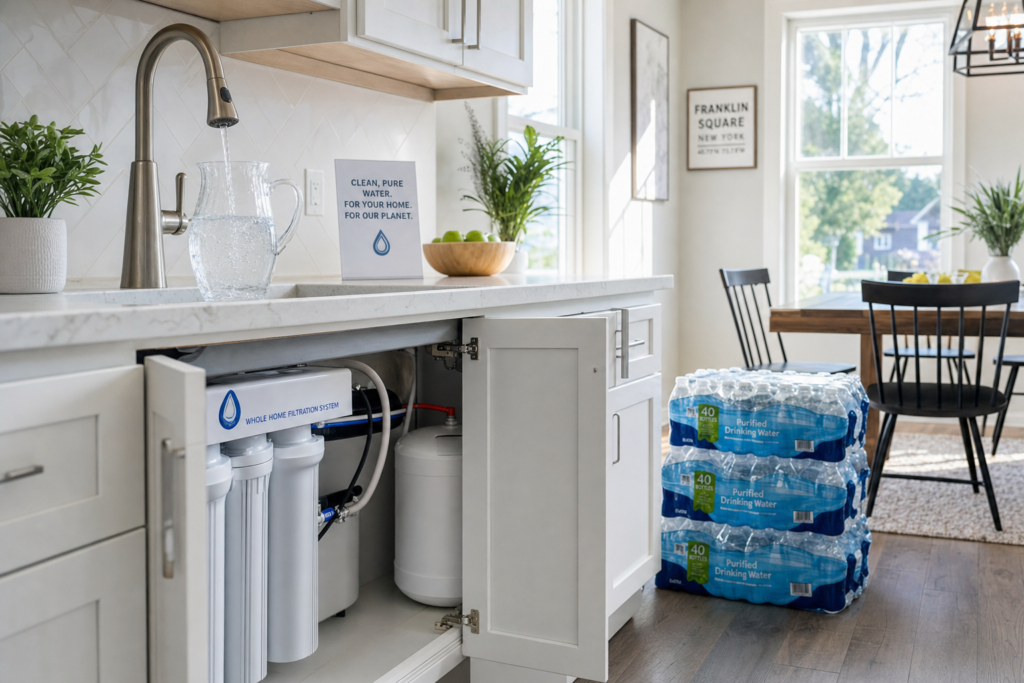
Over time, the family shifted heavily toward bottled water for drinking and cooking, adding a monthly expense and generating extra plastic waste.
5.2 Testing outcomes
When they contacted pHountain Water Filters, a water quality test was performed. The test:
- Identified sediment and mineral issues consistent with aging infrastructure
- Highlighted potential contamination risks that can be associated with older mains and repeated breaks, even when water is treated according to regulations
The family wanted a solution that would address every tap, not just a single faucet.
5.3 The chosen resolution: installing whole-home filtration
Based on the test results and the home’s plumbing layout, the family chose a pHountain pHresh Filtration System with Professional Installation. This whole-house system is designed to:
- Target impurities as water enters the home, so every faucet, shower, and appliance receives filtered water
- Address sediment and impurities associated with older mains and household plumbing
- Help reduce exposure to taste and odor issues, making tap water more appealing for drinking and cooking
After installation, the family reported:
- Using far less bottled water, saving an estimated $20 to $50 per month
- Greater peace of mind about water quality during and after future infrastructure work in their area
6. Deciding Between Waiting, Bottled Water, or Installing a Whole-House Filtration System
If you’re uneasy about Centereach water quality after the 43rd Street main replacement, you essentially have three paths.
6.1 Overview of common approaches and their pros and cons
| Option | Pros | Limitations |
|---|---|---|
| Do nothing and wait | No upfront cost; relies on utility safeguards | Ongoing uncertainty; no control at the home level |
| Buy bottled water | Easy to start; limited to drinking water | Ongoing cost; plastic waste; does not help showers or appliances |
| Whole-house filtration | Targets impurities for every tap in the home | Requires installation and upfront investment |
6.2 Why bottled water may only be a short-term solution
Many Centereach residents turn to bottled water after seeing discolored tap water from main breaks. While this can be understandable in the short term:
- It only covers drinking and sometimes cooking, not showers or dishwashing
- It can become expensive month after month
- It does nothing to address sediment, chlorine, or other contaminants affecting your plumbing and fixtures
If you’re weighing bottled water against filtration, the article Water Filters vs Bottled Water explores the long-term trade-offs in more depth.
6.3 Reasons to invest in whole-house filtration systems on Long Island
A whole-house filtration system is designed for a consistent line of defense at the point where water enters your home. With the pHountain pHresh Filtration System, Centereach homeowners can:
- Target impurities for all uses — drinking, cooking, bathing, laundry, and appliances
- Address sediment and impurities that become an issue after main breaks or flushing events
- Help reduce exposure to poor taste, clarity, and odor of tap water throughout the home
For residents in Centereach and surrounding communities, our Whole-Home Water Filtration for Suffolk County page explains how systems are tailored to local water conditions.
> Concerned about what repeated main breaks may have done to your Centereach tap water? Schedule a Free In-Home Water Test and get clear answers based on your own faucets, not just system-wide averages.
7. How pHountain Supports Centereach Residents Seeking Better Water Quality
If you decide you want a closer look at your Centereach water quality, pHountain Water Filters follows a straightforward process.
7.1 The journey from concern to clean water
- Request a consultation or water test
- Use the online form on our Contact Us page to share your concerns and location.
- On-site water evaluation
- A technician conducts water testing and analysis to understand your home’s specific water conditions.
- System recommendation
- Based on your test results, home size, and plumbing, we recommend an appropriate pHountain pHresh Filtration System or other configuration.
- Professional Installation
- Our team provides Professional Installation, integrating the system into your plumbing so filtered water reaches all designated fixtures.
- Education and support
- We explain how your system works, what it is designed to address, and how to keep it operating effectively.
- Ongoing maintenance and system support are available if you need assistance over time.
7.2 Rooted in local expertise: Suffolk County and neighboring towns
pHountain Water Filters works extensively with homeowners across Suffolk County, including nearby areas like Water Filtration Patchogue NY and Water Filtration Smithtown NY. That local focus helps us:
- Stay informed about infrastructure projects, such as the Centereach main replacement
- Understand common regional water issues, including sediment, minerals, and treatment byproducts
- Provide customised filtration systems that match local water profiles rather than one-size-fits-all setups
If you’re elsewhere on Long Island, our Water Filtration Long Island NY page outlines broader service coverage.
8. Answers to Common Questions About Centereach Water Quality Post-Main Replacement
8.1 I live near 43rd Street in Centereach. Should I still be worried about my tap water after the main was replaced?
Local news reports indicate that the main was replaced to address aging infrastructure and numerous prior breaks, and that the project is meant to improve reliability for nearby homes.(1)(2) That is positive from a system standpoint.
However, distribution system upgrades do not guarantee that water at your tap will match your personal standards for taste, odor, or perceived safety. If you experienced:
- Repeated discoloration
- Sediment in fixtures
- Or simply ongoing concern after the breaks
it’s reasonable to have your own in-home water test done to understand your specific conditions and decide whether additional filtration makes sense.
8.2 My water turned brown after service came back. Is that normal?
Temporary brown or rusty water after main work is a common complaint. It often stems from:
- Disturbed rust and sediment in mains and service lines
- Flushing operations that push accumulated deposits through the system
If the discoloration clears after several minutes of flushing and does not return, it may be an expected short-term effect. If it persists, or if you see grit, particles, or stains in fixtures and laundry, that’s a sign to:
- Document what you see (photos, dates, and times).
- Contact your water provider for guidance.
- Consider an independent water test to evaluate what’s in your tap water.
8.3 Does a new main mean I don’t need a home filtration system?
A new water main can improve reliability and reduce the risk of future breaks on that segment, which is valuable.(1)(2) But it doesn’t change:
- The source water, which still comes from local aquifers
- The use of disinfectants, which can affect taste and odor
- The possibility of sediment, minerals, and other contaminants entering your home through plumbing
Many Centereach homeowners choose whole-house filtration not because the utility is failing to meet regulations, but because they want greater control over water quality at the tap. If you want to evaluate whether a system is right for your home, you can start by scheduling a Free In-Home Water Test.
8.4 How can I confirm if my home was directly impacted by the 43rd Street main replacement?
The local articles reference main replacement work in the Centereach area, including the 43rd Street corridor, but they do not publish a detailed address list.(1)(2) To find out whether your specific home was directly tied into that main segment, you can:
- Review any notices or letters you received about water service interruptions or construction.
- Check local news updates describing the approximate project area.
- Contact your water provider and ask whether your address is connected to the upgraded main.
Regardless of whether you were on that exact segment, the same home-level checks and testing described in this guide can help you understand your current water quality.
> Want more control over your Centereach water quality instead of waiting for the next main break or system upgrade? Explore whole-house options and schedule your Free In-Home Water Test to get started.
This blog is for informational purposes only and does not constitute health, safety, or regulatory advice. Always follow official guidance from your local water utility and public health authorities, and consult qualified professionals for testing, interpretation of results, and decisions about water treatment for your home.
Water quality varies by location. Municipal water provided by SCWA achieved EPA compliance in June 2025. Private well owners should have water tested regularly. pHountain provides free water testing for Nassau and Suffolk County.