Key Points
- Groundwater is the sole source of freshwater supply in Nassau and Suffolk Counties (USGS).
- Public water suppliers must meet federal and state drinking water limits, including New York’s limits for PFOA, PFOS and 1,4-dioxane (NYSDOH).
- Your supplier’s annual water quality report shows what it tested for and found; the EPA explains how to find yours.
- Private wells are not covered by those limits, and testing is up to the owner (EPA).
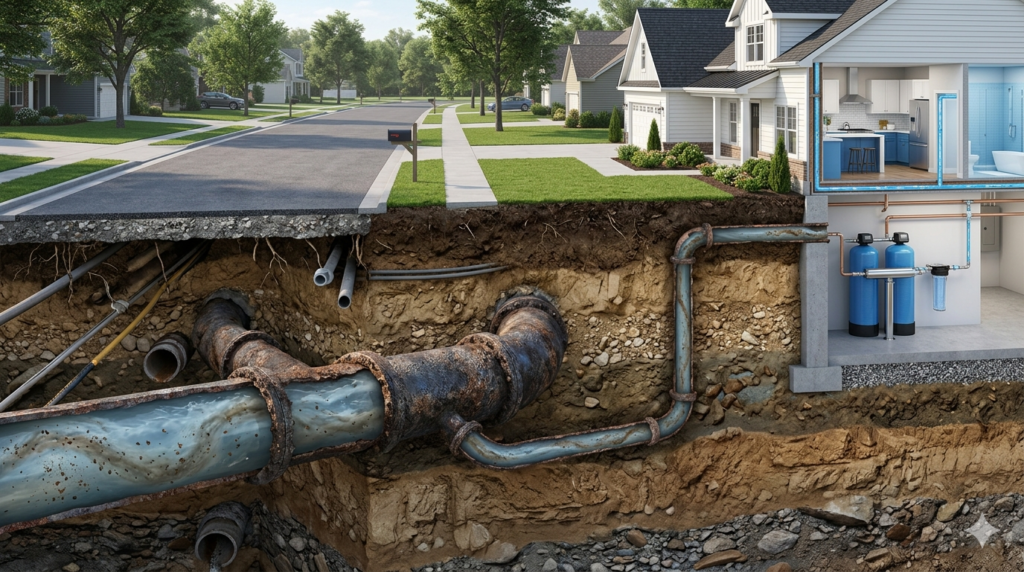
If you’ve noticed a change in your tap water, or seen water main work in your neighborhood, it’s natural to wonder what it means for your home. It’s easy to assume that once crews finish pipe upgrades nearby, any water questions are settled. Public water projects maintain the system that delivers water to your street, but what comes out of your kitchen faucet also depends on the service line and plumbing in your own house.
Your home is the final stop in a large network. This guide explains where Long Island’s drinking water comes from, what is regulated in 2026, how to read your water quality report, and what to check if you’re on a private well.
Where Long Island’s Water Comes From
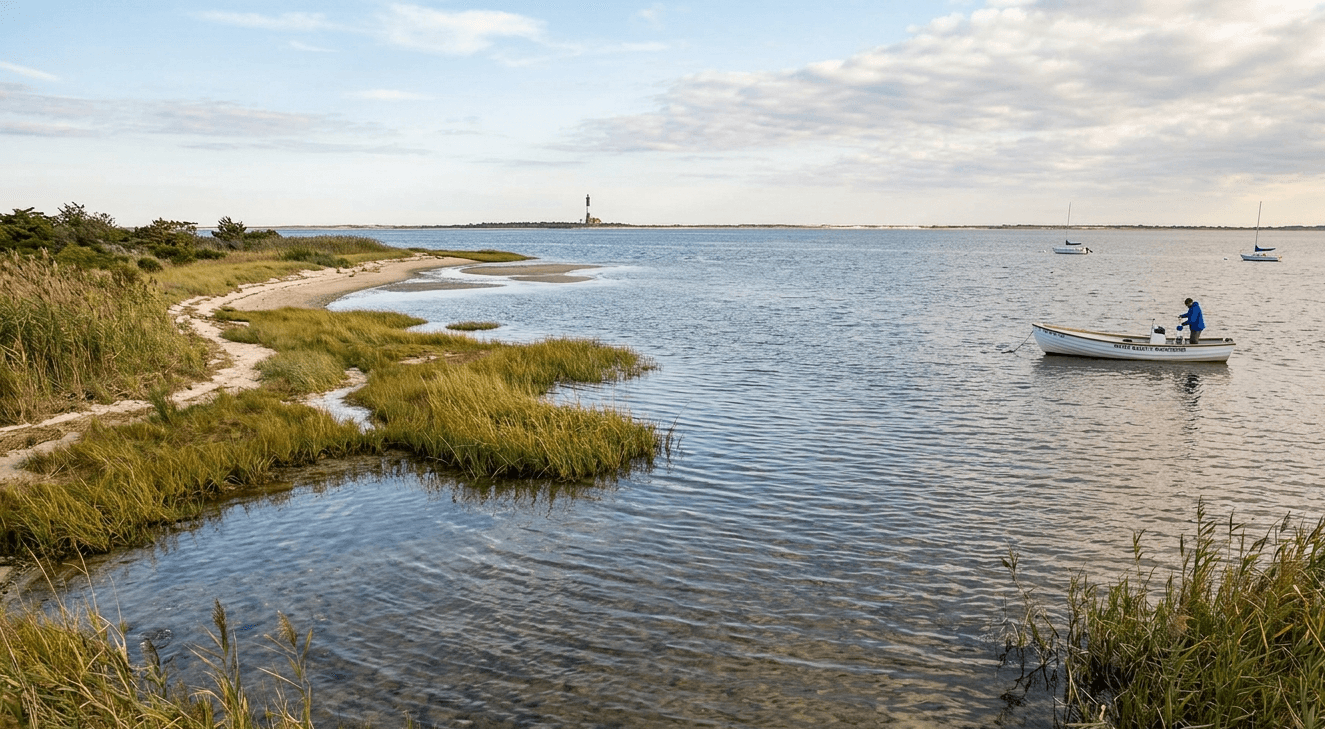
In a September 2021 fact sheet, USGS described the Long Island aquifer system as the sole source of drinking water for nearly 3 million people. Its three main aquifers, the upper glacial, Magothy and Lloyd, together make up a sole-source aquifer system, and groundwater is pumped from it by about 50 water suppliers in Nassau and Suffolk Counties.
EPA defines a sole source aquifer as one that supplies at least 50 percent of the drinking water for its service area, with no reasonably available alternative source should it become contaminated. Once an aquifer is designated, EPA reviews proposed projects in the area that receive federal funding, to make sure they do not contaminate it (EPA). The Suffolk County Department of Health Services describes the county’s groundwater as a federally designated Sole Source Aquifer system (SCDHS).
Because the same groundwater serves the whole region, what happens at the land surface matters. The same USGS fact sheet names nutrients, harmful algal blooms and synthetic chemicals such as PFAS and 1,4-dioxane as concerns for Long Island’s water, and says nutrients like nitrogen and phosphorus, used as fertilizers and released from domestic septic systems, are known to contaminate the aquifer system (USGS).
Nitrogen in Suffolk County
Suffolk County says nitrogen pollution from cesspools and septic systems has been identified as the largest single cause of degraded water quality, contributing to beach closures, shellfishing restrictions, toxic algae blooms and fish kills. It says a conventional septic system was never designed to remove nitrogen, and that even inland, nitrogen from septic systems will eventually reach the groundwater and surface waters. Its Septic Improvement Program, part of the Reclaim Our Water initiative, offers grants and low-interest financing toward systems that remove nitrogen (Suffolk County).
In drinking water, nitrogen is regulated as nitrate. EPA’s enforceable limit for nitrate (measured as nitrogen) in public water is 10 milligrams per liter. EPA lists runoff from fertilizer use and leaking septic tanks and sewage among its sources, and says infants below the age of six months who drink water containing nitrate above the limit could become seriously ill (EPA). That limit applies to public water systems; a private well owner has to test for nitrate themselves.
What Happens Between the Water Main and Your Tap
- Distribution distance: Water travels through mains, then your service line and your home’s plumbing, before it reaches the faucet. Each stage is a different set of pipes.
- Older plumbing: Lead can enter drinking water when plumbing materials that contain lead corrode. Lead pipes are more likely in older cities and in homes built before 1986, and in homes without lead service lines the most common problem is brass or chrome-plated brass faucets and plumbing with lead solder, according to EPA.
- Chemical disinfection: Water utilities add a disinfectant to tap water to kill germs. Chlorine or chloramine levels up to 4 milligrams per liter are considered safe in drinking water, and water containing chlorine can taste and smell different from untreated water, the CDC says.
- Construction nearby: If your home has a lead service line, EPA says you should be aware of nearby construction or maintenance work that could disturb it, because ground tremors from construction may suddenly cause more lead to be released (EPA). If your water looks discolored after work on the mains, contact your water supplier, which can tell you whether running your taps is recommended.
What’s Regulated in 2026: PFAS and 1,4-Dioxane
- New York’s limits: In 2020 New York set maximum contaminant levels of 10 parts per trillion (ppt) for PFOA and for PFOS and 1 part per billion (ppb) for 1,4-dioxane. New York was the first state to set a limit for 1,4-dioxane (NYSDOH).
- The federal rule: In April 2024 EPA set limits of 4.0 ppt for PFOA and for PFOS, plus limits for four other PFAS, with compliance due by 2029; until then, New York’s 10 ppt limits still apply (EPA; NYSDOH).
- Proposed changes: EPA’s May 18, 2026 proposals to let water systems request two more years, to 2031, to meet the PFOA and PFOS limits, and to rescind the other four limits, were still proposals when its extension and rescission pages were last updated, on October 8, 2026.
Public water systems in New York must monitor for more than 100 different contaminants on a regular schedule, including PFOA, PFOS and 1,4-dioxane, according to NYSDOH. For more on the PFAS rules, see our post How Do Long Island PFAS Limits in 2026 Affect My Home’s Water and our PFAS on Long Island guide.
How to Read Your Water Quality Report
Water systems are required to send customers an annual drinking water quality report, also called a Consumer Confidence Report (CCR), and EPA’s revised rule will make the reports easier to read starting in 2027 and will require systems serving over 10,000 customers to distribute them twice a year (EPA). You can find yours through EPA’s CCR page, or through New York’s Know Your NY Water tool, which NYSDOH says lets you find a large public water system near you and view its Annual Drinking Water Quality Report (NYSDOH). If you’re not sure who your supplier is, NYSDOH notes that its information is on your water bill.
When you open the report, look for:
- Your supplier and its sources: the name of the water system and the wells or sources it draws from.
- The detected contaminants table: each contaminant found, the level detected, the range across samples and the limit that applies.
- MCL versus MCLG: an MCL is the enforceable limit; an MCLG is a health-based goal that is not enforceable, as NYSDOH explains.
- Violations: whether the system exceeded a limit or missed required monitoring, and what it is doing about it.
- Lead information: how to reduce exposure from your home’s own plumbing.
- Sampling dates: reports summarize testing from the previous year, so check when results were collected.
If You’re on a Private Well
Private well owners are responsible for delivering safe drinking water to their households, and private wells are not regulated by the federal government under the Safe Drinking Water Act, according to EPA. EPA notes that around 15 percent of the U.S. population, more than 43 million people, rely on private wells, and that a USGS study of 2,100 private wells found water from about one in five contained at least one contaminant above a human-health benchmark.
In Suffolk County, private wells provide water to approximately 50,000 year-round and seasonal homes, and the County Department of Health Services has a testing program for existing homes with private wells. It says private wells in agricultural areas are particularly susceptible to impacts from agricultural chemicals, including fertilizers and pesticides (SCDHS).
For PFAS, New York State does not regulate private wells; NYSDOH uses the public drinking water standards as guidelines and says your local health department can advise on testing and results. PFAS tests are performed by a small number of certified laboratories and may range from $300 to $600 (NYSDOH). Our page on well water has more on private well concerns.
Where Bottled Water Fits
Bottled water can seem like a stop-gap when you lose confidence in your tap water. Bottled water is overseen by the FDA, which sets allowable levels for contaminants in bottled water when EPA sets levels for those same contaminants in drinking water, unless certain exceptions apply (FDA).
It covers the water you buy, not the water that flows from your taps. Our guide on water filters vs bottled water walks through the trade-offs.
Curious what’s in YOUR water? Request a free in-home water test or call (631) 991-3995.
Where the pHountain Filtration System Fits
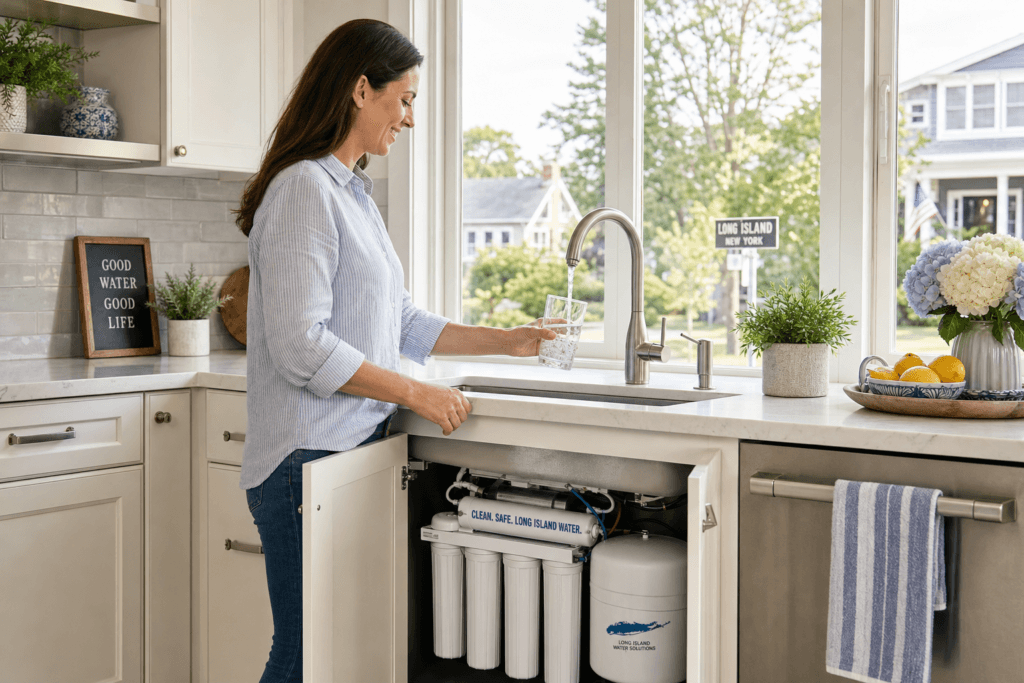
The pHountain Filtration System is a whole-home (point-of-entry) system with a cartridge-free media design intended to reduce common impurities in tap water. It treats your water where it enters your house.
- Whole-Home Coverage: Why filter only one faucet? Installed at the main water entry point, the system treats the water that reaches every shower, sink and appliance in your home.
- Configured Around Testing: A whole-home system is configured around what testing finds. For any specific contaminant, ask for independent certification data (for example NSF/ANSI listings) for the exact system you are considering.
- Installation and Guarantee: The system is professionally installed after a free in-home water test and backed by a 10-year guarantee.
Comparison Table: Common Options
| Feature | Bottled Water | Pitcher Filter | Whole-Home System |
|---|---|---|---|
| Coverage | Drinking only | Drinking only | Whole-home |
| Ongoing Upkeep | Repeat purchases | Regular cartridge changes | Service as recommended for the system |
| Convenience | Low (Heavy) | Low (Refills) | No refills or cases |
| What to Ask | Who bottled it and where | Certification for what you want to reduce | Certification data for the exact system |
| Environmental | Single-use plastic | Used cartridges | One installed system |
What Long Island Customers Say
You can read reviews that customers have left for pHountain Water Filtration on Google on our testimonials page.
Before You Choose a Treatment System
- Read your water quality report to see what your supplier has already measured.
- Test at your tap: Measuring PFAS and 1,4-dioxane at the levels regulators use (parts per trillion and parts per billion) requires analysis by a certified laboratory; a free in-home water test is a starting point for understanding your water and your options.
- Check your plumbing for lead: Ask your water utility whether your service line is lead, or have a licensed plumber check, as EPA suggests.
- Ask about upkeep: EPA notes that filters are only effective if they are maintained according to the manufacturer’s instructions (EPA).
About pHountain Water Filters
pHountain Water Filters serves Long Island: Nassau and Suffolk counties. You can find our office on our Islip location page. We offer a free in-home water test, recommend a system based on what testing finds, and provide professional installation backed by a 10-year guarantee.
Common Questions
How much does a whole house filter cost on Long Island?
Costs vary based on your home size and what your water test finds. A quote for your home follows the free in-home water test.
How do I find out whether my water has PFAS?
On public water, check your annual water quality report and ask your supplier; EPA notes that many public water systems already have PFAS test results (EPA). On a private well, see the private well section above.
Is Long Island tap water safe in 2026?
Public water suppliers on Long Island must meet federal and state drinking water limits, and they publish an annual water quality report showing what they tested for and found; the EPA explains how to find yours. Meeting those limits and how your water tastes or smells are separate questions. If your home is on a private well, testing your water is your responsibility.
What is the difference between a filter and a traditional water softener?
A traditional water softener is designed to address hardness minerals such as calcium and magnesium, and many use salt. A whole-home filtration system treats water at the point of entry for other concerns, depending on its media. Which one fits depends on what testing finds.
Why do I still have sediment after pipe work?
If you notice sediment or discolored water after work on the mains, contact your water supplier first; it can tell you whether running your taps is recommended. If your home has a lead service line, EPA advises paying attention to nearby construction that could disturb it (EPA). If the problem continues, a water test can show what is in the water at your tap.
Ready to Learn What’s in Your Long Island Water?
Book your free in-home water test on our Free In-Home Water Test page.
This blog is for informational purposes only and does not guarantee specific water quality outcomes. Water conditions and regulations can change; always consult your local water provider and a qualified water treatment professional for advice tailored to your home.
Sources
- U.S. Geological Survey, “Managing Water Resources on Long Island, New York, with Integrated, Multidisciplinary Science,” Fact Sheet 2021-3044 (September 2021): https://pubs.usgs.gov/fs/2021/3044/fs20213044.pdf
- U.S. Geological Survey, “Long Island Groundwater”: https://www.usgs.gov/centers/ny-water/science/long-island-groundwater
- U.S. EPA, “Overview of the Drinking Water Sole Source Aquifer Program”: https://www.epa.gov/dwssa/overview-drinking-water-sole-source-aquifer-program
- Suffolk County Department of Health Services, Private Well Water Testing: https://www.suffolkcountyny.gov/Departments/Health-Services/Environmental-Quality/Water-Resources/Private-Well-Water-Testing
- Suffolk County, Reclaim Our Water Initiative and Septic Improvement Program: https://suffolkcountyny.gov/Departments/Planning/Special-Projects/RFEI-Innovative-Alternative-Septic-Systems
- U.S. EPA, National Primary Drinking Water Regulations: https://www.epa.gov/ground-water-and-drinking-water/national-primary-drinking-water-regulations
- U.S. EPA, “Basic Information about Lead in Drinking Water”: https://www.epa.gov/ground-water-and-drinking-water/basic-information-about-lead-drinking-water
- CDC, “About Water Disinfection with Chlorine and Chloramine” (February 14, 2024): https://www.cdc.gov/drinking-water/about/about-water-disinfection-with-chlorine-and-chloramine.html
- New York State Department of Health, “Public Water Systems and Drinking Water Standards for PFAS and Other Emerging Contaminants”: https://www.health.ny.gov/environmental/water/drinking/emerging_pfas_publicwater.htm
- New York State Department of Health, “PFAS and Private Wells”: https://www.health.ny.gov/environmental/water/drinking/pfasinprivatewells.htm
- U.S. EPA, “Per- and Polyfluoroalkyl Substances (PFAS)”: https://www.epa.gov/sdwa/and-polyfluoroalkyl-substances-pfas
- U.S. EPA, “Proposed PFOA and PFOS Compliance Extension Rule”: https://www.epa.gov/sdwa/proposed-pfoa-and-pfos-compliance-extension-rule
- U.S. EPA, “Proposed PFAS Rescission Rule”: https://www.epa.gov/sdwa/proposed-pfas-rescission-rule
- U.S. EPA, Consumer Confidence Reports: https://www.epa.gov/ccr, and “Consumer Confidence Report Rule Revisions”: https://www.epa.gov/ground-water-and-drinking-water/consumer-confidence-report-rule-revisions
- New York State, Know Your NY Water: https://water.ny.gov/
- U.S. EPA, Private Drinking Water Wells: https://www.epa.gov/privatewells
- U.S. EPA, “Reducing PFAS in Your Drinking Water with a Home Filter” (April 2024): https://www.epa.gov/system/files/documents/2024-04/water-filter-fact-sheet.pdf
- U.S. FDA, “Per- and Polyfluoroalkyl Substances (PFAS)”: https://www.fda.gov/food/environmental-contaminants-food/and-polyfluoroalkyl-substances-pfas