On Long Island, as anywhere, water quality is easy to overlook until the taste, smell or clarity of the tap water changes. Across Nassau and Suffolk counties, including the Huntington area, public water suppliers are continually maintaining their systems: they flush water mains, replace aging pipe and add treatment at well sites. These improvements support the local water system, and some of them can briefly change what comes out of your tap.
Whether you rely on public water or a private well, understanding how this work can show up at home, and what suppliers advise when it does, is the first step toward knowing what is flowing through your pipes. This guide draws on what Long Island water suppliers and the New York State Department of Health publish.
What a Well Upgrade Usually Involves on Long Island
Long Island’s public water comes from wells, so “well upgrades” covers a lot of ground. The work this guide covers falls into three groups: new treatment at well sites, water main and service work, and routine maintenance such as hydrant flushing.
New Treatment for Emerging Contaminants
Much of the recent well-site construction follows new drinking water rules. New York set limits of 10 parts per trillion (ppt) for PFOA and PFOS and 1 part per billion (ppb) for 1,4-dioxane in 2020, according to the New York State Department of Health. In April 2024, the U.S. Environmental Protection Agency finalized national limits of 4.0 ppt each for PFOA and PFOS, with compliance required by 2029. In May 2026, EPA proposed letting systems request two more years (to 2031) for PFOA and PFOS and proposed rescinding its limits for PFHxS, PFNA, GenX and certain PFAS mixtures; those proposals were not final as of September 2026.
In the Town of Huntington, the Suffolk County Water Authority (SCWA) announced on September 13, 2024 that two new Advanced Oxidation Process (AOP) systems had been put into service to remove 1,4-dioxane from two public supply wells on Middleville Road in Northport. SCWA said that before the systems were in place it restricted the operation of impacted wells to minimize the public’s exposure, that one of the two wells had been out of service since September 2020 due to elevated levels of 1,4-dioxane, and that with treatment in place the wells returned to regular service, restoring capacity to the system (SCWA, September 13, 2024).
SCWA describes the process this way: a small amount of hydrogen peroxide is added to the water, which passes through an ultraviolet light reactor that breaks apart 1,4-dioxane molecules, and the water then flows through two granular activated carbon (GAC) vessels where remaining traces of the oxidant and other volatile organic compounds are removed. In its September 22, 2025 announcement of two more AOP systems at its Old Dock Road well field in Kings Park, SCWA said it had 19 of these systems in place and that the AOP-GAC combination is the only method approved by state and local health departments to remove 1,4-dioxane (SCWA, September 22, 2025).
Nassau suppliers are doing similar work. The Manhasset-Lakeville Water District reports that in 2025 it installed new GAC vessels at its Eden well station to remove PFAS, and that construction of a new treatment plant for Campbell Well #1 is underway (MLWD 2025 Water Quality Report). Our post on water safety in Manhasset covers that district in more detail.
Keeping Water Flowing While Treatment Is Built
Building treatment can mean running a system differently for a while. In an August 31, 2023 public notice, Liberty New York Water said it was constructing an AOP treatment facility at its Seamans Neck Road plant in its Merrick district to remove 1,4-dioxane from two wells, that it would build two booster pumping stations to sustain water pressure for nearby customers during construction, and that it would operate the affected wells in a “last on, first off” sequence to minimize their use. The notice was issued because testing had found 1,4-dioxane above New York’s 1 ppb limit in those two wells, and the state health department had conditionally granted Liberty an exemption from that limit, with mandatory compliance strategies; it said the water continued to be acceptable for all uses (Liberty New York Water notice).
Because many systems draw on several wells, a well going offline for construction, or returning to service afterward, changes the mix of sources feeding the system. The Manhasset-Lakeville Water District, for example, says the water delivered to your tap is a blend of water produced by its individual wells (MLWD report).
Understanding the Impact of Local Infrastructure Shifts
The change homeowners are most likely to notice comes from work on the pipes. When a supplier flushes hydrants or works on mains, the flow in the pipes changes and can stir up sediment that has settled inside them. SCWA says flushing operations close to your home may be responsible for temporary lower water pressure, discolored water and/or water collecting in the street, and that rusty or discolored water is a result of natural iron and other solid matter being stirred up; it says this is not harmful to your health and typically lasts only for the day the work is conducted (SCWA maintenance announcements).
Suppliers flush on purpose. SCWA says its flushing program opens fire hydrants to remove sediments that may have collected within its pipes, and lets it check that hydrants function properly and that a sufficient water supply is available for fire protection; its site has a real-time flushing map where you can look up your address (SCWA). In Nassau, the Village of Freeport’s annual report lists well and water main flushing among the uses of its unbilled water (Village of Freeport 2025 report); see our post on understanding your home’s water in Freeport.
Cloudy, milky water usually has a different cause. SCWA says milky or cloudy water is almost always caused by harmless trapped air: changes in temperature or pressure in the main create micro-bubbles that make the water look white. Its test is to fill a clear glass and watch it for two minutes; if it clears from the bottom upward, it is just trapped air (SCWA, Report a Water Quality Issue).
Why Your Pipes Are More Than Just Conduits
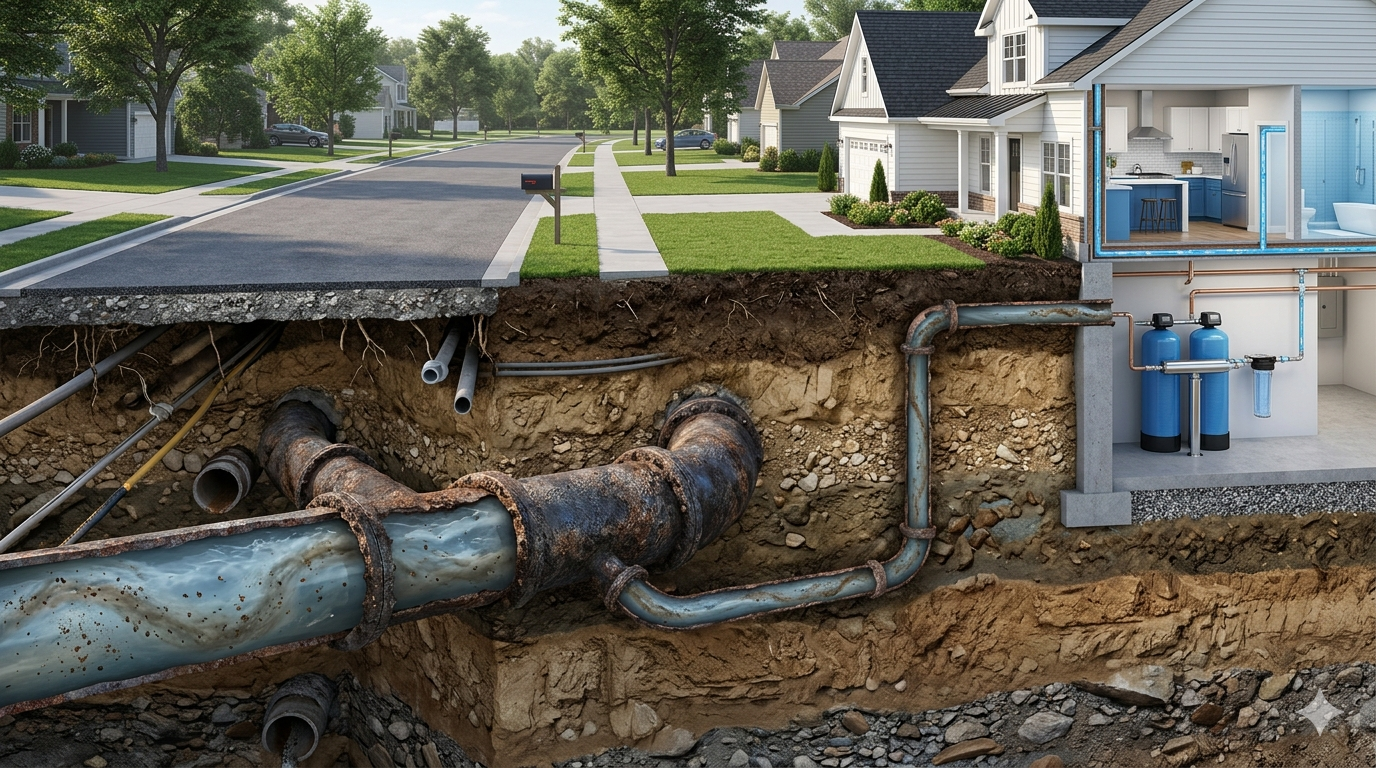
Many residents assume that if water is treated at the source, it reaches the tap in the same state. But the journey from the well to your kitchen faucet runs through water mains, then your service line, then your home’s own plumbing. SCWA notes that during routine main flushing, natural sediment can occasionally enter a service line, and that running your cold water flushes it out. It also points out that it supplies only cold water to your property: if only your hot water is discolored, the issue is inside your water heater, often sediment buildup, and a plumber can flush the tank (SCWA).
EPA describes sediments as loose deposits in the distribution system or home plumbing, and lists rusty color, sediment, metallic taste and reddish or orange staining as the noticeable effects of iron above its 0.3 mg/L guideline, which it treats as an aesthetic standard (EPA, secondary drinking water standards).
What to Do If Your Water Is Discolored After Nearby Work
- Check hot versus cold. Run each separately. If only the hot water is discolored, SCWA says the issue is in your water heater (SCWA).
- Run the cold water. SCWA’s online troubleshooting tool has you use a faucet without a screen or aerator, such as a bathtub or outdoor spigot, and run the cold water only, on full, with a five-minute timer (SCWA). The Riverhead Water District recommends starting with one cold outlet, then opening the other cold faucets until the water runs clean, which it says usually takes 15 to 20 minutes of continuous running (Riverhead Water District).
- Leave the hot water off. Riverhead advises against turning on the hot water so discolored water does not enter your water heater (Riverhead Water District).
- Hold off on laundry. Make sure the cold water is clean before running the washing machine. If clothes are stained, both SCWA and Riverhead suggest rewashing with more detergent and a rust remover, and advise against bleaching them or putting them in the dryer (SCWA; Riverhead Water District).
- Call your supplier if it does not clear. For illness, petroleum or strong chemical odors, SCWA asks customers to call rather than use its online form, because those reports require an immediate dispatch (SCWA).
When Pipe Work Leads to a Boil Water Notice
A loss of pressure is more serious than discoloration. The New York State Department of Health says boil water notices are typically issued when an unexpected condition has caused a potential for biological contamination of a public water system; common reasons include loss of pressure in the distribution system and loss of disinfection, often resulting from events such as water line breaks, treatment disruptions, power outages and floods. Its instructions are to bring water to a full rolling boil for one minute, then let it cool before use (NYSDOH, Boil Water Notices FAQ).
Do not rely on a home filter during a boil water notice. NYSDOH says it does not encourage residents to rely on home treatment units, because most in-home treatment devices are not designed to remove pathogens; it lists carbon filters, water softeners and other ion exchange units, sediment filters, chlorine removers and aerators among the devices with limited or no ability to remove them. When a notice is lifted, it advises running all cold water faucets on full for at least five minutes each, flushing ice makers, running enough water through water heaters and other appliances to replace their contents, and replacing disposable filters such as carbon filters (NYSDOH).
The Case for Whole-House Filtration
When people talk about water quality, many think of a small pitcher filter in the refrigerator. That treats some of your drinking water, but not the water used for bathing, cooking and your appliances.
The pHountain Filtration System
The pHountain Filtration System is a whole-home (point-of-entry) system with a cartridge-free media design intended to reduce common impurities in tap water. Because it is installed at the main entry point of your home, the water you use to fill a glass, rinse vegetables or take a shower all passes through it. That matters for:
- Bathing: showers and baths use the same tap water as the kitchen sink.
- Cooking: the water you boil pasta in or wash produce with comes from the tap.
- Appliances: water heaters, dishwashers and washing machines all draw on the same supply.
A whole-home system is configured around what testing finds. For any specific contaminant, ask for independent certification data (for example NSF/ANSI listings) for the exact system you are considering.
Addressing Contaminants: Beyond the Visible
It is a common misconception that if water looks clear, it is clean. Many of the substances suppliers test for cannot be seen, smelled or tasted, which is why public suppliers test their water and publish the results every year in an annual water quality report, also called a Consumer Confidence Report (EPA). The report lists what was detected, the legal limit, and the likely source.
Reports also describe the treatment each system uses, and they show that treatment differs from place to place. The Manhasset-Lakeville Water District says it removes volatile organic chemicals using air stripping or carbon filtration and removes nitrate from two wells through ion exchange (MLWD). The Village of Freeport describes disinfection, pH adjustment, iron sequestering and corrosion control to reduce metals leaching from household plumbing (Village of Freeport). In Suffolk, SCWA uses AOP followed by GAC for 1,4-dioxane, as described above.
Older homes have one more consideration. Both the Manhasset-Lakeville and Freeport reports say lead in drinking water is primarily from materials and parts used in service lines and home plumbing. EPA’s lead page has more on lead in drinking water.
The Professional Approach: Testing, Customization, and Installation
Water quality is not universal. The water in one Long Island home can differ from a neighbor’s, depending on the age of the plumbing and service line, and on whether the home is on public water or a private well. That is why pHountain Water Filters starts with a consultation and a test.
Step 1: In-Home Water Quality Evaluation
You cannot solve a problem you have not identified. Request a Free In-Home Water Test, and a pHountain specialist will come to your home and test your water on-site. Measuring PFAS and 1,4-dioxane at the levels regulators use (parts per trillion and parts per billion) requires analysis by a certified laboratory; a free in-home water test is a starting point for understanding your water and your options.
Step 2: Customized System Recommendation
We do not pull a generic filter off the shelf. The recommendation takes into account your home’s plumbing, the size of your household, how you use water and what the test shows, and you will know what the system involves before you commit.
Step 3: Professional Installation
Whole-home systems are professionally installed at your home’s main water line and backed by a 10-year guarantee.
Considering Whole-Home Filtration on Long Island
Some households turn to bottled water for drinking. It covers only what you drink, and buying, hauling and recycling the bottles adds up. Our page on Water Filters vs Bottled Water compares the two for Long Island homeowners.
Local Service Across Long Island
pHountain Water Filters is a local company serving homeowners across Long Island, in Nassau and Suffolk counties. It offers a free in-home water test, recommendations based on what testing finds, professional installation and a 10-year guarantee. See our Water Filtration Long Island NY page, or our Huntington service area page if you live in that area.
Maintenance Expectations
Every filtration system needs some upkeep. Before you commit, ask what maintenance the recommended configuration requires and how often, so you know what to expect over time.
If Your Home Is on a Private Well
Public-supply upgrades do not change a private well. Federal and state drinking water limits apply to public water systems, not private wells, and private well owners are responsible for testing their own water (EPA, Private Drinking Water Wells). In Suffolk, the Suffolk County Department of Health Services publishes private well water testing guidance. Some upgrade work reaches private-well neighborhoods directly: SCWA said in September 2025 that since 2019 it has been awarded $78 million through the state’s Water Infrastructure Improvement Act to support treatment for 1,4-dioxane and PFAS and to extend water main to communities on private wells impacted by these contaminants (SCWA). Our well water page has more for private well owners.
Preparing Your Home for the Future
Infrastructure is never static. As Long Island communities grow and drinking water standards change, the systems that supply our water will continue to be upgraded and maintained. A few habits help you keep up:
- Read your supplier’s annual water quality report each year; EPA explains how to find it.
- Watch for work notices. SCWA posts its flushing schedule and a real-time flushing map (SCWA); Nassau suppliers describe planned main and treatment work in their annual reports, and some offer alerts, such as the Village of Freeport’s CivicReady system (Village of Freeport).
- Clean faucet aerators from time to time, since loose sediment can collect in the screens.
- Know what your service line is made of. Under the federal Lead and Copper Rule Revisions, suppliers such as the Village of Freeport have prepared lead service line inventories, and Freeport will email or mail a copy on request (Village of Freeport).
Take Control of Your Water
A change in taste or a notice about local well work is a good prompt to learn more about your water. Whether you are curious about the current state of your tap water or ready to explore a whole-house filtration system, pHountain Water Filters serves homeowners across Long Island.
Start with a Free In-Home Water Test to see what is in your water and what your options are.
This blog is for informational purposes only and does not guarantee specific water quality outcomes. Water conditions and regulations can change; always consult your local water provider and a qualified water treatment professional for advice tailored to your home.
Sources
- Suffolk County Water Authority, “Two New Advanced Treatment Systems Added to Suffolk County Water Authority System” (September 13, 2024): https://www.scwa.com/two-new-advanced-treatment-systems-added-to-suffolk-county-water-authority-system/
- Suffolk County Water Authority, “Suffolk County Water Authority Brings Two New Advanced Treatment Systems Online in Kings Park” (September 22, 2025): https://www.scwa.com/suffolk-county-water-authority-brings-two-new-advanced-treatment-systems-online-in-kings-park/
- Suffolk County Water Authority, Maintenance Announcements: https://www.scwa.com/water-customers/water-updates/maintenance-announcements
- Suffolk County Water Authority, Report a Water Quality Issue: https://www.scwa.com/water-customers/customer-service/report-a-water-quality-issue/
- Riverhead Water District, Recommended Flushing Procedure for Cold Water Lines: https://www.townofriverheadny.gov/DocumentCenter/View/1249/Recommended-Flushing-Procedure-For-Cold-Water-Lines-PDF
- Liberty New York Water, Merrick Operations District, public notice (August 31, 2023): https://new-york-water.libertyutilities.com/uploads/Exemption%20PN%20Liberty%20New%20York%20Water%20Merrick%20-%20Liberty%209.11.23_updated.pdf
- Manhasset-Lakeville Water District, 2025 Water Quality Report: https://www.mlwd.net/pdf/2025%20WaterQualityReport.pdf
- Village of Freeport Water Department, Annual Water Quality Report (March 2026): https://www.freeportny.gov/DocumentCenter/View/14949/2025-Annual-Water-Quality-Report
- New York State Department of Health, Boil Water Notices: Frequently Asked Questions for Residents and Homeowners: https://www.health.ny.gov/environmental/water/drinking/boilwater/faq_residents_and_homeowners.htm
- New York State Department of Health, Drinking Water Standards for PFAS and Other Emerging Contaminants: https://www.health.ny.gov/environmental/water/drinking/emerging_pfas_publicwater.htm
- U.S. EPA, Per- and Polyfluoroalkyl Substances (PFAS): https://www.epa.gov/sdwa/and-polyfluoroalkyl-substances-pfas
- U.S. EPA, Secondary Drinking Water Standards: Guidance for Nuisance Chemicals: https://www.epa.gov/sdwa/secondary-drinking-water-standards-guidance-nuisance-chemicals
- U.S. EPA, Consumer Confidence Reports: https://www.epa.gov/ccr
- U.S. EPA, Lead: https://www.epa.gov/lead
- U.S. EPA, Private Drinking Water Wells: https://www.epa.gov/privatewells
- Suffolk County Department of Health Services, Private Well Water Testing: https://www.suffolkcountyny.gov/Departments/Health-Services/Environmental-Quality/Water-Resources/Private-Well-Water-Testing