
For homeowners on Long Island, including the community of Freeport, water is easy to take for granted. We turn the tap, and it flows. But as water mains age and the rules for public water change, it is reasonable to ask what exactly is coming through your pipes. Whether you are curious about the age of local plumbing or the chemicals used to treat the water supply, a proactive look at your home’s water is a sensible step.
Much of the answer is public. This guide walks through what the Village of Freeport Water Department publishes about its water, how to read its annual report, and the practical options available for your home. pHountain Water Filters serves homeowners across Long Island, including Freeport and the rest of Nassau County.
Where Freeport’s Water Comes From
Homes in the Incorporated Village of Freeport are served by the Village of Freeport Water Department. According to the Village’s Annual Water Quality Report dated March 2026, which covers 2025, the Village’s water is groundwater pumped from 11 wells at three well fields drilled into the Magothy aquifer to a depth of 500 to 700 feet, and the report describes the aquifer’s water quality as generally good to excellent. The Village has two elevated storage tanks with a capacity of 1.5 million gallons and, the report says, did not experience any water shortages or water pressure issues in 2025.
The same report says the system serves an official population of 44,472 full-time residents (2020 Census) through 10,200 metered service connections, with 126.4 miles of water mains in an area of 4.93 square miles within the village boundaries. If your home is outside the village boundaries, your public water supplier may be a different one; your water bill names it.
Understanding What’s in Freeport’s Water Before and After Treatment
Before any treatment, groundwater can pick up substances from what happens on the land above it. The New York State Department of Health, with assistance from the local health department, completed a source water assessment for Freeport’s system that rated most of the wells as having a very high susceptibility to industrial solvents and nitrates, according to the Village’s report. The report attributes the solvent rating primarily to point sources of contamination related to transportation routes near the wells, and the nitrate rating to residential land use such as lawn fertilizing, along with the historical use of cesspools and agricultural activities. It also notes that a susceptibility rating does not mean that the water delivered to consumers is, or will become, contaminated.
How the Village Treats Its Water
The report says the untreated water is low in pH (acidic) and some wells have high iron levels before treatment. The treatment it describes includes:
- Disinfection with sodium hypochlorite or calcium hypochlorite (chlorination).
- pH adjustment with sodium hydroxide (caustic soda), since the untreated water is acidic.
- Iron sequestering with sodium hexametaphosphate and a blend of poly- and orthophosphates, to improve aesthetics and reduce staining.
- Corrosion control with caustic soda and a blend of poly- and orthophosphates, to reduce metals leaching from household plumbing.
- Tray aeration within the elevated storage tanks at the Northeast and Northwest facilities, for taste and odor control by air stripping hydrogen sulfide.
After treatment, water travels through the Village’s mains and then your own service line and plumbing, some of which may be decades old. In his letter at the front of the report, the Mayor says the Village continues to prioritize and replace additional mains as needed.
Common Concerns, and What the 2025 Report Says
Here is how the substances homeowners most often ask about appear in the Village’s 2025 report:
- Chlorine: The Village adds chlorine to control microbes, and the report notes that a Nassau County public health ordinance sets a minimum and maximum chlorine residual. Some people notice the taste or smell of chlorine at the tap.
- Iron: The report says the Village’s water quality meets or exceeds all current federal, state and county parameters except for iron, which it describes as naturally occurring, with aesthetic effects: occasionally a slight coloration. Its table of detected contaminants lists iron at 1.1 milligrams per liter in a February 27, 2025 sample and marks it as a violation of New York’s iron standard of 0.3 milligrams per liter, which the report explains is based on iron’s effects on the taste, odor and color of water. The table’s health-effects note adds that drinking water with very large amounts of iron can cause nausea, vomiting, diarrhea, constipation and stomach pain, and that people with hemochromatosis, a condition in which the body absorbs and stores too much iron, should be aware of their overall iron intake.
- Metals from plumbing: Corrosion control is used to reduce metals leaching from household plumbing, and the report says lead in drinking water comes primarily from materials and parts used in service lines and home plumbing.
- Industrial chemicals: 1,4-dioxane was detected in raw (untreated) water samples at 0.023 to 0.12 parts per billion, below New York’s limit of 1 part per billion.
- Bacteria: E. coli and total coliform appear in the report’s table of contaminants never detected during 2025.
- Unregulated contaminants: The report says no detections were observed in 2025 for the 30 contaminants sampled under EPA’s fifth Unregulated Contaminant Monitoring Rule (UCMR 5).
Some context for that list: EPA says UCMR 5 required public water systems to sample for 30 chemical contaminants, 29 PFAS and lithium, between 2023 and 2025. And on iron, EPA’s guidance on nuisance chemicals lists the noticeable effects of iron above 0.3 mg/L as rusty color, sediment, metallic taste and reddish or orange staining, and says the contaminants covered by those secondary standards are not considered to present a risk to human health at the secondary standard level (0.3 mg/L for iron).
The Village also reports that it received no violations from the Nassau County Department of Health during 2025 and was in compliance with applicable state operating, monitoring and reporting requirements, with the exception of iron (2025 report). New York’s 2020 limits for PFOA, PFOS and 1,4-dioxane, and EPA’s 2024 PFAS rule, apply to public suppliers like the Village; the New York State Department of Health and EPA explain those rules.
The Limitations of Bottled Water Dependency
Bottled water is a common workaround for tap water concerns. It may seem a convenient short-term fix, but it is rarely a complete long-term answer for a household.
First, there is the hassle of buying, hauling and storing heavy cases of water, plus the plastic waste a bottled-water household generates.
More importantly, bottled water only covers what you drink. It does nothing for the water you cook with, wash produce in or bathe in. Our page on Water Filters vs Bottled Water walks through the tradeoffs for Long Island homeowners.
The pHountain Filtration System: A Whole-House Solution
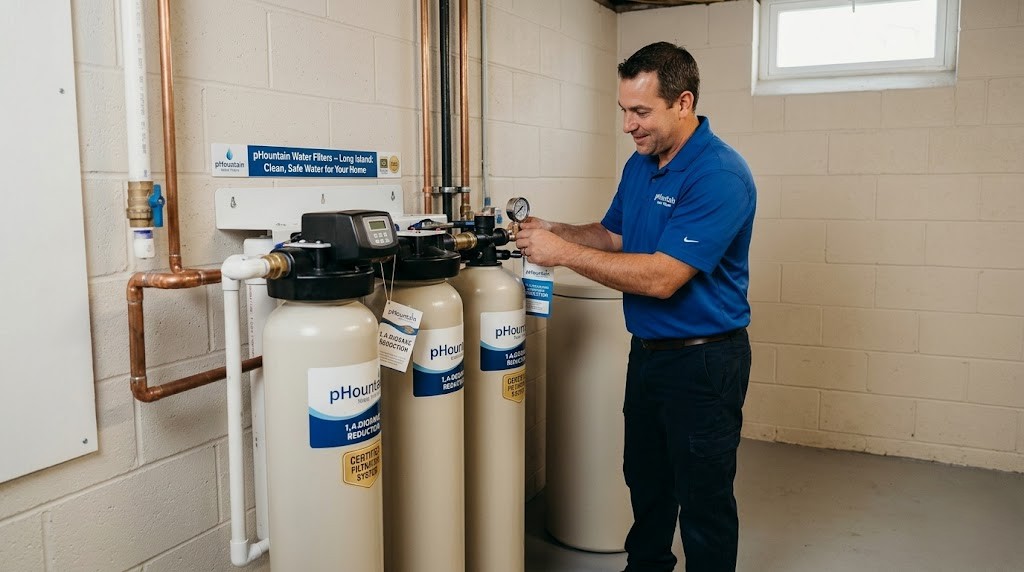
If you want to treat the water used throughout your home, a point-of-use filter, such as a pitcher or a faucet attachment, only treats the water that passes through it. The pHountain Filtration System is a whole-home (point-of-entry) system with a cartridge-free media design intended to reduce common impurities in tap water. It is installed at the main water entry point of your home, so treatment happens before water reaches the rest of your plumbing.
Because it sits where water enters the house, a whole-home system covers:
- Every tap: the guest bathroom gets the same treated water as the kitchen.
- Showers, baths and laundry, not just drinking water.
- Appliances such as the water heater and dishwasher.
A whole-home system is configured around what testing finds. For any specific contaminant, ask for independent certification data (for example NSF/ANSI listings) for the exact system you are considering.
Why Professional Installation Matters
With so many DIY tutorials online, it is tempting to install a water filtration system yourself. But a whole-home system is plumbed into the main water line where it enters your house, and it has to suit your home’s plumbing layout and how your household uses water.
pHountain’s whole-home systems are professionally installed and backed by a 10-year guarantee. Before you commit, you can ask about:
- The configuration for your home: the recommendation takes your plumbing, household size and goals into account.
- Where it goes: how the system would be installed at your main water entry point.
- What upkeep it needs: the maintenance the system requires over time.
The Consultation-to-Installation Workflow
Here is how the process works for homeowners in Freeport and across Long Island.
1. The Initial Consultation
It starts with you. Whether you have noticed a change in the taste of your water or simply want to understand it better, request a Free In-Home Water Test. A team member will reach out to confirm your appointment and discuss your concerns, your home and your goals for your water.
2. Water Quality Evaluation
Before recommending anything, a pHountain specialist comes to your home and tests your water on-site. Measuring PFAS and 1,4-dioxane at the levels regulators use (parts per trillion and parts per billion) requires analysis by a certified laboratory; a free in-home water test is a starting point for understanding your water and your options.
3. System Recommendation and Customization
Based on the results, we suggest a filtration approach for your home, such as a configuration of the pHountain Filtration System, and explain what it involves before you decide.
4. Professional Installation
The system is installed at your main water line, and we walk you through how it operates.
5. After Installation
Your system is backed by a 10-year guarantee. If you have questions later, you can reach the team through our contact page.
Addressing Common Concerns
Here are some of the questions homeowners ask about their water and about whole-house systems.
Is Freeport tap water safe to drink?
Public water suppliers such as the Village of Freeport Water Department must meet federal and state drinking water limits, and they publish an annual water quality report showing what they tested for and found; the EPA explains how to find yours. Freeport’s 2025 report says the Village received no violations from the Nassau County Department of Health that year and that its water met all current parameters except iron, which the report’s table lists above New York’s 0.3 mg/L standard and marks as a violation; the report describes iron’s effects as aesthetic. If your home is on a private well, testing your water is your responsibility (EPA).
Will a system disrupt my plumbing?
A whole-home system connects to the main water line where it enters the house. Before installation, you will get an explanation of where the system would go and what the work involves.
Is maintenance difficult?
Every filtration system needs some upkeep. Ask what the configuration recommended for your home requires, and how often, so you know what to expect over time.
How is this different from a store-bought filter?
Store-bought pitchers and faucet filters treat the water at one tap. A whole-home system treats the water entering the house, so it also covers showers, laundry and appliances, not only drinking water.
What should I do if my water looks discolored?
The Village’s report says its iron is naturally occurring and can occasionally cause a slight coloration. If you have questions about discolored water or anything else about the public supply, contact the Water Department through the Village’s Water page, which also links to the current and archived water quality reports.
Practical Steps for Freeport Homeowners
- Read the annual report. Copies of the report are available at Village Hall, 46 N Ocean Avenue, and the report says a supplemental data package with the full water quality data, before and after treatment, for each well used in 2025 is available at the Village office.
- Check your service line. Under the federal Lead and Copper Rule Revisions, the Village has prepared a lead service line inventory and will email or mail a copy on request, the report says. It also advises using only cold water for drinking, cooking and making baby formula, notes that boiling does not remove lead, and suggests flushing your pipes for several minutes before use. EPA’s lead page has more on lead in drinking water.
- Follow Nassau County watering rules. The report says county watering regulations for lawns and gardens are in effect year-round: no watering between 10 a.m. and 4 p.m., with odd-numbered houses watering only on odd days of the month and even-numbered houses on even days.
- Sign up for alerts. The Village can send emergency alerts by text, email or voice through its CivicReady system, according to the report.
- Know about nearby work. The report says new water mains on North Grove Street and Pearsall Avenue, 1,620 linear feet of 8-inch cement-mortar lined ductile iron main and four fire hydrants, are to be installed during 2026, with about 42 water services transferred. For how main and well work can show up at the tap, see our post on how local well upgrades affect your home’s water.
For more on how we serve the county, see our Water Filtration Nassau County NY page.
What Long Island Customers Say
You can read reviews that customers have left for pHountain Water Filtration on Google on our testimonials page.
Take the First Step Toward Better Water
Whether you live in a historic home with older pipes or in newer construction, knowing what is in your water is the first step toward peace of mind.
If you would like to understand your water and your options, pHountain Water Filters offers a free in-home water test, a recommendation based on what testing finds, and professional installation for homeowners across Long Island.
Schedule your free in-home water test to get started.
This blog is for informational purposes only and does not guarantee specific water quality outcomes. Water conditions and regulations can change; always consult your local water provider and a qualified water treatment professional for advice tailored to your home.
Sources
- Village of Freeport Water Department, Annual Water Quality Report (March 2026, covering 2025): https://www.freeportny.gov/DocumentCenter/View/14949/2025-Annual-Water-Quality-Report
- Village of Freeport, Water: https://www.freeportny.gov/36/Water
- U.S. EPA, Fifth Unregulated Contaminant Monitoring Rule (UCMR 5): https://www.epa.gov/dwucmr/fifth-unregulated-contaminant-monitoring-rule
- U.S. EPA, Secondary Drinking Water Standards: Guidance for Nuisance Chemicals: https://www.epa.gov/sdwa/secondary-drinking-water-standards-guidance-nuisance-chemicals
- New York State Department of Health, Drinking Water Standards for PFAS and Other Emerging Contaminants: https://www.health.ny.gov/environmental/water/drinking/emerging_pfas_publicwater.htm
- U.S. EPA, Per- and Polyfluoroalkyl Substances (PFAS): https://www.epa.gov/sdwa/and-polyfluoroalkyl-substances-pfas
- U.S. EPA, Consumer Confidence Reports: https://www.epa.gov/ccr
- U.S. EPA, Lead: https://www.epa.gov/lead
- U.S. EPA, Private Drinking Water Wells: https://www.epa.gov/privatewells