
Key Takeaways
- The Hicksville Water District flushes its water mains every spring and fall; in 2026 it scheduled flushing for April 19 to 24 and October 18 to 23, overnight, according to the district’s spring and fall announcements.
- In its fall flushing announcement, the district says slight pressure changes or discolored water can occur during flushing, and that running your cold-water faucets until the water clears resolves it.
- Its 2026 Water Main Replacement Project is replacing about 4,000 feet of 1950s-era cast iron main in the northeast part of the district.
- The district’s annual water quality report shows what was detected, the legal limit and whether there was a violation.
- If you want to understand the water in your own house, pHountain Water Filtration offers a free in-home water test.
When the water from your tap suddenly looks tinted, or the pressure dips for an evening, it is natural to wonder why. In Hicksville, one possible explanation is routine work on the water system: the district flushes its mains twice a year and is replacing aging pipe in part of its service area. This post explains what the Hicksville Water District says to expect, what to do at home, and where to look in its annual report if you want to see the numbers yourself.
This post focuses on the pipes under your street and what you see at the tap. For the district’s PFAS and 1,4-dioxane treatment, see our companion post, Hicksville’s PFAS Treatment Milestones: What the Water District Reports and What It Means at Home.
Recent Water System Work in Hicksville
Seasonal main flushing
The district flushes water mains as part of its regular maintenance program. Spring 2026 flushing was scheduled for April 19 to 24 in the northeast quadrant, east of Broadway and north of Old Country Road (spring announcement). Fall 2026 flushing was scheduled for October 18 to 23 in the southwest quadrant, west of Jerusalem Avenue and south of Old Country Road (fall announcement). Both rounds run between 9 p.m. and 5 a.m. to limit the impact on residents, and in both announcements the district said the water is safe to drink during flushing.
Why the district flushes its mains
According to those two announcements, flushing:
- Clears sediment that may have built up in the mains, so water flows more freely to homes
- Guards against possible accumulation of dissolved iron in the mains
- Lets the district check the water’s pH, color and chlorine residual, and review flow rates for fire protection
- Gives crews a chance to check for leaks and test water pressure
The 2026 water main replacement project
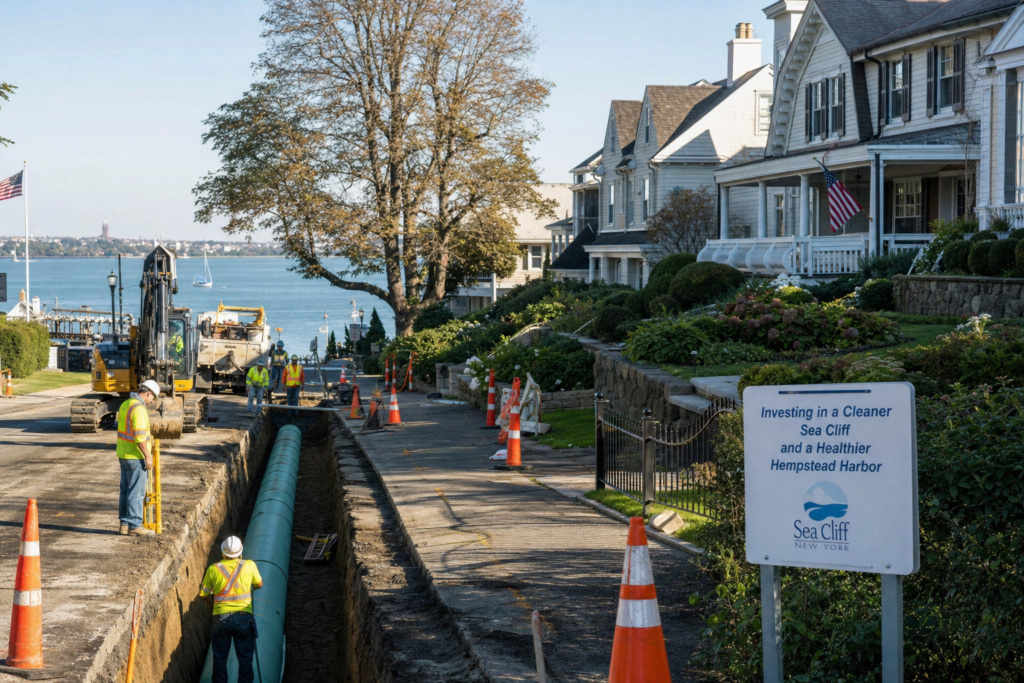
The district has started replacing mains in part of its northeast section, where the pipes are unlined cast iron dating back to the 1950s. It says the area has had recurrent failures, that pipe age was identified as the primary cause, and that the section was its top replacement priority. Work is primarily on Haverford Road, Hollins Road and Cambridge Drive, with tie-in work affecting a limited number of homes on nearby streets. Over about four months, the district plans to replace roughly 4,000 feet of main, 6 fire hydrants and 87 water services from the main to the curb shut-off valve, working weekdays from 7:30 a.m. to 5 p.m. and notifying residents whose driveways may be affected beforehand (project page).
What You May Notice at the Tap, and Why
This table summarizes what the district says in its flushing announcements and its Water FAQ.
| What You Notice | What the District Says | What to Do |
|---|---|---|
| Discolored water during flushing | Discoloration may occur and can affect uses such as laundry | Run cold-water faucets until the water clears; consider holding laundry until then |
| Slight pressure changes during flushing | Slight pressure variations may occur | Contact the district if a problem continues |
| Reddish or “rusty” water | Iron can settle in mains and be stirred up by a main break or an opened hydrant; the district says it is not harmful, though it may not look appealing | If it persists, call the district at 516-931-0184 |
| Rusty water from the hot tap only | Your water heater might be rusting | Have the water heater checked |
| Cloudy water that clears | Often air bubbles, especially in winter, or calcium, a harmless mineral that settles | Let a glass stand and watch it clear |
The Nassau County Department of Health describes taste, odor and rust problems as aesthetic, not health, conditions, asks residents to contact their water supplier about them, and says water systems in Nassau County can usually resolve them in a short period of time (Nassau County Department of Health).
Before You Reach for Bottled Water
Discolored water can make bottled water look like the easy fix. During flushing, though, the district says the water is safe to drink and that discoloration clears when you run the cold-water faucets. The county health department also says there is no need to use bottled water instead of tap water, and that bottled water sold in New York must meet the same Sanitary Code requirements; look for the state certification number (“NYSHDCERT #”) on the label (Nassau County Department of Health).
Single-use bottles also add up to a lot of plastic to carry in and throw out. For the long-term choice between bottled water and treating water at home, see Water Filters vs Bottled Water.
How to Read the Hicksville Water District’s Annual Report
The district posts each year’s Drinking Water Quality Report on its water quality report page, and the EPA explains what these annual reports are. Here is how to read the 2025 edition, dated May 2026:
- Find the table of detected parameters. Its columns give the contaminant, whether there was a violation, the sample date, the level detected (maximum and range), the unit, the goal (MCLG), the limit (MCL or action level) and the likely source.
- Check the units. The report defines mg/l as parts per million, ug/l as parts per billion and ng/l as parts per trillion. “ND” means laboratory analysis indicates the constituent is not present.
- Compare the level to the limit. The MCL is the highest level allowed in drinking water; the MCLG is the level below which there is no known or expected risk to health; an action level is the concentration that, if exceeded, triggers treatment or other requirements.
- Read the footnotes. The 2025 report notes that apparent color exceeded New York’s standard of 15 color units in one sample, with all other samples non-detect. It calls color an aesthetic parameter that is not considered a health risk, typically caused by naturally occurring organic matter or metals such as iron, and says the district continues to monitor it.
- Look beyond the table. The report explains its lead and copper sampling (40 home samples in 2023, with action levels not exceeded at any site and the next round in 2026), lists contaminants tested for but not detected, and says well-by-well data is available at the district office and the local public library. For questions, it lists the district at (516) 931-0184 and the Nassau County Department of Health at (516) 227-9692.
The pHountain Filtration System
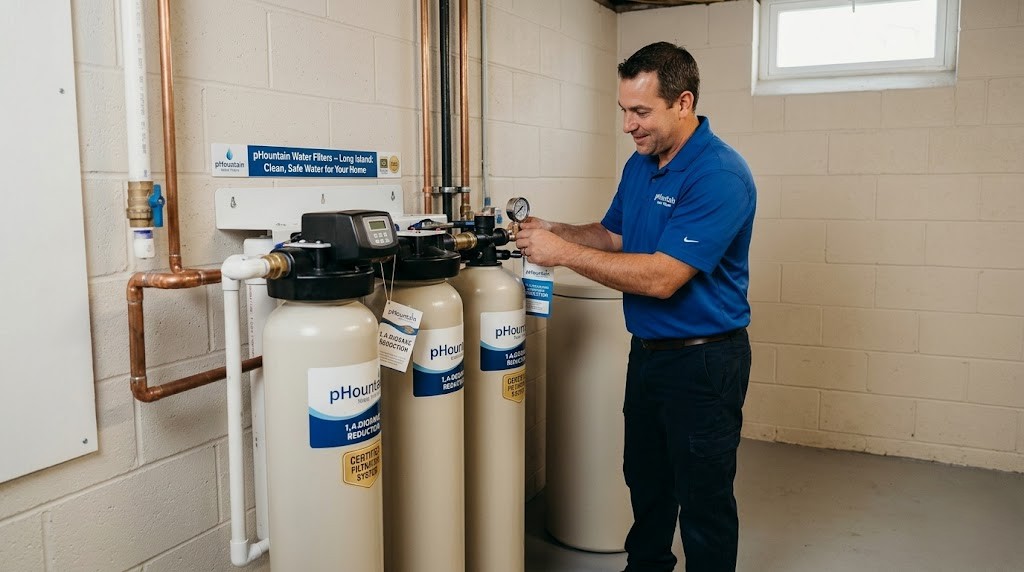
The pHountain Filtration System is a whole-home (point-of-entry) system with a cartridge-free media design intended to reduce common impurities in tap water.
- Whole-home coverage: Unlike a pitcher, which treats only the water you pour into it, the system is installed where the water line enters your home, so water for every tap passes through it.
- Configured around testing: A whole-home system is configured around what testing finds. For any specific contaminant, ask for independent certification data (for example NSF/ANSI listings) for the exact system you are considering.
- Professional installation: Our team installs the system on your main water line.
- 10-year guarantee: Each installed system is backed by a 10-year guarantee.
What Long Island Customers Say
You can read reviews that customers have left for pHountain Water Filtration on Google on our testimonials page.
About pHountain Water Filtration
We are a Long Island company based in Islip, serving homeowners in Nassau and Suffolk Counties from our Islip office. Learn more on our FAQ page or our Nassau County service area page.
Addressing Common Resident Inquiries
How much does a whole-house filter cost on Long Island?
Costs vary with your home’s size, plumbing and what testing shows. We quote each installation individually; you can ask for an estimate during your free in-home water test.
Is my water safe to drink while the district is flushing mains?
In its 2026 spring and fall flushing announcements, the district said the water is safe to drink throughout the flushing process. If it turns discolored, run your cold-water faucets until it clears.
Who is responsible for the water service line to my house?
The district’s FAQ says its jurisdiction ends at the street’s curb, and that the service line belongs to the property owner and is maintained at the owner’s expense. Its lead and copper page has a dashboard for checking your service line’s material and asks residents whose line is not shown, or is labeled unknown, to contact the district.
Is Hicksville tap water safe in 2026?
Public water suppliers must meet federal and state drinking water limits and publish an annual water quality report showing what they tested for and found; the EPA explains how to find yours. The district’s 2025 report says its water meets all federal and state requirements. If your home is on a private well, testing it is your responsibility (EPA).
How do I get started?
Read the district’s latest report, then find out what is in the water at your own tap with a Free In-Home Water Test.
Questions About Your Hicksville Water?
Call pHountain Water Filtration at (631) 991-3995, or request a Free In-Home Water Test online.
This blog is for informational purposes only and does not guarantee specific water quality outcomes. Water quality varies by location, and conditions and regulations can change; consult your water supplier and a qualified water treatment professional for advice about your home. Private well owners should have their water tested regularly. pHountain Water Filtration provides free in-home water tests in Nassau and Suffolk Counties.
Sources
- Hicksville Water District, “Hicksville Water District to Begin Spring Flushing on Evening of April 19” (April 2, 2026): https://hicksvillewater.org/hicksville-water-district-to-begin-spring-flushing-on-evening-of-april-19/
- Hicksville Water District, “Hicksville Water District to Begin Fall Flushing on Evening of October 18” (October 2, 2026): https://hicksvillewater.org/hicksville-water-district-to-begin-fall-flushing-on-evening-of-october-18/
- Hicksville Water District, 2026 Water Main Replacement Project: https://hicksvillewater.org/news/2026-water-main-replacement-project/
- Hicksville Water District, Water FAQ: https://hicksvillewater.org/hwd/water-faq/
- Hicksville Water District, Lead and Copper Updates: https://hicksvillewater.org/news/lead-and-copper-updates/
- Hicksville Water District, Water Quality Report page: https://hicksvillewater.org/hwd/water-quality-report/
- Hicksville Water District, 2025 Drinking Water Quality Report (May 2026): https://hicksvillewater.org/wp-content/uploads/2026/05/26.04.28-2025-HKWD-Drinking-Water-Quality-Report-FINAL1.pdf
- Nassau County Department of Health, Public Water Supply: https://www.nassaucountyny.gov/2970/Public-Water-Supply
- U.S. EPA, Consumer Confidence Reports: https://www.epa.gov/ccr
- U.S. EPA, Private Drinking Water Wells: https://www.epa.gov/privatewells