Key Takeaways
- On May 13, 2024, EPA and New York State broke ground on PFAS treatment at the Hicksville Water District’s Plant 6, EPA announced.
- In a September 30, 2026 release, the district said Plant 6 had opened with treatment for 1,4-dioxane and PFAS.
- The district’s 2025 water quality report lists PFOA and PFOS as not detected, and 1,4-dioxane at up to 0.28 parts per billion, below New York’s 1 part per billion limit.
- Treatment at the well protects the supply; what reaches your faucet also passes through your own service line and plumbing.
- A free in-home water test is a starting point for understanding the water in your own house.
News about water treatment projects can raise questions for any homeowner. If you live in Hicksville, you may have seen construction at a local water plant or heard about PFAS and 1,4-dioxane in Long Island groundwater. When chemical names show up in the headlines, it is natural to wonder what that means for your kitchen tap. Understanding what your water supplier is doing, and what its own reports say, is the first step toward a clear answer.
Public water in Hicksville comes from the Hicksville Water District, which pumps groundwater from 14 wells in the Magothy aquifer and served about 48,000 people in 2025, according to its 2025 report.
Understanding the Hicksville Infrastructure Update
On May 13, 2024, EPA and New York State broke ground at the district’s Plant 6 on a system to remove PFAS, often called “forever chemicals,” funded by a $2 million Bipartisan Infrastructure Law grant and a $3 million New York State Water Infrastructure Improvement grant. EPA said the plant’s two wells supply 15 percent of Hicksville’s drinking water; PFOA and PFOS there were below New York’s 10 parts per trillion standard but above the new federal limit of 4 parts per trillion, and 1,4-dioxane was nearing the state limit of 1 part per billion. As a short-term measure, the district was blending well water at the plant so tap water met standards (EPA).
Update (October 2026): The district held a ribbon cutting for Plant 6, which has two Advanced Oxidation Process (AOP) systems and four granular activated carbon (GAC) filters to treat 1,4-dioxane and PFAS. With it complete, the district said, all 13 of its 14 supply wells that have been affected by these contaminants now have treatment in place. Grants covered $5 million of the roughly $13 million cost, about 38.5 percent, according to the district’s September 30, 2026 release.
PFAS (per- and polyfluoroalkyl substances) are a large family of synthetic chemicals; EPA has set enforceable drinking water limits for six of them (EPA).
Why Hicksville Water Quality Is Under Scrutiny
- Infrastructure Evolution: The district treats water at all of its wells. Its 2025 report lists pH adjustment to reduce corrosion of mains and in-house plumbing, air stripping for volatile organic compounds, nitrate removal, GAC at eight plants and AOP at seven. Its facilities page explains that AOP mixes groundwater with a low dose of an oxidant, most commonly hydrogen peroxide, and uses ultraviolet light to destroy 1,4-dioxane molecules before the water passes through GAC.
- Regulatory Thresholds: In 2020, New York set limits of 10 parts per trillion (ppt) for PFOA and PFOS and 1 part per billion (ppb) for 1,4-dioxane, the first state limit for 1,4-dioxane (NYSDOH). In April 2024, EPA finalized limits of 4.0 ppt each for PFOA and PFOS, with compliance by 2029. In May 2026, EPA proposed letting systems request two more years, to 2031, for PFOA and PFOS, and rescinding its limits for PFHxS, PFNA, GenX and a PFAS mixture; those were still proposals on EPA’s PFAS page in October 2026.
- Environmental Factors: A state source water assessment rated most of the district’s wells as very highly susceptible to industrial solvents and all of them as highly susceptible to nitrates; the report notes that this rates potential contamination of the source water, not the water delivered to you. In a 2019 fact sheet, the district said 1,4-dioxane reached the groundwater mainly from Long Island manufacturers that used the solvent TCA, stabilized with 1,4-dioxane, from the 1950s to the 1990s, and also from household products washed down the drain.
What the Latest Water Quality Report Shows
The district’s 2025 report, dated May 2026, says its drinking water meets all federal and state requirements. It lists PFOA, PFOS, PFHxS, PFNA and HFPO-DA among the contaminants that were not detected; 1,4-dioxane from not detected to 0.28 micrograms per liter (parts per billion), with no violation; and three other PFAS monitored under EPA’s fifth Unregulated Contaminant Monitoring Rule (6:2 FTS, PFBA and PFPeA) detected at parts-per-trillion levels, with no limit set for them.
To read the full table yourself, or if you have noticed discolored water during main flushing, see our companion post, Discolored Hicksville Tap Water After Flushing or Main Work? Here’s Why.
The Bottled Water Trap
It can be tempting to respond to water headlines by heading to the grocery store. The Nassau County Department of Health says bottled water must meet the same standards as your public water but is not required to be tested as extensively, and that it can cost 1,000 times more than tap water (Nassau County Department of Health). Bottled water also covers only what you drink; showers, cooking and laundry still use tap water. We walk through the long-term trade-offs in Water Filters vs Bottled Water.
Curious what’s in your water? A free in-home water test is a starting point for understanding your home’s water and your options: Free In-Home Water Test.
The pHountain Filtration System: A Whole-Home Option
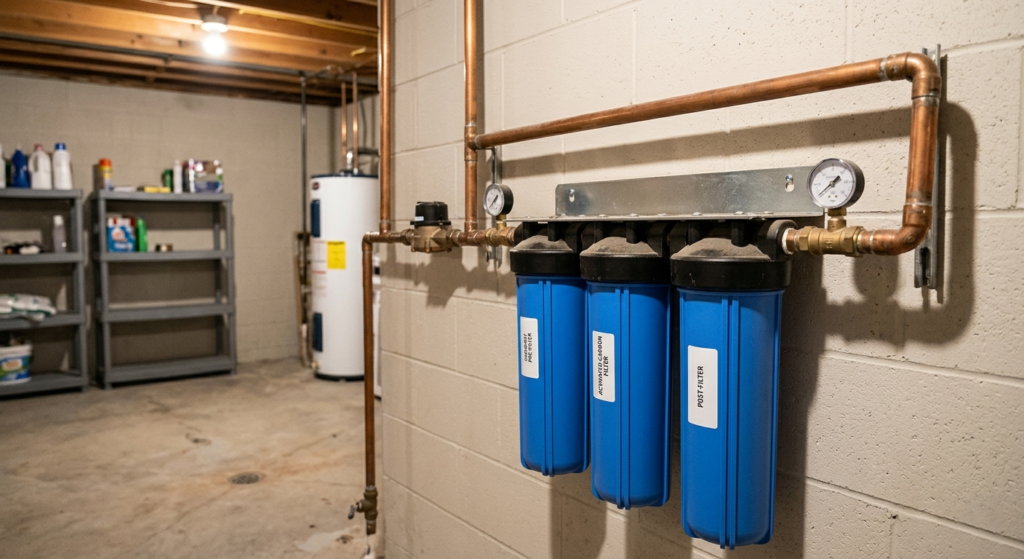
The pHountain Filtration System is a whole-home (point-of-entry) system with a cartridge-free media design intended to reduce common impurities in tap water. Because it is installed where the water line enters your home, every shower, every meal and every glass of water comes from the same treated supply.
A whole-home system is configured around what testing finds. For any specific contaminant, ask for independent certification data (for example NSF/ANSI listings) for the exact system you are considering.
Each system is recommended after a free in-home water test, professionally installed and backed by a 10-year guarantee. You can meet our team to learn who will be working in your home.
Comparing Common Home Water Options
| Home Strategy | Coverage Area | Typical Use Case |
|---|---|---|
| Bottled water | Drinking only | Short-term response when tap water seems off |
| Pitcher or fridge filter | One or two taps | Apartments or small households with modest needs |
| Whole-home filtration | Entire house | Long-term option that treats water for the whole house |
What Long Island Customers Say
You can read reviews that customers have left for pHountain Water Filtration on Google on our testimonials page.
Weighing Long-Term Options
- Start with information: Read your supplier’s annual report, then test the water at your own tap.
- Match coverage to your needs: Decide whether you want treatment at one faucet or for the whole house.
- Understand the upkeep: Every treatment option needs some care; ask what is required and how often.
- Consider your own plumbing: Your service line, pipes and fixtures are part of what reaches your glass.
- Ask about installation and coverage: pHountain whole-home systems are professionally installed and backed by a 10-year guarantee.
About pHountain Water Filtration
We are based in Islip and serve homeowners across Long Island, in Nassau and Suffolk Counties. We don’t believe in one-size-fits-all solutions: every whole-home recommendation starts with a free in-home water test. Learn more about us, visit our Islip location page, or see our Nassau County service area page.
Frequently Asked Questions
How much does a whole house filter cost on Long Island?
Costs vary with your home’s size, plumbing and what testing shows. We quote each installation individually after the free in-home water test.
Is Hicksville tap water safe in 2026?
Public water suppliers must meet federal and state drinking water limits and publish an annual water quality report showing what they tested for and found; the EPA explains how to find yours, and the district posts its reports on its water quality report page. New York’s health department says residents can continue to drink their water unless told otherwise by their water system or health department (NYSDOH). If your home is on a private well, testing it is your responsibility (EPA).
Do I need a home filter if my water district treats for PFAS?
The Nassau County Department of Health says: “Filters are not necessary for homes that are supplied by public water systems. Public water systems are routinely tested and meet drinking water standards set by the Federal and State Governments.” If you still wish to install a filter, it advises choosing one with a flow indicator and strictly following the manufacturer’s recommendations for maintenance (Nassau County Department of Health). If you are weighing home treatment for your own reasons, a test of your tap water is a sensible place to start.
What is the difference vs traditional water softeners?
A traditional water softener is designed to reduce hardness minerals, typically through ion exchange that uses salt. A whole-home filtration system is a different kind of equipment, configured around what testing finds in your water.
What is the first step for a concerned resident?
Stop guessing. Read the district’s annual report, then find out what is in the water at your own tap. Measuring PFAS and 1,4-dioxane at the levels regulators use (parts per trillion and parts per billion) requires analysis by a certified laboratory; a free in-home water test is a starting point for understanding your water and your options.
Questions about your Hicksville home’s water? Call (631) 991-3995 or request a Free In-Home Water Test from pHountain Water Filtration.
This blog is for informational purposes only and does not guarantee specific water quality outcomes. Water quality varies by location, and conditions and regulations can change; consult your water supplier and a qualified water treatment professional for advice about your home. Private well owners should have their water tested regularly. pHountain Water Filtration provides free in-home water tests in Nassau and Suffolk Counties.
Sources
- U.S. EPA, “EPA and New York State Break Ground on Project to Ensure Clean Drinking Water for Hicksville, N.Y. Households” (May 13, 2024): https://www.epa.gov/newsreleases/epa-and-new-york-state-break-ground-project-ensure-clean-drinking-water-hicksville-ny
- Hicksville Water District, “Hicksville Water District Cuts the Ribbon on State-of-the-Art Water Treatment Facility” (September 30, 2026): https://hicksvillewater.org/hicksville-water-district-cuts-the-ribbon-on-state-of-the-art-water-treatment-facility/
- Hicksville Water District, 2025 Drinking Water Quality Report (May 2026): https://hicksvillewater.org/wp-content/uploads/2026/05/26.04.28-2025-HKWD-Drinking-Water-Quality-Report-FINAL1.pdf
- Hicksville Water District, Facilities: https://hicksvillewater.org/hwd/plants/
- Hicksville Water District, 1,4-Dioxane Fact Sheet (2019): https://hicksvillewater.org/wp-content/uploads/2019/04/14D-fact-sheet.pdf
- U.S. EPA, Per- and Polyfluoroalkyl Substances (PFAS): https://www.epa.gov/sdwa/and-polyfluoroalkyl-substances-pfas
- New York State Department of Health, Drinking Water Standards for PFAS and Other Emerging Contaminants: https://www.health.ny.gov/environmental/water/drinking/emerging_pfas_publicwater.htm
- Nassau County Department of Health, Public Water Supply: https://www.nassaucountyny.gov/2970/Public-Water-Supply
- U.S. EPA, Consumer Confidence Reports: https://www.epa.gov/ccr
- U.S. EPA, Private Drinking Water Wells: https://www.epa.gov/privatewells