
Key Takeaways
- In March 2026, an environmental group, Citizens Campaign for the Environment (CCE), released a report, prepared with Stony Brook University and Public Employees for Environmental Responsibility (PEER), on PFAS in Long Island vegetables (CCE). It was not a state or federal agency’s testing program.
- PFAS in the environment can enter the food supply through crops and animals grown, raised or processed in contaminated areas, the FDA says.
- PFAS are often called “forever chemicals”; the EPA describes them as long-lasting chemicals whose components break down very slowly over time.
- The drinking water limits for PFAS apply to public water systems. They don’t cover food, and they don’t cover private wells (EPA).
- pHountain Water Filters offers a free in-home water test across Nassau and Suffolk counties, a starting point for knowing what is in your own tap water.
What the Produce Headlines Mean for Long Island Families
If you live on Long Island, you may have seen headlines in March 2026 about PFAS in locally grown vegetables. PFAS, short for per- and polyfluoroalkyl substances, are a large group of human-made chemicals. EPA describes them as widely used, long-lasting chemicals whose components break down very slowly, and says they are present at low levels in a variety of food products and in the environment (EPA).
Those headlines raise a fair question for families who buy from local farms or grow their own vegetables: what do PFAS rules actually cover? The limits most people hear about apply to drinking water from public water systems. PFAS in food is handled by a different agency, with different tools.
This post explains what’s known about PFAS in food, how that differs from PFAS in tap water, and what you can check at home.
Understanding the March 2026 Produce Report
CCE says it worked with Stony Brook University and PEER on a collaborative study that examined whether PFAS chemicals were detected in four types of locally grown vegetables on Long Island. It released the report in March 2026, held a virtual presentation on the results, and said it found PFAS detections in all the samples tested (CCE).
A few points help put that report in context:
- Who did the study: CCE, Stony Brook University and PEER, not a state or federal agency’s food-testing program (CCE).
- What was tested: vegetables, not tap water.
- What contamination nearby does and doesn’t mean: FDA says PFAS contamination in the environment where food is grown “does not necessarily mean the food will contain detectable levels of PFAS,” because uptake depends on factors including the type of PFAS and the type of food (FDA).
PFAS have been used since the 1950s in products including water-, grease- and oil-resistant products and some firefighting foams, and they can travel through soil into groundwater and then into sources of drinking water, according to the New York State Department of Health (NYSDOH). EPA says PFAS are found in water, air, fish and soil at locations across the nation and the globe (EPA).
On Long Island, groundwater is the sole source of freshwater supply for Nassau and Suffolk (USGS), so what reaches it matters for public water and private wells alike.
How PFAS Can End Up in Food
- Environmental contamination: PFAS in the environment can enter the food supply through crops and animals grown, raised or processed in contaminated areas (FDA).
- Processing and cookware: It is also possible for very small amounts of PFAS to enter foods through processing and cookware, FDA says (FDA).
- Uptake varies by plant: The amount of PFAS taken up by foods depends on many factors, and FDA is contributing to research on how PFAS is taken up by plants and how concentrations vary between plants and parts of a plant (FDA).
- Water used in the kitchen: When PFAS is found in drinking water, the main exposure is typically from drinking the water and eating foods prepared with it; household uses such as cleaning, dishwashing, showering and bathing do not result in significant exposure, according to NYSDOH.
PFAS in Food vs. PFAS in Tap Water: Who Sets the Limits
Food, public tap water, private wells and bottled water each fall under different rules. The table below summarizes them as of October 2026.
| Water or food | Who oversees it | What applies |
|---|---|---|
| Public tap water | EPA and, in New York, NYSDOH | New York limits of 10 ppt for PFOA and PFOS now; federal limits of 4.0 ppt by 2029 (NYSDOH) |
| Private wells | The homeowner | Not regulated for PFAS; NYSDOH uses the public standards as guidelines (NYSDOH) |
| Food, including produce | FDA | Testing, and action when a level may be injurious to health (FDA) |
| Bottled water | FDA | FDA is working on a regulation to set levels for certain PFAS (FDA) |
Drinking Water Limits
EPA’s April 2024 rule set enforceable limits of 4.0 ppt for PFOA and for PFOS, plus limits for four other PFAS, with compliance due by 2029 (EPA). EPA’s May 2026 proposals to let water systems request two more years, to 2031, to meet the PFOA and PFOS limits, and to rescind the other four limits, were still proposals when its extension and rescission pages were last updated on October 8, 2026. Our post How Do Long Island PFAS Limits in 2026 Affect My Home’s Water covers those rules in detail.
Food
FDA says that since 2019 it has tested over 1,900 samples of foods on the U.S. market. No PFAS were detected above the method detection limit in over 95% (1,290 out of 1,352) of the fresh and processed foods it tested through its Total Diet Study, while PFAS were detected more often in seafood (FDA). FDA also says that most foods not grown or produced in specific areas with known PFAS contamination do not have detectable levels of PFAS, and it recommends eating a varied, well-balanced diet (FDA).
If FDA finds that the level of PFAS in a food may render it injurious to health, it says it takes action, which may include working with the manufacturer and keeping the product from entering or remaining on the U.S. market. FDA lists bottled water, seafood and infant formula as potential priority areas for future action levels (or allowable levels, for bottled water) (FDA).
Private Wells
New York State does not regulate PFAS in private wells; NYSDOH uses the public drinking water standards as guidance when it evaluates private well results and recommends actions (NYSDOH). Private well owners are responsible for the safety of their own water (EPA).
Where Bottled Water Fits
When tap water quality feels uncertain, bottled water can seem like the safest short-term option. It helps to know how it is regulated.
FDA sets allowable levels for contaminants in bottled water when EPA sets levels for those same contaminants in drinking water, unless certain exceptions apply, and says it is working on a regulation to establish levels for certain PFAS in bottled water (FDA). In a targeted survey in 2023 and 2024, FDA detected PFAS in 10 of 197 bottled water samples and determined that none of the levels would have exceeded EPA’s limits if detected in public drinking water (FDA).
Bottled water also covers only the water you buy, not the water that comes out of your taps for cooking. If you’re weighing the two, our water filters vs bottled water guide walks through the trade-offs.
Curious What’s in YOUR Water?
Get a free in-home water test: request one on our Free In-Home Water Test page.
Where the pHountain Filtration System Fits
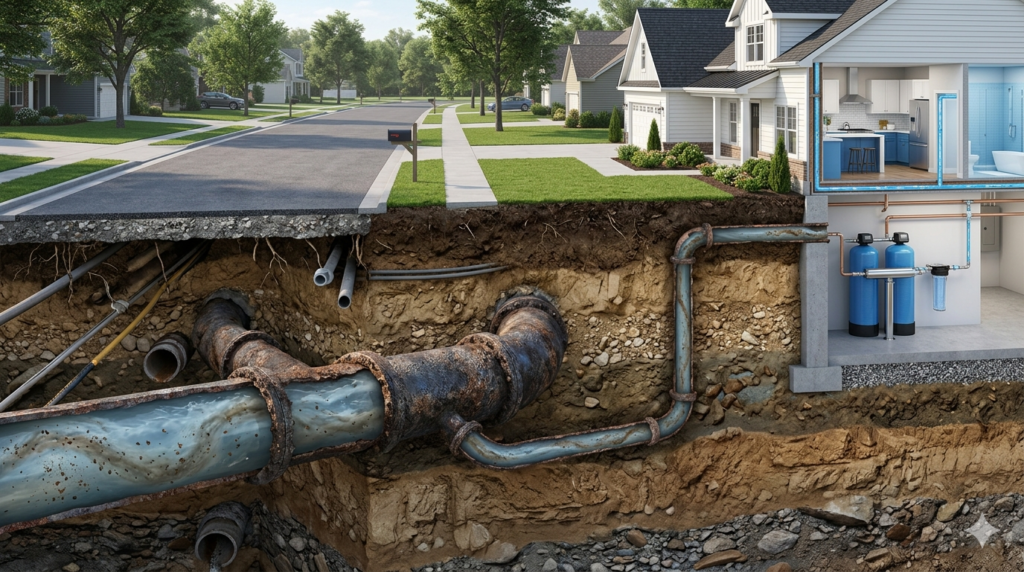
The pHountain Filtration System is a whole-home (point-of-entry) system with a cartridge-free media design intended to reduce common impurities in tap water. Unlike point-of-use filters that treat only one tap, it is installed where water enters the house, so every faucet, shower and water-using appliance receives water that has passed through it.
A whole-home system is configured around what testing finds. For any specific contaminant, ask for independent certification data (for example NSF/ANSI listings) for the exact system you are considering.
It is recommended after a free in-home water test, professionally installed on your main water line, and backed by a 10-year guarantee.
Measuring PFAS and 1,4-dioxane at the levels regulators use (parts per trillion and parts per billion) requires analysis by a certified laboratory; a free in-home water test is a starting point for understanding your water and your options. For private wells, NYSDOH says PFAS tests may range from $300 to $600 and are performed by a small number of certified laboratories (NYSDOH).
Comparing Your Options: Bottled Water, Pitcher Filters, and Whole-Home Filtration
| Feature | Bottled Water | Pitcher Filter | Whole-Home Filtration |
|---|---|---|---|
| Coverage | Drinking only | Drinking water from the pitcher | Entire house |
| What to check for PFAS | FDA regulates bottled water | Certification to NSF/ANSI 53 or 58 for PFAS reduction (EPA) | Independent certification data for the exact system |
| Ongoing upkeep | Repeat purchases | Cartridge changes on the maker’s schedule | Service as recommended for the system |
| Convenience | Buying and storing bottles | Regular refills | No daily refills |
| Environmental impact | Plastic bottles | Used cartridges | One installed system |
What Long Island Customers Say
You can read reviews that customers have left for pHountain Water Filtration on Google on our testimonials page.
Questions to Ask Before You Pay for Any Filter
- Has PFAS been measured in your water? EPA suggests first contacting your water provider, notes that many public water systems already have PFAS results, and says that if PFAS have not been measured in your water, or have been measured below federal limits, a filter may not be useful to you (EPA).
- Is it certified, and what will upkeep cost? EPA notes that as of April 2024 PFAS filter certifications focus on PFOA and PFOS, that a filter can cost from $20 to more than $1,000 before maintenance, and that filters only work if maintained as the manufacturer instructs (EPA).
- Who installs it, and what is guaranteed? Ask whether installation is included and what the guarantee covers.
Why Long Island Residents Contact pHountain Water Filters
- Serves Long Island: Nassau and Suffolk Counties.
- Free in-home water testing for Nassau & Suffolk County residents.
- Professional installation and a 10-year guarantee on installed systems.
Frequently Asked Questions
How much does a whole house filter cost on Long Island?
Costs vary based on home size and system needs. The starting point is a free in-home water test, followed by a quote for your home.
Will filtering my tap water reduce PFAS in produce?
No. A water filter treats water, not food grown somewhere else. NYSDOH says the main exposure to PFAS in water is from drinking it and from eating foods prepared with it (NYSDOH). For food, FDA recommends a varied, well-balanced diet (FDA).
Is Long Island tap water safe in 2026 considering these PFAS findings?
Public water suppliers must meet federal and state drinking water limits, including New York’s 10 ppt limits for PFOA and PFOS (NYSDOH), and they publish an annual water quality report showing what they tested for and found; the EPA explains how to find yours. The March 2026 report concerned vegetables, not tap water. If your home is on a private well, testing your water is your responsibility.
How does a whole-home filter differ from a traditional water softener?
A traditional water softener is designed to address hardness minerals such as calcium and magnesium. A whole-home filtration system treats water at the point of entry for other concerns, depending on its media. Which one fits your home depends on what testing finds.
Should I be concerned about washing garden vegetables with tap water?
NYSDOH does not address rinsing produce specifically. It says that when PFAS is found in drinking water, the main exposure is typically from drinking the water and eating foods prepared with it, and that household uses such as cleaning, dishwashing, showering and bathing do not result in significant exposure (NYSDOH). If your garden is watered from a private well near a known PFAS site, your local health department can advise on testing.
Ready to Learn What’s in Your Long Island Water?
Request your free in-home water test on our Free In-Home Water Test page.
This blog is for informational purposes only and does not provide medical advice or guarantee specific water quality outcomes. Water conditions and regulations can change; always consult your local water provider, your health department and a qualified water treatment professional for advice tailored to your home.
Sources
- Citizens Campaign for the Environment, “Highlights and Happenings: March 2026”: https://www.citizenscampaign.org/whats-new-at-cce/highlights-and-happenings-march-2026
- U.S. FDA, “Per- and Polyfluoroalkyl Substances (PFAS)” (content current as of July 9, 2026): https://www.fda.gov/food/environmental-contaminants-food/and-polyfluoroalkyl-substances-pfas
- U.S. FDA, “Questions and Answers on PFAS in Food”: https://www.fda.gov/food/process-contaminants-food/questions-and-answers-pfas-food
- U.S. EPA, “PFAS Explained”: https://www.epa.gov/pfas/pfas-explained
- U.S. EPA, “Per- and Polyfluoroalkyl Substances (PFAS)”: https://www.epa.gov/sdwa/and-polyfluoroalkyl-substances-pfas
- U.S. EPA, “Proposed PFOA and PFOS Compliance Extension Rule”: https://www.epa.gov/sdwa/proposed-pfoa-and-pfos-compliance-extension-rule
- U.S. EPA, “Proposed PFAS Rescission Rule”: https://www.epa.gov/sdwa/proposed-pfas-rescission-rule
- U.S. EPA, “Reducing PFAS in Your Drinking Water with a Home Filter” (April 2024): https://www.epa.gov/system/files/documents/2024-04/water-filter-fact-sheet.pdf
- U.S. EPA, Private Drinking Water Wells: https://www.epa.gov/privatewells
- U.S. EPA, Consumer Confidence Reports: https://www.epa.gov/ccr
- New York State Department of Health, “Public Water Systems and Drinking Water Standards for PFAS and Other Emerging Contaminants”: https://www.health.ny.gov/environmental/water/drinking/emerging_pfas_publicwater.htm
- New York State Department of Health, “PFAS and Private Wells”: https://www.health.ny.gov/environmental/water/drinking/pfasinprivatewells.htm
- U.S. Geological Survey, “Long Island Groundwater”: https://www.usgs.gov/centers/ny-water/science/long-island-groundwater