
Key Points
- Lead in drinking water comes primarily from materials and parts used in service lines and home plumbing, according to the Jericho Water District’s 2025 water quality report.
- Homes built before 1986 are more likely to have lead pipes, fixtures and solder (NYSDOH).
- In October 2024, EPA finalized the Lead and Copper Rule Improvements, which require most water systems to replace lead service lines within 10 years.
- Your supplier’s annual report shows its lead results; the water at your own tap can differ.
- You cannot see, taste or smell lead dissolved in water, so testing is the only sure way to know (EPA).
If you have noticed a change in your tap water or wonder about the age of your plumbing, you are asking a sensible question. The water that leaves a well and treatment plant is only part of the story; how it interacts with the materials inside your own walls matters too. If you are researching how to check your home’s water for lead, this guide covers where lead can come from, where to find your water district’s lead results, and practical steps you can take.
The Reality of Aging Plumbing and Lead
Nassau County’s list of community water systems includes no Syosset water district. The Jericho Water District has its headquarters at 125 Convent Road in Syosset, and five of its 25 wells are in Syosset, according to its 2025 Annual Drinking Water Quality Report; its website says it covers 37 square miles and serves more than 58,000 people. The name on your water bill tells you which supplier serves your address, and that supplier’s annual report is the one to read.
The report also draws a line between the district’s job and yours: the district is responsible for providing high-quality drinking water and removing lead pipes, but cannot control the variety of materials used in the plumbing in your home.
Age matters. Homes built before 1986 are more likely to have lead pipes, fixtures and solder, and newer “lead-free” plumbing can still contain trace amounts of lead (NYSDOH). If a home has a lead service line (the pipe that connects it to the water main), that pipe is typically the most significant source of lead; in homes without one, the most common problem is brass or chrome-plated brass faucets and plumbing with lead solder (EPA).
How Lead Gets Into Tap Water
It often comes down to chemistry and time.
- Corrosion of older materials: Lead can enter drinking water when lead pipes and plumbing materials containing lead corrode, according to EPA’s lead page. EPA’s Lead and Copper Rule requires water systems to treat water so it is less corrosive to the materials it touches (EPA).
- Stagnation: The longer water sits in pipes, the more lead it may contain. The Nassau County Department of Health says lead levels increase in proportion to the time water stays in piping.
- Water chemistry and temperature: Corrosion is more likely where water has high acidity or low mineral content (EPA), and lead can leach from brass fixtures and lead solder particularly when running hot water (NYSDOH).
Where Lead Results Appear in Your Annual Water Quality Report
Every community water system must deliver an annual water quality report, or Consumer Confidence Report (EPA). In the Jericho Water District’s 2025 report, lead and copper appear under “Lead and Copper Contaminants” in the table of detected contaminants:
- The headline number is a 90th percentile. The report lists lead at 1.7 micrograms per liter (µg/L, or parts per billion), the 90th percentile of 120 tap samples, against an action level of 15 µg/L, with no violation; copper is listed at 0.23 mg/L against 1.3. Under EPA’s rule, if more than 10 percent of tap samples exceed the lead action level, the system must take additional actions, such as improving corrosion control and educating the public (EPA).
- The system figure is not your home’s figure. The report itself says that because lead levels may vary over time, lead exposure is possible even when your tap sampling results do not detect lead at one point in time.
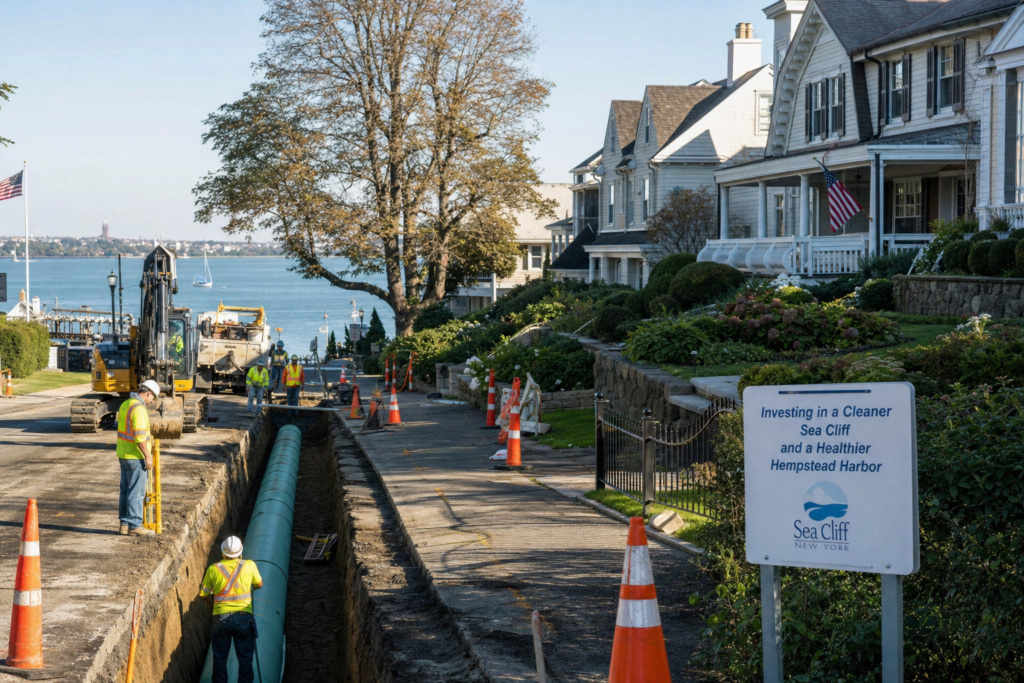
- Service lines. The report says the district posted its lead service line inventory on its website by the end of the third quarter of 2025. Its Spring 2026 newsletter says that in December 2025 the contract for replacing all lead service lines, including goosenecks (short connector pipes), was awarded, that affected property owners had been notified in writing, and that the work is expected to be complete by spring 2027.
- Testing. If you are concerned about lead and want your water tested, the report says to contact the district’s superintendent at (516) 921-8280.
What EPA’s Lead and Copper Rule Improvements Change
According to EPA’s October 2024 fact sheet and its LCRI questions and answers, the final rule:
- Requires most water systems to replace lead service lines, and certain galvanized lines, under their control within 10 years or less
- Lowers the lead action level from 15 µg/L to 10 µg/L
- At sites with lead service lines, requires collecting the first-liter and fifth-liter samples and using the higher result
- Requires annual reports to include clear health language about lead and to say where to find the system’s lead service line replacement plan
EPA’s Q&A says systems must begin complying three years after the rule’s publication in the Federal Register, and gives late 2027 as the expected start of compliance; a few earlier requirements, such as the initial service line inventory, applied from October 16, 2024. These dates come from EPA’s LCRI page and Q&A as last updated in December 2025 and March 2026; check them for the current status.
Bottled Water and Filters: What Health Officials Advise
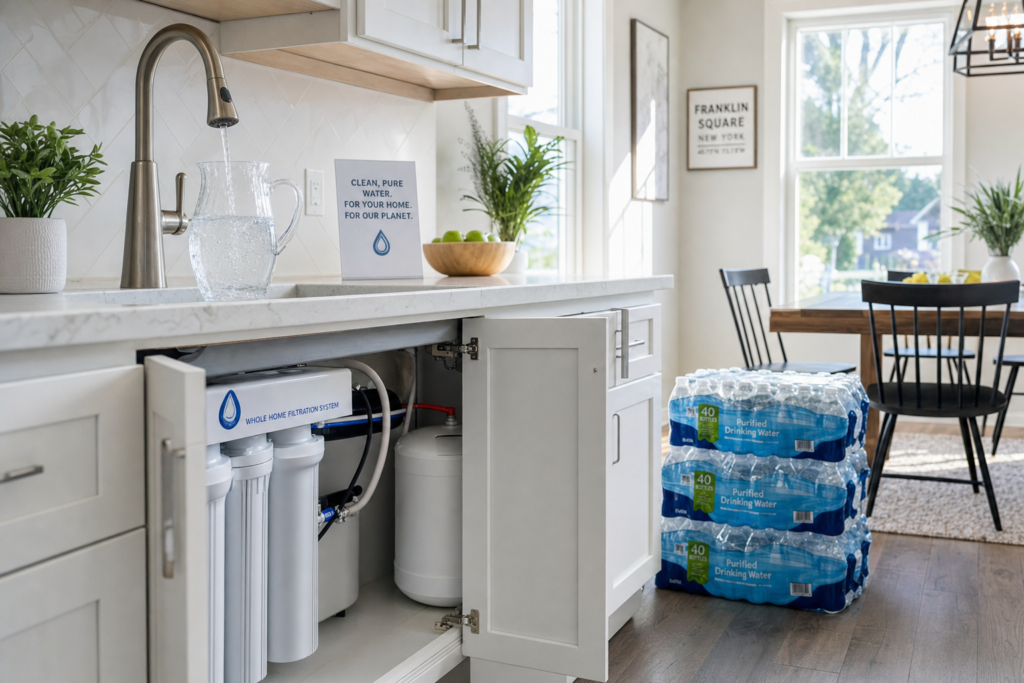
Bottled water can feel like a convenient fix. The New York State Department of Health advises using bottled water certified by New York State, or a Lead Content Certified water filter, if your home is served by a lead service line or lead-containing plumbing is found in your home. The Jericho Water District’s report says a filter certified by an American National Standards Institute accredited certifier to reduce lead is effective in reducing lead exposures, used according to its instructions. For the long-term trade-offs, see Water Filters vs Bottled Water.
Curious what’s in your water? A free in-home water test is a starting point for understanding your home’s water and your options: Free In-Home Water Test. For a lead result specifically, certified commercial laboratories can test your water; the New York State Department of Health puts the cost at $15 to $50 per sample.
Where a Whole-Home System Fits
If you are considering treatment for the whole house, here is how our installed service works.
- Whole-home coverage: The pHountain pHresh Filtration System is a whole-home (point-of-entry) system with a cartridge-free media design intended to reduce common impurities in tap water. Installed at the main water entry point, it treats the water for your shower, kitchen faucet and laundry alike.
- Configured around testing: A whole-home system is configured around what testing finds. For any specific contaminant, ask for independent certification data (for example NSF/ANSI listings) for the exact system you are considering.
- Professional installation: Every system is professionally installed on your main water line.
- 10-year guarantee: Each installed system is backed by a 10-year guarantee.
Treatment is separate from the plumbing itself: the Jericho report says you can help protect your family by identifying and removing lead materials within your home plumbing.
Where Lead Can Hide, and How to Check
| Possible Source | Why It Matters | How to Check |
|---|---|---|
| Lead service line | Typically the most significant source in homes that have one (EPA) | Check your supplier’s service line inventory, or ask your utility or a licensed plumber |
| Brass or chrome-plated brass faucets | The most common problem in homes without a lead service line (EPA) | Look for lead-free certification marks when you replace fixtures |
| Lead solder on pipes | More likely in homes built before 1986 (NYSDOH) | Ask a licensed plumber to look at your pipes and joints |
| Water that sits in pipes | The longer it sits, the more lead it may contain (EPA) | Have a certified laboratory test your tap water |
EPA’s Protect Your Tap guide walks you step by step through finding lead pipes in your home. The neighboring Hicksville Water District’s lead and copper page describes a simple check: lead is dull gray and very soft, turns bright silver when scraped with a key, and even a strong magnet will not stick to it.
What Long Island Customers Say
You can read reviews that customers have left for pHountain Water Filtration on Google on our testimonials page.
Practical Steps to Reduce Lead Exposure
EPA lists these steps, which you can take separately or together (EPA):
- Use cold water for drinking, cooking and baby formula. Boiling water does not remove lead (EPA).
- Run your water before drinking if it has been sitting; how long depends on whether you have a lead service line, so ask your water utility (EPA). NYSDOH suggests at least 30 seconds, or until the water is cold, after several hours of no use (NYSDOH).
- Clean your aerator, the screen at the end of the faucet, where sediment and lead particles can collect.
- Use a filter properly: choose one certified to remove lead, replace the cartridge on time, and do not run hot water through it (EPA).
- Watch for nearby construction if you have a lead service line, since work nearby can disturb it.
- Have your water tested through your water utility or a certified laboratory.
About pHountain Water Filtration
We are a Long Island company based in Islip, serving homeowners in Nassau and Suffolk Counties. Our Meet the Team page introduces the people who will visit your home, and our Islip location page shows where to find us. See also our Nassau County service area page.
Common Client Questions
How much does a whole house filter cost on LI?
Pricing varies with your home’s plumbing layout and water usage. We quote each installation individually after the free in-home water test.
How do I find out if my service line is made of lead?
Ask your water supplier first: EPA says it may know whether the service connector used in your home or area is made of lead, and the Jericho Water District’s report says it has posted its service line inventory online. If your utility has no record, EPA says a licensed plumber may be able to help (EPA).
Is Syosset tap water safe in 2026?
Public water suppliers must meet federal and state drinking water limits and publish an annual water quality report showing what they tested for and found; the EPA explains how to find yours. Lead is a special case: because it comes primarily from service lines and in-home plumbing, as the Jericho Water District’s report notes, a system-wide result does not describe your own tap. If your home is on a private well, testing it is your responsibility (EPA).
Why does my water have a metallic taste?
Taste is not a reliable sign of lead: the EPA says you cannot see, taste or smell lead dissolved in water. If you notice a lasting change in taste, contact your water supplier, and if you want to know whether lead is present, have your water tested by a certified laboratory.
Want a clearer picture of your Syosset home’s water? Call (631) 991-3995 or request a Free In-Home Water Test from pHountain Water Filtration.
This blog is for informational purposes only and does not guarantee specific water quality outcomes. Water quality varies by location, and conditions and regulations can change; consult your water supplier and a qualified water treatment professional for advice about your home. Private well owners should have their water tested regularly. pHountain Water Filtration provides free in-home water tests in Nassau and Suffolk Counties.
Sources
- Jericho Water District, Annual Drinking Water Quality Report for 2025: https://www.jerichowater.org/wp-content/uploads/2026/05/JWD_2025_ADWQR.pdf
- Jericho Water District, Spring 2026 Newsletter: https://www.jerichowater.org/wp-content/uploads/2026/06/JWD-Spring-2026-Newsletter.pdf
- Jericho Water District: https://www.jerichowater.org/
- Nassau County, Public Water System Phone Numbers: https://www.nassaucountyny.gov/DocumentCenter/View/34015
- Nassau County Department of Health, Public Water Supply: https://www.nassaucountyny.gov/2970/Public-Water-Supply
- U.S. EPA, Basic Information about Lead in Drinking Water: https://www.epa.gov/ground-water-and-drinking-water/basic-information-about-lead-drinking-water
- U.S. EPA, Lead: https://www.epa.gov/lead
- U.S. EPA, Lead and Copper Rule Improvements: https://www.epa.gov/ground-water-and-drinking-water/lead-and-copper-rule-improvements
- U.S. EPA, LCRI Questions and Answers: https://www.epa.gov/ground-water-and-drinking-water/lcri-questions-and-answers
- U.S. EPA, Fact Sheet: EPA’s Lead and Copper Rule Improvements (October 2024): https://www.epa.gov/system/files/documents/2024-10/final_lcri_fact-sheet_general_public.pdf
- U.S. EPA, Protect Your Tap: A Quick Check for Lead: https://www.epa.gov/ground-water-and-drinking-water/protect-your-tap-quick-check-lead
- New York State Department of Health, Lead in Drinking Water: https://www.health.ny.gov/environmental/water/drinking/lead/
- Hicksville Water District, Lead and Copper Updates: https://hicksvillewater.org/news/lead-and-copper-updates/
- U.S. EPA, Consumer Confidence Reports: https://www.epa.gov/ccr
- U.S. EPA, Private Drinking Water Wells: https://www.epa.gov/privatewells