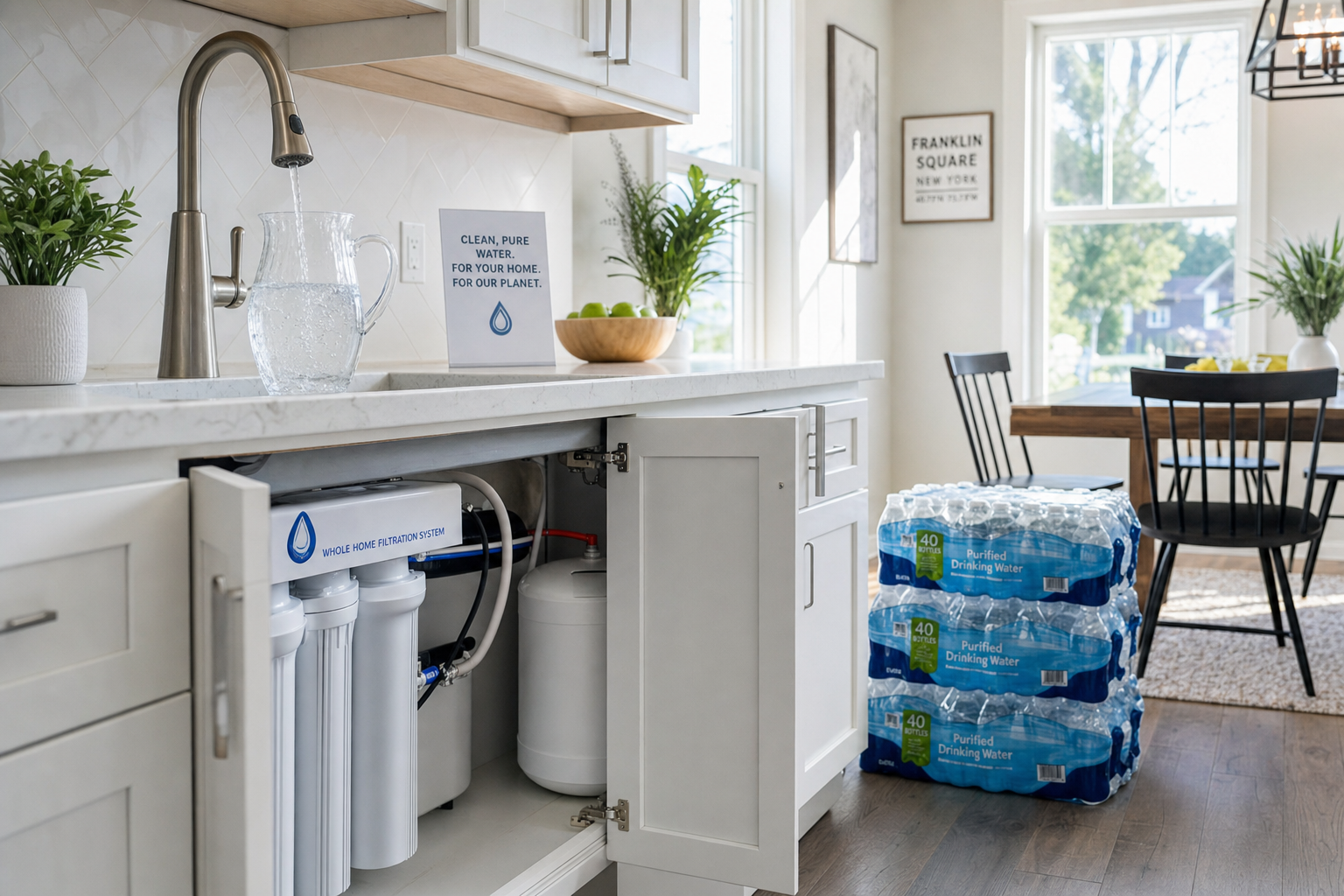
News about PFAS and 1,4-dioxane in Long Island groundwater raises two questions for Franklin Square homeowners: what is in their tap water, and what it would cost to do something about it at home. Public water suppliers work under New York State oversight: the New York State Department of Health (NYSDOH) says it regulates the operation, design and quality of public water supplies in cooperation with county health departments.
This guide is about the cost question. It sets out what a household should count when comparing bottled water, small filters and a whole-home system over several years, and where the real numbers come from: your water bill, your supplier’s annual water quality report, your own receipts and written quotes. For the 1,4-dioxane background, see our companion post, 1,4-Dioxane and Your Tap Water in Franklin Square and Garden City Park: What to Check.
1. Current Expenses Franklin Square Residents Face
Even when a water supplier meets every limit, some homeowners take their own precautions, and those precautions come with ongoing costs. The common options are:
- Bulk bottled water for drinking and sometimes cooking
- Pitcher or faucet-mounted filters as a quick add-on
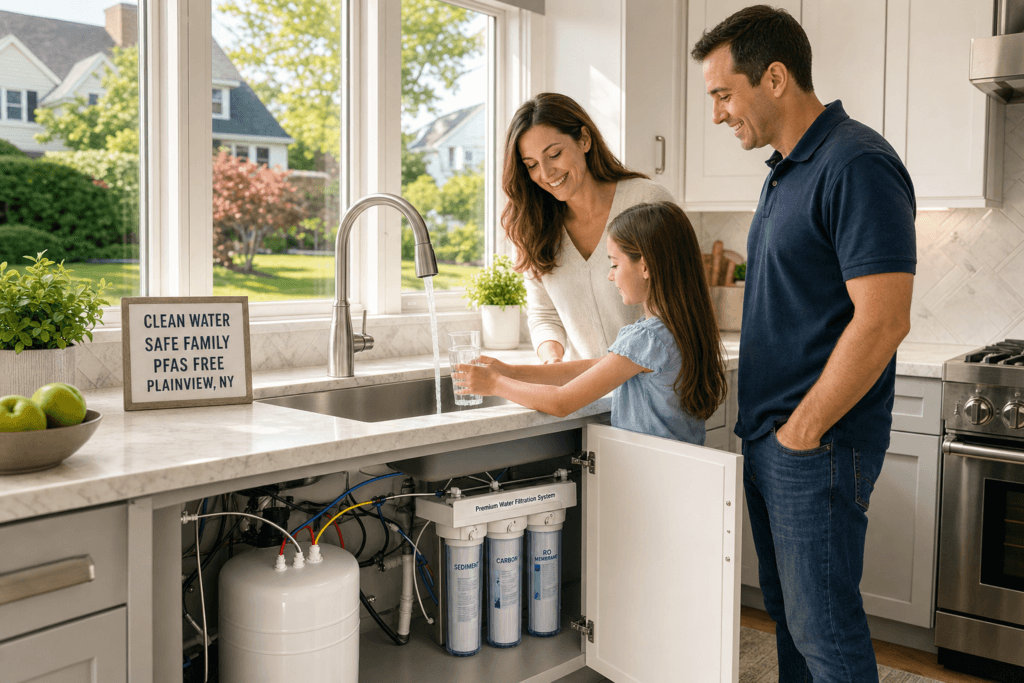
- Under-sink units for the kitchen only
- Whole-home filtration systems installed on the main line
There is also a cost every household on public water already pays: the water itself. Before comparing products, it helps to know what your supplier charges and what it is already doing about emerging contaminants.
2. How PFOS and Emerging Contaminants Affect Household Water Costs
2.1 New York’s Regulatory Perspective on PFOS and PFAS
The NYSDOH Drinking Water Protection Program describes how New York handles public drinking water and emerging contaminants. The state:
- Oversees the delivery of drinking water to make sure it is suitable for people to drink, working with county health departments
- Takes advice on emerging contaminants from its Drinking Water Quality Council, which makes recommendations to the Department of Health
- Provides tools such as the Environmental Public Health Tracker, which shows maps, graphs and tables of public drinking water data, and Know Your NY Water, which finds a large public water system near you and its Annual Drinking Water Quality Report
New York has limited PFOA and PFOS in public water to 10 parts per trillion (ppt) each, and 1,4-dioxane to 1 part per billion (ppb), since 2020 (NYSDOH). The EPA finalized federal limits of 4.0 ppt for PFOA and for PFOS in April 2024, with compliance required by 2029, and in May 2026 it proposed letting systems request two more years, to 2031 (EPA). When the EPA last updated its page on that proposal, on October 8, 2026, it was still a proposed rule, not a final one.
2.2 How Treatment Costs Reach Your Water Bill
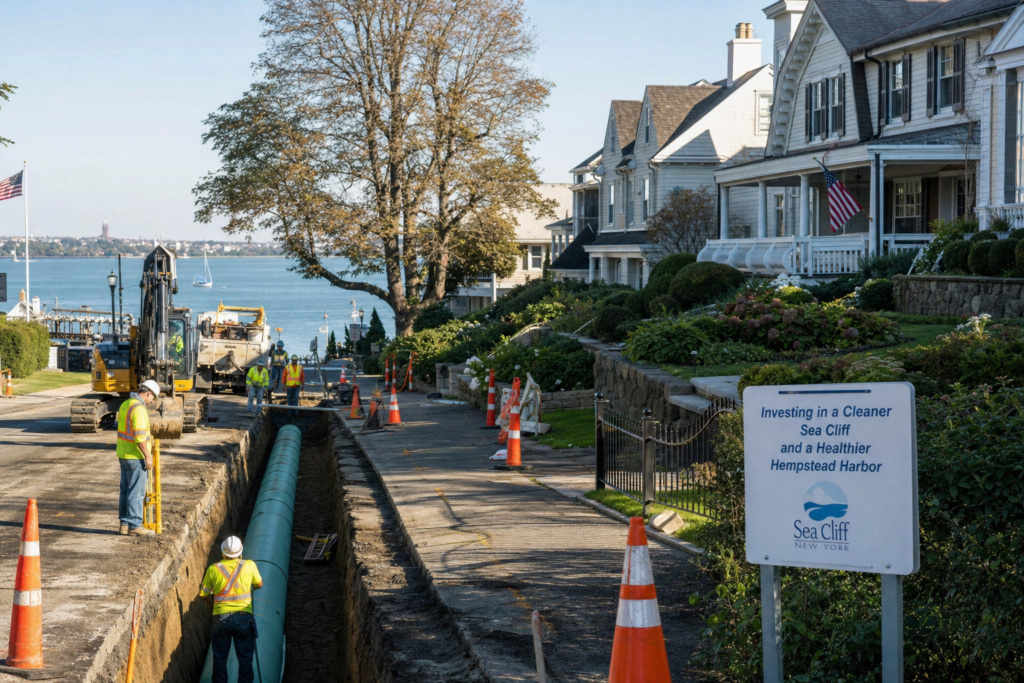
When contaminants are found, utilities plan and build treatment, and that cost is part of what customers pay. The Franklin Square Water District (FSWD) says so on its Rates & Info page: new federal and state requirements, such as stricter PFAS limits and lead service line inventories, require more advanced and more expensive testing and filtration technologies, and the district says it has built two new treatment plants in the past five years at a cost of more than $10 million.
The district’s 2025 Drinking Water Quality Report (dated May 2026) describes the treatment in place: packed tower aeration for volatile organic compounds, granular activated carbon (GAC) for perfluorinated compounds at Wells 1 and 2, and an advanced oxidation process (AOP) plus GAC at Wells 4 and 5 for 1,4-dioxane and perfluorinated compounds. In a June 15, 2022 notice, the district said testing had found 1,4-dioxane above New York’s 1 ppb limit at Well No. 5, which it removed from service until a treatment system could be built. Its 1,4-Dioxane Updates page has the quarterly progress reports it posted on that treatment.
In other words, a Franklin Square household on district water already pays, through its water bill, for treatment at the source. In-home options are an extra layer on top of that, so it’s worth knowing what each one costs and what it adds.
3. Comparing Costs: Bottled Water, Small Filters, and Whole-Home Filtration Systems
The comparison below describes how each option’s costs behave rather than giving prices, because prices depend on your usage, household size and the products you choose. Section 8 shows how to put your own numbers in.
3.1 Cost Comparison Table for Common Solutions
| Option | Typical Use | Ongoing Cost Pattern | Key Limitation |
|---|---|---|---|
| Bottled water | Drinking (sometimes cooking) | Weekly or monthly store spend or delivery | Does not help showers or laundry |
| Pitcher / faucet filters | Drinking and coffee/tea | Replacement cartridges on the maker’s schedule | Limited capacity and flow rate |
| Under-sink drinking system | Kitchen tap only | Cartridge changes on the maker’s schedule | No coverage for baths or other taps |
| Whole-home filtration system | Every faucet and shower in the home | Periodic service over the system’s life | Higher upfront investment |
4. Evaluating the True Cost of Bottled Water in Franklin Square
4.1 How Bottled Water Comes Into the Home
Bottled water usually arrives in a few forms:
- Cases of single-serve bottles for school, work and home
- 3–5 gallon jugs for dispensers
- Occasional emergency supplies during local water news or advisories
Bottled water is regulated too. NYSDOH regulates commercial bottled water suppliers (NYSDOH), and FSWD’s 2025 report notes that the State Health Department’s and the FDA’s regulations set limits for contaminants in bottled water “which must provide the same protection for public health.” Relying on bottles as your main strategy, though, is a recurring expense.
4.2 Five-Year Spend Outlook: Bottled Water vs a Filtration System
Instead of a “typical family” estimate, use real figures:
- Tap water: FSWD’s published rates are $38.00 for the first 9,000 gallons and $3.80 for each additional 1,000 gallons, and its 2025 report says the $38.00 covers a quarter and that the typical district resident pays less than $1 per day for water. At $3.80 per 1,000 gallons, each additional gallon costs less than half a cent.
- Bottled water: divide the price on your receipt by the number of gallons you bought (one gallon is 128 fluid ounces) to get your price per gallon, then multiply by the gallons your household goes through in a month.
- Five-year total: multiply the monthly figure by 60 and set it beside a written quote for a filtration system, including installation and expected maintenance over the same five years.
FSWD’s own view, in an April 23, 2026 article, is that tap water is significantly less expensive than buying bottled water regularly. Your receipts will show how large that gap is for your household.
5. Small Filters: Examining the True Long-Term Expense
5.1 Upfront Savings vs Recurring Costs
Pitcher and faucet-mounted filters often look like the most budget-friendly solution. The initial purchase is low, but:
- Cartridge replacements recur year after year
- Multiple devices (kitchen, fridge, bathroom) multiply that cost
- Pairing a filter with bottled water means paying for both
Over three to five years, those costs add up. Note each cartridge’s price and replacement interval so you can include them in your comparison.
5.2 What Small-Scale Filters Cover
Small filters typically treat one faucet or a single pitcher at a time. That means:
- Showers and baths still use untreated tap water
- Bathroom sinks, laundry and dishwashers are untreated
How much that matters depends on the contaminant. On its PFAS and Private Wells page, NYSDOH says people are exposed to PFAS in water mainly through drinking it and through food prepared with it, and that household uses such as cleaning, washing and bathing do not result in significant exposure. The same page says that a filter for your drinking water can decrease PFAS exposure, and that units using GAC or reverse osmosis, from pitchers to larger systems, can be effective in removing PFAS from drinking water. A certified drinking-water filter therefore belongs in your comparison; whole-home treatment is about the other taps, and depends on what testing finds and how you want water treated throughout the house.
New York’s guidance also says that if a “Do Not Use” notice is ever issued, additional precautions are needed, and residents should contact their local health department for guidance (NYSDOH).
6. Whole-Home Filtration Systems: Assessing Value and Coverage
6.1 Costs and Coverage of Whole-Home Systems
A whole-home filtration system is installed where water enters the house, so every tap receives water that has passed through it. The upfront investment is higher, but:
- Operating costs are spread over years of use
- It can replace or lower spending on bottled water and multiple small filters
- It gives one point of treatment for drinking, cooking, bathing and cleaning water
Whether it costs less than your current routine over time depends on your own numbers: the written quote, the maintenance it lists and what you spend today.
6.2 What Professional Installation Involves
With pHountain Water Filters, a whole-home system follows a set process:
- Free in-home water test to understand your specific conditions
- System recommendation based on what testing finds and on your home’s plumbing and water use
- Professional installation on your main water line
- 10-year guarantee on the pHountain pHresh Filtration System
7. What Long Island Customers Say
You can read reviews that customers have left for pHountain Water Filtration on Google on our testimonials page.
8. How to Calculate Your Own Water-Related Spending in Franklin Square
Use this simple process to see where your money is going today.
8.1 Step 1 – Tally Bottled Water and Filter Expenses
- Gather your last 3 months of receipts or bank statements.
- Highlight any water-related purchases, including bottles, jugs, delivery and filter cartridges.
- Calculate an average monthly total for those three months.
8.2 Step 2 – Add What You Pay for Tap Water
- Find your last few water bills. If you are an FSWD customer, the district’s Understanding Your Bill page explains where the billing period, meter readings and amount due appear.
- Note the amount for each billing period and convert it to a monthly figure.
- Keep it separate from your bottled water and filter spending: you pay it whichever option you choose.
8.3 Step 3 – Project Expenses Over Several Years
- Multiply your monthly bottled water and filter average by 12 to estimate your yearly spend.
- Multiply again by 3 or 5 to see what that looks like over the medium term.
- Compare that figure with a written quote for a whole-home system plus its listed maintenance over the same period.
8.4 Step 4 – Consider Intangible Costs
Beyond dollars, consider:
- Time spent shopping for and carrying bottled water
- Storage space taken up by cases and jugs
- Plastic waste from single-use bottles
- Convenience of treated water at every tap rather than one
9. Staying Updated: Franklin Square Water Quality Resources
Your supplier’s annual water quality report, also called a Consumer Confidence Report, is where the real numbers about your water come from. The EPA explains how to find yours, and the NYSDOH drinking water pages link to tools for finding a large public water system’s report and viewing public drinking water data.
If your water bill comes from the Franklin Square Water District, its Water Quality page has the 2025 report. According to that report:
- The district’s five wells draw from the Magothy aquifer, and over 170 separate parameters are tested in each well numerous times per year.
- PFOS was detected at up to 2.21 nanograms per liter (parts per trillion) and 1,4-dioxane at up to 0.23 micrograms per liter (parts per billion), with no violations; the report lists New York’s limits of 10 ppt and 1 ppb.
- PFOA is among the contaminants the report lists as not detected.
- Lead and copper action levels were not exceeded at any site tested in 2023, the next round of sampling is scheduled for 2026, and lead levels at your home may be higher than at other homes because of the materials used in your plumbing. The EPA’s lead page explains that lead can enter drinking water when lead pipes and plumbing materials containing lead corrode, and how to reduce the risk.
If your bill comes from a different public water supplier, use that supplier’s report and rate schedule instead. For questions about notices or advisories, you can also contact the Nassau County Department of Health, which FSWD’s report lists as a contact.
For regional context, see Long Island Has a PFAS Problem. Here’s What You Need to Know.
10. Deciding Between Bottled Water, Filters, and Whole-Home Systems
Here’s a practical way to weigh your choices if PFOS is on your mind.
10.1 Bottled Water: When It Makes Sense and When It Doesn’t
Bottled water can play a role when:
- You need short-term coverage during a specific advisory
- You’re waiting on test results or a system installation
- You want a backup supply for emergencies
As a permanent solution, it is a recurring cost that covers drinking and cooking water only.
You can learn more about this tradeoff in depth here: Water Filters vs Bottled Water.
10.2 Can Small Filters Meet Your Needs?
Pitchers and faucet filters can be useful if:
- You live alone or have very low water usage
- You only want filtered drinking water at a single tap
- You’re renting and can’t modify plumbing
They treat only the tap they are on, and replacement cartridges are a cost to include in your comparison. Check that a filter is certified for the contaminant you care about; FSWD’s 2025 report, for example, says that using a filter certified by an American National Standards Institute accredited certifier to reduce lead is effective in reducing lead exposures.
10.3 When a Whole-Home System May Be the Better Investment
A whole-home system may fit when:
- You own your home in Franklin Square or nearby
- You want treated water at every tap, not just the kitchen
- You already spend regularly on bottled water and several small devices
- You want a single, professionally installed system rather than a patchwork of products
For a broader view of how whole-home systems fit into Nassau County options, see: Water Filtration Nassau County NY and Water Filtration Hempstead NY.
If you want to know what’s in your own tap water before deciding, you can request a Free In-Home Water Test.
11. How pHountain Water Filters Supports Franklin Square Residents
pHountain Water Filters provides residential water filtration across Long Island, including Franklin Square and the rest of Nassau County.
11.1 Testing and Personalized Recommendations
For Franklin Square homeowners, the process typically includes:
- Water testing to understand your home’s water
- System design based on your home’s plumbing and water usage
- Professional installation of the recommended configuration
Measuring PFAS and 1,4-dioxane at the levels regulators use (parts per trillion and parts per billion) requires analysis by a certified laboratory; a free in-home water test is a starting point for understanding your water and your options.
11.2 The pHountain pHresh Filtration System
The pHountain pHresh Filtration System is a whole-home (point-of-entry) system with a cartridge-free media design intended to reduce common impurities in tap water. It is recommended after a free in-home water test, professionally installed and backed by a 10-year guarantee.
A whole-home system is configured around what testing finds. For any specific contaminant, ask for independent certification data (for example NSF/ANSI listings) for the exact system you are considering.
To explore service in nearby communities, you can also review: Water Filtration Long Island NY and Water Filtration Levittown NY.
12. Actionable Advice for Franklin Square Homeowners
If you want to get a handle on both your water and its cost, here’s a straightforward path:
- Review your supplier’s annual water quality report, using the district’s site or New York’s drinking water tools.
- Contact your local health department with any questions about notices or advisories.
- Audit your current spending on bottled water and small filters using the method in Section 8.
- Schedule a water test to understand your home’s specific conditions.
- Compare total 3–5 year costs of bottled water, small filters and a whole-home system, using written quotes.
- Decide whether a whole-home installation fits your budget and goals.
Frequently Asked Questions
How does PFOS in Franklin Square water affect my household budget?
PFOS itself doesn’t change your water bill directly, but treating for it is part of what utilities spend. FSWD says stricter PFAS limits require more advanced and more expensive testing and filtration technologies (FSWD), and its 2025 report lists GAC treatment for perfluorinated compounds. At home, concern about PFOS can also lead to spending on bottled water and filters. Those purchases add up over several years, so total them before comparing them with the quote for a system.
Are Franklin Square residents covered by New York’s drinking water protections?
Public water systems in Franklin Square fall under New York’s drinking water regulations. NYSDOH says it works with county health departments to regulate the operation, design and quality of public water supplies, and runs programs that help fund public drinking water systems (NYSDOH). Suppliers must meet federal and state limits and publish an annual water quality report. Private wells are not covered by those limits, and testing a private well is the owner’s responsibility.
If my Franklin Square provider meets state standards, why consider a filter at all?
State oversight is designed to make sure the water a public system delivers is suitable to drink (NYSDOH). Some homeowners still prefer a household-level option so they can:
- Choose treatment that matches their own comfort level
- Have treated water at every tap, not just the kitchen
- Potentially spend less on bottled water over time
There is also the plumbing inside the house, which a supplier does not control: FSWD’s 2025 report notes that lead levels at your home may be higher than at other homes because of the materials used in your plumbing.
What’s the first step if I’m worried about PFOS in my Franklin Square home?
Start by:
- Reading your water supplier’s annual report for its PFOS, PFOA and other PFAS results.
- Contacting your supplier or the Nassau County Department of Health if you see terms like PFOS, PFAS or “emerging contaminants” and want them explained.
- Arranging testing at your home; for PFAS, that means a certified laboratory.
When you’re ready to look at your options, you can request a Free In-Home Water Test.
This blog is for informational purposes only and is not intended as health, safety, or regulatory advice. Always consult your local water provider, health department, or appropriate licensed professional for guidance specific to your situation.
Sources
- Franklin Square Water District, 2025 Drinking Water Quality Report (May 2026): https://www.fswd.org/wp-content/uploads/2026/04/2025-Water-Quality-Report.pdf
- Franklin Square Water District, Water Quality: https://www.fswd.org/water-quality/
- Franklin Square Water District, Rates & Info: https://www.fswd.org/billing/rates-info/
- Franklin Square Water District, Understanding Your Bill: https://www.fswd.org/billing/understanding-your-bill/
- Franklin Square Water District, 1,4-Dioxane Information (June 15, 2022): https://www.fswd.org/14-dioxane-information/
- Franklin Square Water District, 1,4-Dioxane Updates: https://www.fswd.org/resources/14-dioxane-updates/
- Franklin Square Water District, “Bottled Water vs. Tap Water: What are the real differences?” (April 23, 2026): https://www.fswd.org/bottled-water-vs-tap-water-what-are-the-real-differences/
- https://www.health.ny.gov/environmental/water/drinking/
- https://www.health.ny.gov/environmental/water/drinking/emerging_pfas_publicwater.htm
- New York State Department of Health, “PFAS and Private Wells” (revised May 2023): https://www.health.ny.gov/environmental/water/drinking/pfasinprivatewells.htm
- https://www.epa.gov/sdwa/and-polyfluoroalkyl-substances-pfas
- U.S. EPA, “Proposed PFOA and PFOS Compliance Extension Rule” (last updated October 8, 2026): https://www.epa.gov/sdwa/proposed-pfoa-and-pfos-compliance-extension-rule
- https://www.epa.gov/ccr
- https://www.epa.gov/lead
- https://www.epa.gov/privatewells