When 1,4‑dioxane shows up in Long Island water news, Levittown homeowners may wonder: what is it, what limit applies to it, and what can I find out about the water in my own house?
This guide covers what is on record about 1,4‑dioxane, how New York regulates it in public drinking water, and practical steps you can take at home.
What you should understand about 1,4‑dioxane
- 1,4‑dioxane is an industrial chemical. According to the EPA, it is manufactured, processed and used in industrial and commercial settings, forms as a byproduct of some manufacturing processes, and turns up as a contaminant in consumer products such as dish soaps and laundry detergents. EPA’s risk evaluation (December 2020, with a final supplement in November 2024) identified cancer among the risks of exposure to it, including through drinking water drawn from contaminated surface water.
- New York regulates it in public water. In 2020 New York set a maximum contaminant level of 1 part per billion (ppb) for 1,4‑dioxane in public drinking water. New York was the first state to set a limit for it, according to the New York State Department of Health.
- Levittown relies on groundwater. Like the rest of Long Island, Levittown draws its drinking water from the aquifer system beneath the Island, so what happens to that groundwater matters at your tap.
- Private wells are not covered. Drinking water limits apply to public water systems, not private wells. Private well owners are responsible for testing their own water, according to the EPA.
Treatment by your public water supplier is essential. But it doesn’t fully answer the question that matters most to you: what’s happening to the water in your specific house, at your faucets, your showers, and inside your appliances?
From the aquifer to your tap: where water quality can change
Here’s how water typically reaches a Levittown home, and where its quality can change along the way:
- Aquifer to well. Long Island’s sole‑source aquifer sits under Levittown just like it does under the rest of Nassau and Suffolk. Over time, industrial chemicals can migrate through soil into the groundwater, and public supply wells draw from that same aquifer.
- Treatment at the well. Public water suppliers treat and test water to meet state and federal limits, including New York’s 1 ppb limit for 1,4‑dioxane. When standards change, suppliers may need to upgrade treatment to meet them.
- Distribution lines. Even after treatment, water still has to move through miles of pipes under Levittown streets. Those pipes can add their own issues, from sediment and discolored water to metals that weren’t part of the original treatment design.
- Your home’s plumbing. Once water reaches your curb, it passes through your own service line, then through your home’s plumbing. Older pipes, hot‑water heaters, and fixtures can all influence taste, odor, and what actually comes out of each tap.
That’s why two houses on the same block, both on public water, can have different water at the tap. Treatment upgrades at the well improve the baseline, but they don’t give you direct control over the plumbing inside your own home.
Elsewhere in Nassau County, in Bethpage, the Navy‑Grumman groundwater plume, whose primary contaminant is TCE and other chlorinated solvents, has impacted public supply wells, and 1,4‑dioxane is also treated there, according to the New York State Department of Environmental Conservation. For more on regional contamination beyond Levittown:
- Long Island Has a PFAS Problem. Here’s What You Need to Know
- Bethpage’s Groundwater Plume and 1,4-Dioxane: What Long Island Homeowners Should Know
Reasons to consider filtration at home
- Bottled water covers only part of the house. Families who rely on bottled water for drinking and cooking are still showering, washing dishes, and doing laundry with tap water. We compare the tradeoffs in Water Filters vs Bottled Water.
- Pitcher filters and faucet attachments treat one tap. Countertop and fridge filters are a natural first step, but they only treat a fraction of the water you use.
- A layer you control. Public suppliers work to meet regulatory limits; a home system adds a layer of treatment that you control.
Our team’s view is straightforward: public water treatment is essential, but it operates at the system level. A whole‑home filtration system works at the house level.
If you want to see how we serve your specific neighborhood, you can explore our Levittown‑focused page here: Water Filtration Levittown NY
The pHountain Filtration System for Levittown homes
The core concept is simple: treat the water at the point it enters your home, not just at one faucet.
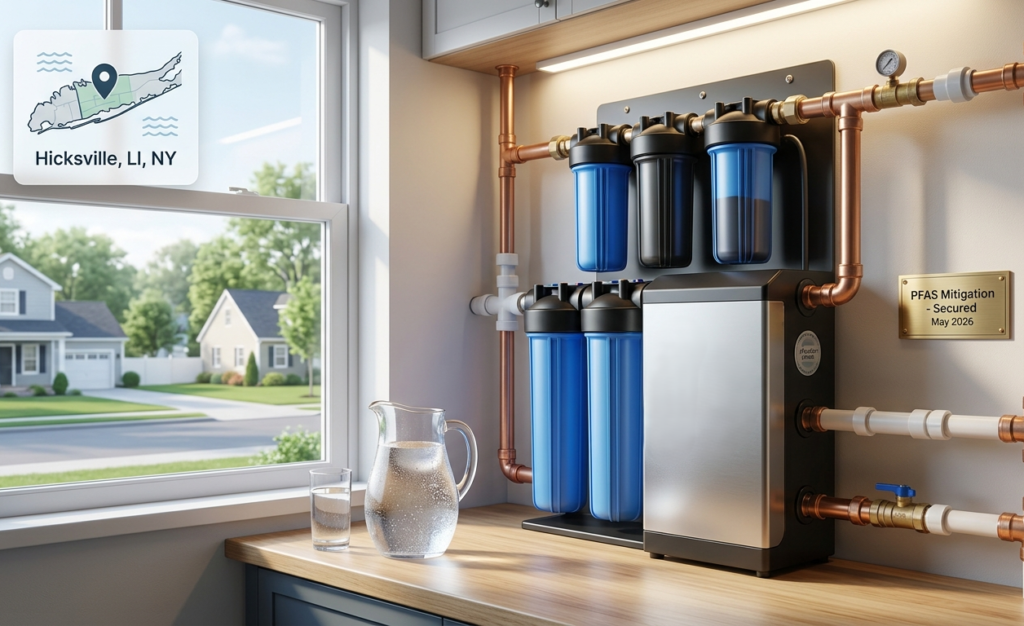
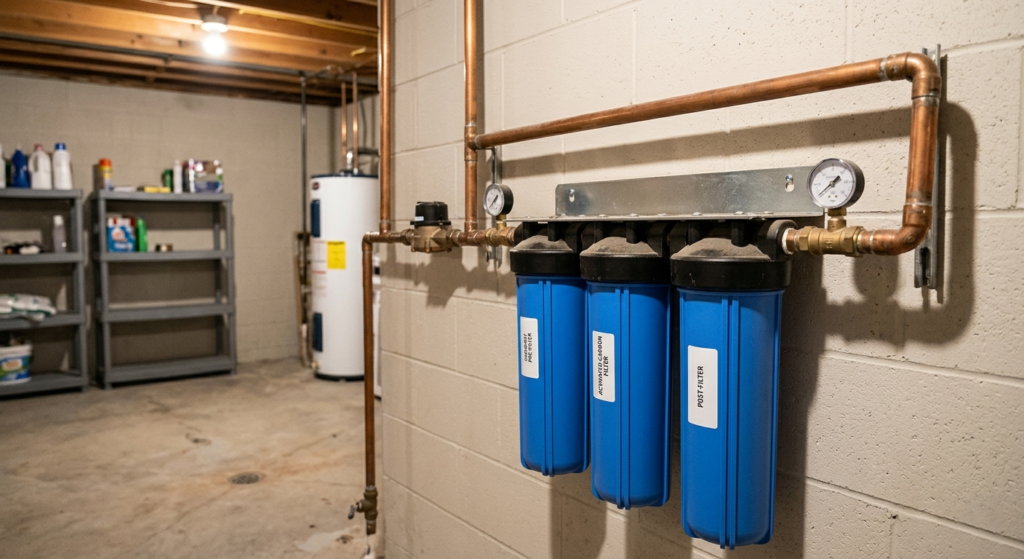
The pHountain Filtration System is a whole‑home (point‑of‑entry) system with a cartridge‑free media design intended to reduce common impurities in tap water. We install it where the water line first comes into your Levittown home, so from that point forward every faucet, showerhead, and appliance receives treated water:
- Kitchen taps
- Bathroom sinks and showers
- Laundry machines
- Dishwashers
- Ice makers and fridge dispensers
A whole‑home system is configured around what testing finds. For any specific contaminant, ask for independent certification data (for example NSF/ANSI listings) for the exact system you are considering.
Professional installation
Our process for Levittown homes typically looks like this:
- Water testing – We start with a free in‑home water test of your tap water.
- System recommendation – Based on your test results and home size, we recommend a configuration of the pHountain Filtration System suited to your situation.
- Professional installation – Our technicians install the system on your main water line.
If you’re comparing options across Long Island, it can also help to look at how we serve neighboring areas:
Practical next steps for Levittown homeowners
If 1,4‑dioxane news has you thinking about your water, here’s a practical checklist:
- Read your annual water quality report. Your public water supplier publishes an annual water quality report (a Consumer Confidence Report) that lists the regulated contaminants detected in your water. The EPA explains how to find and read yours.
- Contact your public water supplier. Ask how it monitors and treats for 1,4‑dioxane and how it communicates updates to residents.
- Take stock of your current setup. Where do you currently filter water, if at all? Are you noticing chlorine smell, staining, or cloudy water? How much bottled water are you buying?
- Get your own water tested. Measuring PFAS and 1,4‑dioxane at the levels regulators use (parts per trillion and parts per billion) requires analysis by a certified laboratory; a free in‑home water test is a starting point for understanding your water and your options. You can request a visit here: Free In‑Home Water Test
- Compare long‑term options. After you see your results, weigh the ongoing cost of bottled water and piecemeal filters against a whole‑home system installed at the point of entry.
Common inquiries from Levittown water users
1. Is Levittown’s tap water considered safe?
Public water suppliers must meet federal and state drinking water limits, including New York’s 1 ppb limit for 1,4‑dioxane, and they publish an annual water quality report that lists the regulated contaminants detected. The EPA explains how to find your supplier’s report. Private wells are not covered by those limits, so well owners are responsible for testing their own water.
2. I’m on Levittown public water. Do I still need to test my water at home?
It’s worth doing. Even when you’re on a public system, what comes out of your tap is influenced by your service line, your home’s plumbing, and your fixtures. A test at the tap tells you about your water after it travels from the well, through treatment, across the distribution system, and into your house. For 1,4‑dioxane specifically, measuring at the 1 ppb level requires a certified laboratory.
3. How is a whole‑house system different from the pitcher filter on my counter?
A pitcher filter only treats the water you pour into it, usually for drinking. It doesn’t touch showers, baths, laundry, dishwashers, or bathroom sinks. A whole‑house system like the pHountain Filtration System is installed where water enters your Levittown home, so it treats the water used throughout the house.
If 1,4‑dioxane news has you rethinking your water, the most useful next step is to learn what’s in your own tap and explore whole‑home options. You can book a free in‑home water test with our team here: Free In‑Home Water Test
Sources
- 1. — https://www.health.ny.gov/environmental/water/drinking/emerging_pfas_publicwater.htm
- 2. — https://www.epa.gov/assessing-and-managing-chemicals-under-tsca/final-risk-evaluation-14-dioxane
- 3. — https://www.epa.gov/privatewells
- 4. — https://www.epa.gov/ccr
- 5. — https://extapps.dec.ny.gov/docs/remediation_hudson_pdf/130003aarodou2ou3.pdf