Key Takeaways
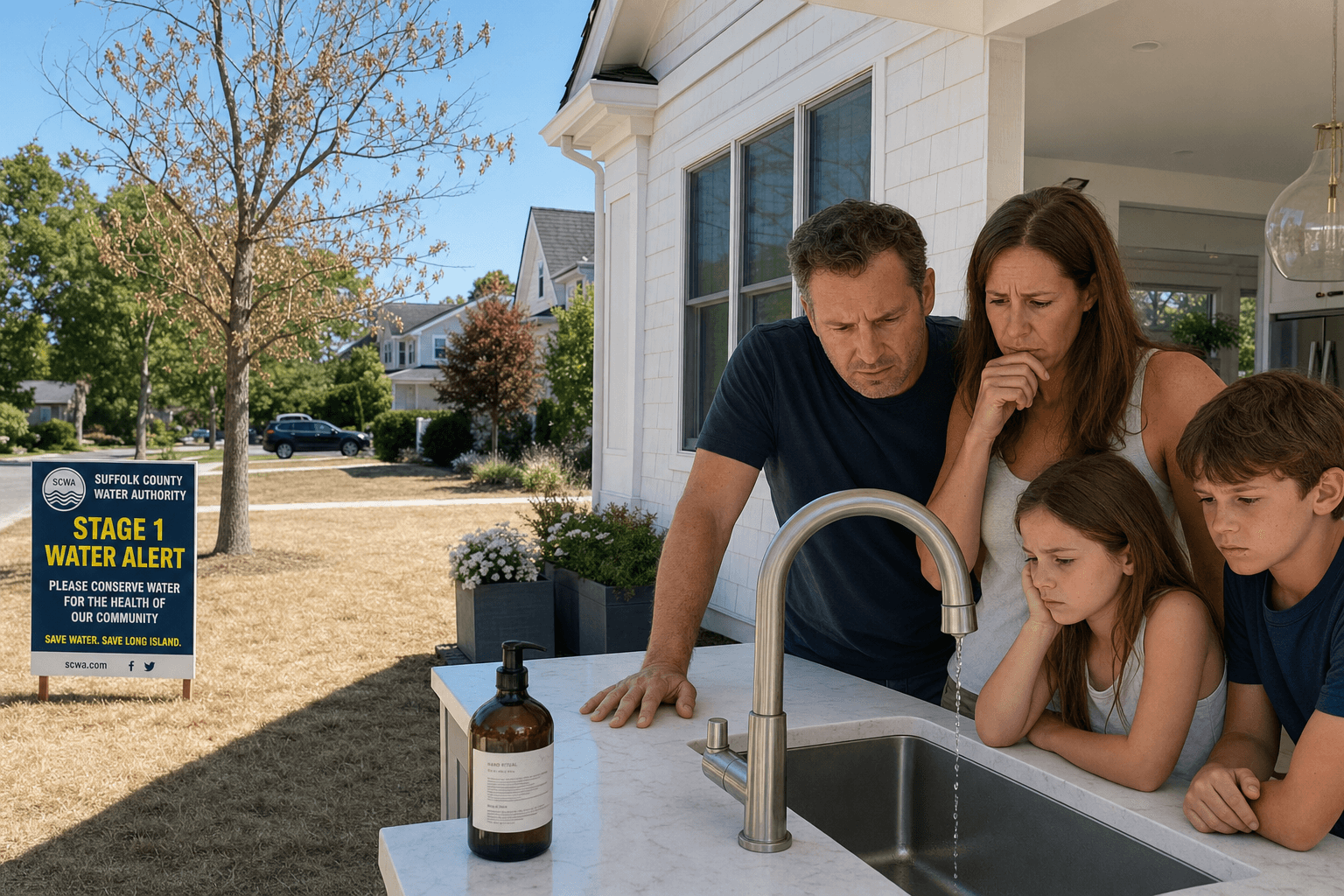
- On July 14, 2026, the Suffolk County Water Authority (SCWA) declared a Stage 1 Water Alert for all customers in East Hampton, Southampton, Southold and Shelter Island, citing drought and record pumpage. It lifted the alert for East Hampton on July 31; it stayed in effect in Southold.
- SCWA said overnight and early-morning lawn irrigation was what left its storage tanks low, and low tank levels reduce pressure, which can lower flow to homes and limit water for fire protection (SCWA).
- SCWA’s odd/even schedule applies by street address, with a daily no-watering window from 10 a.m. to 4 p.m. SCWA describes the odd/even schedule as its policy for all lawn watering, not only during alerts (SCWA, September 10, 2025).
- SCWA offers Water Wise account credits for devices such as smart irrigation controllers and rain sensors, and free Water Wise Checkups (SCWA).
- Home water filtration treats the water that enters your house; it does not add supply or raise system pressure.
What’s Behind East Hampton’s Water Pressure Concerns in Summer?
If you live in East Hampton, summer is when SCWA has warned that pressure can drop. On July 14, 2026, SCWA declared a Stage 1 Water Alert for all customers in East Hampton, Southampton, Southold and Shelter Island. It said that, despite rain the week before, Suffolk County remained in a moderate drought, with portions of the county, particularly on the East End and Huntington, experiencing severe drought conditions (SCWA).
Our post on managing water use and pressure during the SCWA East End Stage 1 water alert covers the alert itself and what it meant for East Hampton homes. This post focuses on the part of the alert that is in your hands: lawn and irrigation watering, how SCWA’s rules work, and the tools SCWA offers to follow them.
Drought and Demand: Why Lawn Watering Became the Focus
SCWA set a pumpage record in June 2026, withdrawing 11.15 billion gallons of water across its entire system, and nearly exceeded its peak pumpage-per-minute record by reaching 540,000 gallons per minute. With production facilities operating at capacity, SCWA said no additional infrastructure was available to meet that demand (SCWA, July 14, 2026).
The warnings started earlier. Ahead of the July 4 holiday weekend, SCWA urged customers to reduce water use and said the greatest strain on the system occurs overnight and during the early morning hours when lawn irrigation systems are running, The South Shore Press reported on July 2, 2026. SCWA officials warned that without voluntary conservation, the system could experience pressure drops affecting both customers and emergency responders.
SCWA’s conservation page makes the same point in general terms: during spring and summer, demand spikes in the early morning when most sprinkler systems run.
How Irrigation Demand Lowers Water Pressure: The Essentials
SCWA’s July 14, 2026 announcement lays out the chain (SCWA):
- Sprinklers run at the same hours: SCWA reported high demand during overnight and early-morning hours from irrigation systems.
- Storage tanks start the day low: As a result, tanks begin the day at low levels and require more time to refill.
- Tank levels set the pressure: The weight of the water in the tanks creates the pressure that pushes water through the mains. When tank levels drop too low, pressure drops as well, which can lower flow to homes.
- Fire protection depends on the same reserve: The tanks also function as a reserve supply, and SCWA said low tank levels mean emergency services may not have the water they need to respond to a fire.
That is why SCWA’s alert focused on lawn watering.
SCWA’s Odd/Even Lawn Watering Schedule, Explained
SCWA’s Odd/Even Lawn Watering page sets out the rules:
- Odd addresses (ending in 1, 3, 5, 7 or 9) water on odd calendar days.
- Even addresses (ending in 0, 2, 4, 6 or 8) water on even calendar days.
- No-watering window: 10 a.m. to 4 p.m. daily. Regardless of your address, SCWA says automatic irrigation is restricted during these midday hours, when evaporation is highest.
- Lookup tool: The page lets you enter your house number to see whether today is a watering day for you, and shows a monthly calendar.
SCWA treats this as standing policy. When it lifted a 2025 Stage 1 alert on September 10, 2025, it reminded all customers of its policy that all lawn watering follow the odd/even schedule, which it said significantly reduces peak demand (SCWA).
What Changes During a Stage 1 Alert
Under the July 2026 Stage 1 alert, SCWA went a step further: it asked customers to refrain from lawn watering unless absolutely necessary, and said that customers who do water must adhere to the odd/even schedule and the 10 a.m. to 4 p.m. ban (SCWA, July 14, 2026). When it kept the alert in Southold on July 31, SCWA’s chief executive said that system stability depends on customers limiting early-morning irrigation (SCWA). In other words, the midday ban is about evaporation, while overnight and early-morning watering is what SCWA said draws its tanks down. During an alert, consider watering less often, not just at a different hour.
Irrigation Tips From SCWA and EPA WaterSense
These steps come from SCWA’s and EPA’s own guidance. Treat them as a checklist for your system:
- Set your controller to match the schedule. SCWA has setup guides for common irrigation controllers, from smart app-based models to older dial timers.
- Let the weather decide. EPA says WaterSense labeled irrigation controllers use local weather or soil moisture data to adjust your schedule, and that schedules should be adjusted for seasonal changes (EPA WaterSense). SCWA’s WaterWise Gardening Guide recommends monitoring rainfall and using rain sensors to limit automatic watering.
- Know how much your lawn needs. SCWA’s gardening guide says lawns generally require only an inch of water a week, and that lawns and plants are healthier with fewer, longer soakings. EPA puts a typical landscape at about one inch a week, including rainfall.
- Inspect your sprinkler heads. Because most irrigation systems run overnight or early in the morning, EPA notes that broken heads can be hard to spot; it suggests checking each zone for heads that don’t pop up fully or are tilted (EPA Sprinkler Spruce-Up).
- Keep water off the pavement. EPA recommends turning sprinklers that spray driveways, sidewalks or walls back toward the landscape (EPA).
- Use cycle-and-soak on slopes or heavy soil. If water pools or runs off, EPA suggests splitting run times into shorter intervals with breaks so the water soaks in (EPA).
- Mulch and mow high. SCWA’s gardening guide says mulch can reduce evaporation and suggests mowing at 3 inches with a mulching mower.
- Choose drought-tolerant plants. The same guide lists drought-tolerant ornamentals it recommends for Long Island and says native plants are good choices.
EPA’s drought advice also includes “Take a sprinkler break”: grass doesn’t need to be green year round, and the green returns when the rains do (EPA WaterSense, drought).
Bottled Water During a Watering Alert
SCWA’s 2026 alert announcements were about lawn watering, tank levels and pressure. Neither the July 14 nor the July 31 release said anything about drinking water quality. If you are weighing bottled water against filtration for other reasons, our page on Water Filters vs Bottled Water walks through the tradeoffs for Long Island homeowners.
Curious What’s in Your Water?
Pressure and water quality are separate questions. If you want to know what is in your own tap water, book a free in-home water test.
The pHountain Filtration System: What It Is and What It Isn’t
The pHountain Filtration System is a whole-home (point-of-entry) system with a cartridge-free media design intended to reduce common impurities in tap water.
- Whole-home coverage: It is installed at your main water inlet, so it treats the water that reaches every tap and shower.
- Recommended after testing: A system is recommended after a free in-home water test.
- Professional installation: It is professionally installed.
- 10-year guarantee: It is backed by a 10-year guarantee.
A whole-home system is configured around what testing finds. For any specific contaminant, ask for independent certification data (for example NSF/ANSI listings) for the exact system you are considering.
What it isn’t: a fix for the pressure drops SCWA described. Those come from demand on the public system, and the remedy SCWA asked for was less lawn watering (SCWA).
Bottled Water vs Pitcher Filter vs Whole-Home Filtration: A Quick Comparison
| Feature | Bottled Water | Pitcher Filter | Whole-Home Filtration |
|---|---|---|---|
| What it covers | Drinking only | Drinking and some cooking | All water entering the home |
| Showers and laundry | No | No | Yes |
| Convenience | Buy, carry and store | Refill by hand | Built into your plumbing |
| Installation | None | None | Professional installation |
What Long Island Customers Say
You can read reviews that customers have left for pHountain Water Filtration on Google on our testimonials page.
Credits SCWA Offers for Water-Saving Devices
If you are upgrading your irrigation anyway, SCWA’s Water Wise page lists account credits for water-saving devices. As listed there in October 2026:
- Smart irrigation controllers: $150 credit.
- Rain sensors: $75 credit.
- Pressure regulators and smart leak-detecting valves: $100 credit each.
- Rain barrels and solar pool covers: $75 credit each.
- Rules: the maximum credit is $250 per account every three years, the credit applies to the device only (not installation or labor), and it cannot exceed the purchase price. Check the page for current amounts before you buy.
SCWA also offers a free Water Wise Checkup, which it says includes a review of your irrigation system, timer settings and landscaping, along with an indoor check for leaks.
About pHountain Water Filters
- Serves Long Island (Nassau and Suffolk counties), including East Hampton and the rest of the East End.
- Offers a free in-home water test as the starting point for any recommendation.
- Provides professional installation of whole-home systems.
- Backs the pHountain Filtration System with a 10-year guarantee.
For more on service across the region, see our page on Whole-Home Water Filtration for Suffolk County.
Frequently Asked Questions
Does SCWA’s odd/even schedule apply when there is no water alert?
Yes, as SCWA policy. In its September 10, 2025 announcement lifting that year’s Stage 1 alert, SCWA reminded all customers of its policy that all lawn watering follow the odd/even schedule (SCWA). Before it declared the 2026 alert, SCWA asked customers to follow its lawn watering schedule voluntarily, The South Shore Press reported on July 2, 2026. Its odd/even page also lists the daily 10 a.m. to 4 p.m. no-watering window.
What did SCWA ask East Hampton customers to do during the 2026 Stage 1 alert?
SCWA asked customers to refrain from lawn watering unless absolutely necessary and, if they did water, to follow the odd/even schedule with no lawn watering between 10 a.m. and 4 p.m. (SCWA, July 14, 2026). It lifted the alert for East Hampton on July 31, 2026 (SCWA).
Is East Hampton’s tap water safe to drink during a drought alert?
Public water suppliers such as SCWA must meet federal and state drinking water limits, and they publish an annual water quality report showing what they tested for and found; the EPA has a page on finding yours. SCWA’s 2026 alert was about conserving water and managing system pressure. If your home is on a private well, testing your water is your responsibility (EPA).
Why can water pressure drop in East Hampton in summer?
SCWA says heavy overnight and early-morning irrigation leaves its storage tanks low at the start of the day, and low tank levels reduce system pressure, which can lower flow to homes (SCWA). After late-July rain, SCWA said reduced lawn irrigation improved early-morning tank levels in East Hampton and allowed operating pressure to remain steady (SCWA, July 31, 2026).
How much does a whole-house filter cost on Long Island?
Costs vary with the home and its water needs. The starting point is a free in-home water test, followed by a quote for your home.
Questions About Your East Hampton Water?
If you want a clearer picture of what is in your tap water, request a Free In-Home Water Test from pHountain Water Filters.
This blog is for informational purposes only. Watering rules and alerts can change; always check SCWA’s current guidance and consult a qualified professional for advice tailored to your home.
Sources
- Suffolk County Water Authority, “Suffolk County Water Authority Declares Stage 1 Water Alert on the East End Amid Drought and Record Pumpage” (July 14, 2026): https://www.scwa.com/suffolk-county-water-authority-declares-stage-1-water-alert-on-the-east-end-amid-drought-and-record-pumpage/
- Suffolk County Water Authority, “Suffolk County Water Authority Rescinds Stage 1 Water Alert for Southampton, East Hampton, and Shelter Island; Alert Remains in Southold” (July 31, 2026): https://www.scwa.com/suffolk-county-water-authority-rescinds-stage-1-water-alert-for-southampton-east-hampton-and-shelter-island-alert-remains-in-southold/
- Suffolk County Water Authority, “Suffolk County Water Authority Rescinds Stage 1 Water Alert” (September 10, 2025): https://www.scwa.com/suffolk-county-water-authority-rescinds-stage-1-water-alert/
- Suffolk County Water Authority, Odd/Even Lawn Watering: https://www.scwa.com/oddeven/
- Suffolk County Water Authority, Conservation: https://www.scwa.com/conservation/
- Suffolk County Water Authority, Setting Your Irrigation Controller: https://www.scwa.com/setting-your-irrigation-controller/
- Suffolk County Water Authority, WaterWise Gardening Guide (PDF): https://www.scwa.com/assets/1/6/WaterWise_Gardening_Pamphlet.pdf
- Suffolk County Water Authority, Water Wise Programs: https://www.scwa.com/waterwise/
- Suffolk County Water Authority, Water Wise Checkup: https://www.scwa.com/water-customers/customer-service/water-wise-checkup/
- The South Shore Press, “Heat Wave Pushes Water Demand Near Record Levels” (July 2, 2026): https://www.southshorepress.com/local/heat-wave-pushes-water-demand-near-record-levels-209a1512
- EPA WaterSense, Watering Tips: https://www.epa.gov/watersense/watering-tips
- EPA WaterSense, Sprinkler Spruce-Up: https://www.epa.gov/watersense/sprinkler-spruce-up
- EPA WaterSense, When In Drought: https://www.epa.gov/watersense/drought-watersense
- EPA, Consumer Confidence Reports: https://www.epa.gov/ccr
- EPA, Private Drinking Water Wells: https://www.epa.gov/privatewells