Key Takeaways
- Your supplier: The Suffolk County Water Authority (SCWA) supplies public water in the greater Bohemia area. In 2018 it wrote to its “Greater Bohemia customers” (SCWA notice) and co-hosted a town hall for its Bohemia, Oakdale, Holbrook and Ronkonkoma customers (meeting flyer).
- Annual report: SCWA’s 2026 Drinking Water Quality Report covers testing in calendar year 2025 and shows results by distribution area.
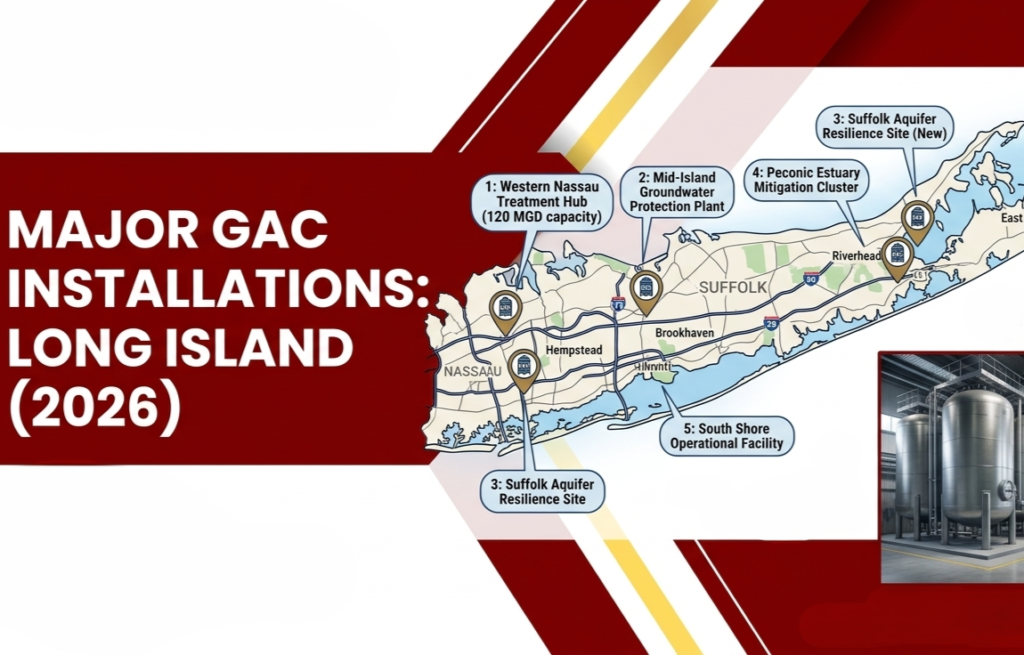
- Treatment: SCWA’s report says approximately 36% of its wells receive granular activated carbon (GAC) treatment to remove pesticides and herbicides, PFAS such as PFOA and PFOS, and volatile organic compounds (report, pages 42–44).
- Discolored water: SCWA says iron that settles in water mains can be disturbed when fire hydrants are opened, and that rusty water normally clears in four to eight hours (SCWA FAQ).
- Your home: What happens in your own plumbing, and whether you want any treatment at home, is a separate question that testing helps answer.
Bohemia’s Public Water Supply
If you live in Bohemia, you may have questions about your local water supply and what infrastructure and treatment work means for your tap. That is a reasonable question to ask. SCWA says it upgrades its distribution system year-round to maintain water quality, support fire protection and improve reliability, and its Capital Projects Map lets you enter your address to see whether construction is scheduled near your home.
Public water in the greater Bohemia area comes from SCWA, which draws it from Long Island’s underground aquifers. SCWA’s FAQ explains that all the water it delivers comes from these sand and gravel formations, mostly from the Magothy aquifer. When water leaves a well and its treatment, it travels through water mains and then through your home’s service line and plumbing before it reaches your kitchen sink. Each step can affect what you see and taste at the tap.
Understanding GAC Treatment in the Bohemia Area
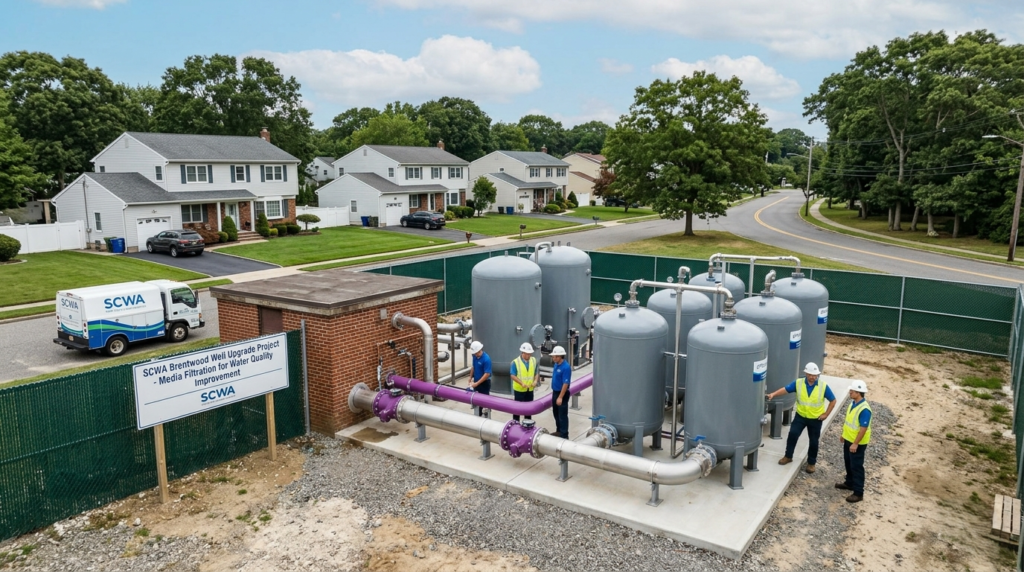
Granular activated carbon is a treatment in which water passes through carbon media before it reaches customers. In an October 20, 2026 release about state grant funding for three GAC projects, SCWA said GAC removes PFAS this way and that it continues to deploy GAC systems throughout its service territory. Its 2026 report adds that air strippers, ion exchange, perchlorate resin filters and advanced oxidation are also used as needed (report, pages 42–44).
In Bohemia, treatment for PFAS has a history. On February 1, 2018, after media reports that Long Island MacArthur Airport might be designated a New York State Superfund site because it had used and stored a firefighting foam containing PFOS, SCWA told its Greater Bohemia customers that it had filtration in place to address PFOS, the contaminant the state was concerned about (SCWA notice). It held a public meeting with state and county legislators at Connetquot Public Library in Bohemia on February 5, 2018 (meeting flyer).
The rules have changed since then. SCWA’s 2018 notice said there was no federal or state drinking water standard for PFOS at the time. New York set limits (MCLs) of 10 ppt for PFOA and for PFOS in 2020 (NYSDOH), and EPA finalized limits of 4.0 ppt for each in April 2024. EPA’s page also describes May 2026 proposals to change parts of that rule (EPA); they were still proposals when EPA last updated its extension and rescission pages on October 8, 2026.
For the PFAS results in your own area, SCWA’s 2026 report lists PFAS testing by distribution area, and its See My Water Quality lookup shows the report for your address.
How to Read Your Water Quality Report
SCWA divides its service area into 30 distribution areas, each with its own table of results, and explains how to read them on pages 4 and 5 of its report (report, pages 4–5). For each detected compound, the table shows:
- Likely source: where the compound might come from, such as natural deposits, fertilizer or household plumbing;
- MCL: the highest amount of the compound allowed in drinking water;
- MCLG: the level below which there is no known or expected health risk;
- Range of readings: the low, high and average values found during the year, and the number of tests.
Once you know your distribution area, you can compare each reading with its limit. The EPA explains these annual reports, which it calls Consumer Confidence Reports, and how to find yours. Past reports are on SCWA’s Water Quality Reports page.
Why Water Can Look or Taste Different at Your Tap
A treated supply is not the whole story of what comes out of your faucet. SCWA’s own guidance points to three common reasons:
- Iron in the mains: SCWA says iron occurs naturally in some areas, particularly along Long Island’s South Shore. It is invisible in its natural state but becomes visible once the water meets air and mixes with chlorine. Some settles in water mains and can be disturbed when fire hydrants are opened, which sometimes results in iron in tap water. SCWA says iron is not normally considered harmful to health but can cause off-taste, odor or staining, that rusty water normally clears in four to eight hours, and that if its lab finds excessive iron it will notify customers not to drink the water until it clears (SCWA FAQ).
- Chlorine: SCWA adds very small amounts of chlorine, which New York State requires, to kill germs or bacteria that might be present in the mains. If you taste or smell it, SCWA suggests keeping a pitcher of water in the refrigerator, where the chlorine turns to gas and leaves the water (SCWA FAQ).
- Your home’s plumbing: SCWA’s report lists household plumbing as the likely source of the copper and lead it measures (report, pages 4–5), and says it adds lime or soda ash to raise the water’s pH, which greatly reduces or eliminates leaching of lead and copper from customers’ plumbing (pages 42–44). Older homes can have lead in pipes, solder or fixtures; the EPA’s lead page has more.
If you notice a change in taste, odor or color, SCWA’s Report a Problem page has a water quality option for exactly that.
Bottled Water and Your Tap
When questions come up about tap water, bottled water can feel like the simple answer, but it covers drinking only and adds ongoing cost and plastic waste. Your supplier’s annual report, and a test of your own water, are better guides to whether you need anything at all. Our page on Water Filters vs Bottled Water compares the long-term tradeoffs for Long Island homeowners.
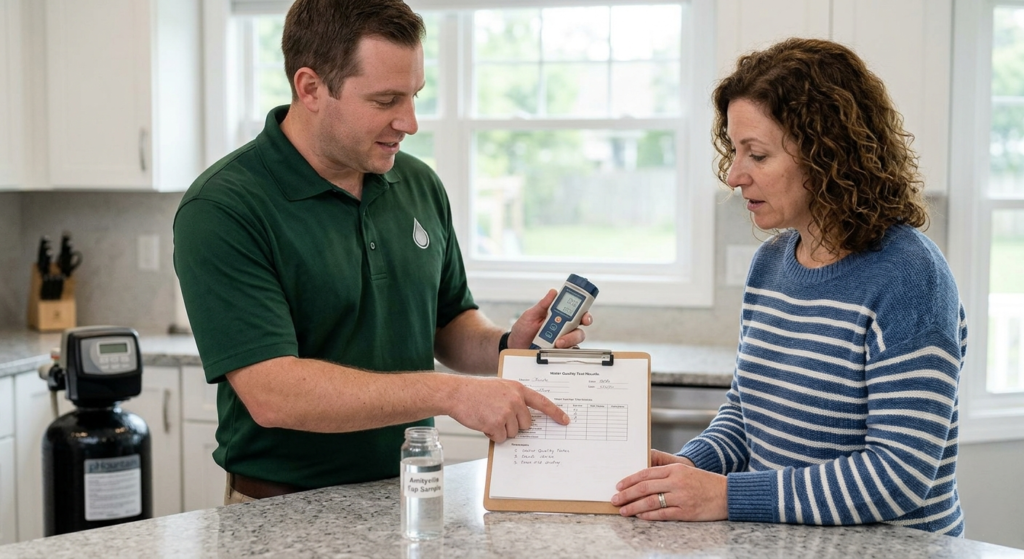
Curious what’s in your water? Measuring PFAS and 1,4-dioxane at the levels regulators use (parts per trillion and parts per billion) requires analysis by a certified laboratory; a Free In-Home Water Test is a starting point for understanding your water and your options.
Where Whole-Home Filtration Fits
The pHountain Filtration System is a whole-home (point-of-entry) system with a cartridge-free media design intended to reduce common impurities in tap water. It is recommended after a free in-home water test, professionally installed, and backed by a 10-year guarantee.
- Whole-home coverage: Unlike a pitcher filter that treats a little water at a time, a point-of-entry system treats water where it enters the house, so showers, laundry and kitchen taps all receive the same treated water.
- Configured to your water: A whole-home system is configured around what testing finds. For any specific contaminant, ask for independent certification data (for example NSF/ANSI listings) for the exact system you are considering.
| Option | Coverage | Typical Use Case |
|---|---|---|
| Bottled water | Drinking only | Short-term or portable drinking water |
| Pitcher filter | One tap at a time | Drinking water for smaller households |
| Whole-home system | Entire house | Long-term option that treats water for the whole house |
What Long Island Customers Say
You can read reviews that customers have left for pHountain Water Filtration on Google on our testimonials page.
What a Whole-Home System Involves
- Testing first: A recommendation follows a free in-home water test.
- A quote for your home: Whole-home installations are quoted per home, because cost depends on the house, its plumbing and the configuration.
- Professional installation: The system is professionally installed at your main water entry point.
- 10-year guarantee: Installed systems are backed by a 10-year guarantee.
- Upkeep: Ask what maintenance the configuration you are considering requires over time.
Serving Bohemia and the Rest of Long Island
- Local office: Our office is in Islip, and we serve Bohemia and the rest of the Town of Islip.
- Service area: pHountain Water Filtration serves Long Island, in Nassau and Suffolk counties.
- What we offer: A free in-home water test, professional installation and a 10-year guarantee on installed systems.
- More answers: Our FAQ page covers common questions about testing and installation.
Frequently Asked Questions
How much does a whole house filter cost on Long Island?
Costs vary with your home’s size and its water, so whole-home installations are quoted per home after a free in-home water test.
Does SCWA treat its water for PFAS?
SCWA says it uses GAC to remove PFAS and continues to deploy GAC systems throughout its service territory (SCWA, October 20, 2026). Its 2026 report lists PFAS test results for each distribution area, so you can see the readings for yours.
Is Bohemia tap water safe in 2026?
Public water suppliers such as SCWA must meet federal and state drinking water limits, and they publish an annual water quality report showing what they tested for and found; the EPA explains how to find yours. If your home is on a private well, testing your water is your responsibility.
Why is my water rusty or discolored?
SCWA attributes rusty water to naturally occurring iron that settles in the mains and can be disturbed, for example when fire hydrants are opened, and that rusty water normally clears in four to eight hours (SCWA FAQ). If it does not clear, or you have other concerns about taste, odor or color, report it through SCWA’s Report a Problem page.
Questions About Your Bohemia Water?
If you live in Bohemia or elsewhere on Long Island and want a clearer picture of your tap water, you can request a Free In-Home Water Test or call (631) 991-3995.
This blog is for informational purposes only and does not guarantee specific water quality outcomes. Water conditions and regulations can change; consult your water supplier and a qualified water treatment professional for advice about your home.
Sources
- SCWA, “To Bohemia Customers” (February 1, 2018): https://www.scwa.com/bohemia/
- Bohemia Town Hall Meeting flyer for SCWA Bohemia, Oakdale, Holbrook and Ronkonkoma customers (February 5, 2018), NYSDEC document repository: https://extapps.dec.ny.gov/data/DecDocs/152251/Fact%20Sheet.HW.152251.2018-02-05.SCWA%20Bohemia%20Public%20Meeting%20flyer.pdf
- SCWA, 2026 Drinking Water Quality Report: https://s3.us-east-1.wasabisys.com/scwa-awqr/AWQR2026/WebFiles/water-quality-report-2026-scwa%20index_v1.html
- SCWA, 2026 report, pages 4–5 (How to Read Your Water Quality Data): https://s3.us-east-1.wasabisys.com/scwa-awqr/AWQR2026/WebFiles/pages/pages%204-5.pdf
- SCWA, 2026 report, pages 42–44 (Statistics, Well Information and Water Treatment): https://s3.us-east-1.wasabisys.com/scwa-awqr/AWQR2026/WebFiles/pages/pages%2042-44.pdf
- SCWA, Water Quality Reports: https://www.scwa.com/water-quality/water-quality-reports/
- SCWA, See My Water Quality: https://www.scwa.com/mywaterquality/
- SCWA, Water Quality FAQ: https://www.scwa.com/water-quality/water-education/faqs/
- SCWA, Capital Projects Map: https://www.scwa.com/water-customers/water-updates/capital-projects-map/
- SCWA, Report a Problem: https://www.scwa.com/water-customers/customer-service/report-a-problem/
- SCWA, “Suffolk County Water Authority Awarded $4.55 Million for PFAS Treatment Projects” (October 20, 2026): https://www.scwa.com/suffolk-county-water-authority-awarded-455-million-for-pfas-treatment-projects/
- NYSDOH, PFAS and other emerging contaminants in public water systems: https://www.health.ny.gov/environmental/water/drinking/emerging_pfas_publicwater.htm
- EPA, Per- and Polyfluoroalkyl Substances (PFAS): https://www.epa.gov/sdwa/and-polyfluoroalkyl-substances-pfas
- EPA, “Proposed PFOA and PFOS Compliance Extension Rule”: https://www.epa.gov/sdwa/proposed-pfoa-and-pfos-compliance-extension-rule
- EPA, “Proposed PFAS Rescission Rule”: https://www.epa.gov/sdwa/proposed-pfas-rescission-rule
- EPA, Consumer Confidence Reports: https://www.epa.gov/ccr
- EPA, Lead: https://www.epa.gov/lead