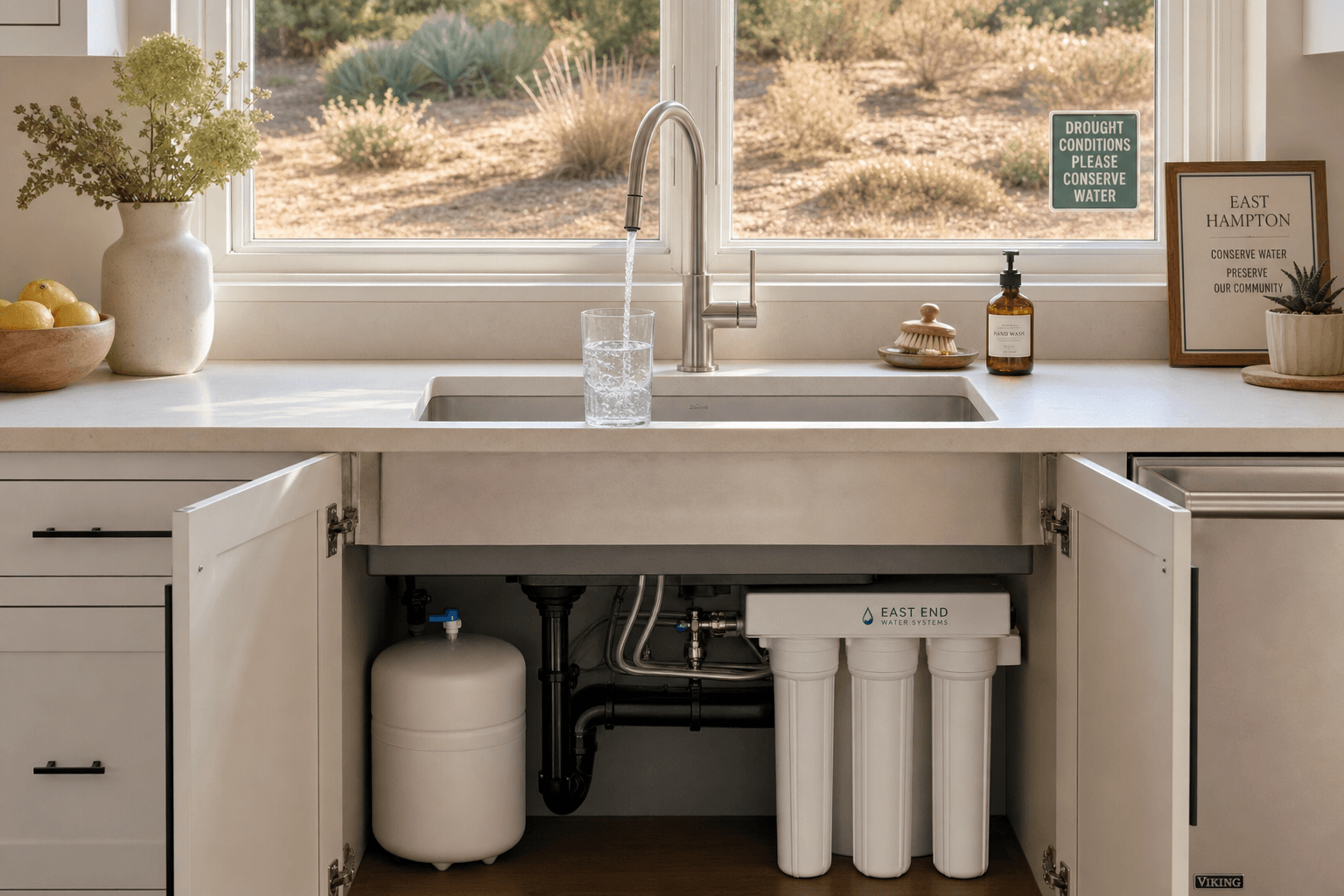
In mid-July 2026, East Hampton homeowners got something that usually only shows up in utility emails and local news: an SCWA Stage 1 water alert on the East End. Behind that alert were drought conditions, record demand, and infrastructure that SCWA said was “reaching maximum capacity”, along with a warning that customers could see low water pressure in the early morning, News 12 Long Island reported.
This post explains what the East End water alert meant for East Hampton, how pressure drops can show up at the tap, and what you can do in your own home when the municipal system is under stress.
Update: On July 31, 2026, SCWA lifted the Stage 1 alert for Southampton, East Hampton and Shelter Island; it remained in effect for customers in Southold, according to SCWA’s announcement.
Decoding the East End Stage 1 Water Alert
On July 14, 2026, the Suffolk County Water Authority (SCWA) declared a Stage 1 water alert for all customers in the towns of Southold, Shelter Island, Southampton and East Hampton, citing drought and record pumpage. As part of that alert, SCWA:
- Asked customers to stop watering lawns or, if they must water, follow an odd/even watering schedule, according to News 12
- Warned of possible low water pressure in the early morning hours, when demand is highest, according to News 12
- Said that while Suffolk County remained in a moderate drought, portions of the county, particularly on the East End and Huntington, were experiencing severe drought
Why SCWA Issued the Alert
According to SCWA’s July 14 announcement:
- Demand hit record levels: SCWA said it set a system-wide pumping record in June.
- Production facilities were operating at capacity, with no additional infrastructure available to meet the demand.
- Low tank levels reduce system pressure, which can lower flow to homes and limit water availability for fire protection. SCWA said demand from irrigation systems was high during overnight and early morning hours.
That combination is why East Hampton residents may notice lower-than-normal water pressure in the early morning.
The Impact of Low Water Pressure Inside Your Home
Stage 1 alerts focus on usage reduction, but for homeowners, the more immediate pain point is what low pressure can mean inside the house.
What You May Notice When Pressure Drops
When demand outpaces what the system can pump, tank levels fall and pressure drops, which can lower flow to homes, SCWA said. Inside the house, that can mean:
- Shower pressure drops, especially on upper floors.
- Appliances fill more slowly, like washing machines and dishwashers.
Drinking Water Standards Still Apply
Public utilities like SCWA are required to provide drinking water that meets federal and state standards, and that requirement doesn’t pause during a drought.
Practical Advice for Managing Water During an Alert
Even if you’re not ready to invest in a filtration system, there are practical ways to manage water use while a Stage 1 alert is active.
Following SCWA’s Water Conservation Guidelines
SCWA asked customers to refrain from watering lawns, or at minimum to follow an odd/even watering schedule, News 12 reported. SCWA’s announcement set out the details:
- Odd-numbered addresses: water only on odd-numbered calendar days
- Even-numbered addresses: water only on even-numbered calendar days
- No lawn watering between 10 a.m. and 4 p.m.
This matters because irrigation drives overnight and early-morning demand, and reducing it:
- Helps stabilize pressure for indoor uses like showers and cooking
- Eases stress on storage tanks and pumping equipment
- Supports drought management efforts across the East End
Household Practices to Mitigate Low-Pressure Effects
You can also adjust your routine to work with the system instead of against it:
- Shift laundry and dishwasher cycles. Run these outside the early-morning peak. This can help maintain more stable pressure when you need it most for showers.
- Stagger high-demand uses. Avoid running multiple showers, outdoor hoses, and appliances at once. This reduces sudden pressure drops inside your own plumbing.
- Clean aerators and showerheads regularly. Unscrew aerators and soak them to remove sediment buildup. This can restore some pressure and improve flow at fixtures.
Where Whole-Home Filtration Fits
Municipal systems like SCWA’s focus on delivering water that meets regulatory standards to the property line. What happens inside your home is where whole-home filtration comes in.
The pHountain Filtration System is a whole-home (point-of-entry) system with a cartridge-free media design intended to reduce common impurities in tap water. Installed at the main water entry point, it treats all household water: not just drinking taps, but also showers, laundry, and appliances.
A whole-home system is configured around what testing finds. For any specific contaminant, ask for independent certification data (for example NSF/ANSI listings) for the exact system you are considering.
Over time, a whole-home system can also reduce reliance on bottled water. Our post on Water Filters vs Bottled Water walks through the long-term tradeoffs for Long Island homeowners.
Evaluating Water Treatment Options in East Hampton
The table below outlines how typical options compare.
| Home Strategy | Coverage Area | Typical Use Case |
|---|---|---|
| Bottled water | Drinking only | Short-term response when tap water seems off |
| Pitcher or fridge filter | One or two taps | Apartments or small households with modest needs |
| Whole-home filtration | Entire house | Long-term option that treats water for the whole house |
Of these options, whole-home filtration is the one that covers every faucet and fixture in the house.
To learn more about how this applies across Suffolk County, visit our page on Whole-Home Water Filtration for Suffolk County.
East End Water Conditions
Water conditions in East Hampton, Southampton, Southold, and Shelter Island are shaped by:
- Local groundwater characteristics
- Age and condition of nearby mains and service lines
- Seasonal demand from both year-round residents and seasonal visitors
pHountain Water Filters serves Long Island, including East Hampton and the rest of Suffolk County. That local focus means system recommendations can be tailored to:
- Regional water conditions
- Household size, plumbing layout, and usage habits
What Happens at a Home Water Assessment in East Hampton
If you decide to investigate your home’s water more closely, here’s how the pHountain Water Filters process typically works for East Hampton homeowners.
Step 1: Arrange a Local Visit
You can start by requesting a Free In-Home Water Test online. A team member will:
- Confirm your location in East Hampton or nearby East End town
- Discuss any changes you’ve noticed (pressure, taste, odor, discoloration)
- Schedule a convenient time for a home visit and water evaluation
Step 2: On-Site Water Review
During the visit, a technician will typically:
- Test your water on-site.
- Discuss any known local issues related to SCWA alerts, drought, or infrastructure work in your area.
This helps determine which water characteristics are most relevant to your home.
Step 3: Customized System Proposal and Installation Details
Based on the evaluation, pHountain Water Filters will:
- Recommend a customized configuration of the pHountain Filtration System or other appropriate solutions
- Explain how the system would be installed at your main water entry point
- Outline maintenance expectations so you know what’s required over time
For a broader view of how we serve the region, you can explore our Water Filtration Long Island NY service area page.
East Hampton Water Alert: Top Questions Answered
Is East Hampton’s water safe to drink during a Stage 1 alert?
Public water suppliers such as SCWA must meet federal and state drinking water limits, and they publish an annual water quality report showing what they tested for and found; the EPA explains how to find yours. The July 2026 Stage 1 alert focused on conserving water and managing system pressure. If your home is on a private well, testing your water is your responsibility.
If you notice changes in taste, odor, or clarity, contact SCWA. An in-home evaluation can also give you a clearer picture at the household level.
Why is my East Hampton water pressure lower in the morning than at night?
SCWA warned that low water pressure may occur in the early morning hours, when demand is at its highest, according to News 12, and its announcement tied high overnight and early-morning demand to irrigation systems. When irrigation, showers, and appliances all draw water in the same early-morning hours, that can:
- Drive up peak demand
- Cause pressure dips in tanks and mains
- Lead to weaker flow at your fixtures
Shifting some high-use activities to later in the day and following lawn-watering guidance can help.
Will this Stage 1 alert keep happening every summer on the East End?
Drought severity, heat waves, and demand patterns vary year to year. SCWA said it set a pumping record in June 2026. SCWA lifted the 2026 alert for East Hampton on July 31.
Do I need a whole-home filter if I only drink bottled water during the alert?
Bottled water can help with drinking needs, but it doesn’t address:
- Shower and bath water, which still comes from your taps
- Water used for cooking, washing produce, or making coffee
- Sediment that can affect appliances and plumbing
A whole-home filtration system treats all water entering your house, across every faucet and fixture, not just what you drink.
If you’re in East Hampton and want a clearer picture of your tap water, start with a Free In-Home Water Test and personalized filtration plan from pHountain Water Filters.
This blog is for informational purposes only and does not guarantee specific water quality outcomes. Water conditions and regulations can change; always consult your local water provider and a qualified water treatment professional for advice tailored to your home.
Sources
- https://longisland.news12.com/suffolk-county-water-authority-asks-customers-to-stop-watering-lawns
- https://www.scwa.com/suffolk-county-water-authority-declares-stage-1-water-alert-on-the-east-end-amid-drought-and-record-pumpage/
- Suffolk County Water Authority, “Suffolk County Water Authority Rescinds Stage 1 Water Alert for Southampton, East Hampton, and Shelter Island; Alert Remains in Southold” (July 31, 2026): https://www.scwa.com/suffolk-county-water-authority-rescinds-stage-1-water-alert-for-southampton-east-hampton-and-shelter-island-alert-remains-in-southold/
- https://www.epa.gov/ccr


