In July 2026, state and county agencies announced an investigation of PFAS in groundwater near the Suffolk County Water Authority’s (SCWA) Bridgehampton Road wellfield in East Hampton, including an ultra-short-chain compound called PFPrA, and Suffolk County offered testing to nearby homes on private wells, according to the New York State Department of Environmental Conservation’s July 2026 community update. For a household waiting on a well result, the practical questions are what to drink in the meantime and what each option will cost in money and time.
This post looks at that waiting period. It explains what Suffolk County’s private well testing involves, what the county says to do until results arrive, and how three options compare:
- Wait for results and make no long-term changes yet
- Switch to bottled water for drinking and cooking
- Plan for a whole-home filtration system such as the pHountain Filtration System, with professional installation
For what investigators have reported about the contamination itself and its likely source, see our companion post, East Hampton Well Owners Seeing PFAS Headlines After the Cove Hollow Battery Fire.
Understanding the East Hampton Investigation and What It Costs Households
On July 28, 2026, News 12 Long Island reported that Suffolk County officials were urging state environmental regulators to address the contamination. According to that report:
- County Health Commissioner Gregson Pigott described the contaminant as a short-chain PFAS compound.
- SCWA had removed several public wells from service as a precaution, and officials estimated that nearly 30 private wells in the area could be affected.
- County health officials were contacting residents with private wells and offering testing.
- Suffolk County Executive Ed Romaine and SCWA linked the contamination to a fire at a battery energy storage facility in East Hampton three years earlier, while state environmental officials said it was too early to determine the source.
The DEC’s July 2026 update gave more detail. The Suffolk County Department of Health Services (SCDHS) identified 26 homes in the area that are not connected to public water and offered their owners private well sampling. At that point ten owners had requested sampling and nine wells had been sampled, and the initial results reviewed had found no PFPrA above the state’s site-specific screening value. The DEC also said that, where appropriate, it will give impacted private well owners the opportunity for alternate water supplies.
The investigation has continued since then. The DEC’s September 2026 community update describes preliminary findings about the source and says a final report is expected in fall 2026. While that work goes on, each household still decides how to handle its own water, and each choice has a cost.
If you’re on a private well anywhere in Suffolk County, our guide on what your well water isn’t telling you covers private well testing and treatment in more general terms.
How Suffolk County’s Private Well Testing Works
Outside a targeted investigation, testing an existing private well through the county is something you request yourself. The SCDHS Private Well Water Testing Program page explains how it works:
- What is tested: basic potability, with the analyses usually performed covering microbiological quality, inorganic chemical content, volatile organic compounds and petroleum derivatives. Homes in agricultural areas can also have their water tested for carbamate pesticides. PFAS are not on that list, so if PFAS is your question, ask the department what your analysis will include.
- Fees: $100 for sample collection and analysis of an existing private well that the department has approved, or that serves a residence with a valid Certificate of Occupancy; $350 for a well serving new construction, or one without final approval or a valid Certificate of Occupancy. Households with a cumulative family income under $25,000 can be exempted from the $100 fee by signing a notarized exemption form.
- Who takes the sample: department staff, following sampling protocol and using specially prepared containers. You can’t deliver your own sample. If you can’t be home, a sample can be collected from an outside tap if one is available, as long as the electricity is on so the pump can run.
- Timing: in most cases a sample can be collected within six weeks of the department receiving your check, and you should allow at least eight weeks from sampling for the results to arrive by mail, with a cover letter containing the department’s recommendations.
- Which well, and how often: the county tests only your primary drinking water well, not irrigation wells, and it may limit how often a well is tested. You can use a commercial laboratory at any time, and the county suggests one for home sales, because it cannot promise results before a contract or closing date.
The county’s Water Resources page says its Office of Water Resources now takes Private Well Test Requests through an online portal, where applicants can pay by credit card and check the status of an application.
Testing for PFAS specifically costs more. The New York State Department of Health’s PFAS and Private Wells page (revised May 2023) says PFAS tests may range from $300 to $600 and are performed by a small number of certified laboratories. For PFPrA, the DEC’s East Hampton PFAS Investigation page says analysis is available only through a very small number of laboratories, and that none of the methods has yet been certified by the federal or state governments.
The True Price of Waiting Without a Plan
Waiting for official results is a reasonable first step. It still helps to know what the wait involves.
What the wait can cost
- Time: Under the county’s standard program, allow for two stages: up to about six weeks in most cases before the sample is collected, then at least eight weeks for results, according to the SCDHS testing page.
- Stopgap purchases: If you’re unsure about your water, the county’s interim advice is bottled water (see the next section). That is a recurring cost for as long as the wait lasts.
- Uncertain future costs: News 12 reported in July that the DEC said more testing and analysis would be needed before officials could determine the source and develop a long-term cleanup strategy, and the DEC’s September update put its final report in fall 2026. A plan built around a very short wait may not match how long the investigation takes.
Living with uncertainty
Waiting also has a non-financial side. In the July 28 News 12 report, a DEC official said there was “no indication that anyone’s being exposed” to the contaminant, and the agency said nine private wells tested in the area showed no elevated levels of cancer-causing chemicals. Those results describe the wells tested at the time, not every well.
The county’s testing page adds that a contaminated nearby well does not automatically mean yours is contaminated, and that each well has to be sampled. A neighbor’s result does not stand in for your own test.
What to Use for Drinking Water Until Results Arrive
The county’s testing page answers this directly: if you are unsure whether your water is safe to drink, use bottled water or water from an approved public supply until the analysis is complete.
For PFAS, state guidance helps you decide how far that needs to go. The New York State Department of Health says people are exposed to PFAS in water mainly through drinking it and through food prepared with it, and that household uses such as cleaning, washing and bathing do not result in significant exposure (NYSDOH). That page covers PFAS in general and does not discuss PFPrA. For a pending PFAS result, bottled water for drinking and cooking covers the main exposure route the state describes. For anything else, follow the recommendations in your results letter.
The same NYSDOH page says that a water filter for your drinking water can decrease exposure to PFAS, that filters using granular activated carbon (GAC) or reverse osmosis (RO) can be effective in removing PFAS from drinking water, and that, given the expense of testing, some people choose a filter instead of a test. If you add any treatment before the county samples your well, tell the department: its testing page says it usually tests the raw, unfiltered water unless asked otherwise, and that it does not encourage filters that don’t meet New York State or Suffolk County standards.
Comparing the Expenses: Bottled Water Versus Whole-House Filtration
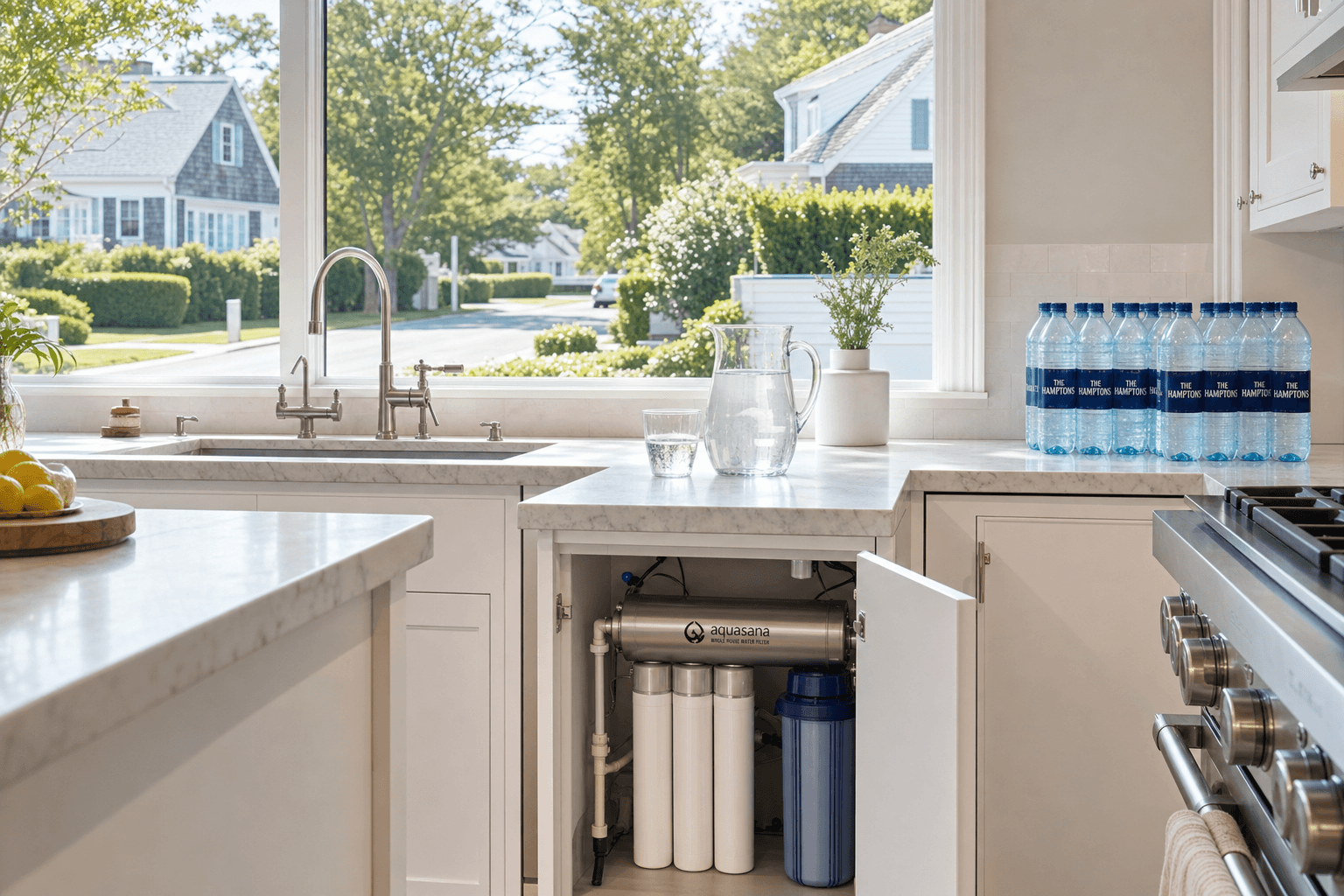
Bottled water is usually the quickest change to make. Over months, though, it becomes a running cost, and it only covers the water you drink and cook with.
Below is a simplified comparison of the main approaches. Prices depend on your household and the products you choose, so the table describes the kind of cost rather than amounts; your receipts and written quotes supply the numbers.
Table: How Costs Behave by Water Strategy
| Home Strategy | Upfront Cost | Ongoing Cost | Key Trade-Offs |
|---|---|---|---|
| Rely on Bottled Water | Low (a cooler or dispenser, if used) | Recurring purchases or delivery for as long as you rely on it | The county’s interim advice while you’re unsure of your water; covers drinking and cooking only; hauling, storage and plastic waste |
| Pitcher / Faucet Filters Only | Low to moderate | Replacement cartridges on the maker’s schedule | Treats small volumes at one tap; check that its certification covers your concern |
| Whole-Home Filtration System | Higher (system plus installation) | Periodic service over time | Treated water at every tap; configured around test results, so the decision is easier once results are in |
Whatever you compare, compare like with like: your monthly bottled water cost for drinking and cooking against the cost of the treatment your results actually call for.
How the East Hampton Findings Shift Water Cost Considerations
1. Private wells: from a one-time test to a plan
For homeowners on private wells in the investigation area, SCDHS offered sampling to homes that are not connected to public water and communicates results to owners as they arrive, according to the DEC’s investigation page.
The realistic choices become:
- Test once and act on the result
- Plan for follow-up testing, and for treatment if a result calls for it
- Ask about alternate water supplies first if your well is affected, since the DEC has said it will offer that opportunity to impacted private well owners where appropriate
- Install a permanent treatment system configured around what testing finds
Who pays matters here. Suffolk County’s testing page says that, generally, the owner of a private well is responsible for its water supply, and that the department cannot require a public agency to take corrective action, extend public water or supply bottled water. It also says financial aid may be available from federal (USEPA) or state (NYSDEC) programs in severe cases of contamination, and that a landlord may be responsible for providing drinkable water to a tenant. Federal and state drinking water limits apply to public water systems, not private wells (EPA).
2. Public water users: what’s within your control
If you’re on public water in East Hampton:
- SCWA removed wells at the Bridgehampton Road wellfield from service or reduced their use after the PFPrA detections, according to the DEC’s July update, and the State Department of Health said SCWA acted to minimize use of the affected wellfield for drinking water.
- Your supplier must meet federal and state drinking water limits and publishes an annual water quality report showing what it tested for and found.
Some homeowners on public water still consider whole-home filtration for taste, odor or sediment, or to rely less on bottled water. Whether that makes sense depends on your supplier’s report and on what testing at your own tap finds.
For the bigger picture, see our overview of PFAS on Long Island, including the federal and state drinking water limits.
What Long Island Customers Say
You can read reviews that customers have left for pHountain Water Filtration on Google on our testimonials page.
The pHountain Filtration System for East Hampton Homes
The pHountain Filtration System is a whole-home (point-of-entry) system with a cartridge-free media design intended to reduce common impurities in tap water. Installed on the home’s main water line, it treats the water that reaches every faucet, shower and appliance. It is recommended after a free in-home water test, professionally installed and backed by a 10-year guarantee.
A whole-home system is configured around what testing finds. For any specific contaminant, ask for independent certification data (for example NSF/ANSI listings) for the exact system you are considering.
Measuring PFAS at the levels regulators use (parts per trillion and parts per billion) requires analysis by a certified laboratory; a free in-home water test is a starting point for understanding your water and your options.
To see how whole-home treatment compares with other options, our guide on water filters vs bottled water walks through cost, convenience and coverage in more detail.
What to Settle Before a Whole-Home Installation
If you do decide on whole-home treatment, the installation details affect both cost and coverage.
Questions to ask before you sign
- System sizing: East Hampton homes vary in size, occupancy and plumbing. Ask how the proposed system was sized for your household’s water use.
- Plumbing integration: A system on the main line serves every fixture, not just one sink. Ask how irrigation lines, outbuildings or future additions will be handled.
- Testing and maintenance: Ask which test results the recommendation is based on, what maintenance the system needs over time and what that maintenance costs, and get it in a written quote.
East Hampton’s Water Quality Questions: PFPrA and Beyond
Understanding PFPrA
According to the State Department of Health’s East Hampton Area PFAS in Drinking Water page (updated July 22, 2026):
- PFPrA (perfluoropropanoic acid) was the primary PFAS detected in public drinking water supply wells and groundwater in East Hampton.
- There is no enforceable contaminant-specific drinking water standard for PFPrA; NYSDOH says PFPrA, like many PFAS, is considered an unspecified organic contaminant, subject to New York’s general standard of 50 parts per billion. NYSDOH developed a preliminary screening level of 3 parts per billion, which state and county authorities are using to assess PFPrA in private and public well water during the investigation.
- NYSDOH says PFPrA is not widely studied, that it is considered less toxic than PFOA or PFOS, and that the body gets rid of it relatively quickly.
The DEC’s September update adds that shorter-chain PFAS travel faster through groundwater and soil, because they don’t stick to soil particles as easily as longer-chain PFAS.
Tracking the investigation
In July, county officials told News 12 that testing had expanded to nearby ponds. By the DEC’s September 2026 update, the agencies had:
- Sampled seven existing monitoring wells and collected groundwater data from 14 new monitoring wells across the investigation area
- Collected more than 40 soil samples at multiple depths from 12 locations
- Scheduled a final report for fall 2026, with a community meeting planned once the summary report is finalized
Until that report is out, the most useful information for any one home is its own test result.
If you’re elsewhere in Suffolk County, our overview of whole-home water filtration for Suffolk County explains options across the county.
Practical Steps for East Hampton Residents
Here is a practical, cost-aware plan for the waiting period:
- Identify your water source: Confirm whether you’re on SCWA public water or a private well. If you’re unsure, check your bills or ask your landlord or property manager.
- Check for testing offers or notices: SCDHS offered sampling to homes in the investigation area that are not on public water. If you haven’t been contacted and want your well tested, you can request testing through the county’s private well testing program.
- Calculate your current bottled water spending: Add up a month of bottled water, jugs or delivery, then multiply by the number of months you expect to wait for results and a decision.
- Compare short-term and long-term options: Decide whether to stay with bottled water until results arrive, add a certified filter for drinking water, or plan a whole-home system for full coverage.
- Schedule a water evaluation: pHountain Water Filters offers a free in-home water test for homeowners across Long Island.
- Get installation and maintenance terms in writing: Know where a system would be installed, how it is maintained and what ongoing costs to expect, and compare that with your current and projected bottled water spending.
East Hampton Well Water Costs: Answers to Common Questions
Is East Hampton tap water safe to drink right now?
Public water suppliers such as SCWA must meet federal and state drinking water limits and publish an annual water quality report showing what they tested for and found; the EPA explains how to find yours. Private wells are not covered by those limits, and testing a private well is the owner’s responsibility.
For the East Hampton investigation, the DEC’s investigation page says initial private well results reviewed so far found no PFPrA above the preliminary screening value and no PFOA or PFOS above the state’s 10 parts per trillion limit. For your own well, the letter that comes with your results and the county health department are the places to start.
I’m on a private well near the investigation area. What should I do?
- Find out whether your well has been offered testing by county health officials.
- If not, request testing through the county’s program or use a commercial laboratory, and ask either one what the analysis covers.
- Until results arrive, follow the county’s advice to use bottled water or water from an approved public supply if you’re unsure about your water.
- Consider a home water evaluation to understand your options if results show a problem.
pHountain Water Filters serves homeowners across Long Island, including East Hampton and the rest of Suffolk County.
How much does a whole-home filtration system cost compared with bottled water?
Exact system costs vary by home size, water conditions and configuration, and bottled water costs depend on how much your household uses. To compare them:
- Total your actual bottled water spending from receipts or delivery invoices.
- Add testing costs: $100 for the county’s standard analysis of an existing well that the department has approved or that serves a home with a valid Certificate of Occupancy (SCDHS), and $300 to $600 for a PFAS test, according to the 2023 guidance from NYSDOH.
- Get a written quote for any system you are considering, including installation and maintenance.
Comparing those totals over the same period gives you a figure for your own home rather than an average.
Does the East Hampton PFPrA investigation affect all of Suffolk County?
The state’s investigation is focused on the area around SCWA’s Bridgehampton Road wellfield in East Hampton and the nearby battery energy storage facility, according to the DEC. Elsewhere in Suffolk, your public water supplier’s annual report, or a test of your own well, tells you about your water.
More broadly, the State Department of Health notes that PFAS are commonly found in the environment and have been detected in public drinking water and in private wells (NYSDOH).
Can I just use a pitcher filter to deal with PFAS-type concerns?
NYSDOH says filtration units using GAC or RO can be effective in removing PFAS from drinking water, and that they range from filtered water pitchers to larger systems (NYSDOH). Pitchers have practical limits:
- They treat only small volumes of drinking water
- They don’t cover showers, baths, laundry or other taps
- Their cartridges need replacing on the maker’s schedule
That guidance is about PFAS in general, not PFPrA specifically, so check whether a filter’s certification covers the compound you are concerned about.
If you’re in East Hampton and want to talk through your options while you wait for results, start with a free in-home water test.
This blog is for informational purposes only and does not replace professional water testing, legal advice, or guidance from public health authorities. Always follow official notices and recommendations from your local water provider and health department.
Sources
- New York State Department of Environmental Conservation, “Bridgehampton Road Wellfield PFAS Source Investigation” community update (July 2026): https://extapps.dec.ny.gov/data/der/factsheet/s2601953update0726.pdf
- New York State Department of Environmental Conservation, “Bridgehampton Wellfield PFAS Source Investigation Update” community update (September 2026): https://dec.ny.gov/sites/default/files/2026-09/s2601953update0926.pdf
- New York State Department of Environmental Conservation, “East Hampton PFAS Investigation”: https://dec.ny.gov/environmental-protection/site-cleanup/regional-remediation-project-information/region-1/east-hampton-pfas-investigation
- New York State Department of Health, “East Hampton Area PFAS in Drinking Water” (updated July 22, 2026): https://health.ny.gov/environmental/investigations/east_hampton/east_hampton.htm
- New York State Department of Health, “PFAS and Private Wells” (revised May 2023): https://www.health.ny.gov/environmental/water/drinking/pfasinprivatewells.htm
- Suffolk County Department of Health Services, “Private Well Water Testing Program”: https://www.suffolkcountyny.gov/Departments/Health-Services/Environmental-Quality/Water-Resources/Private-Well-Water-Testing-Program
- Suffolk County Department of Health Services, Water Resources: https://www.suffolkcountyny.gov/Departments/Health-Services/Environmental-Quality/Water-Resources/Private-Well-Water-Testing
- News 12 Long Island, “East Hampton groundwater contamination sparks calls for state cleanup” (July 28, 2026): https://longisland.news12.com/east-hampton-groundwater-contamination-sparks-calls-for-state-cleanup
- https://www.epa.gov/privatewells
- https://www.epa.gov/ccr


