
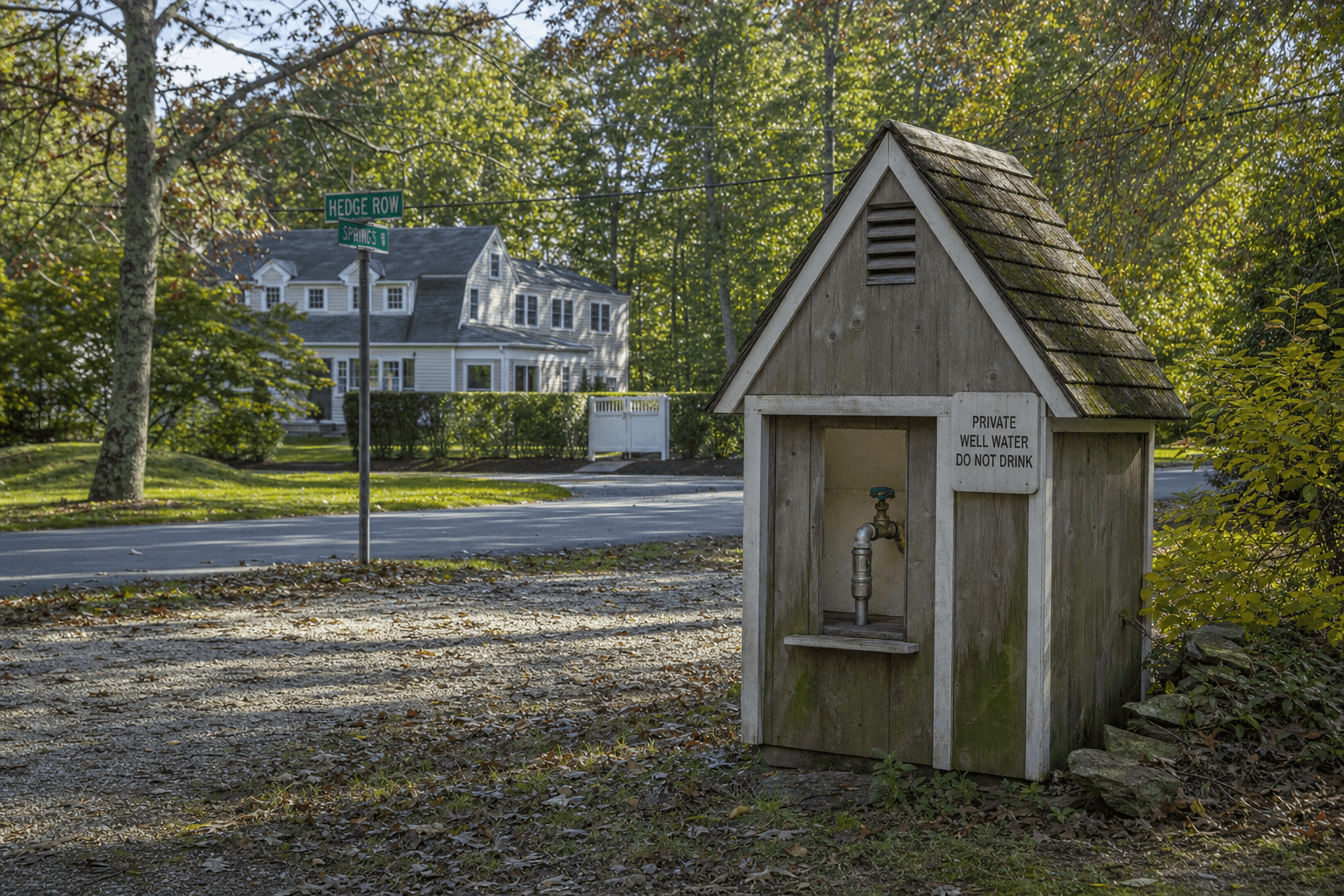
East Hampton homeowners near Cove Hollow Road have been seeing more news about PFAS contamination and private well testing since the Cove Hollow battery facility fire. If you rely on a well, or you’re simply worried about what’s coming out of your taps, it can be hard to know what’s signal and what’s noise.
This guide walks through what’s publicly known about East Hampton PFAS water contamination around Cove Hollow, why local officials are testing wells, and how you can take practical steps to understand and improve your home’s water quality.
1. PFAS Impact and Responses Following the Cove Hollow Fire
Public reports have raised questions about whether PFAS chemicals from the Cove Hollow Road battery fire may have affected nearby groundwater and private wells.
Local and regional coverage has highlighted three key points:
- Fire-related contamination concerns: News coverage has reported PFAS detection and ongoing investigation around the Cove Hollow battery fire site in East Hampton, including impacts on local groundwater and private wells near the facility site on Cove Hollow Road.(Newsday)
- Town and water authority response: East Hampton officials and water providers have published information and Q&As to help residents understand drinking water issues, testing, and the role of public supplies vs. private wells.(Town of East Hampton)
- Broader groundwater vulnerability on the East End: Regional environmental groups have pointed to past contamination cases near East Hampton and surrounding East End communities as evidence that Long Island’s sole-source aquifer is vulnerable when industrial or infrastructure incidents occur.(Citizens Campaign for the Environment)
1.1 Highlights on PFAS Risks Around Cove Hollow
While specific technical details about the Cove Hollow incident are still being evaluated, PFAS concerns in similar events often come from:
- Firefighting activities: Certain firefighting foams historically contained PFAS compounds, which can migrate into soil and groundwater.
- Industrial or infrastructure materials: Components used in energy storage or industrial sites may contain PFAS-related substances that can enter the environment if damaged.
Because PFAS can be persistent in the environment, local agencies often focus on well testing and longer-term monitoring after an incident like the Cove Hollow battery fire.(Newsday)
2. What PFAS and PFPrA Mean for Your East Hampton Water
The acronym PFAS refers to a broad class of man‑made chemicals. In local Cove Hollow coverage, you may also see references to PFPrA, which is one of the specific PFAS‑type compounds of concern.
2.1 Pathways for PFAS to Enter Private Wells
On the East End, many homes—especially outside village centers—depend on private wells rather than public water mains. That can matter in a situation like Cove Hollow, because:
- Public water systems can install centralized treatment and are subject to regular monitoring and reporting.
- Private wells are essentially unregulated at the state and federal level; homeowners are responsible for testing and treatment decisions.
When PFAS enter soil or surface water near a site, they can gradually move down into the underlying aquifer. Depending on local geology and groundwater flow, that plume may intersect with private wells in the area over time.(Citizens Campaign for the Environment)
2.2 Why Relying on Your Neighbor’s Well Test Could Be Risky
One of the most confusing aspects of East Hampton PFAS issues is how site‑specific they can be:
- Two homes on the same road can show very different PFAS levels.
- A shallow well may experience different conditions than a deeper well drawing from another part of the aquifer.
- Groundwater flow can carry contaminants along narrow paths, skipping some homes and affecting others.
That’s why town information pages emphasize that individual testing is the only way to know what is present in your own well.(Town of East Hampton)
3. Steps to Determine If Your East Hampton Water Is at Risk
If you live near Cove Hollow Road or in another part of East Hampton where groundwater issues have been discussed, there is a straightforward sequence you can follow.
3.1 Consult Official Resources for Water Safety Information
- Review town Q&As: The Town of East Hampton has published drinking water questions and answers for residents, including guidance on public water vs. private wells and how to interpret different testing programs.(Town of East Hampton)
- Check for advisories or letters: Look for any mailings, door hangers, or public notices about the Cove Hollow area, PFAS testing, or recommendations to connect to public water.
- Understand your water source: Confirm whether your home is on:
- Public water (served by a water authority), or
- A private well on your property.
Public information and town updates are the baseline—but they still won’t tell you what’s happening inside your specific plumbing.
3.2 Arrange Targeted PFAS Testing for Your Well Water
If you have a private well, many experts and local advocates recommend independent laboratory testing for PFAS and related contaminants in situations like Cove Hollow.(Citizens Campaign for the Environment)
When you arrange testing, consider:
- Scope of analysis: Ask for a panel that includes PFAS compounds relevant to Long Island and East Hampton issues, along with basic water quality indicators (pH, hardness, metals, etc.).
- Sampling locations:
- At a minimum, test at a kitchen tap where you draw drinking water.
- If you already have any filters installed, test both before and after the filter to see what’s in your raw well water vs. your household water.
- Frequency: After an incident like the Cove Hollow fire, some homeowners choose to retest periodically to see whether levels are stable or changing over time.
pHountain Water Filters offers water quality testing and analysis as part of its consultation process, including PFAS‑focused evaluations for Long Island homes. You can learn more and schedule a visit through the Free In-Home Water Test page.
4. Illustrating a Typical East Hampton Well Owner’s Response After the Cove Hollow Incident
To illustrate how this plays out in real life, here is a composite case based on situations pHountain Water Filters has seen in East Hampton. This is not a single customer, but a realistic example drawn from multiple experiences.
4.1 Background: Private Well Use on Cove Hollow Road
- A homeowner on Cove Hollow Road relied on a private well for all household water.
- After news reports on the battery fire and PFAS contamination, they became concerned about potential long‑term exposure from their well.
- Town and media updates confirmed that local groundwater and private wells were being evaluated in the area around the fire site.(Newsday)
The homeowner had started buying bottled water for drinking and cooking but still used tap water for showers, dishwashing, and laundry.
4.2 Laboratory Testing and Key Results
Working through a water quality consultation:
- Initial review: pHountain Water Filters reviewed the homeowner’s location relative to the Cove Hollow site and discussed known public information.
- Targeted testing: A water sample was collected from the kitchen tap and sent to an independent laboratory for PFAS analysis and basic chemistry.
- Results: The lab report showed:
- Elevated PFAS levels in the well water, consistent with contamination patterns reported near the battery fire site.
- Other environmental contaminants at modest levels that the homeowner wanted to address as well.
With this data, the homeowner could make an informed decision about long‑term water treatment.
4.3 Final Decision: Installing Whole-Home Filtration
The homeowner decided to install a pHountain pHresh Filtration System to address PFAS and other contaminants throughout the house, not just at one sink.
Key elements of the solution:
- Whole‑house coverage: The system was configured to treat water for all fixtures—kitchen, bathrooms, laundry, and outdoor spigots—so that the entire household supply passed through filtration.
- Addresses targeted contaminants: The configuration focused on PFAS, industrial chemicals, sediment, and heavy metals, based on the test report and local conditions.
- Professional installation: pHountain Water Filters technicians integrated the system into the home’s plumbing with minimal disruption and verified correct operation before leaving.
Over time, the homeowner reported:
- Less reliance on bottled water, with estimated savings of around $30 to $70 per month, depending on how much bottled water they had been buying previously.
- Increased peace of mind knowing their well water was being treated across the entire home.
5. Comparing Different Homeowner Responses: Wait and Watch, Bottled Water, or Filtration Installation
After hearing about East Hampton PFAS water contamination, many homeowners consider three main paths. Each has trade‑offs.
5.1 Comparative Overview of Water Safety Approaches
| Option | Short-Term Pros | Long-Term Considerations |
|---|---|---|
| Wait and Monitor Only | No upfront cost; you can watch for new town or SCWA updates | Does not address any PFAS or other contaminants that may already be in your well; may prolong uncertainty |
| Use Bottled Water for Drinking Only | Immediate change for drinking water; simple to start | Does not affect showers, baths, dishwashers, or laundry; recurring cost and plastic waste; lifting and storing bottles |
| Install Whole‑Home Filtration | Designed for every tap and fixture; addresses dependence on bottled water | Requires upfront investment and professional installation; you still need periodic system maintenance and monitoring |
For many East Hampton well owners, the turning point is realizing that bottled water doesn’t change what’s in the water used for bathing, washing dishes, or brushing teeth. That’s one reason more Long Island homeowners are exploring whole‑house systems that can address a broader range of contaminants.
To learn how that looks across Suffolk County, you can explore Whole-Home Water Filtration for Suffolk County.
6. How pHountain Water Filters Guides East Hampton Families Through Water Quality Challenges
pHountain Water Filters focuses on Long Island and NYC‑area homes, with extensive experience in Suffolk County’s groundwater challenges, including PFAS, industrial chemicals, and other environmental contaminants.
6.1 The Journey From Concern to Customized Filtration Solutions
- Online or in‑person consultation request
- You share your address, water source (public vs. well), and any specific concerns—such as proximity to Cove Hollow Road or other known contamination sites.
- Water quality evaluation
- We conduct water testing and analysis, including PFAS‑focused panels where appropriate, and review any existing lab reports you may have.
- System recommendation
- Based on test results, we recommend a configuration of the pHountain pHresh Filtration System or other filtration options tailored to your home’s size and water usage.
- Professional installation
- Our technicians handle the plumbing work, verify flow and pressure, and explain how to use and maintain your system.
- Ongoing support
- We remain available for maintenance, periodic checks, and updates if your water conditions or household needs change.
If you’re comparing options, the article Water Filters vs Bottled Water outlines the cost, convenience, and environmental differences in more detail.
6.2 Insights from Our Long Island Water Quality Experience
Because pHountain Water Filters works across Long Island, we see patterns that are specific to this region’s aquifer and infrastructure:
- PFAS hotspots linked to industrial sites, fire training areas, and infrastructure incidents
- Well‑dependent neighborhoods where residents may not receive the same level of testing as those on public water
- Mixed‑source communities where some homes are on public water and others on wells, leading to confusion about who is covered by which testing programs
For a broader look at regional trends beyond East Hampton, you can read Long Island Has a PFAS Problem. Here’s What You Need to Know.
> If you live near Cove Hollow Road or elsewhere in East Hampton and rely on a private well, now is a practical time to get your water tested and understand your options.
You can start that process today through the Free In-Home Water Test page.
Frequently Asked Questions
7.1 I live near Cove Hollow Road. Does public testing mean my well is safe?
Public testing around the Cove Hollow battery fire site helps identify whether PFAS and related contaminants are present in local groundwater and some private wells.(Newsday) However:
- Not every individual well can be tested in public programs.
- PFAS distribution can be uneven, depending on groundwater flow and well depth.
The Town of East Hampton notes that private well owners are responsible for their own testing.(Town of East Hampton) Independent testing focused on your specific well is the most direct way to know what’s in your water.
7.2 My East Hampton home is on public water. Should I still consider filtration?
If you’re connected to a public water system, your water provider is required to meet state and federal standards and to conduct regular monitoring. In some East End communities, water authorities have installed or proposed treatment systems to address PFAS and other contaminants detected in source wells.(Citizens Campaign for the Environment)
Some homeowners on public water still choose whole‑home filtration to:
- Add an extra layer of treatment at the home level
- Address taste, odor, and sediment issues that can persist even with compliant tap water
- Address bottled water dependency for convenience and cost reasons
Whether that makes sense for you depends on your comfort level, water quality reports, and household priorities.
7.3 How often should I test my East Hampton private well for PFAS?
There is no single rule that fits every situation, but general practices in areas with known or suspected contamination often include:
- Baseline testing now, especially if you are near Cove Hollow Road or other sites mentioned in public contamination reports
- Follow‑up testing if:
- Town or news updates indicate changing conditions
- You install a new filtration system and want to document performance
- You notice changes in water quality (taste, color, or odor)
Regional advocates have emphasized that proactive testing is important on the East End where groundwater has been affected in multiple places over time.(Citizens Campaign for the Environment)
7.4 Can pHountain Water Filters help if I’m outside East Hampton but still in Suffolk County?
Yes. pHountain Water Filters serves homeowners across Suffolk County and the broader Long Island region, including communities that have seen PFAS‑related concerns. If you’re elsewhere in the county, you can explore coverage areas and services at Water Filtration Long Island NY.
> Ready to understand what’s actually in your East Hampton water and explore whole‑home filtration options? Connect with pHountain Water Filters today through the Contact Us page.
This blog is for informational purposes only and does not constitute professional advice, diagnosis, or treatment. Always consult appropriate professionals regarding your specific water quality, health concerns, or legal questions.
Water quality varies by location. Municipal water provided by SCWA achieved EPA compliance in June 2025. Private well owners should have water tested regularly. pHountain provides free water testing for Nassau and Suffolk County.