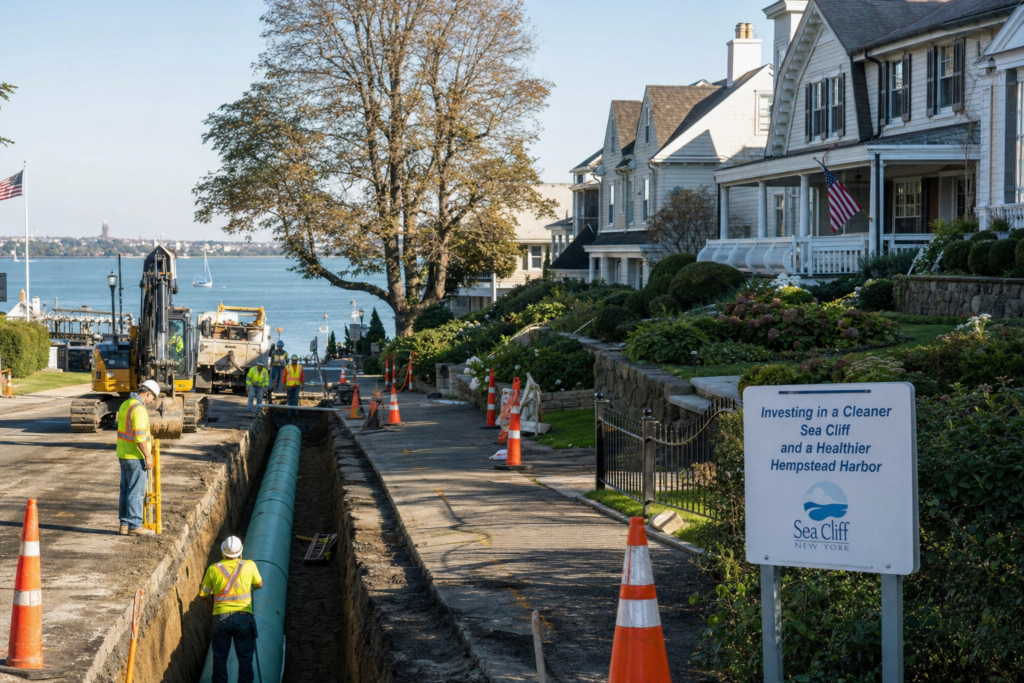
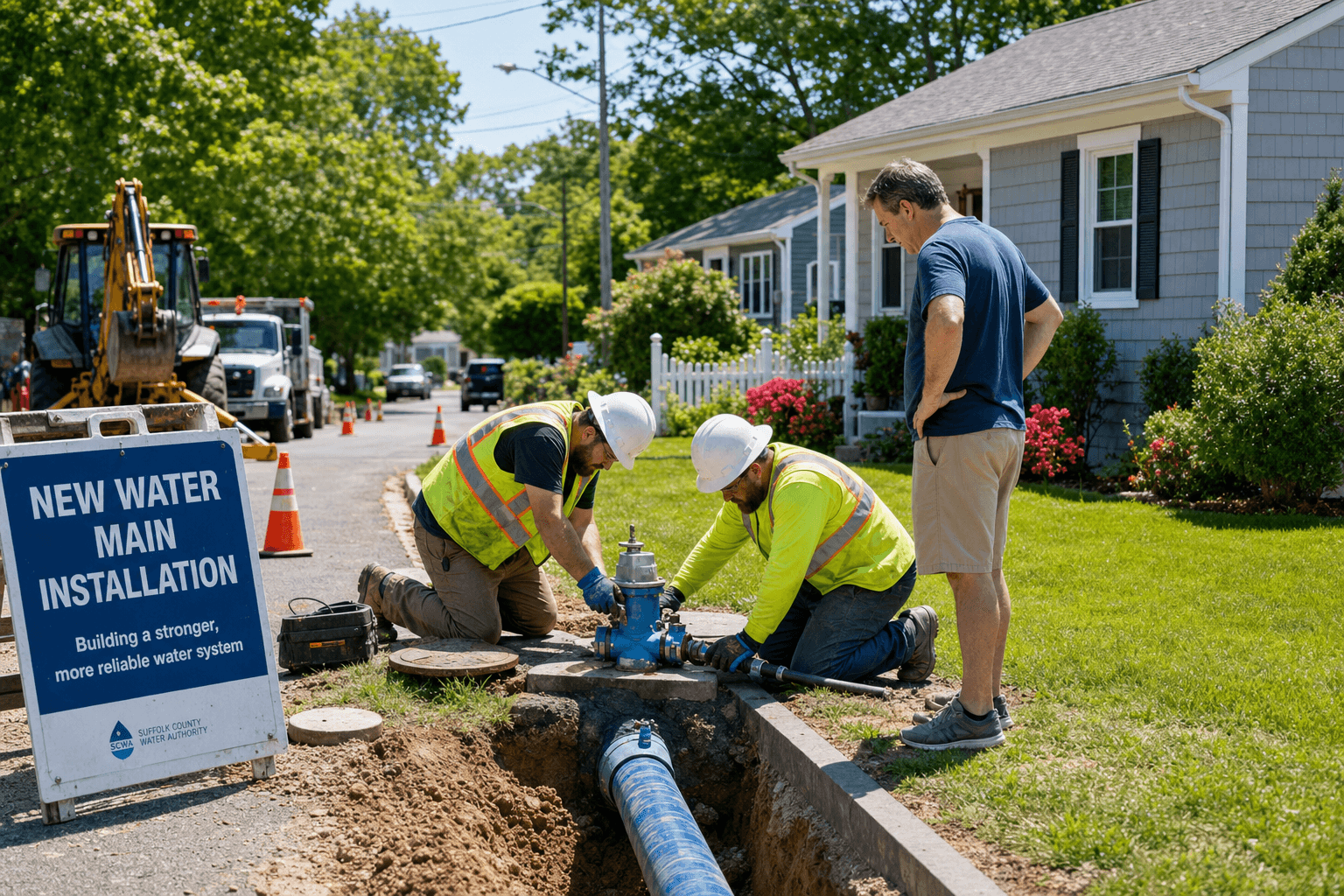
Residents along National Boulevard in Medford and Bellport are being offered connection to a new PFAS-focused public water main after contamination was found in local groundwater. Up to 20 homes that have relied on private wells are expected to transition to this new main through late 2026, with connection costs eliminated for impacted homeowners.
If you live in this area, you may be asking: once my home is tied into the new main, do I still need a home water filtration system?
This guide walks through what the Medford Bellport PFAS water main project means, where public water helps, and why many Long Island homeowners still choose whole-home filtration as a second layer of protection.
1. Overview of the May 2026 Medford–Bellport PFAS Water Main Project
In May 2026, Suffolk County officials announced that homes along National Boulevard in Medford and Bellport affected by PFAS contamination would be able to connect to a public water main at no direct connection cost to residents.
1.1 Project specifics at a glance
- Location: National Boulevard area in Medford and Bellport
- Issue: PFAS compounds detected in local private wells
- Homes affected: Up to 20 homes expected to transition from well water to public water service
- Timeline: Connection phase rolling out through late 2026
- Goal: Provide an alternative to PFAS-impacted private wells by supplying treated public water
Public water in Suffolk County is generally overseen and tested under stricter regulations than private wells. For many homeowners, this extension offers an important upgrade over relying on a contaminated well.
> If your home is eligible, connecting to the new main is usually a smart first step in managing PFAS risk.
2. The Risks PFAS Pose to Medford and Bellport Groundwater Quality
PFAS (per- and polyfluoroalkyl substances) are a large family of synthetic chemicals that can persist in the environment and accumulate over time. They’ve been used in products like non-stick coatings, firefighting foam, and stain-resistant fabrics.
On Long Island, PFAS have increasingly been detected in groundwater, including private wells and some public supply wells.
Because no additional external sources are permitted for this article, please refer to the Long Island Advance coverage for context on how PFAS are impacting local water and why Suffolk County is prioritizing projects like the Medford–Bellport extension.
If you want a broader overview of how these chemicals show up across the region, pHountain Water Filters explains the bigger picture in Long Island Has a PFAS Problem. Here’s What You Need to Know.
3. Contrasting the Role of Public Water and Private Wells in This PFAS-Affected Area
Even with the same PFAS plume in the area, public water customers and private well owners face different situations.
3.1 Advantages offered by the new public water main
For homes that connect to the new main:
- Source change: You move away from a PFAS-impacted private well to a regulated public supply.
- More oversight: Public water providers must follow state drinking water standards and perform regular testing.
- Central treatment: PFAS and other contaminants are typically addressed at the wellfield or treatment plant, not at each individual home.
For many residents, this substantially improves baseline water quality compared to staying on a known contaminated well.
3.2 Limitations of relying on public water without home filtration
Even with public water, there are reasons some homeowners add home filtration:
- Distribution system: Water can pick up sediment, metals, or byproducts as it travels through miles of mains and household plumbing.
- Household-specific plumbing: Older pipes, fixtures, or in-home plumbing materials can influence what comes out of your tap.
- Broader contaminant mix: PFAS is one concern; homeowners may also worry about chlorine, disinfection byproducts, heavy metals, or other industrial contaminants that can be present at low levels.
That’s why many families treat the public system as the first line of defense, then use whole-home filtration as a second layer tailored to their own house.
4. Evaluating the Need for Filtration After Your Home Connects to the PFAS Water Main
The answer depends on your risk tolerance, plumbing, and long-term goals.
4.1 Why some homeowners rely solely on public water
- Regulatory confidence: You’re comfortable with state standards and local testing.
- Budget focus: You prefer to minimize new household expenses.
- Short-term stay: You expect to move within a few years and don’t want to invest in infrastructure.
For some households, connecting to the new main and stopping there feels like enough.
4.2 Reasons others supplement with a whole-home filtration system
Many Long Island homeowners who switch from wells to public water still choose whole-house filtration to:
- Standardize water quality at every tap: Not just the kitchen sink, but showers, bathrooms, laundry, and outdoor spigots.
- Address non-PFAS concerns: Such as chlorine taste and odor, sediment, or other environmental contaminants.
- Add a personal margin of safety: Even when public water meets standards, some families prefer an extra barrier between the supply and their taps.
If you’re weighing whether to invest in filtration, it can help to see how this plays out in real homes.
5. Composite Case Study of a Typical Medford–Bellport Homeowner
To protect privacy, this is a composite case based on typical situations pHountain Water Filters sees in Suffolk County — not a single named customer.
5.1 Typical challenges faced
- Home type: Single-family home in the Medford–Bellport area
- Water source: Private well, with neighbors notified of PFAS concerns nearby
- Testing: Independent well test shows elevated PFAS levels, enough to raise concerns about long-term use
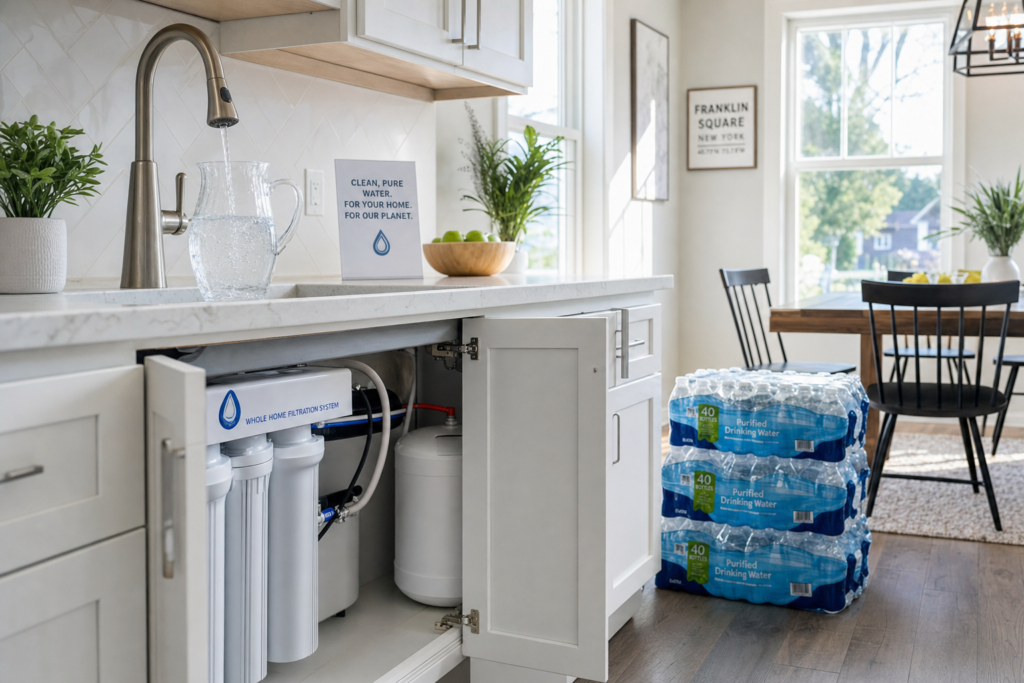
- Impact: Family becomes uneasy using the water for drinking, cooking, and bathing, and starts relying heavily on bottled water
5.2 How filtration was implemented
Before any public main connection was available, the homeowner worked with pHountain Water Filters to:
- Conduct a water quality evaluation to understand PFAS and other issues
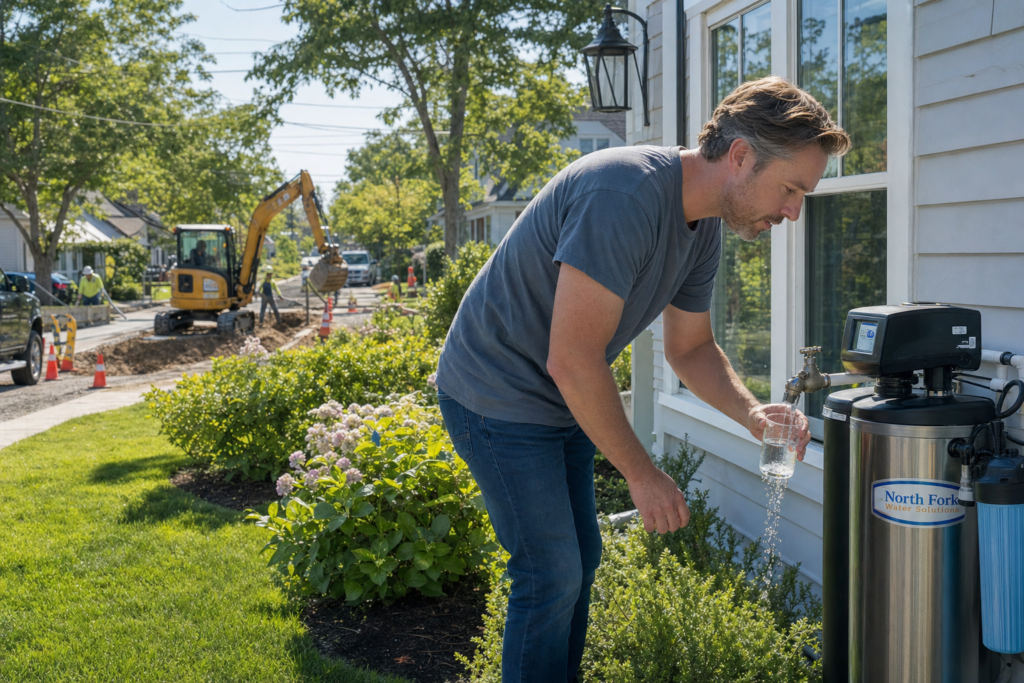
- Install a pHountain pHresh Filtration System as a whole-house solution
- Have the system professionally installed so it integrated cleanly with existing plumbing
This gave the household consistent, filtered water from every faucet and shower in the home.
5.3 The results and ongoing benefits
After installation, the family:
- Reduced bottled water purchases, cutting costs by an estimated $30 to $60 per month compared with their prior mix of bottled water and smaller filters
- Simplified their routine — no more hauling cases of bottles or constantly changing small cartridges
Even if this home later connects to a public main, the existing whole-house system can continue to provide added filtration on top of the municipal supply.
If you’re comparing options, the blog Water Filters vs Bottled Water walks through how ongoing costs can stack up over time.
6. Practical Guidance: Planning Your Next Moves on National Boulevard
For Medford and Bellport residents in the PFAS zone, a step-by-step approach can keep decisions manageable.
6.1 Step 1: Confirm your inclusion in the water main extension
- Check eligibility: Confirm whether your address on National Boulevard is included in the extension area.
- Understand timing: Ask when your home is expected to be connected — early in the rollout, or closer to late 2026.
- Clarify costs: Local coverage reports that connection fees are being eliminated for affected homes, but verify any remaining costs for plumbing changes on your property.
6.2 Step 2: Review your current water quality status
Even if you’re scheduled to be connected:
- Well owners: Keep copies of any PFAS test results you already have.
- Public water customers nearby: Consider testing if you’ve noticed taste, odor, or staining issues, especially if your home has older plumbing.
If you’re on well water outside the immediate project zone, pHountain Water Filters has a dedicated guide: What Your Well Water Isn’t Telling You.
6.3 Step 3: Determine whether to filter before or after connection
Some homeowners choose to:
- Install filtration now, especially if they’re uneasy using the well for another year or two.
- Wait until after connection, then test again and decide based on the new water source.
There isn’t a single right answer — it depends on how you balance cost, timing, and peace of mind.
7. The Role of Whole-Home Filtration Systems for Medford and Bellport Homes
A whole-house system is not a replacement for the PFAS water main project — it’s a complement.
7.1 Capabilities of whole-house filtration systems
pHountain Water Filters offers high-capacity systems that:
- Treat water for the entire home: Kitchen, bathrooms, laundry, and outdoor fixtures all receive filtered water.
- Target multiple contaminant categories: Including chlorine, heavy metals, sediment, bacteria, microorganisms, and various environmental contaminants.
- Improve everyday experience: Many homeowners report better taste, odor, and clarity from their water supply.
The pHountain pHresh Filtration System is built for whole-home use and is installed directly into your plumbing by trained technicians.
7.2 Advantages of professional filtration system installation
- Correct sizing: Systems are matched to your home’s water usage and plumbing layout.
- Clean integration: Technicians ensure the system works smoothly with existing pipes and fixtures.
- Verification: After installation, the system is tested for proper operation, and homeowners are shown how everything works.
To learn more about how these systems are applied across the region, see Whole-Home Water Filtration for Suffolk County.
8. Comparing the Medford–Bellport PFAS Water Main Extension with Home Filtration Options
Here’s a simple comparison of what the public main extension and a whole-home filtration system each bring to the table.
| Aspect | PFAS Water Main Extension (Public) | Whole-Home Filtration (In-Home) |
|---|---|---|
| Primary purpose | Provide regulated public water to homes with impacted wells | Add an additional layer of filtration tailored to your home |
| Who controls it | Local water authority | Individual homeowner |
| Coverage | All taps connected to public system | All taps and fixtures in your home’s plumbing |
| Contaminant focus | Meets state drinking water standards for multiple contaminants, including PFAS | Targets chlorine, heavy metals, sediment, bacteria, and various environmental contaminants (system-specific) |
| Upfront cost | Connection cost eliminated for eligible homes | System and installation cost borne by homeowner |
| Ongoing oversight | Authority testing and compliance | Homeowner maintenance with support from installer |
Both approaches can work together: the public system manages water at the community level, and home filtration adds a customized layer at the household level.
> Mid-article callout: If you’re in Medford or Bellport and want to see what’s in your water before or after the main connection, you can request a Free In-Home Water Test from pHountain Water Filters.
9. How pHountain Water Filters Supports Long Island Homeowners Affected by PFAS
Whether you’re on a PFAS-impacted well, recently connected to the main, or already on public water elsewhere in Suffolk County, the process is similar.
9.1 Standard consultation and service workflow
- Initial outreach: You contact pHountain Water Filters through the Contact Us page or request a Free In-Home Water Test.
- Water evaluation: A water analysis is performed to understand your contaminant profile and general water conditions.
- System recommendation: Based on results and household size, a customized filtration setup is recommended.
- Professional installation: Technicians install the system into your home’s plumbing.
- Follow-up and support: You receive guidance on maintenance and periodic check-ins as needed.
9.2 Importance of tailored filtration in the context of regional PFAS challenges
In towns like Medford, Bellport, Hicksville, Levittown, and others across Long Island, PFAS is part of a larger water quality story. Infrastructure projects help, but they don’t always address every concern at the tap.
For example, our post on Securing Household Water Safety Amidst New PFAS Infrastructure Milestones in Hicksville shows how residents in another town are navigating similar questions about public projects and home filtration.
10. Common Questions from Medford and Bellport Homeowners About PFAS and Filtration
10.1 My home on National Boulevard is eligible for the PFAS main. Should I still test my water?
Yes. Even if you plan to connect, testing your current well gives you a baseline and helps you decide whether to:
- Use filtration while you wait for connection
- Continue filtering even after you’re on public water
After connection, you can test again to see how the new supply compares.
10.2 I’m on a private well near Medford–Bellport but not in the 20-home project area. What should I do?
If you’re outside the current extension zone:
- Treat the project as a signal that PFAS has been found in local groundwater.
- Consider independent testing for PFAS and other contaminants.
- If results show issues, you can explore filtration and other options tailored to your home.
pHountain Water Filters serves homeowners across Suffolk County and broader Long Island; see Water Filtration Long Island NY for regional coverage details.
10.3 If I already invested in a whole-home system and then connect to the PFAS main, is my system wasted?
No. Many homeowners keep their whole-house filtration even after switching water sources. The system can:
- Continue addressing non-PFAS concerns such as chlorine, sediment, and other contaminants
- Provide a consistent quality regardless of any future changes in the municipal supply
In some cases, your installer may recommend minor adjustments based on the new water chemistry.
10.4 How does this Medford–Bellport project relate to PFAS issues elsewhere on Long Island?
The Medford–Bellport extension is one example of how local authorities are responding to PFAS findings in groundwater. Similar concerns have surfaced in other communities. For a broader view, see Long Island Faces PFAS Contamination in Produce After March 2026 Detection and Levittown Residents Face New PFAS Concerns After EPA Guidance.
> Closing callout: If you live in Medford, Bellport, or anywhere in Suffolk County and want a clearer picture of your tap water, you can start by requesting a Free In-Home Water Test from pHountain Water Filters.
This blog is for informational purposes only and does not constitute health or regulatory advice. Always consult your local water provider, health department, or a qualified professional for guidance specific to your situation.
Water quality varies by location. Municipal water provided by SCWA achieved EPA compliance in June 2025. Private well owners should have water tested regularly. pHountain provides free water testing for Nassau and Suffolk County.