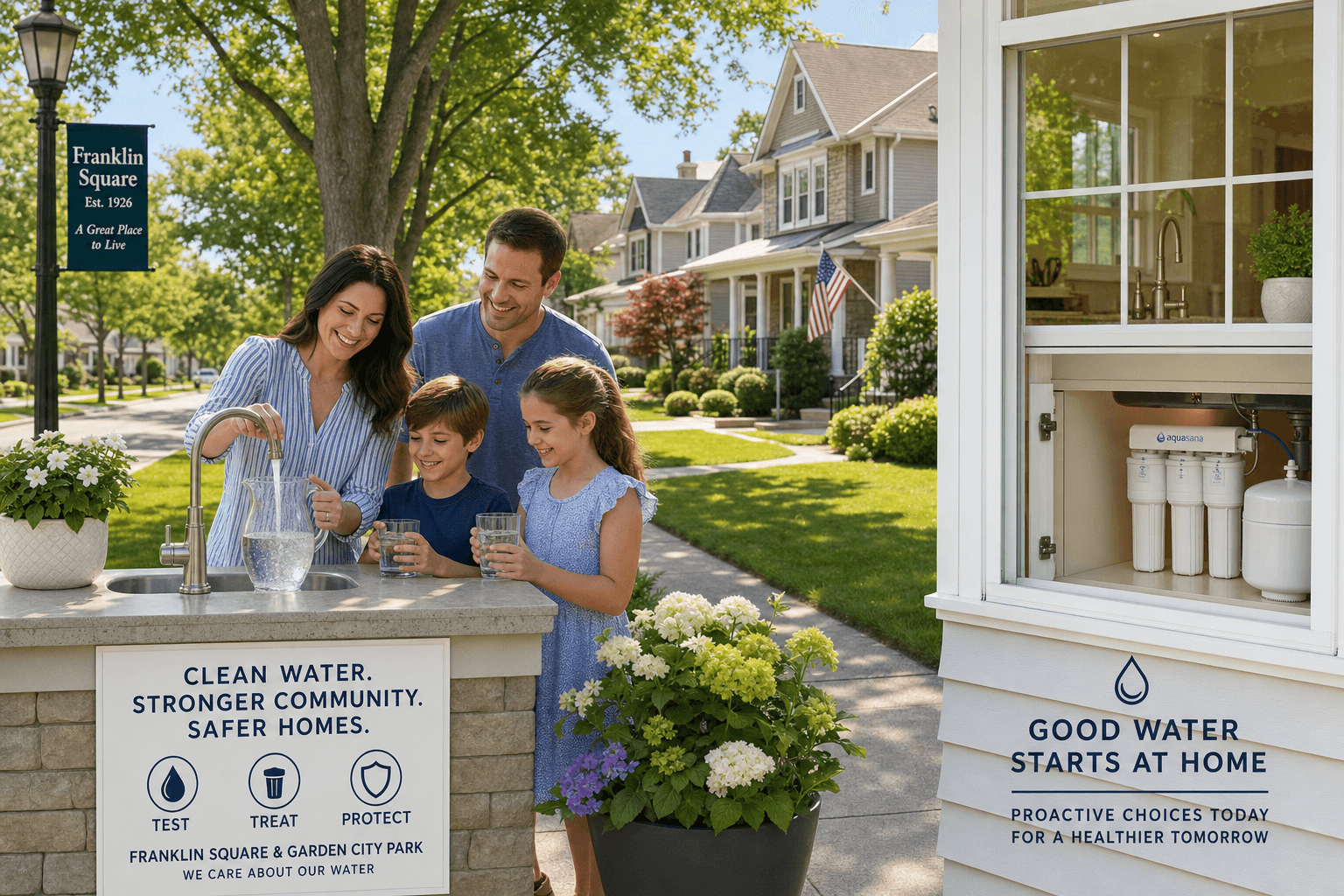
Franklin Square and Garden City Park residents may have heard about 1,4-dioxane in Long Island groundwater and wonder what it means for their own taps.
New York set an enforceable drinking water limit (a maximum contaminant level, or MCL) of 1 part per billion (ppb) for 1,4-dioxane in 2020, and was the first state to set one (New York State Department of Health). Public water systems in New York must monitor for it on a regular schedule.
This blog walks through what this means for your home, how to read your water supplier’s reports, and practical steps you can take to understand and improve the water coming out of your own faucets.
1. Understanding the Role of AOP Treatment Systems
1.1 A quick look at 1,4-dioxane in Nassau County
- 1,4-dioxane is a synthetic chemical. The U.S. EPA describes it as a byproduct of some manufacturing processes and a contaminant in products such as dish soaps and laundry detergents (EPA).
- It has been found in Long Island groundwater, including in Nassau County. In Bethpage, for example, 1,4-dioxane is among the contaminants treated in the Navy-Grumman groundwater plume, whose primary contaminant is the solvent TCE (NYSDEC).
- Because New York’s 1 ppb limit is enforceable, public water systems whose wells exceed it must take action, such as adding treatment, to meet it.
For Franklin Square and Garden City Park homeowners, the practical question is what this means inside their homes, not just at the treatment plant.
1.2 How AOP treatment targets 1,4-dioxane
The Advanced Oxidation Process typically combines UV light and hydrogen peroxide to break down 1,4-dioxane molecules in water.
In plain terms:
- Hydrogen peroxide is added to the water stream.
- UV lamps energize the mixture.
- Reactive species formed in the process attack certain chemical bonds, including those in 1,4-dioxane.
AOP systems are major infrastructure built at the wellhead or treatment plant, not something installed in individual homes.
2. Reasons Franklin Square and Garden City Park Residents May Want a Closer Look
2.1 System-wide progress vs. what comes out of your tap
Even when a supplier meets every limit, a few things are worth knowing:
- Distribution system factors: Water travels through miles of pipes before reaching your kitchen sink. Conditions in those pipes are not identical to what exists at the plant.
- Home plumbing: Older plumbing, fixtures, and in-home devices can influence what ultimately comes out of your tap.
That is why some homeowners look at point-of-entry or point-of-use filtration even when their supplier meets state limits.
2.2 What New York’s 1 ppb limit means for you
- Utilities must meet the state limit of 1 ppb for 1,4-dioxane and monitor for it regularly (NYSDOH).
- Results are published in your supplier’s annual water quality report, so you can check the numbers yourself.
- Homeowners can use those reports, plus testing at their own taps, to see how system-level treatment shows up in their homes.
If you’re in Franklin Square or Garden City Park, looking past headlines to the data for your own supplier and home is the most useful next step.
3. How You Can Verify the Safety of Your Franklin Square or Garden City Park Tap Water
3.1 Start with your utility’s water quality reports
Your local water provider is required to publish an annual water quality report, also called a Consumer Confidence Report (CCR). These documents may show:
- Detected 1,4-dioxane levels, if any, at the system level
- Other contaminants that were detected
- Treatment updates, such as new treatment systems coming online
Look closely for:
- Sampling dates: Are you seeing results from before or after any new treatment came online?
- Trends: Do 1,4-dioxane numbers appear to be decreasing, or hovering near state limits?
- Notes about ongoing projects: Some wells or treatment trains may still be in transition.
If the data is confusing, you can pair it with a local perspective by reading more about regional contamination issues in pieces like Long Island Has a PFAS Problem. Here’s What You Need to Know.
3.2 Follow up with home-specific testing
System-wide reports don’t always reflect what’s happening after water moves through:
- Your street’s mains
- Your building’s plumbing
- Your in-home fixtures and appliances
That’s why some homeowners choose independent or in-home testing as a next step.
- Identify your concerns: Is your focus 1,4-dioxane, other chemicals, taste/odor, or all of the above?
- Schedule a professional assessment: A local provider can help you understand which questions about your water are worth testing for.
- Compare options: Some residents start with a Free In-Home Water Test to get a clearer picture before investing in permanent equipment.
Measuring PFAS and 1,4-dioxane at the levels regulators use (parts per trillion and parts per billion) requires analysis by a certified laboratory; a free in-home water test is a starting point for understanding your water and your options.
This layered approach—public data plus testing at your own taps—gives Franklin Square and Garden City Park families a more complete view of what they’re actually using every day.
4. Evaluating Your Choices: Relying on Your Supplier, Using Bottled Water, or Installing Whole-Home Filtration
When you’re deciding what to do about your home’s water, you’re usually weighing three main approaches.
4.1 Side-by-side comparison
Below is a general comparison for a typical Franklin Square or Garden City Park household:
| Option | Main Benefit | Main Drawback |
|---|---|---|
| Rely only on your supplier’s treatment | Uses treatment you already pay for, which must meet federal and state limits | Limited control over distribution system or household plumbing issues |
| Buy bottled water | Quick access to alternative drinking water | Ongoing cost, plastic waste, no help for showers or laundry |
| Whole-house filtration system | Filters water for every tap in the home | Requires upfront investment and installation planning |
Some households blend these strategies for a while—using bottled water short-term while they evaluate more permanent filtration options.
A whole-home system is configured around what testing finds. For any specific contaminant, ask for independent certification data (for example NSF/ANSI listings) for the exact system you are considering.
If you’re exploring this route, you can see how pHountain Water Filters serves your area on our Water Filtration Nassau County NY page.
5. How pHountain Water Filters Supports Franklin Square and Garden City Park Families
5.1 A step-by-step path from concern to solution
For Franklin Square and Garden City Park residents, the process typically looks like this:
- Initial conversation: You reach out through our Contact Us page to share your questions about your water.
- Water evaluation: We help you arrange testing focused on the questions you have about your water.
- Customized recommendation: Based on your results, we recommend a configuration of the pHountain Filtration System or other appropriate options tailored to your home size and water usage.
- Professional Installation: Our technicians handle integration into your plumbing, aiming to minimize disruption and ensure proper performance.
- Follow-up support: We remain available to answer questions, discuss maintenance, and reassess if local water conditions change.
This process is designed to give you clarity at each step, so you can make informed decisions rather than react to every new headline.
6. Answers to Common Questions About 1,4-Dioxane and Your Household
6.1 I live in Franklin Square. Does 1,4-dioxane treatment mean my water is “safe”?
Public water suppliers must meet federal and state drinking water limits, including New York’s 1 ppb limit for 1,4-dioxane (NYSDOH), and publish an annual water quality report showing what was detected. That report is the best place to see how your supplier is doing.
However:
- AOP is focused on certain chemicals, not every possible contaminant.
- Water quality can change between the plant and your home.
- “Safe” is a broad term that depends on your personal risk tolerance and what other substances you’re concerned about.
If your home is on a private well, these limits don’t apply to it, and testing it is your responsibility. Some homeowners also choose to verify conditions in their own home through testing and, if needed, add in-home filtration for an additional layer of protection.
6.2 I’m in Garden City Park. If my utility meets state standards, why do some homeowners still add a whole-house filter?
State standards are designed for system-wide compliance, not necessarily to match each homeowner’s preferences. Homeowners who look at whole-house filtration usually want:
- Better-tasting and better-smelling water than what chlorinated systems alone provide
- Coverage for baths, showers, and laundry, not just drinking water
A whole-house system such as the pHountain Filtration System treats the water for the entire home, and its configuration should be based on what testing finds.
6.3 How do I know whether 1,4-dioxane affects my home’s water?
To understand your home’s situation:
- Review your utility’s latest reports for 1,4-dioxane and other contaminants, noting dates and trends.
- Arrange targeted testing to check what’s actually coming from your taps; for 1,4-dioxane, that means a certified laboratory.
- Compare options for filtration if your results show contaminants you’d like to address.
6.4 Does pHountain Water Filters only work with Western Nassau, or do you cover other Long Island towns too?
pHountain Water Filters serves Long Island (Nassau and Suffolk Counties). In addition to Franklin Square and Garden City Park, we support homeowners across the region through service-area pages like:
If you’re unsure whether your home is in our service area, you can contact us to confirm.
Ready to move beyond headlines and see what’s actually flowing from your faucets in Franklin Square or Garden City Park? Take the next step and request a Free In-Home Water Test with pHountain Water Filters.
This content is for informational purposes only and is not intended as health, medical, or regulatory advice. Always consult your local water provider, appropriate regulatory agencies, and qualified professionals for guidance specific to your situation.
Sources
- https://www.health.ny.gov/environmental/water/drinking/emerging_pfas_publicwater.htm
- https://www.epa.gov/assessing-and-managing-chemicals-under-tsca/final-risk-evaluation-14-dioxane
- https://extapps.dec.ny.gov/docs/remediation_hudson_pdf/130003aarodou2ou3.pdf
- https://www.epa.gov/ccr
- https://www.epa.gov/privatewells