Essential Findings for Well Owners
- EPA’s enforceable limit (maximum contaminant level, or MCL) for nitrate in public drinking water is 10 mg/L, measured as nitrogen, according to EPA’s National Primary Drinking Water Regulations.
- Federal and state drinking water limits apply to public water systems, not private wells; private well owners are responsible for testing their own water, as EPA’s private well guidance explains.
- EPA recommends testing a private well every year for nitrates, total coliform bacteria, total dissolved solids and pH (EPA: Protect Your Home’s Water).
- The Suffolk County Water Authority’s 2026 Drinking Water Quality Report says nitrate levels may rise quickly for short periods of time because of rainfall or agricultural activity (SCWA report, page 36).
- The Suffolk County Department of Health Services runs a private well testing program, and charges for the service (county program page).
If your Commack home draws its water from a private well, you have a certain independence from the public system. That independence comes with a responsibility: the limits public suppliers must meet do not apply to private wells, so testing and looking after your family’s water is up to you, as EPA explains. Groundwater chemistry can change, and nitrate is one of the substances EPA recommends checking every year.
This post explains where nitrate comes from, what Suffolk County and New York State say about nitrogen in Long Island’s groundwater, how to test a well, and what your options are, including connecting to public water where it is available.
Factors Influencing Groundwater Chemistry
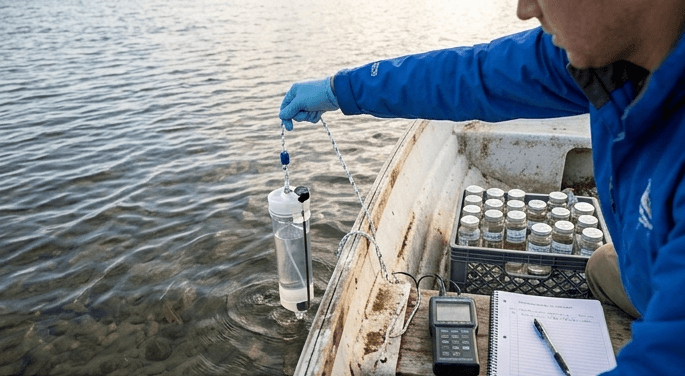
Groundwater is not a static resource; it is connected to the surface above it. The Suffolk County Water Authority (SCWA) explains in its water quality FAQ that all the water in Long Island’s aquifers comes from precipitation, which works its way through the sandy soil into the aquifers, and that “what we put on the ground eventually can wind up in our groundwater.” SCWA also notes that the shallowest aquifer, the upper glacial aquifer, is the main source of water for private wells serving individual homes.
Nitrate reaches groundwater from several sources. EPA lists runoff from fertilizer use, leaking from septic tanks and sewage, and erosion of natural deposits as sources of nitrate in drinking water (EPA), and says nitrate can contaminate a private well through groundwater movement, surface water seepage and run-off (EPA: Potential Well Water Contaminants).
Does Nitrate Change Over Time?
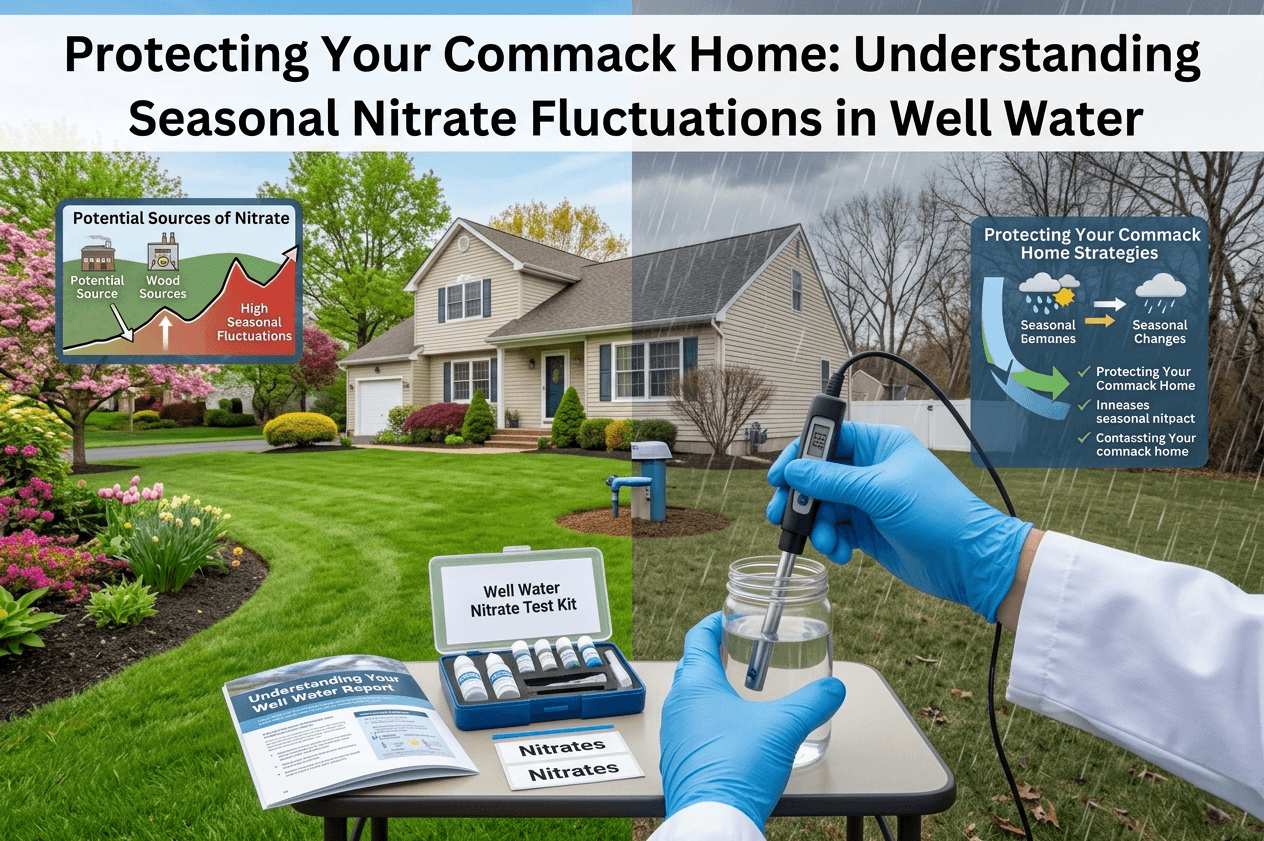
It can. SCWA’s 2026 Drinking Water Quality Report says nitrate levels may rise quickly for short periods of time because of rainfall or agricultural activity. EPA also advises testing a well immediately if conditions near it change significantly, for example after flooding, land disturbances or new construction (EPA). A single test shows your water at one point in time, which is one reason to test on a regular schedule.
Nitrogen on Long Island: What the State and County Say
The New York State Department of Environmental Conservation (DEC) says nitrogen is the leading cause of water quality deterioration in Long Island’s surface and groundwater. It comes primarily from wastewater, such as sewage treatment plants and residential cesspools, and from fertilizer and stormwater runoff, and it contaminates the groundwater that is the sole source of Long Island’s drinking water (DEC LINAP fact sheet). DEC’s Long Island Nitrogen Action Plan (LINAP), a collaboration with Suffolk and Nassau counties and the Long Island Regional Planning Council, was a multiyear effort to reduce nitrogen in surface and ground waters and has since been absorbed into DEC’s Long Island Watershed Program.
Suffolk County says nitrogen pollution from cesspools and septic systems has been identified as the largest single cause of degraded water quality, that a conventional septic system was never designed to remove nitrogen, and that even inland, nitrogen from septic systems will eventually reach the groundwater and surface waters (Suffolk County, Reclaim Our Water). The county’s Septic Improvement Program offers grants and low-interest financing toward nitrogen-reducing septic systems.
Susceptibility Factors for Private Wells
Several factors affect how exposed a well is to activity at the surface. SCWA notes that private wells tend to be relatively shallow and therefore more likely to pick up surface contaminants (SCWA FAQ), and its July 27, 2026 announcement said private wells are often untested because no regulations require owners to monitor their water quality. EPA suggests testing for nitrate and nitrite when there are areas of intensive agriculture nearby (EPA), and Suffolk County says private wells in agricultural areas are particularly susceptible to fertilizers and pesticides (Suffolk County Department of Health Services).
A neighbor’s results are not a substitute for your own. Suffolk County’s health department says that when a nearby well is found to be contaminated, it does not automatically mean yours is, and that each well has to be sampled to determine its quality. It also says the majority of wells it has tested meet the drinking water standards set for health-related reasons (county program page).
Why Nitrate Matters for Infants
EPA says infants below the age of six months who drink water containing nitrate above the MCL could become seriously ill and, if untreated, may die; symptoms include shortness of breath and blue-baby syndrome (EPA). EPA’s private well guidance explains that high nitrate levels reduce the blood’s ability to carry oxygen, and that this acute condition can come on rapidly, over a period of days (EPA). SCWA’s report advises anyone caring for an infant to ask a health care provider for advice (SCWA report, page 36).
How to Test a Commack Well
- Every year: EPA recommends annual testing for nitrates, total coliform bacteria, total dissolved solids and pH, and more frequent testing if small children or elderly adults live in the home or someone is pregnant or nursing (EPA).
- Certified laboratories: EPA advises using only laboratories certified for drinking water testing, and notes that your local health department may offer private well testing (EPA).
- Suffolk County’s program: The county health department collects and analyzes private well samples for a fee listed on its program page. Analyses usually cover microbiological quality, inorganic chemicals, volatile organic compounds and petroleum derivatives. The county says results take several weeks, and that you can have your water tested by a commercial laboratory at any time (county program page).
- While you wait: If you are unsure whether your well water is safe to drink, the county suggests using bottled water or water from an approved public supply until the analysis is complete (county program page).
Bottled Water: A Stopgap, Not a Plan
Bottled water can be a sensible stopgap; as noted above, Suffolk County suggests it, or water from an approved public supply, while a well test is pending. Over the long term, bottled water is practical for drinking but not for bathing or laundry, and it adds ongoing cost and plastic waste. Our page on Water Filters vs Bottled Water compares the tradeoffs for Long Island homeowners.
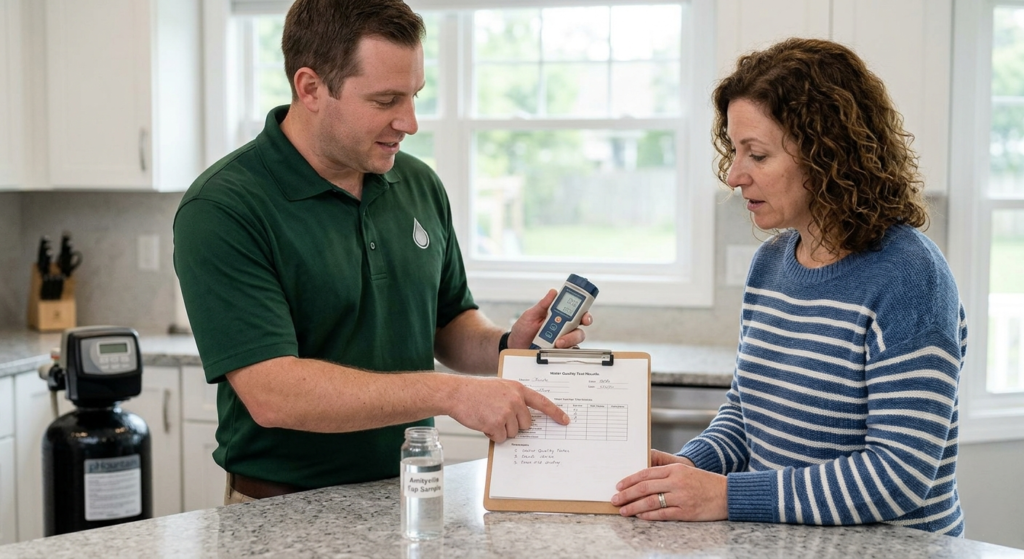
Curious what’s in your water? Request a Free In-Home Water Test. It is a starting point for understanding your water and your options. For a nitrate result, use a certified laboratory or the county’s testing program.
If Public Water Is Available
SCWA advises private well owners that if public water is available where they live, they should give serious thought to connecting (SCWA FAQ). On July 27, 2026, SCWA launched an online tool that gives residents on private wells an instant estimate of the cost of connecting to the public system and shows financing options for up to 25 years, SCWA said.
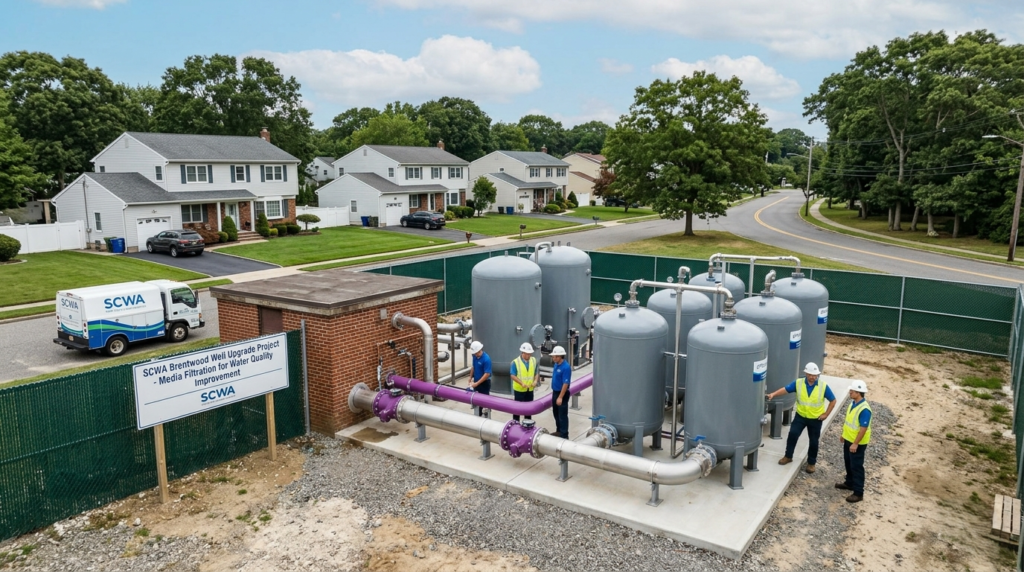
For homes on public water, nitrate is regulated: public suppliers must meet the 10 mg/L limit and publish an annual water quality report (EPA). SCWA operates a public supply well in Commack: its September 2025 emerging contaminants update lists “Ruth Blvd #2 (Commack)” (SCWA update). If SCWA is your supplier, its See My Water Quality lookup shows the report for your address, and its 2026 report says that at some pump stations it blends wells together to lower contaminants such as nitrate, and that it uses ion exchange filters for nitrate removal (SCWA report, pages 42–44). If a different water district bills you, look for that district’s annual report.
The pHountain Filtration System
The pHountain Filtration System is a whole-home (point-of-entry) system with a cartridge-free media design intended to reduce common impurities in tap water. What it involves:
- Whole-home coverage: Unlike a pitcher or under-sink unit, it is installed where water enters the house, so it treats the water used at every faucet and fixture.
- Testing first: A system is recommended after a free in-home water test.
- Professional installation: It is professionally installed at your main water entry point.
- 10-year guarantee: Installed systems are backed by a 10-year guarantee.
A whole-home system is configured around what testing finds. For any specific contaminant, ask for independent certification data (for example NSF/ANSI listings) for the exact system you are considering.
Water Treatment Comparison
| Option | Coverage | Typical Use Case |
|---|---|---|
| Bottled water | Drinking only | Stopgap while a well test is pending |
| Pitcher or fridge filter | One or two taps | Drinking water at a single tap |
| Whole-home filtration | Entire house | Long-term treatment configured around test results |
| Public water connection (where available) | Entire house | Replaces the well as the water source; the supplier must meet federal and state limits |
What Long Island Customers Say
You can read reviews that customers have left for pHountain Water Filtration on Google on our testimonials page.
Planning the Cost
- Test first: A certified laboratory or the county’s program gives you the nitrate result and other numbers to plan around.
- Whole-home filtration: Installations are quoted per home after a free in-home water test, because cost depends on the house and the configuration.
- Public water: Where it is available, SCWA’s cost-to-connect tool estimates the connection cost and shows financing options.
Working With pHountain Water Filtration in Commack
pHountain Water Filtration serves Long Island, including Commack and the rest of Suffolk County. For local details, see our Commack service area page.
- Local office: Our office is in Islip.
- Free in-home water test: Recommendations start with a test of your water.
- Professional installation: Whole-home systems are professionally installed.
- 10-year guarantee: Installed systems carry a 10-year guarantee.
Common Inquiries
What is the estimated investment for a full-home system on Long Island?
Costs depend on your water test results and the size of your home. Whole-home installations are quoted per home after a free in-home water test.
What is the drinking water limit for nitrate?
EPA’s MCL for nitrate is 10 mg/L, measured as nitrogen (EPA). It applies to public water systems. Private wells are not covered, but you can compare your own laboratory results with it.
Is tap water considered safe for local homeowners in 2026?
Public water suppliers must meet federal and state drinking water limits, and they publish an annual water quality report showing what they tested for and found; the EPA explains how to find yours. If your home is on a private well, testing your water is your responsibility, and the Suffolk County Department of Health Services offers a testing program.
What are the recommended steps for changing water quality?
Have your water tested by a certified laboratory or through the county’s program to find out what changed. If you are caring for an infant, ask your health care provider for advice, as SCWA’s report recommends. If public water is available, consider whether connecting makes sense; otherwise, choose any treatment around what the results show.
Questions About Your Commack Water?
If you live in Commack or elsewhere on Long Island and want a clearer picture of your water, you can request a Free In-Home Water Test or call (631) 991-3995.
This blog is for informational purposes only and does not guarantee specific water quality outcomes. Water conditions and regulations can change; consult your water supplier, the Suffolk County Department of Health Services, a certified laboratory or your health care provider for advice about your home.
Sources
- EPA, National Primary Drinking Water Regulations: https://www.epa.gov/ground-water-and-drinking-water/national-primary-drinking-water-regulations
- EPA, Private Drinking Water Wells: https://www.epa.gov/privatewells
- EPA, Protect Your Home’s Water: https://www.epa.gov/privatewells/protect-your-homes-water
- EPA, Potential Well Water Contaminants and Their Impacts: https://www.epa.gov/privatewells/potential-well-water-contaminants-and-their-impacts
- EPA, Consumer Confidence Reports: https://www.epa.gov/ccr
- Suffolk County Department of Health Services, Private Well Water Testing: https://www.suffolkcountyny.gov/Departments/Health-Services/Environmental-Quality/Water-Resources/Private-Well-Water-Testing
- Suffolk County Department of Health Services, Private Well Water Testing Program: https://www.suffolkcountyny.gov/Departments/Health-Services/Environmental-Quality/Water-Resources/Private-Well-Water-Testing-Program
- Suffolk County, Reclaim Our Water Initiative: https://suffolkcountyny.gov/Departments/Planning/Special-Projects/RFEI-Innovative-Alternative-Septic-Systems
- NYSDEC, Long Island Nitrogen Action Plan: https://dec.ny.gov/nature/waterbodies/oceans-estuaries/long-island-watershed-program/initiatives/linap
- NYSDEC, LINAP fact sheet (2024): https://dec.ny.gov/sites/default/files/2024-04/linap-factsheet2024.pdf
- SCWA, 2026 Drinking Water Quality Report, page 36: https://s3.us-east-1.wasabisys.com/scwa-awqr/AWQR2026/WebFiles/pages/pages%2036.pdf
- SCWA, 2026 Drinking Water Quality Report, pages 42–44: https://s3.us-east-1.wasabisys.com/scwa-awqr/AWQR2026/WebFiles/pages/pages%2042-44.pdf
- SCWA, Water Quality FAQ: https://www.scwa.com/water-quality/water-education/faqs/
- SCWA, “Suffolk County Water Authority Launches Online Tool to Estimate Connection Costs for Private Well Owners and New Construction” (July 27, 2026): https://www.scwa.com/suffolk-county-water-authority-launches-online-tool-to-estimate-connection-costs-for-private-well-owners-and-new-construction/
- SCWA, See My Water Quality: https://www.scwa.com/mywaterquality/
- SCWA, connection cost estimator: https://www.scwa.com/costtoconnect/
- SCWA, Emerging Contaminants Action Plan monthly update (September 22, 2025): https://www.scwa.com/assets/1/6/EC_Board_Update_2025-09.pdf