
What’s happening now in Mattituck and on the North Fork
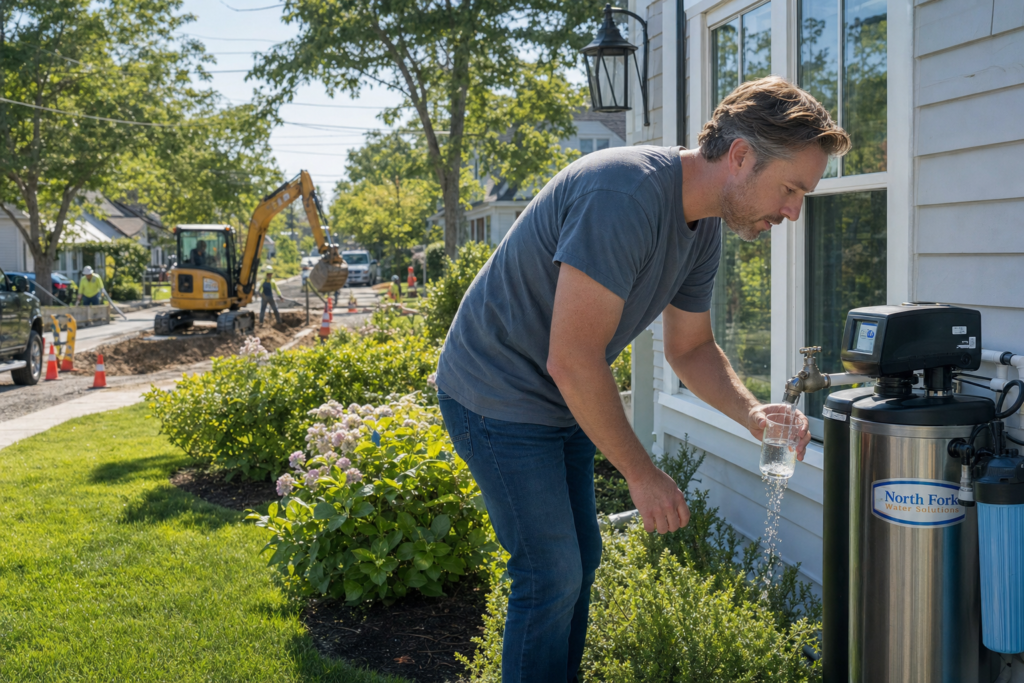
Suffolk County Water Authority stated on August 6, 2026, that it is “partnering with County Executive Ed Romaine and Suffolk County to pursue state and federal grant funding to extend public water to up to 60 homes in Mattituck near Reeve Avenue, an area where private wells are impacted by groundwater contamination” (SCWA).
In the same announcement, SCWA said “The proposed $2.4 million project will install 3,850 feet of new water main” (SCWA).
Key points for North Fork private well owners
- New York State Department of Health explained on November 7, 2014, that the Private Well PFAS Testing and Mitigation Rebate Pilot Program “offers limited, free private well testing and rebates for PFAS water treatment in six counties” and that “What we learn will inform future efforts to support New Yorkers on private wells” (NYSDOH).
- NYSDOH stated on November 7, 2014, that “Rebates are available only if your private well test results for PFOA or PFOS are equal to or greater than New York State drinking water standards for public water (10 nanograms per liter (ng/L) or 10 parts per trillion (ppt)” (NYSDOH).
- Suffolk County Water Authority reported that “In 2024, the Suffolk County Department of Health Services conducted an assessment of private wells in the area” and that “Of 39 wells tested, 31 contained PFOA and/or PFOS” (SCWA).
- SCWA also stated that “Test results showed 22 wells exceeded the state drinking water limit of 10 parts per trillion (PPT)” and that “The highest concentration detected was over 1,000 PPT, which is more than 100 times the state limit” (SCWA).
How the state PFAS testing and rebate pilot works
New York State Department of Health explained on November 7, 2014, that the Private Well PFAS Testing and Mitigation Rebate Pilot Program “offers limited, free private well testing and rebates for PFAS water treatment in six counties” and that “What we learn will inform future efforts to support New Yorkers on private wells” (NYSDOH).
The Department cautioned on November 7, 2014, that “We also may pause as we carefully track available funds for rebates because we don’t want to turn anyone away who has been tested as part of this program and is eligible for a rebate for PFAS water treatment” and advised residents to “look for future announcements here and from these six counties” (NYSDOH).
NYSDOH clarified on November 7, 2014, that “This program is for household drinking water” and that “Private wells used only for agriculture are not eligible” (NYSDOH).
The agency explained on November 7, 2014, that “Perfluorooctanoic acid (PFOA) and perfluorooctanesulfonic acid (PFOS) are the two most commonly found and studied PFAS” and that “New York State’s PFOA and PFOS public drinking water standards are used as the guidance values to recommend PFAS water treatment and determine eligibility for a rebate” (NYSDOH).
NYSDOH further stated on November 7, 2014, that “Rebates are available only if your private well test results for PFOA or PFOS are equal to or greater than New York State drinking water standards for public water (10 nanograms per liter (ng/L) or 10 parts per trillion (ppt)” (NYSDOH).
NYSDOH stated on November 7, 2014, that “Only property owners can apply for a rebate for PFAS water treatment” (NYSDOH).
What this means for your Mattituck or North Fork well
All of these moving pieces can feel like a lot when you are trying to make steady, practical decisions for your home.
You may find it helpful to think about your own well in the short term and any possible public water main on your road as a separate, longer-term track.
In the short term, you can decide what kind of testing, expert advice, and follow-up feels right for your household and budget.
In the longer term, you can keep an eye on local updates so you are ready to weigh your options if a main extension or connection offer ever reaches your street.
If you want to go deeper into the topics mentioned here, you can explore the PFAS, Private Well Water, and Water Quality & Safety sections on this site.
For additional Mattituck-specific context, you can also read the earlier post PFAS and the Mattituck Water Main Extension.
Taking a calm, step-by-step approach can make it easier to plan for both your well and any future public water connections.
If you’re weighing testing and filtration for your Suffolk home
Thinking about everything at once can feel overwhelming, so it can help to take your next steps one at a time.
You might start by deciding what kind of information you want about your water and who you want to involve in that conversation.
Measuring PFAS and 1,4-dioxane at the levels regulators use (parts per trillion and parts per billion) requires analysis by a certified laboratory; a free in-home water test is a starting point for understanding your water and your options.
pHountain offers a free, no-obligation in-home water test.
pHountain serves homes across Long Island, in Nassau and Suffolk Counties.
pHountain’s specialists are trained for both well water and municipal supply.
If you would like a simple starting point at home, you might visit the Free In-Home Water Test page.
Information on our website about water quality, health benefits, or filtration performance is provided for general educational purposes only and does not constitute medical, legal, or engineering advice.
Works Cited
- “Private Well PFAS Testing and Mitigation Rebate Pilot Program.” New York State Department of Health, 7 Nov. 2014, www.health.ny.gov/environmental/water/drinking/privatewellspilot. Accessed 28 Oct. 2026.
- “Suffolk County Water Authority Partners with Suffolk County to Seek State and Federal Grants to Fund Mattituck Water Main Extension.” Suffolk County Water Authority, 6 Aug. 2026, www.scwa.com/suffolk-county-water-authority-partners-with-suffolk-county-to-seek-state-and-federal-grants-to-fund-mattituck-water-main-extension. Accessed 28 Oct. 2026.