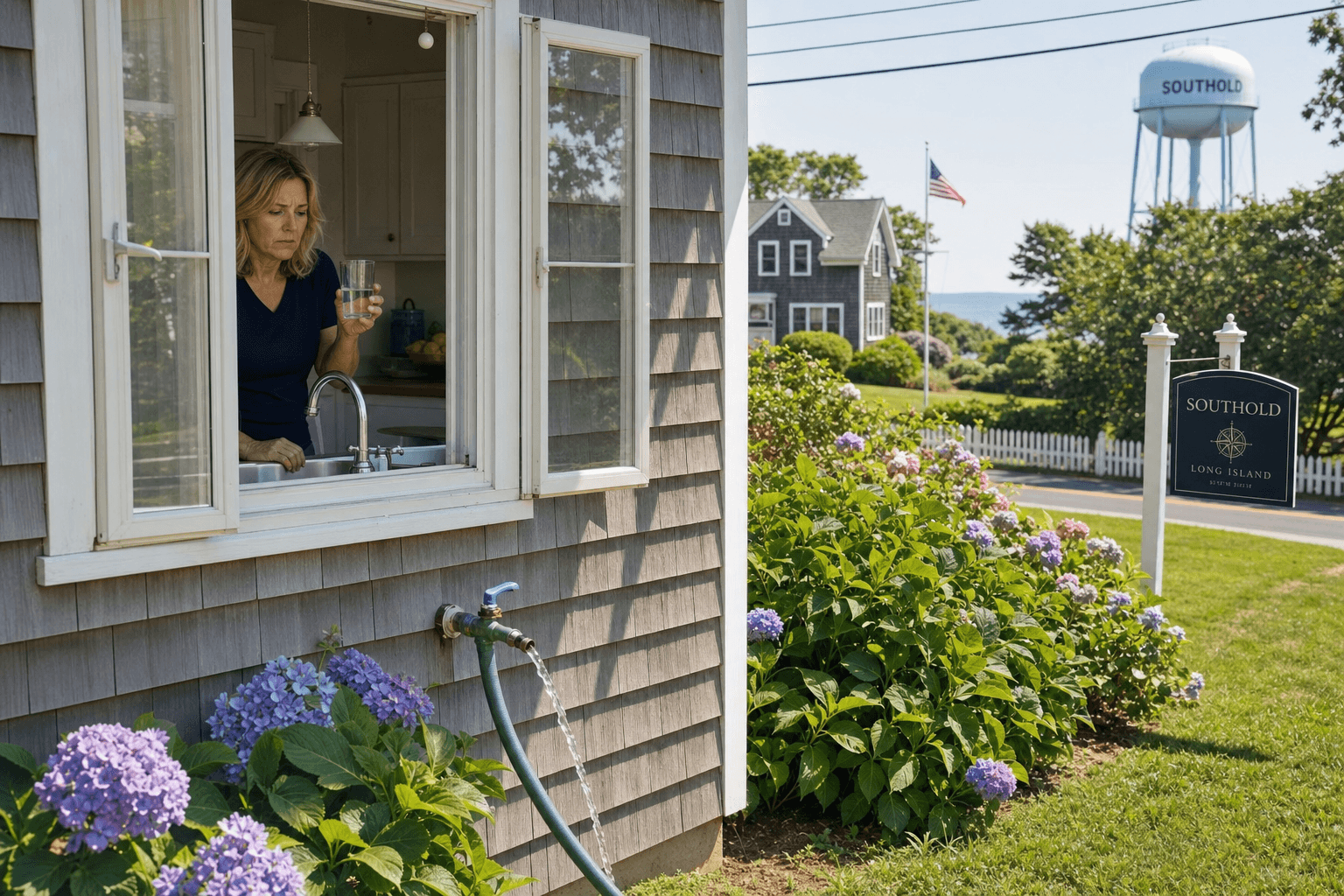
Southold homeowners can notice lower water pressure in the hottest weeks of summer. In 2026 the Suffolk County Water Authority (SCWA) explained why. On July 14 it declared a Stage 1 water alert for four East End towns, and on July 31 it lifted the alert for Southampton, East Hampton and Shelter Island but kept it in Southold, where it said North Fork storage tanks were still reaching low levels during peak morning hours.
Below, you’ll see what SCWA said was happening, what it asked Southold customers to do, and what you can do inside your own home. This post is about summer demand and the alert. For SCWA’s longer-term North Fork water main project, see our post on what North Fork homeowners should check while the water main project advances.
1. Understanding the Causes of Southold’s Summer Water Pressure Changes
Southold’s public water comes from groundwater, not from a river or reservoir: SCWA’s conservation page says Suffolk County’s only source of drinking water is its underground aquifer system. On the North Fork, SCWA says that supply is thinner and shallower than in other parts of Long Island, which leaves the area susceptible to saltwater intrusion, threatened by surface-level contamination and limited in its supply to meet water demand (SCWA, July 24, 2026).
In summer, several stressors hit at once:
- Lawn irrigation: SCWA reported high demand on its infrastructure during overnight and early-morning hours from irrigation systems (SCWA, July 14, 2026).
- Drought: In the same announcement, SCWA said Suffolk County remained in a moderate drought, with portions of the county, particularly on the East End and Huntington, in severe drought (SCWA).
- Record pumping: SCWA said it set a pumpage record in June, withdrawing 11.15 billion gallons across its entire system, and nearly exceeded its peak pumpage-per-minute record at 540,000 gallons per minute (SCWA).
Demand is also growing over time. SCWA says that, despite conservation efforts, water demand on the North Fork continues to increase, which strains existing infrastructure and the local water source (SCWA).
1.1 What Homeowners Notice When System Demand Spikes
SCWA’s July 14 announcement describes the chain of events. Heavy overnight irrigation means storage tanks begin the day at low levels and take longer to refill. The weight of the water in those tanks creates the pressure that pushes water through the mains, so when tank levels drop too low, pressure drops too, which can lower flow to homes and limit the water available for fire protection.
- Noticeable pressure drops: At a public hearing on SCWA’s North Fork pipeline project, officials described a 300,000-gallon tank on Moore’s Lane in Greenport that can drop to only a few feet of water during summer demand, reducing both water pressure and the reserve available for emergencies such as fires, and the 30-foot tank dropped to 6.5 feet at 5 a.m. on July 3, the Suffolk Times reported on August 21, 2026.
- Timing: Because the strain comes from overnight and early-morning irrigation, SCWA said its tanks begin the day low (SCWA, July 14, 2026) and, in Southold, kept reaching low levels during peak morning hours (SCWA, July 31, 2026).
SCWA’s 2026 announcements describe this as a demand and pressure problem. Neither the July 14 nor the July 31 release said anything about drinking water quality changing.
2. What SCWA’s 2026 Stage 1 Water Alert Meant for Southold
2.1 Timeline of the Alert
- July 14, 2026: SCWA declared a Stage 1 water alert for all customers in the towns of Southold, Shelter Island, Southampton and East Hampton, citing drought and record pumpage.
- July 31, 2026: SCWA rescinded the alert for Southampton, East Hampton and Shelter Island. The alert remained in effect for customers in Southold.
- Early August 2026: SCWA planned a public meeting on the Southold water situation at the Greenport firehouse on Third Street, the Suffolk Times reported on July 31.
When this post was revised on October 21, 2026, SCWA’s news page listed no later announcement about the Southold alert. Check that page for the current status.
For what the alert meant on the South Fork, see our post on managing water use and pressure during the SCWA East End Stage 1 water alert.
2.2 Why the Alert Stayed in Southold
According to SCWA’s July 31 announcement:
- Rain helped elsewhere: Late-July rainfall decreased demand, and reduced lawn irrigation improved early-morning storage tank levels in Southampton and East Hampton, allowing operating pressure to remain steady there.
- North Fork tanks stayed low: The alert continued in Southold because North Fork water storage tanks kept reaching low levels during peak morning hours despite the rain. SCWA said tank levels dictate system pressure, which affects residential water flow and fire protection reserves.
- Demand above capacity: SCWA Chairman Charlie Lefkowitz said the situation in Southold remained difficult “with customer demand still outstripping our pumping capacity.”
- Early-morning irrigation is the key: SCWA Chief Executive Officer Jeff Szabo said, “System stability depends on customers limiting early morning irrigation.”
2.3 What SCWA Asked Southold Customers to Do
Under the alert, SCWA asked Southold customers to refrain from lawn watering unless necessary. If they must water, they should strictly follow the odd/even schedule (SCWA, July 31, 2026):
- Odd-numbered street addresses may water only on odd-numbered calendar days.
- Even-numbered street addresses may water only on even-numbered calendar days.
- No lawn watering is permitted between 10 a.m. and 4 p.m.
SCWA points customers to its conservation page for details and water-saving methods. For a closer look at lawn and irrigation settings, see our post on lawn watering and SCWA’s odd/even rules on the East End.
2.4 Where the North Fork Water Main Project Fits
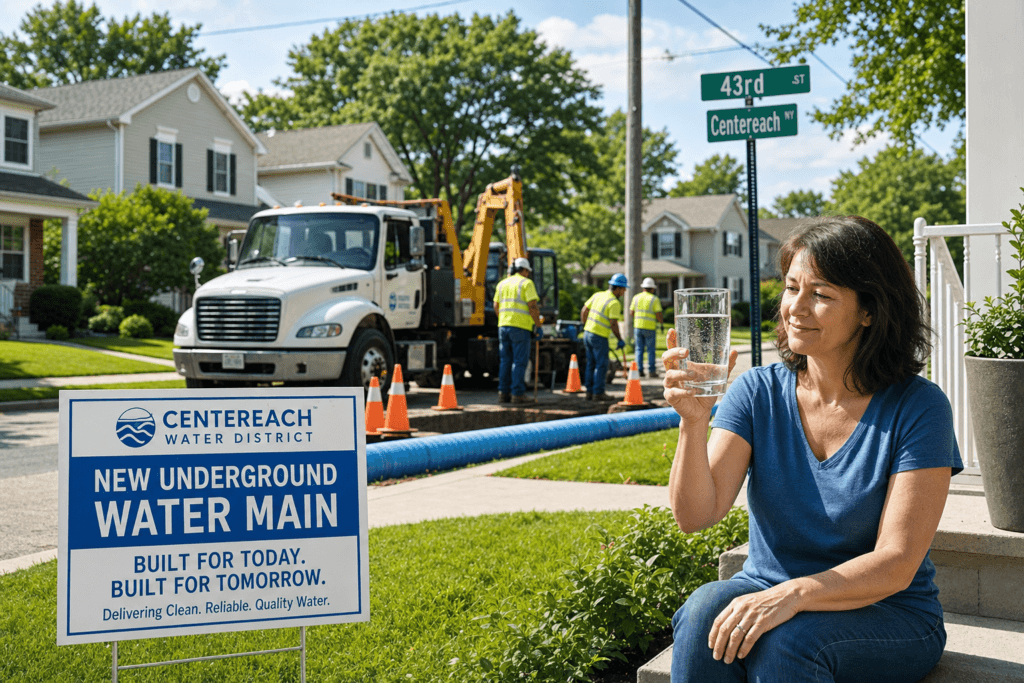
SCWA’s long-term answer to North Fork supply is a new transmission main with a booster station that, according to SCWA, is intended to stabilize water pressure and ease the daily pumping burden on local wells, with completion anticipated in 2028 (SCWA, July 24, 2026). For now, SCWA says system stability in Southold depends on customers limiting early-morning irrigation (SCWA, July 31, 2026). Our North Fork water main post covers the project itself.
3. Summer Water Use and Your Home’s Water Quality
A summer pressure problem is not the same thing as a water quality problem, but it is a good moment to look at what is actually in your water.
3.1 What You Can Check About Southold Tap Water
- Chlorine smell: SCWA says that before water leaves the pump station, minute traces of chlorine are routinely added, according to state health department specifications, to prevent bacterial growth in its water mains and tanks (SCWA 2026 Drinking Water Quality Report, pages 42–44).
- Your annual report: SCWA’s Annual Water Quality Report covers all testing conducted during the calendar year, with charts, data, maps and explanations (SCWA water quality reports). EPA calls these annual reports Consumer Confidence Reports and has a page on finding yours.
- Results near your address: SCWA’s See My Water Quality map lets you search an address and view testing results from the nearest sample station.
- Changes you notice: If your water’s taste, odor or clarity changes, note when it happened and contact SCWA.
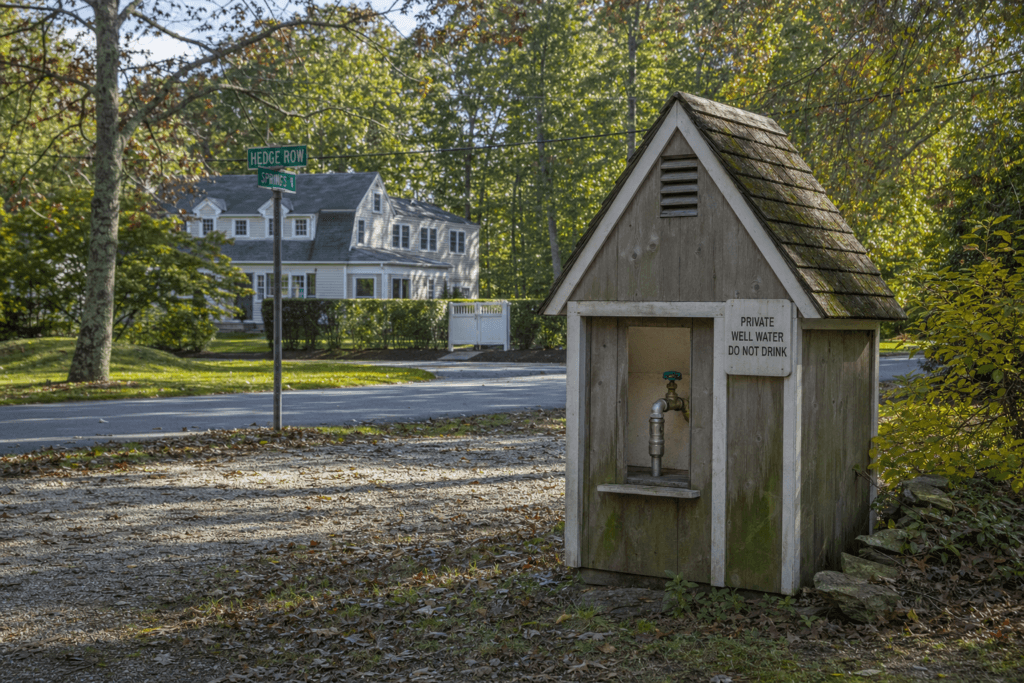
If your home is on a private well rather than SCWA water, testing it is your responsibility (EPA), and the Suffolk County Department of Health Services has guidance on private well water testing.
4. What Long Island Customers Say
You can read reviews that customers have left for pHountain Water Filtration on Google on our testimonials page.
5. Practical Steps Southold Residents Can Take to Ease Summer Demand
Whether you’re on public water in Southold or a nearby North Fork community, you can take simple steps to ease strain on the system at peak hours.
5.1 Practical Conservation Tips for Peak Summer Demand
At the SCWA hearing on the pipeline project, Greenport officials supported the pipeline for reliability and fire protection but acknowledged that more aggressive conservation will be needed, and Southold Town Supervisor Al Krupski said automatic sprinkler systems were still watering after 3 inches of rain, the Suffolk Times reported on August 21, 2026. You can help by:
- Adjusting irrigation controllers
- Skip watering after rain: Turn off or pause automatic systems after substantial rainfall.
- Watch the early-morning hours: SCWA’s rules ban lawn watering from 10 a.m. to 4 p.m., but its July 31 release said Southold’s system stability depends on customers limiting early-morning irrigation. During an alert, consider watering less often rather than only shifting the hour.
- Checking for leaks
- A constantly running toilet can waste more than 200 gallons a day, and a faucet dripping once per second can waste more than 3,000 gallons a year, according to SCWA’s leak facts.
- EPA suggests a simple toilet test: add a few drops of food coloring to the tank, and if color shows up in the bowl after 10 minutes, you have a leak (EPA WaterSense).
- Using efficient fixtures
- Standard showerheads use 2.5 gallons per minute, while WaterSense labeled showerheads must use no more than 2.0, and EPA says the label also requires a satisfactory shower (EPA WaterSense).
- Prioritizing essential uses
- During heat waves, consider limiting non-essential outdoor use such as hosing down driveways or washing cars at home.
These steps lower the peak demand that SCWA said drew its North Fork tanks down. They also ease pumping from the Upper Glacial Aquifer, which SCWA says most North Fork wells draw from, and where over-pumping risks drawing saltwater into the freshwater supply (SCWA).
5.2 How to Check and Improve Your Home’s Water Quality
To get a clear picture of your own water:
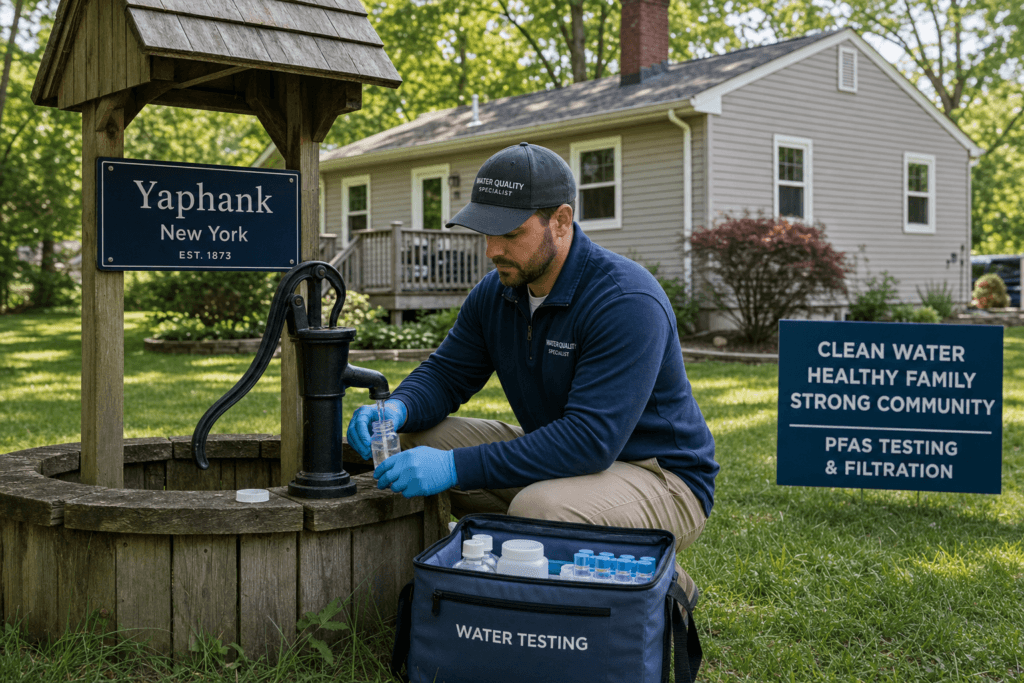
- Arrange in-home testing
- A free in-home water test is a starting point for understanding your water and your options.
- Review your options
- Whole-house filtration at the main line treats the water that feeds every tap, including water for drinking, cooking, bathing and laundry.
- Under-sink systems at the kitchen tap cover drinking and cooking water only.
- Consider long-term costs
- Compare the ongoing cost of bottled water with the cost of a filtration option. Our page on Water Filters vs Bottled Water walks through the tradeoffs.
6. Where Whole-Home Filtration Fits in Southold
SCWA’s alert and its water main project deal with supply and pressure across the system. Home filtration does not add supply or raise system pressure; it is about treating the water that enters your house.
6.1 About the pHountain Filtration System
The pHountain Filtration System is a whole-home (point-of-entry) system with a cartridge-free media design intended to reduce common impurities in tap water. It is installed at the point where water enters your home, so every tap and shower receives filtered water.
- It is recommended after a free in-home water test.
- It is professionally installed.
- It is backed by a 10-year guarantee.
A whole-home system is configured around what testing finds. For any specific contaminant, ask for independent certification data (for example NSF/ANSI listings) for the exact system you are considering.
6.2 Comparing Water Quality Strategies for Southold Homeowners
Here’s a quick comparison of how different strategies line up for a Southold household:
| Approach | What It Covers | Limitations |
|---|---|---|
| Relying on public water alone | Water treated and tested by SCWA, which must meet state and federal standards | No treatment of your own beyond what the supplier does; summer pressure still depends on system demand |
| Bottled water only | Drinking water | Ongoing cost and packaging; does nothing for showers, laundry, or cooking with tap water |
| Under-sink filter | Drinking and cooking water at one faucet | Other taps and showers are not treated |
| Whole-house filtration | All water entering the home, including showers and appliances | Requires professional installation and upfront investment; does not change system pressure |
For homeowners in Suffolk County, including Southold, you can learn more about regional options on our page for Whole-Home Water Filtration for Suffolk County.
7. Answers to Common Questions on Southold’s Water Supply and Summer Demand
7.1 Why can my Southold water pressure drop on summer mornings?
SCWA says heavy overnight and early-morning irrigation leaves its storage tanks low at the start of the day, and low tank levels reduce system pressure, which can lower flow to homes (SCWA, July 14, 2026). In 2026 the alert stayed in Southold after July 31 because North Fork tanks kept reaching low levels during peak morning hours (SCWA, July 31, 2026). At a hearing on SCWA’s pipeline project, officials described a Greenport storage tank that can drop to only a few feet of water during summer demand; the 30-foot tank dropped to 6.5 feet at 5 a.m. on July 3, the Suffolk Times reported.
7.2 Will the North Fork water main project end summer pressure problems?
SCWA says the project includes a new booster station to stabilize water pressure and improve system reliability, and that the new transmission line will ease the daily pumping burden on local wells; it anticipates completion in 2028 (SCWA). Local officials have supported the project but stressed that conservation must still play a role (Suffolk Times). Until it is complete, peak-hour demand is the part customers can influence.
7.3 Why does my Southold tap water smell like chlorine?
SCWA routinely adds minute traces of chlorine before water leaves the pump station, to prevent bacterial growth in its mains and tanks (SCWA 2026 Drinking Water Quality Report). Its annual report also has information on disinfection byproducts. If the smell or taste of your water changes noticeably, contact SCWA, and consider having your water tested so you know what is in it.
7.4 I live in Southold but travel often in summer. Is there anything I should do before leaving the house?
If you’re away during peak season:
- Turn off or reprogram irrigation systems to avoid unnecessary watering, especially after rain. This helps keep early-morning demand down.
- Check for leaks before you go, so you’re not wasting water or risking damage while away.
- Consider shutting off your main water supply if you’ll be gone for an extended period and your plumbing allows it safely.
When you return, consider running your taps for a few minutes to flush water that has been sitting in your home’s pipes before drinking or cooking with it.
7.5 How can I get my Southold water tested and explore filtration options?
pHountain Water Filters serves homeowners across Long Island, including the North Fork. You can request a Free In-Home Water Test, and any system recommendation is based on what the test finds.
This material is for general informational purposes only and is not intended as professional plumbing, health, or environmental advice. Water conditions and restrictions can change; always check with SCWA and the appropriate agencies for guidance specific to your home and local rules.
Sources
- Suffolk County Water Authority, “Suffolk County Water Authority Declares Stage 1 Water Alert on the East End Amid Drought and Record Pumpage” (July 14, 2026): https://www.scwa.com/suffolk-county-water-authority-declares-stage-1-water-alert-on-the-east-end-amid-drought-and-record-pumpage/
- Suffolk County Water Authority, “Suffolk County Water Authority Rescinds Stage 1 Water Alert for Southampton, East Hampton, and Shelter Island; Alert Remains in Southold” (July 31, 2026): https://www.scwa.com/suffolk-county-water-authority-rescinds-stage-1-water-alert-for-southampton-east-hampton-and-shelter-island-alert-remains-in-southold/
- Suffolk County Water Authority, Draft Environmental Impact Statement announcement for the North Fork Water Main Project (July 24, 2026): https://www.scwa.com/suffolk-county-water-authority-issues-draft-environmental-impact-statement-for-north-fork-water-main-project-announces-revised-route/
- Suffolk County Water Authority, News: https://www.scwa.com/news/
- Suffolk County Water Authority, Conservation: https://www.scwa.com/conservation/
- Suffolk County Water Authority, Leak Facts: https://www.scwa.com/water-quality/helpful-household-tips/leak-facts/
- Suffolk County Water Authority, 2026 Drinking Water Quality Report, pages 42–44: https://s3.us-east-1.wasabisys.com/scwa-awqr/AWQR2026/WebFiles/pages/pages%2042-44.pdf
- Suffolk County Water Authority, Water Quality Reports: https://www.scwa.com/water-quality/water-quality-reports/
- Suffolk County Water Authority, See My Water Quality: https://www.scwa.com/mywaterquality/
- The Suffolk Times, “SCWA revised pipeline project draws support, conservation concerns” (August 21, 2026): https://suffolktimes.timesreview.com/2026/08/scwa-revised-pipeline-project-draws-support-conservation-concerns/
- The Suffolk Times, “Rain eases East End water alert — but not in Southold” (July 31, 2026): https://suffolktimes.timesreview.com/2026/07/rain-eases-east-end-water-alert-but-not-in-southold/
- EPA WaterSense, Fix a Leak Week: https://www.epa.gov/watersense/fix-leak-week
- EPA WaterSense, Showerheads: https://www.epa.gov/watersense/showerheads
- EPA, Consumer Confidence Reports: https://www.epa.gov/ccr
- EPA, Private Drinking Water Wells: https://www.epa.gov/privatewells
- Suffolk County Department of Health Services, Private Well Water Testing: https://www.suffolkcountyny.gov/Departments/Health-Services/Environmental-Quality/Water-Resources/Private-Well-Water-Testing