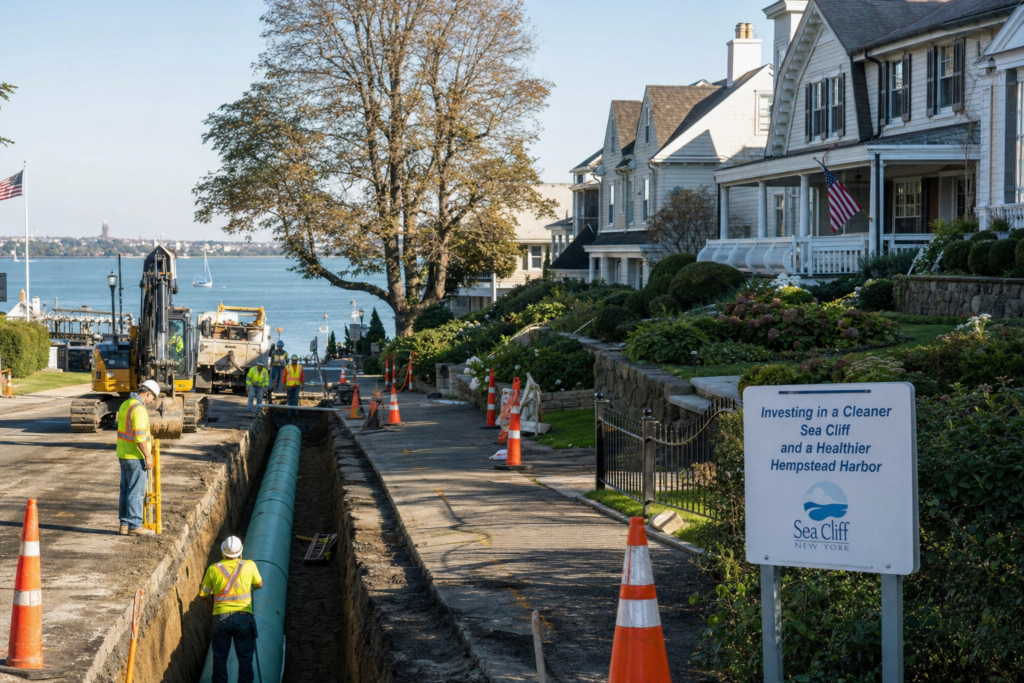
Suffolk County officials are pursuing the Mattituck water main extension to connect dozens of homes near Reeve Avenue to public water after serious PFAS contamination was found in private wells.(1)
If you live in this part of Mattituck and rely on a private well, you may be asking two urgent questions:
- What exactly is happening with the water main extension?
- What can I do right now to protect my home’s water?
This guide walks through the project, explains what the PFAS findings mean, and outlines practical steps Mattituck homeowners can take — including how a whole-home filtration system can work alongside a future public water connection.
1. Understanding the Scope of the Mattituck Water Main Extension Project
The Mattituck water main extension is a proposed Suffolk County Water Authority (SCWA) project designed to bring public water to homes near Reeve Avenue that currently depend on private wells.
Key details of the project
According to SCWA, the proposal includes:(1)
- 3,850 feet of new water main to be installed
- Up to 60 properties eligible for connection
- A total project cost of about $2.4 million, including the main, service taps, and private service lines for all 60 homes
Without outside funding, connection costs could exceed $40,000 per home.(1) That’s why SCWA and Suffolk County are actively seeking state and federal grants to help cover the work.
Why Reeve Avenue and nearby homes were targeted
In 2024, the Suffolk County Department of Health Services tested private wells in the Reeve Avenue area of Mattituck. The results were alarming:(1)
- 22 wells exceeded the New York State drinking water limit of 10 parts per trillion (ppt) for certain PFAS
- The highest PFAS concentration was over 1,000 ppt — more than 100 times the state limit
County and SCWA officials have described this as a water quality issue and are working to secure funding so affected homeowners can connect to a regulated public water supply.(1)
2. What PFAS Presence Means for Your Mattituck Well Water
If you’re on a private well in Mattituck, especially near Reeve Avenue, understanding PFAS is important for making informed decisions about your water.
What are PFAS?
PFAS (per- and polyfluoroalkyl substances) are a large group of manufactured chemicals used for things like nonstick coatings, stain resistance, firefighting foam, and water-repellent products.(1)
Key characteristics:
- Extremely persistent: PFAS break down very slowly in the environment
- Water-soluble: They can move with groundwater and reach private wells
- Widespread: PFAS have been detected in drinking water supplies across the country
The Environmental Protection Agency has stated that exposure to certain PFAS levels has been associated with potential health concerns.(1)(3) pHountain Water Filters does not provide medical advice; always consult a qualified health professional for health-related questions.
Vulnerability of Private Wells to PFAS
Unlike public water systems, private wells:
- Do not receive mandatory routine testing for PFAS or many other contaminants
- Do not have built-in treatment unless the homeowner installs it
- Draw untreated groundwater, which can be impacted by historical spills, industrial activity, or other contamination sources(1)
SCWA notes that private wells are susceptible to PFAS contamination specifically because they lack the required monitoring and treatment that public systems must use.(1)
3. SCWA’s Role and Strategy for Addressing PFAS Challenges in Mattituck
The water main extension is only part of the response. SCWA has laid out a broader approach for dealing with PFAS in its service areas.
SCWA’s PFAS monitoring and treatment
SCWA reports that it uses advanced monitoring to test for PFAS in public supply wells and applies granular activated carbon (GAC) treatment when PFAS are detected.(1)
For Mattituck, the steps include:
- Assessing private wells in the Reeve Avenue area (already completed in 2024)
- Planning the water main extension to connect affected homes to public water
- Applying for grants to keep connection costs manageable
How the project is being funded
To help homeowners avoid the full cost of connection, SCWA has:(1)
- Applied to the New York State Water Infrastructure Improvement (WIIA) program, which can cover up to 70% of allowable project costs
- Applied for a federal grant through the local congressional delegation
SCWA has used similar grant strategies in other Suffolk communities such as Manorville, Calverton, Westhampton, and Oak Beach to help minimize or eliminate out-of-pocket connection costs for residents.(1)
There is no guarantee that all requested funds will be awarded, but if both state and federal grants are fully approved, connection costs for Mattituck residents could be significantly reduced or potentially covered.(1)
4. Immediate Actions for Private Well Owners in Mattituck
Even with the water main extension moving forward, there may be a multi-year gap between today and the day your home is actually connected to public water. During that time, you still need to manage your water quality.
Here are practical steps to consider.
Step 1: Identify if your well lies within the affected zone
If you are near Reeve Avenue in Mattituck and on a private well:
- Check official notices: Look for letters or notices from Suffolk County or SCWA.
- Contact local authorities: Reach out to the Suffolk County Department of Health Services or SCWA to confirm whether your address was part of the tested group.
- Review local coverage: Local reporting has tracked PFAS testing and the extension effort; staying up to date can help you understand how close you are to the identified contamination zone.(2)
If you’re outside the immediate focus area but still on a private well in Mattituck, PFAS may still be a concern. Groundwater doesn’t stop at street boundaries.
For a broader look at how PFAS is showing up across Long Island, you can review this overview of Long Island’s PFAS problem.
Step 2: Schedule current and comprehensive water testing
If your well has never been tested for PFAS, or if your last test is more than a year old:
- Schedule laboratory testing that explicitly includes PFAS (such as PFOA and PFOS).
- Consider retesting periodically, especially if you’re near known contamination.
SCWA and Suffolk County have supported PFAS testing initiatives in impacted areas while pursuing the Mattituck extension.(2)
To understand other common well-water issues on Long Island, you can explore What Your Well Water Isn’t Telling You.
Step 3: Choosing between temporary fixes and long-term protection
Once you have test results, you’ll need to choose how to respond — both until the water main arrives and after you connect.
Typical options include:
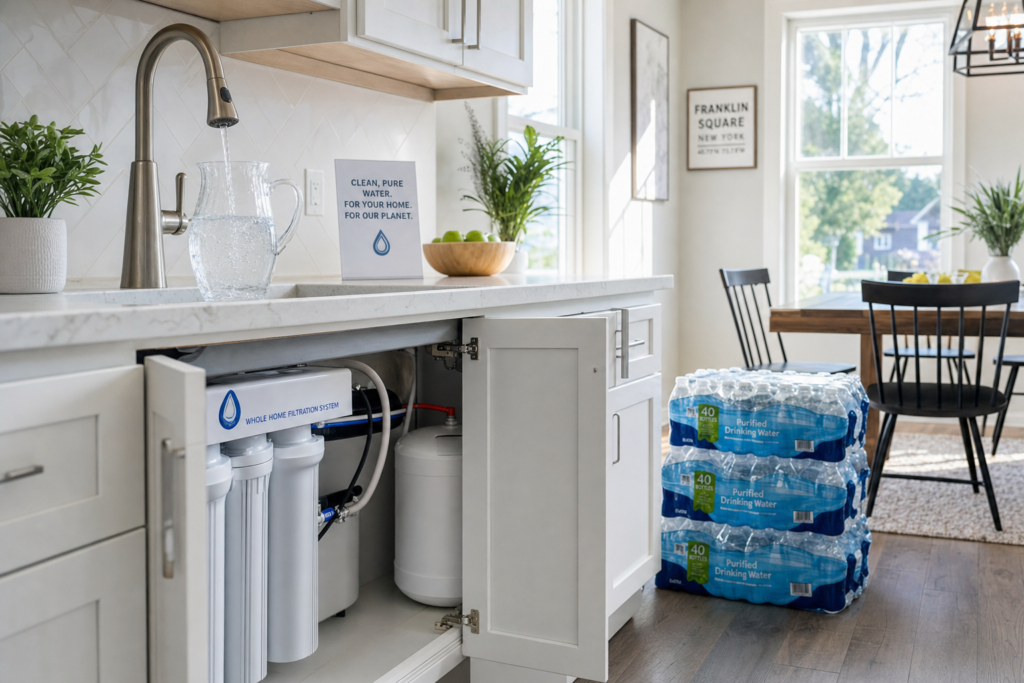
- Bottled water for drinking and cooking
- Pitcher or faucet filters for limited drinking coverage
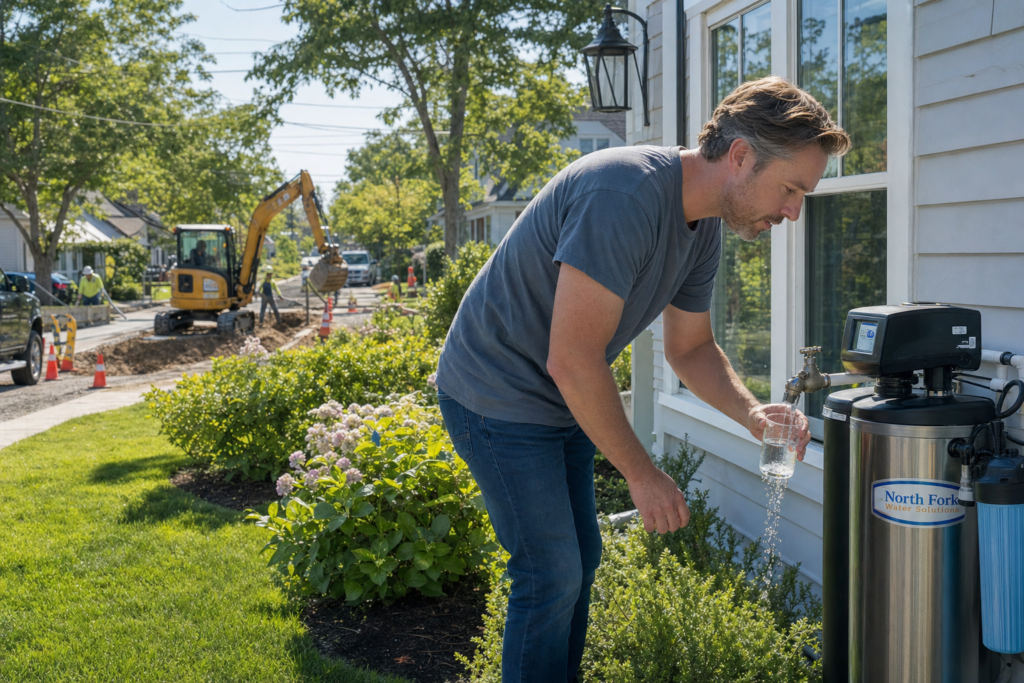
- Whole-home filtration at the main line, treating all water entering the house
The table below compares these approaches in simple terms.
| Option type | Coverage in home | Ongoing effort for homeowner | Long-term suitability |
|---|---|---|---|
| Bottled water | Drinking only | High (constant buying) | Low |
| Pitcher / faucet units | Some drinking taps | Medium (frequent changes) | Medium |
| Whole-home filtration | Every tap & fixture | Lower (periodic service) | High |
For a more detailed comparison between filtration and bottled water spending, see Water Filters vs Bottled Water.
5. Integrating Whole-Home Filtration Ahead of and Beyond the Water Main Extension
Many Mattituck homeowners are unsure whether it makes sense to invest in a whole-house filtration system if they may eventually connect to SCWA water. In practice, a properly designed system can support you now on well water and later on municipal water.
Protecting your home with well water filtration
A whole-home system installed at the main water entry point can be configured to address:
- PFAS concerns with appropriate filter media
- Chlorine, sediment, and other contaminants that may appear in different water sources
- Taste and odour issues that make water unpleasant to drink
At pHountain Water Filters, we start with water quality testing and analysis to understand your specific well conditions, then recommend a customised water filtration system suited to those test results and your home’s plumbing.
Lasting advantages after switching to public water
Many Long Island homes that are already on public water still choose to install whole-home filtration. Reasons include:
- Additional taste and odour improvement beyond what public treatment provides
- House-wide coverage, including showers, baths, and laundry
- Consistency if water quality changes due to infrastructure work or seasonal shifts
You can see how we support municipal-water homes across the region on our Whole-Home Water Filtration for Suffolk County page and our Water Filtration Long Island NY service area overview.
6. A Representative Mattituck Homeowner’s Experience with PFAS Challenges
To make this more concrete, here’s a composite example based on real situations we’ve seen in the Reeve Avenue area of Mattituck. This is not a single named customer, but it reflects common patterns.
The problem: elevated PFAS in a private well
- A homeowner near Reeve Avenue relied on a private groundwater well for all household water.
- After county outreach, the homeowner participated in PFAS testing.
- Results showed qualitatively elevated PFAS contamination, including PFOA/PFOS above recommended safety thresholds.
The family began relying heavily on bottled water for drinking and cooking, which quickly became expensive and inconvenient.
The solution: whole-home filtration with professional installation
Working with pHountain Water Filters, the homeowner:
- Completed a water quality evaluation to confirm contaminants of concern.
- Chose a pHountain pHresh Filtration System as a whole-house solution.
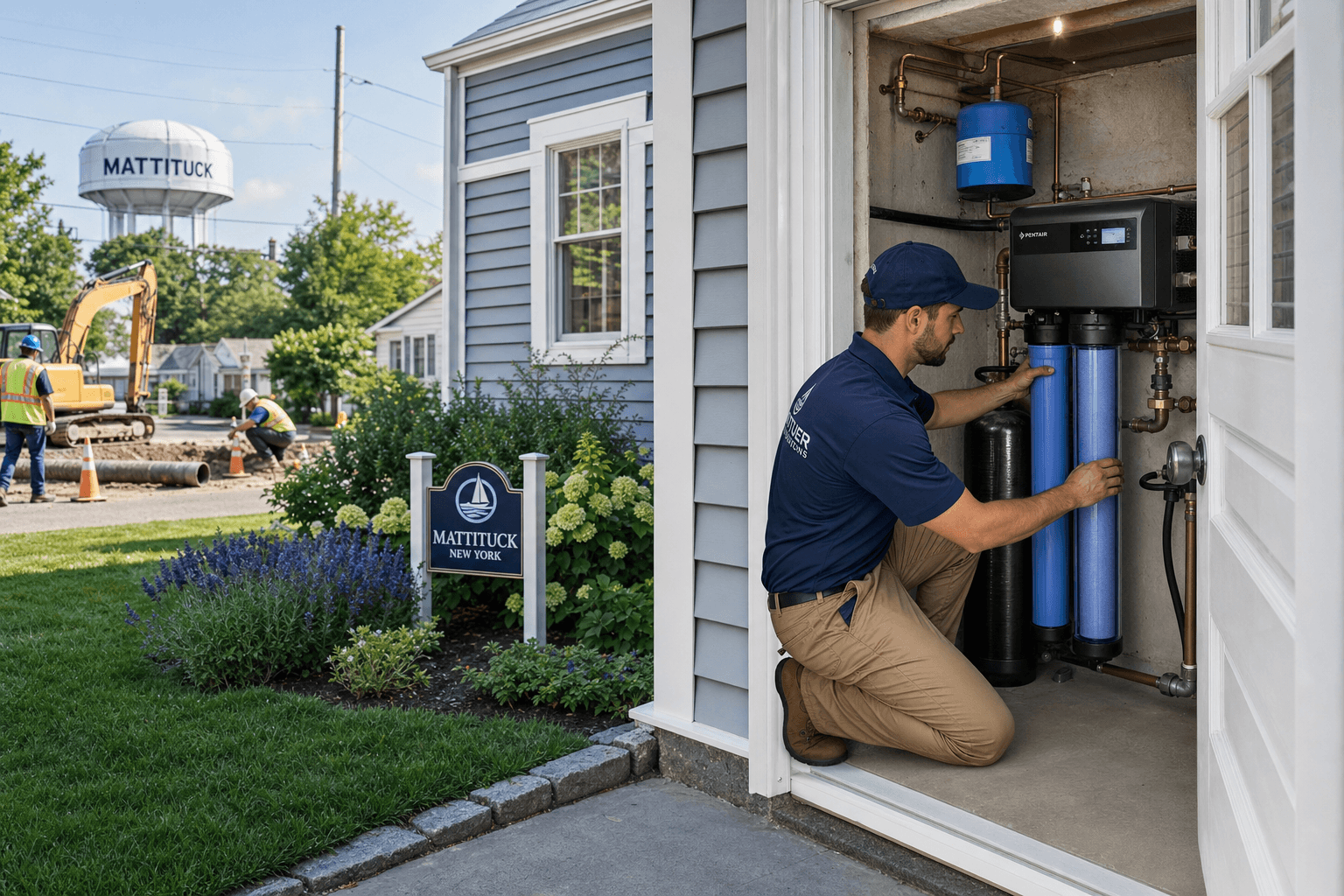
- Had the system installed via professional installation at the main water line.
The goal was to help reduce exposure to PFAS and other contaminants throughout the home — not just at the kitchen sink — while also improving taste and convenience.
The impact: less bottled water and more confidence
After installation, the family:
- Relied far less on bottled water
- Estimated a savings of around $30 to $70 per month compared with prior bottled water and related costs
- Gained more confidence using their tap water for everyday tasks like cooking, showering, and laundry
If and when this homeowner connects to the Mattituck water main extension, the same whole-home system can continue working with the new public water supply.
> Looking for a clear plan for your Mattituck home? You can request a Free In-Home Water Test to understand what’s in your water and discuss filtration options tailored to your situation.
7. Navigating Your Filtration Journey with pHountain Water Filters
If you decide to explore a whole-house filtration solution while the Mattituck water main extension moves forward, here’s what the process usually looks like.
Step 1: Initial consultation
- You contact pHountain Water Filters through our Contact Us page or online form.
- We discuss your home’s location, whether you’re on a private well, and any known test results or concerns (such as PFAS).
Step 2: Water testing and analysis
- We review existing lab results if you already have them.
- If needed, we arrange water quality testing and analysis to identify relevant contaminants and water conditions.
Step 3: System recommendation and customisation
Based on your water profile and household needs, we:
- Recommend an appropriate configuration of the pHountain pHresh Filtration System or other solutions
- Take into account that your home may transition from well water to SCWA water in the future
- Design the system so it can adapt as your water source changes
Step 4: Professional installation and follow-up
- Our technicians handle professional installation at the main water entry point.
- After installation, the system is tested to confirm proper operation.
- We walk you through how the system works and outline maintenance and system support going forward.
8. Common Questions from Mattituck Homeowners About PFAS and Water Safety
Is every private well in Mattituck affected by PFAS?
No. The 2024 assessment focused on private wells in the Reeve Avenue area, where 22 wells were found above the state PFAS limit and one sample exceeded 1,000 ppt.(1)
However, if you have a private well anywhere in Mattituck, PFAS and other contaminants are still possible. The only way to know your specific situation is through laboratory testing of your own well.
If I’m near Reeve Avenue but not one of the 60 homes, should I be worried?
If you’re close to the mapped contamination area but not currently included in the Mattituck water main extension, you may still want to:
- Test your well, including PFAS, through a certified lab
- Consider interim filtration solutions if contaminants are detected
- Stay in touch with local officials in case the project boundaries change over time
Groundwater contamination can extend beyond the initial group of tested homes, so it’s wise to treat your well independently rather than assuming it’s unaffected.
How long will it take for the water main extension to be completed?
The exact timeline depends on grant approvals, design, permitting, and construction scheduling. SCWA has already applied for state and federal funding, but there is no published completion date yet.(1)
Because these projects can take time, many homeowners choose to install filtration now to address current water quality concerns, then maintain that system once they connect to public water.
Will I still benefit from a whole-home system after connecting to SCWA water?
Yes, many homes on public water across Suffolk County still opt for whole-home filtration to:
- Enhance taste and odour
- Provide house-wide coverage for showers, baths, and appliances
- Add an extra layer that helps reduce exposure to contaminants beyond regulatory minimums
If you’re already thinking ahead to your future connection, you can explore region-wide options on our Whole-Home Water Filtration for Suffolk County page.
Protecting your family’s water in Mattituck doesn’t have to wait for the last foot of pipe to be laid. Whether you’re on a private well today, expecting to connect to the Mattituck water main extension, or already on public water elsewhere in Suffolk County, pHountain Water Filters can help you design a customised, long-term filtration strategy for your home.
> Ready to understand your own water quality — not just the averages? Start with a Free In-Home Water Test and a tailored consultation for your Mattituck property.
This content is for informational purposes only and does not constitute health, medical, or plumbing advice. Always consult qualified professionals for testing, diagnosis, treatment, or installation decisions related to your water supply, health, or home.
Water quality varies by location. Municipal water provided by SCWA achieved EPA compliance in June 2025. Private well owners should have water tested regularly. pHountain provides free water testing for Nassau and Suffolk County.