On June 8, 2026, regulators confirmed that the Brookhaven landfill is a source of PFAS “forever chemicals” and 1,4-dioxane in local groundwater, impacting areas around the site and down the contamination plume. According to Inside Climate News, thousands of residents near the Brookhaven landfill are now facing documented groundwater contamination tied directly to the facility.
I’ve walked into a lot of Long Island homes after bad water news breaks, and the pattern is always the same: confusion, mixed messages, and families trying to decide what’s actually in their water and what to do next. Brookhaven landfill water contamination isn’t an abstract environmental story — it’s about what comes out of your taps, fills your kids’ bathtubs, and runs through every appliance in your house.
In this post, I’ll walk you through five practical checks every Brookhaven homeowner should make right now, what the current reports actually say, and how our team at pHountain Water Filters approaches protection for both private wells and public supply homes in Suffolk County.
What Brookhaven Residents Must Understand Immediately
- Regulators have confirmed the Brookhaven landfill as a source of PFAS and 1,4-dioxane in local groundwater, affecting areas around the site and along the plume path, according to Inside Climate News.
- Thousands of Brookhaven residents may be in the path of this contamination, with particular concern for private wells drawing from local aquifers near the landfill, as reported by Riverhead Local.
- Community and environmental groups are pressing for faster action, expanded monitoring, and better protection for households in the impacted area, according to Citizens Campaign for the Environment.
- Private well owners in Brookhaven should prioritize professional lab testing for PFAS and 1,4-dioxane and consider whole-home treatment that targets industrial contaminants.
- Homes on public water still benefit from point-of-entry filtration that helps address chlorine, disinfection byproducts, and emerging contaminants that may not be fully addressed at the plant.
Insights From the Latest Brookhaven Landfill Contamination Reports
The June 8, 2026 update on the Brookhaven landfill didn’t come out of nowhere — residents have been raising alarms about odors, truck traffic, and possible pollution for years. According to Inside Climate News, recent environmental reviews now link elevated PFAS and 1,4-dioxane in groundwater directly to the landfill, closing the loop on what many neighbors suspected.
PFAS are a class of man-made “forever chemicals” used in everything from firefighting foam to non-stick coatings. They don’t break down easily in the environment and can travel with groundwater over long distances. 1,4-dioxane is a synthetic industrial solvent and stabilizer historically used in manufacturing and in some consumer products. Both have become signature contaminants for Long Island because they move readily through sandy soils and into the aquifers that supply our drinking water. According to Citizens Campaign for the Environment, the Brookhaven landfill has been a focal point of concern precisely because those conditions make any leak or seepage more likely to reach wells.
Local coverage from Riverhead Local describes a community increasingly frustrated by what they see as slow action and limited transparency. Residents interviewed there point to spreading plumes and worry that the contamination footprint will grow if stronger controls and cleanup plans are not implemented quickly.
From a technical standpoint, landfills can impact groundwater when leachate — the liquid that percolates through layers of waste — escapes containment systems or is not fully captured and treated. Once PFAS and 1,4-dioxane enter the soil and groundwater around a landfill, they can migrate along the natural flow of the aquifer, potentially intersecting with private wells or even influencing the raw water that public suppliers draw before treatment. On Long Island, where nearly all drinking water comes from groundwater, that pathway is especially important.
So while agencies and water suppliers debate standards, timelines, and cleanup strategies, Brookhaven families are left with a very practical question: what does this mean for my home’s water right now?
The Journey of Contaminants From Landfill to Your Household
From what we’ve seen across Long Island, there’s a fairly predictable chain of events when a site like the Brookhaven landfill is tied to groundwater contamination:
1. How PFAS and 1,4-Dioxane Enter the Aquifer
According to Inside Climate News, environmental reviews found elevated PFAS and 1,4-dioxane in groundwater connected to the landfill. In simple terms, that means contaminants have already moved beyond the landfill’s immediate footprint and into the subsurface water system.
On Long Island, sandy soils and a relatively shallow water table make it easier for contaminants to migrate downward and outward. Once they’re in the aquifer, they travel along the natural groundwater gradient.
2. The Contamination Plume Expands Beneath Nearby Areas
Riverhead Local reports that thousands of residents are within the path of the contamination plume. A plume is simply the zone where contaminated groundwater is moving. It doesn’t mean every well in that area is impacted to the same degree, but it does mean that the risk profile for homes in that path is higher than for homes outside it.
In Brookhaven, this is particularly concerning for neighborhoods closest to the landfill and those downgradient — the direction groundwater naturally flows.
3. Private Wells Face Direct Exposure First
Private wells don’t have the benefit of centralized monitoring and treatment. According to Citizens Campaign for the Environment, environmental advocates have been pushing for more testing and support for well owners near the landfill because they can be directly drawing from the contaminated portion of the aquifer.
If your home near the Brookhaven landfill relies on a private well, you are essentially your own water authority. That makes independent testing and in-home treatment critical.
For a deeper look at private well risks across Long Island, we’ve broken down the basics in our guide on what your well water isn’t telling you.
4. Ongoing Risks Even with Public Water Supply
Even if you’re on public water, you’re not completely removed from the landfill story. Public suppliers can treat water to meet regulatory standards, but PFAS and 1,4-dioxane are evolving targets, and treatment decisions can lag behind new science and new rules.
We’ve seen this pattern in other Long Island communities dealing with PFAS in produce and groundwater, which we cover in detail in our article on Long Island’s PFAS problem. The Brookhaven situation fits into that same regional pattern: legacy industrial contaminants in the aquifer, ongoing monitoring, and a mix of treatment and infrastructure responses.
In short: whether you’re on a private well or public supply in Brookhaven, landfill-driven contamination should push you to take a closer look at your own home’s water.
Five Essential Checks for Protecting Your Brookhaven Home’s Water
Here’s how we’re advising Brookhaven homeowners to respond to the landfill news, based on what we’ve seen in hundreds of Long Island houses.
Check 1: Identify Your Water Source and Risk Zone
Before anything else, you need clarity on two things:
- Are you on a private well or public water?
- Is your home within or near the reported contamination plume area around the Brookhaven landfill?
Your water bill, if you receive one, will usually indicate the water supplier. If you don’t get a water bill and rely on a pump and pressure tank, you’re almost certainly on a private well.
Then, compare your location to publicly available plume maps or descriptions from coverage like Riverhead Local and updates highlighted by Citizens Campaign for the Environment. If you’re in the immediate vicinity of the Brookhaven landfill or in the down-gradient direction, treat your situation as higher risk.
For Suffolk County in general, we break down whole-home options for both well and public supply homes in our overview of whole-home water filtration for Suffolk County.
Check 2: Obtain Specialized Testing for PFAS and 1,4-Dioxane
Generic “free” test strips and basic hardness/chlorine tests are not enough in a PFAS and 1,4-dioxane situation. You need:
- Lab-quality testing that specifically analyzes for PFAS compounds
- Testing for 1,4-dioxane, which requires more specialized methods than standard panels
According to Inside Climate News, regulators are already basing decisions on measured PFAS and 1,4-dioxane in Brookhaven groundwater. That same level of specificity is what you want at the household level.
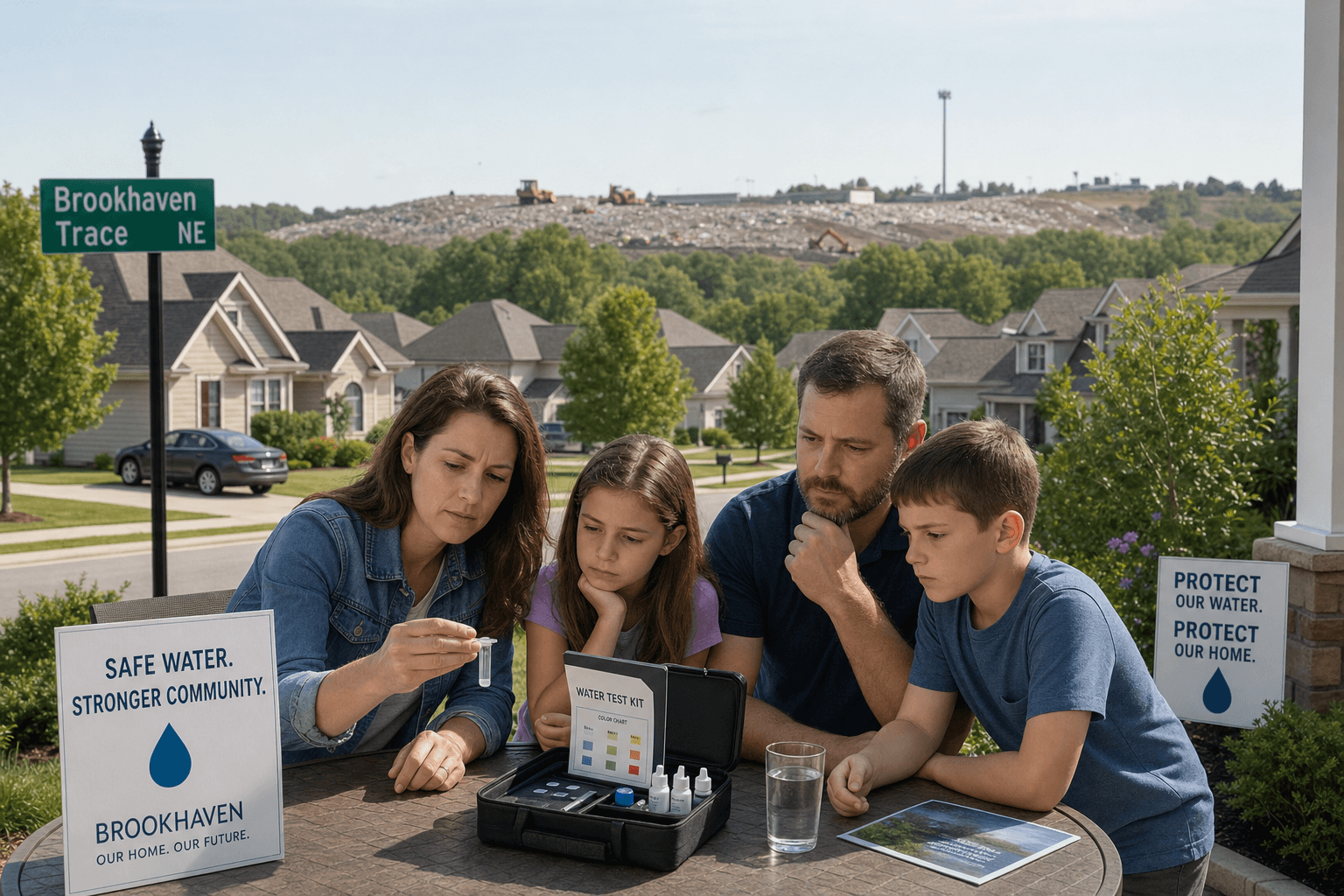
Our team at pHountain Water Filters starts with in-home screening and then, where warranted, guides homeowners toward appropriate lab testing for PFAS and 1,4-dioxane. You can schedule a free in-home water test so we can help you determine if more advanced analysis is needed.
Check 3: Assess Whole-Home Water Exposure, Not Just Drinking Water
When people hear “contamination,” they usually think about what they drink from the kitchen sink. But in a Brookhaven landfill water contamination scenario, every tap matters:
- Showers and baths
- Bathroom sinks used for brushing teeth
- Laundry and dishwashers
- Outdoor spigots and hose bibs
PFAS and 1,4-dioxane are not just a “glass of water” problem; they’re a whole-house water quality issue. That’s why we focus on point-of-entry solutions that treat water as it comes into the home, not just a single faucet.
If you’re currently relying on bottled water for drinking but still showering and washing with unfiltered tap or well water, you’re only addressing a small part of the picture. We compare those tradeoffs in detail in our breakdown of water filters vs bottled water.
Check 4: Explore Whole-House Systems Built for Industrial Pollutants
Once you understand your source and have baseline testing, the next check is whether your current setup addresses industrial contaminants like PFAS, 1,4-dioxane, and related chemicals.
The pHountain pHresh Filtration System is designed for whole-house, point-of-entry treatment. It targets broad contaminant categories that we routinely see across Long Island:
- Chlorine and disinfection byproducts commonly found in municipal water
- Heavy metals that can enter from infrastructure or local geology
- Industrial chemicals and environmental contaminants, including those associated with landfills and manufacturing
- Sediment and particulates that can carry other pollutants
- Bacteria and microorganisms that can affect taste, odor, and clarity
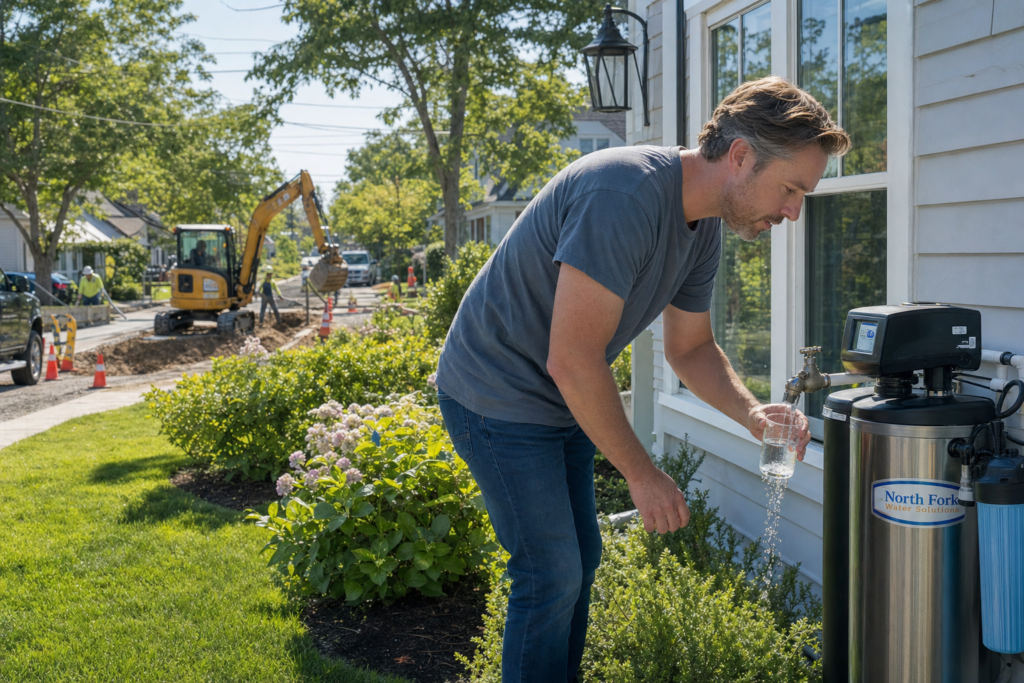
We pair the pHountain pHresh Filtration System with professional, certified installation so the system is integrated directly into your main water line. That means every faucet, shower, and appliance in your Brookhaven home benefits from the same level of treatment.
Because we customize configurations based on actual water conditions, our team can focus on the contaminant categories most relevant to Brookhaven landfill water contamination while still addressing everyday concerns like taste, odor, and scale. Over time, that can also help protect plumbing fixtures, water heaters, and appliances from sediment and corrosion-related issues.
Check 5: Develop a Sustainable Plan Beyond Immediate Fixes
Landfill-related contamination is not a one-week story — it’s a long-term reality. According to Citizens Campaign for the Environment, advocates expect monitoring, remediation, and policy debates around the Brookhaven landfill to continue for years.
Your plan should be just as long-range:
- Schedule regular water testing, especially if you’re on a private well near the landfill.
- Track updates from trusted sources like Inside Climate News and Riverhead Local.
- Reassess your filtration strategy as regulations and contaminant profiles evolve.
At pHountain Water Filters, we design systems with high capacity and low maintenance in mind so that once a Brookhaven homeowner has a solution in place, it can support them through these longer cycles of monitoring and change. Our role doesn’t end at installation — we stay available for follow-up testing, adjustments, and education as new information comes out.
For a broader Long Island context on PFAS and evolving standards, our overview on Long Island’s PFAS problem walks through how these issues have been unfolding across the region, not just in Brookhaven.
How the pHountain pHresh Filtration Suite Addresses Brookhaven’s Challenges
When we look at the Brookhaven landfill water contamination situation, a few design priorities stand out for any serious filtration approach:
- Whole-home coverage
- Capability to address industrial contaminants and municipal byproducts
- Professional installation with an understanding of Long Island plumbing and groundwater
- Long-term reliability with manageable maintenance
The pHountain pHresh Filtration System is built around those priorities.
Comprehensive Entry-Point Treatment Protects Every Faucet
We install the pHountain pHresh Filtration System at the main water entry point of your home. That means:
- Kitchen and bathroom sinks
- Showers and tubs
- Laundry machines and dishwashers
- Outdoor spigots
all receive treated water. For a Brookhaven home near the landfill plume, this is critical. You’re not just addressing what you drink; you’re addressing what you bathe in, cook with, and run through your appliances every day.
Formulated to Combat Industrial and Everyday Contaminants
Our systems are designed to help reduce exposure to:
- Chlorine used by public suppliers
- Heavy metals that can appear due to plumbing materials or local conditions
- Industrial chemicals and environmental contaminants like those associated with landfills
- Sediment and visible impurities
- Bacteria and microorganisms that can impact clarity and odor
On Long Island, where PFAS and 1,4-dioxane have become headline issues, we configure systems with industrial contaminant concerns front and center. That doesn’t mean ignoring everyday water quality issues — it means building a solution that recognizes the full contaminant landscape.
Certified Technicians Ensure Proper Installation and Support
Our technicians are trained specifically for whole-house filtration on Long Island and in the broader NYC metro area. That matters because:
- Older homes may have unique plumbing challenges.
- Private wells near Brookhaven may require particular installation considerations.
- Public-supply homes in Suffolk County need systems integrated without disrupting existing meter or backflow setups.
We handle the plumbing integration, test the system on-site, and walk you through how your new setup works. For many Brookhaven homeowners, that peace of mind — knowing the system was installed by professionals who work on Long Island water every day — is just as important as the equipment itself.
Built for Endurance: High Capacity with Minimal Maintenance
Brookhaven landfill water contamination is not going away next month. Our systems are built for high capacity and designed to minimize frequent intervention, so you’re not constantly worrying about cartridge changes or short-lived fixes.
We stay available for maintenance and support, but the goal is clear: give your home a robust, whole-house foundation so ongoing PFAS and 1,4-dioxane developments in Brookhaven don’t translate into constant stress about your water.
If you’re in Brookhaven or elsewhere in Suffolk County and want to explore what this could look like in your home, our Suffolk County whole-home filtration page is a good starting point.
Composite Brookhaven-Area Case Study: Responding to PFAS and 1,4-Dioxane Exposure
Because of privacy and case-study rules, this example is a composite based on multiple Brookhaven-area and Long Island customers our team has worked with. It reflects real-world patterns, but no single identifiable household.
Situation Overview
A Brookhaven family living a few miles from the landfill relied on a private well. After hearing about the confirmed PFAS and 1,4-dioxane groundwater contamination linked to the landfill, they requested testing.
Lab results showed:
- Significantly elevated PFAS levels in their well water
- Detectable 1,4-dioxane in the same samples
This mirrored the types of contamination patterns reported near the landfill by Inside Climate News and highlighted by Citizens Campaign for the Environment.
Initial Reaction
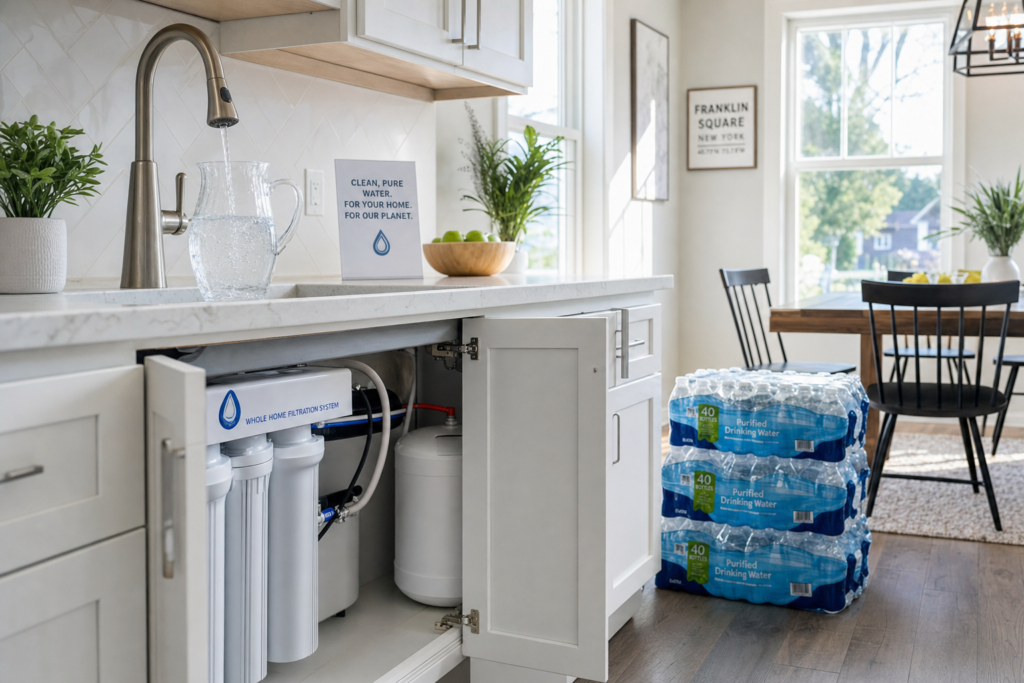
Before contacting us, the family switched to bottled water for drinking and cooking. Within a month, they were spending an extra $30–$60 on bottled water, not counting the hassle of hauling cases and dealing with plastic waste.
They quickly realized that bottled water did nothing for:
- Showers and baths
- Brushing teeth
- Laundry and dishwashing
— all still using contaminated well water.
Our Recommended Solution
After a detailed consultation and review of their lab results, the pHountain Water Filters team recommended a whole-house configuration based on the pHountain pHresh Filtration System with professional installation at the main water entry point.
Key aspects of their setup:
- Whole-home treatment to address industrial contaminants, chlorine (for future disinfection they might add), sediment, and other common Long Island water issues
- Customized configuration tailored to their well’s test results and household water usage
- Professional integration with their existing pressure tank and plumbing layout
Results Achieved
Post-installation, the family:
- Shifted away from heavy bottled water use, saving roughly $30–$60 per month
- Gained consistent, treated water at every tap, not just for drinking
- Had a clear testing and maintenance plan going forward, rather than reacting piecemeal to each new Brookhaven landfill update
This composite mirrors what we’re seeing repeatedly across Long Island: once contamination like PFAS and 1,4-dioxane is confirmed in a local area, families move from short-term bottled water fixes to long-term, whole-house filtration strategies.
Addressing Common Concerns About Brookhaven Water Contamination
1. If I’m on public water in Brookhaven, should I still be worried about the landfill contamination?
Public water suppliers are required to meet regulatory standards, and they may already be taking steps to address PFAS and 1,4-dioxane in their source water. However, according to Riverhead Local, residents remain concerned about the spread of landfill-related contamination and the pace of infrastructure and treatment upgrades.
Even on public water, many Brookhaven homeowners choose whole-house filtration to address not just emerging contaminants, but also chlorine, disinfection byproducts, and other substances that can remain in compliant water.
2. I live near the Brookhaven landfill and use a private well. What should I do first?
Based on what’s been reported by Inside Climate News and Citizens Campaign for the Environment, private wells near the landfill are a key concern. Your first steps should be:
- Confirm your exact location relative to the landfill and known plume areas.
- Schedule targeted testing for PFAS and 1,4-dioxane.
- Consult with a water-quality professional about whole-home filtration options tailored to your results.
We can help you start this process with a free in-home water test and guidance on appropriate lab testing.
3. Is a refrigerator or pitcher filter enough protection for Brookhaven landfill water contamination?
Pitcher and refrigerator filters are typically designed to improve taste and address some basic contaminants, but they do not provide whole-house protection and are not generally configured for complex industrial contaminants like PFAS and 1,4-dioxane.
In a Brookhaven landfill water contamination scenario, you need to think beyond one tap. That’s why we focus on whole-house systems installed at the point of entry, so every faucet and fixture benefits from the same level of treatment.
4. How does Brookhaven’s situation compare to other Long Island PFAS problems?
The Brookhaven landfill is part of a broader Long Island pattern where PFAS and 1,4-dioxane have been detected in groundwater, wells, and even produce, as we discuss in our piece on Long Island’s PFAS problem. According to Citizens Campaign for the Environment, the landfill has become a focal point because contamination has been directly tied to the facility, prompting community demands for faster action.
For homeowners, the takeaway is similar across the Island: don’t assume your tap is exempt just because the contamination headline is in another town. Testing and in-home treatment provide localized protection regardless of where the plume maps fall.
5. How does pHountain Water Filters test Brookhaven water and recommend a system?
Our process is straightforward:
- We schedule an in-home visit to perform initial water screening and review your concerns, location, and whether you’re on public supply or a private well.
- If your home is near the Brookhaven landfill or you have reason to suspect PFAS/1,4-dioxane, we help you pursue appropriate lab testing for those specific contaminants.
- Once results are in, we design a whole-house solution using the pHountain pHresh Filtration System, configured for your water’s unique profile and your home’s plumbing.
- Our certified installers integrate the system at the main water entry, test it, and explain how to monitor and maintain it.
This approach gives Brookhaven homeowners a clear path from “I heard about the landfill contamination” to “I know what’s in my water and what I’m doing about it.”
Take Action Today to Protect Your Brookhaven Water Quality
Brookhaven landfill water contamination with PFAS and 1,4-dioxane is now confirmed by regulators, and the situation is still evolving. You don’t control how fast agencies move, but you do control what happens at your own front door.
If you live near the Brookhaven landfill — or anywhere in Suffolk County — and want clarity on your water, start with a no-cost assessment from our team. We’ll test, explain what we see in plain language, and walk you through whole-home options built around the pHountain pHresh Filtration System.
Schedule your Free In-Home Water Test and put a real plan in place for your Brookhaven home.
Water quality varies by location. Municipal water provided by SCWA achieved EPA compliance in June 2025. Private well owners should have water tested regularly. pHountain provides free water testing for Nassau and Suffolk County.