For homeowners in Manhasset and across Long Island, water quality is more than a matter of convenience. As drinking water standards change and contaminants such as PFAS and 1,4-dioxane stay in the news, it makes sense to take a closer look at the water flowing from your kitchen faucet, your showers and your laundry room.
Whether you rely on public water or a private well, knowing where your water comes from, how it is treated and what your supplier’s testing shows is the first step toward making informed decisions about your home’s water. This guide covers what Manhasset’s water supplier publishes, what its latest annual report says, and practical steps you can take at home.
pHountain Water Filters serves homeowners across Long Island, in Nassau and Suffolk counties, including Manhasset.
Who Supplies Manhasset’s Water
Manhasset’s public water comes from the Manhasset-Lakeville Water District (MLWD). According to the district’s 2025 Water Quality Report, MLWD serves all of Manhasset and Lake Success as well as portions of New Hyde Park, North Hills and Great Neck, and its service area includes the Village of Plandome. The report says the district serves over 45,000 people through more than 10,500 service connections in a 10.2-square-mile area.
All of the district’s water comes from underground wells. MLWD draws its supply from the Magothy and Lloyd aquifers and operates fourteen wells at eleven sites in Manhasset, Lake Success, North Hills, Great Neck and New Hyde Park, and the water delivered to your tap is a blend of water produced by the individual wells, the report explains.
Understanding the Landscape of Water Quality in Manhasset
Living in Manhasset offers many advantages, but like the rest of Long Island, it depends on groundwater, and what happens on the land above an aquifer can affect what reaches the wells. A source water assessment completed by the New York State Department of Health, with assistance from the Nassau County Department of Health, rated most of the district’s wells as having a very high susceptibility to industrial solvents and a high to very high susceptibility to nitrates, according to MLWD’s report. The report adds that a susceptibility rating is an estimate of the potential for contamination of the source water; it does not mean the water delivered to customers is, or will become, contaminated.
Here is how the substances homeowners most often ask about fit into that picture, according to the district’s report:
- Chlorine: MLWD treats its raw water with sodium hypochlorite (chlorine) to control bacteria and with sodium hydroxide to adjust pH. Some people notice the taste or smell of chlorine at the tap.
- Industrial solvents: The report says 11 of the district’s 14 active wells have shown trace levels of volatile organic chemicals, and that the district operates seven treatment plants to remove them, using air stripping (aeration) or carbon filtration (adsorption).
- Nitrate: Nitrate has a long local history, covered in the next section.
- Lead: The report says lead in drinking water comes primarily from materials and parts used in service lines and home plumbing. More on that below.
- Sediment: Fine particles can cloud water and settle in aerators, water heaters and appliances.
If your home is on a private well rather than the public supply, the picture is different: federal and state drinking water limits apply to public water systems, and private well owners are responsible for testing their own water, as EPA explains.
Nitrate, Cesspools and the Searingtown Wells
MLWD’s report explains that in the early 1970s the Nassau County Department of Health strongly recommended creating a sewage collection district to protect the public water supply, but the proposal was defeated, and the Manhasset area uses cesspools for sewage disposal. Since then, the report says, nitrate levels in several district wells that draw from the Magothy aquifer have risen steadily: two wells exceeded the maximum allowable level for nitrate in 2004, and two more, Searingtown wells 1 and 2, exceeded it in 2009. A nitrate removal system was then built at Searingtown Station.
Today the district removes nitrate from the Searingtown wells through ion exchange, and it blends raw water from Shelter Rock Road well #2 and the Gracefield well as a treatment technique for the high nitrate level in the Shelter Rock well, according to the same report. Nitrate was detected below the 10 mg/l limit in 2025 but at more than half of it, so the report carries the required health notice: nitrate in drinking water above 10 mg/l is a health risk for infants of less than six months of age, and if you are caring for an infant and using tap water to prepare formula, you may want to use an alternate source of water or ask your health care provider for advice.
PFAS and 1,4-Dioxane: What MLWD Is Doing
New York set drinking water limits of 10 parts per trillion (ppt) for PFOA and PFOS and 1 part per billion (ppb) for 1,4-dioxane in 2020, according to the New York State Department of Health. In April 2024, the U.S. Environmental Protection Agency finalized limits of 4.0 ppt each for PFOA and PFOS, and public water systems must comply by 2029. In May 2026, EPA proposed letting systems request two more years (to 2031) for PFOA and PFOS and proposed rescinding its limits for PFHxS, PFNA, GenX and certain PFAS mixtures; those proposals were not final as of September 2026.
In its 2026 newsletter and 2025 report, MLWD says it is constructing treatment plants to meet the new standards, funded through bonds, capital funds and grants, and that it is pursuing legal action against the manufacturers of these chemicals so that the treatment costs do not ultimately fall on customers. The district reports that:
- In 2025 it installed new granular activated carbon (GAC) vessels at its Eden well station to remove PFAS, along with a reconstruction of the building.
- A new treatment plant for Campbell Well #1 was bid and awarded in 2025, and construction is underway.
- The New York State Environmental Facilities Corporation awarded a grant covering 60% of the roughly $3 million construction cost of the GAC plant at the Campbell well site.
- That grant comes on top of two earlier grants totaling more than $16 million for two treatment facilities designed to remove 1,4-dioxane from three supply wells at the Searingtown Road and Shelter Rock Road plants.
In the report’s table of detected contaminants for 2025, PFOA ranged from not detected to 7.93 ppt (ng/l), below New York’s 10 ppt limit, and PFOS appears on the list of contaminants tested for but not detected. 1,4-dioxane ranged from not detected to 0.73 ppb (ug/l), below the state’s 1 ppb limit (MLWD 2025 report). The federal 4.0 ppt limits for PFOA and PFOS apply to public water systems from 2029, and they are the new standards the district says its treatment plants are being built to meet.
For a look at how treatment projects and other well work can show up at your tap, see our post on how local well upgrades affect your home’s water.
Reading Manhasset’s Annual Water Quality Report
Every community water supplier publishes an annual water quality report, also called a Consumer Confidence Report; EPA explains what these reports contain and how to find yours. MLWD’s 2025 report says that last year the district’s tap water met all State drinking water health standards and that the system did not violate a maximum contaminant level or any other water quality standard.
When you read your copy, look for:
- The table of detected contaminants: the level detected (often a range), the date of the highest result, the legal limit (MCL), the health-based goal (MCLG) and the likely source.
- The list of contaminants tested for but not detected, which is often longer than the detected list.
- The source water assessment, which describes the potential threats to the wells.
- The treatment section, which describes what is done to the water before it reaches you.
- Lead information and system improvements, including planned work in your neighborhood.
The report also reminds readers that all drinking water, including bottled water, may reasonably be expected to contain at least some small amounts of contaminants, and that their presence does not necessarily indicate that water poses a health risk.
Lead Service Lines in Older Manhasset Homes
MLWD’s report says lead can enter drinking water through lead service lines and, less commonly, household plumbing, and that homes built before 1950 may have a lead service line, which should be replaced. The district has prepared a lead service line inventory under the federal Lead and Copper Rule Revisions; the report says you can review MLWD’s service line records for your home and request a free inspection if you believe the recorded material is incorrect. The district’s website links to its service line material viewer and to a Lead Service Line Replacement Program grant funded by the New York State Department of Health.
The district completed its required testing of 30 possible high-risk samples for lead and copper in 2023, and the results showed no violation of EPA criteria; another round of 30 samples will be tested during summer 2026, according to the report. Because lead levels can vary over time, the report advises using only cold water for drinking, cooking and making baby formula, notes that boiling does not remove lead, and suggests flushing your pipes for several minutes before use by running the tap, taking a shower or doing a load of laundry or dishes. EPA’s lead page has more on lead in drinking water.
The Limitations of Bottled Water Dependency
A common response to concerns about tap water is to switch to bottled water. That covers drinking, but it is rarely a complete approach: it adds cost and plastic waste, and it does nothing for the water your household uses for everything else. Bottled water has its own rules, too: MLWD’s report notes that State Health Department and FDA regulations establish limits for contaminants in bottled water, which must provide the same protection for public health.
Consider the water your family uses for other tasks:
- Cooking: You use tap water to wash vegetables, boil pasta and make soups.
- Bathing and showering: Showers, baths and handwashing all use tap water, whatever you drink.
- Appliances: Minerals and sediment can leave buildup in fixtures, water heaters and appliances over time.
Our page on Water Filters vs Bottled Water walks through the long-term tradeoffs for Long Island homeowners.
Where Whole-House Filtration Fits
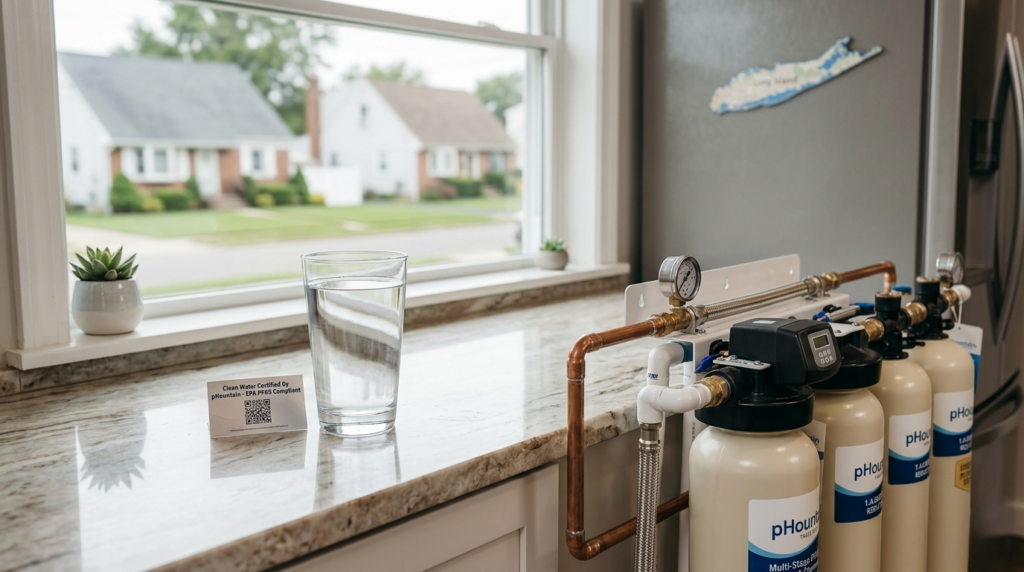
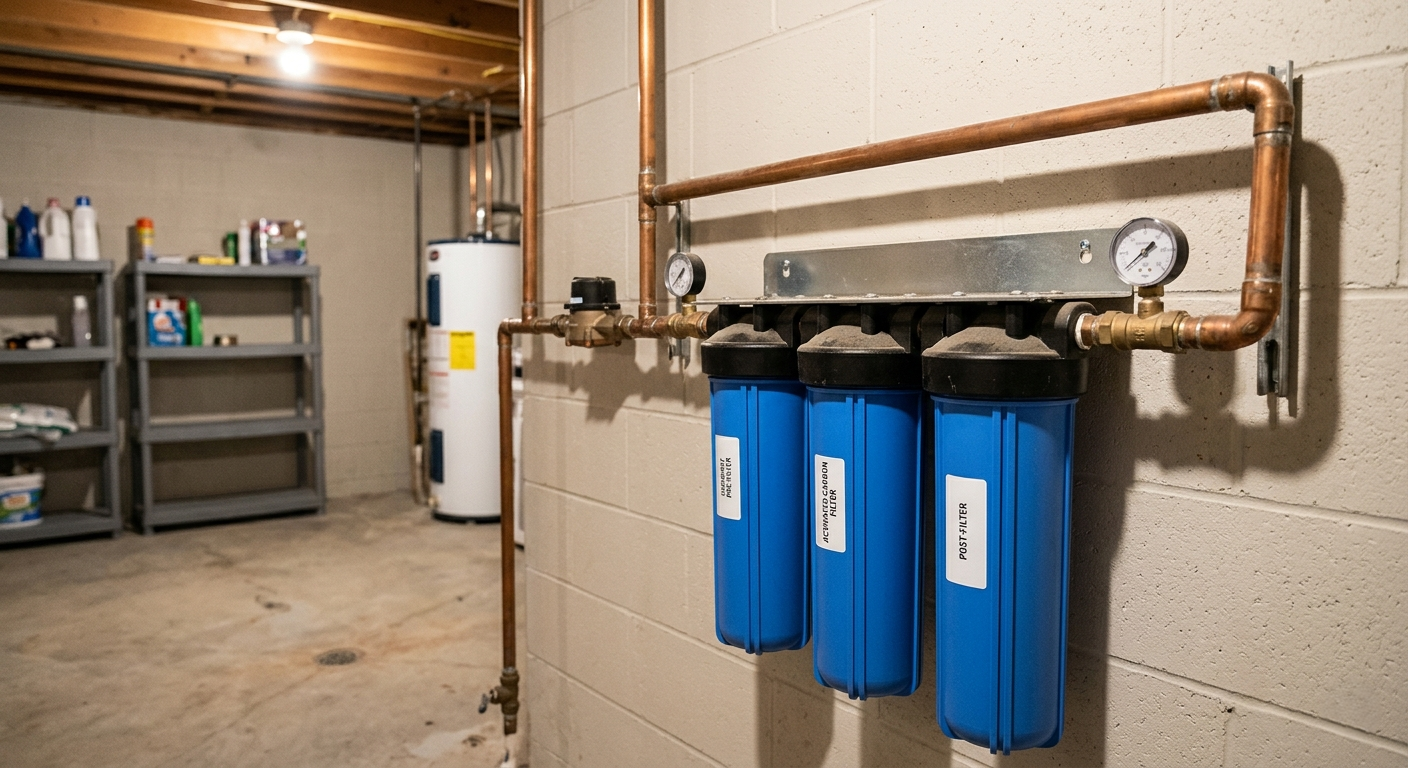
The pHountain Filtration System is a whole-home (point-of-entry) system with a cartridge-free media design intended to reduce common impurities in tap water. Unlike point-of-use filters that treat water at a single sink, it is installed at the main water entry point, so the water for your morning shower, your kitchen sink and your washing machine all passes through it.
Professional Installation vs. the DIY Approach
Some homeowners try to “patchwork” their home’s water with several off-the-shelf, under-sink filters. Each of those treats only the water at the tap where it is installed. A whole-home system connects to your main water line, which makes it a plumbing job. pHountain’s whole-home systems are professionally installed and backed by a 10-year guarantee.
Tailoring Solutions to Your Home
No two homes in Manhasset have exactly the same water. The age of your plumbing, the material of your service line, and whether you are on the public supply or a private well all make a difference, which is why a “one-size-fits-all” product is rarely the right answer.
That is why the process starts with testing. A whole-home system is configured around what testing finds. For any specific contaminant, ask for independent certification data (for example NSF/ANSI listings) for the exact system you are considering.
The pHountain Water Filters Process: From Testing to Installation
We have designed our process around a free in-home water test:
- Request a visit. Ask for a Free In-Home Water Test online, and a team member will contact you to confirm a time.
- On-site water test. A pHountain specialist comes to your home, tests your water and walks you through the results and your options.
- Recommendation. If whole-home filtration makes sense for your home, you get a recommended configuration of the pHountain Filtration System before you commit to anything, and you can ask how it would be installed and what maintenance it needs.
- Professional installation. The system is installed at your main water line and backed by a 10-year guarantee.
Measuring PFAS and 1,4-dioxane at the levels regulators use (parts per trillion and parts per billion) requires analysis by a certified laboratory; a free in-home water test is a starting point for understanding your water and your options. For more on how we work across the county, see our Water Filtration Nassau County NY page.
Manhasset Water: Common Questions
Is Manhasset tap water safe to drink?
Public water suppliers such as MLWD must meet federal and state drinking water limits, and they publish an annual water quality report showing what they tested for and found; the EPA explains how to find yours. MLWD’s 2025 report says its system had no violations. If your home is on a private well, testing your water is your responsibility (EPA).
Who do I contact with questions about my water?
For questions about the public supply, contact the Manhasset-Lakeville Water District; its report lists contact details for its superintendent and for the Nassau County Department of Health, and says customers concerned about lead can contact the district about having their water tested.
Are there lawn watering rules in Manhasset?
Yes. MLWD reminds customers that Nassau County’s sprinkling rules remain in effect: no lawn, garden or shrub sprinkling between 10:00 a.m. and 4:00 p.m.; even-numbered addresses sprinkle on even-numbered calendar days and odd-numbered addresses on odd-numbered days; hoses must have a hand-operated automatic shut-off nozzle; and hosing driveways, sidewalks and streets is prohibited. The district’s 2026 newsletter also says customers who buy and install a WaterSense-labeled smart lawn irrigation controller in 2026 may receive a $150 account credit, with the offer expiring December 31, 2026.
If you’re in Manhasset and want a clearer picture of your tap water, start with a Free In-Home Water Test from pHountain Water Filters.
This blog is for informational purposes only and does not guarantee specific water quality outcomes. Water conditions and regulations can change; always consult your local water provider and a qualified water treatment professional for advice tailored to your home.
Sources
- Manhasset-Lakeville Water District, “H2O Update 2026” and 2025 Water Quality Report: https://www.mlwd.net/pdf/2025%20WaterQualityReport.pdf
- Manhasset-Lakeville Water District website: https://www.mlwd.net/
- Manhasset-Lakeville Water District, Sprinkler & Hose Regulations: https://mlwd.net/css_sprinkler.php
- New York State Department of Health, Drinking Water Standards for PFAS and Other Emerging Contaminants: https://www.health.ny.gov/environmental/water/drinking/emerging_pfas_publicwater.htm
- U.S. EPA, Per- and Polyfluoroalkyl Substances (PFAS): https://www.epa.gov/sdwa/and-polyfluoroalkyl-substances-pfas
- U.S. EPA, Consumer Confidence Reports: https://www.epa.gov/ccr
- U.S. EPA, Lead: https://www.epa.gov/lead
- U.S. EPA, Private Drinking Water Wells: https://www.epa.gov/privatewells