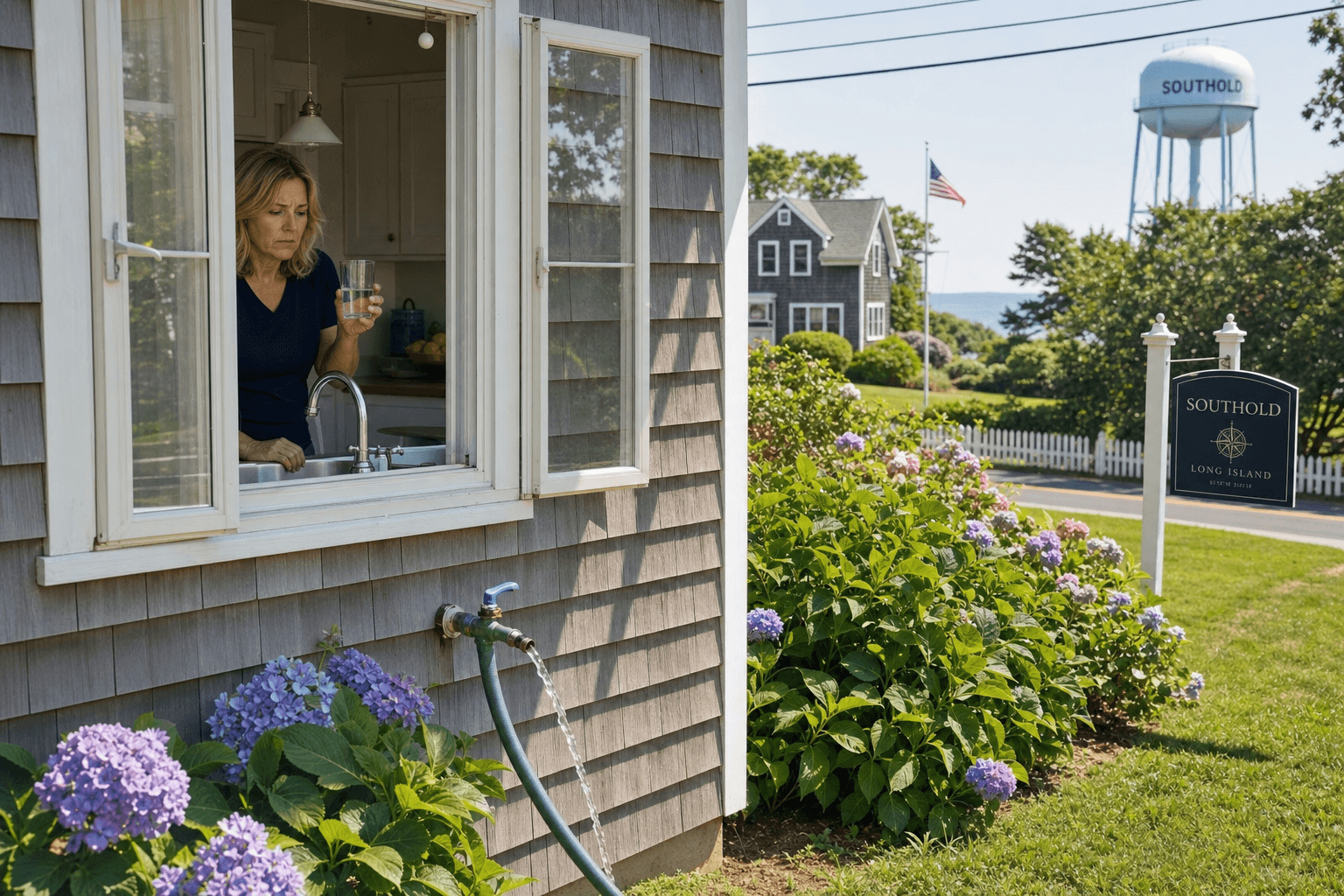
Southold homeowners are noticing lower water pressure, changing taste, and more chlorine odor at the tap in the hottest months. These are not just annoyances — they are symptoms of broader Southold water supply problems tied to heavy summer demand on a thin, stressed aquifer and an aging water system.
Below, you’ll see what’s happening beneath your feet, how big infrastructure projects may (and may not) help your day‑to‑day water, and what you can do inside your own home to keep water quality consistent all year.
1. Understanding the Causes of Southold’s Summer Water Pressure and Quality Changes
Southold’s public water comes from local groundwater aquifers, not from a river or reservoir. On the North Fork, that groundwater supply is thinner and shallower than in many other parts of Long Island, which makes it more vulnerable when demand spikes and when contaminants reach the water table (SCWA).
In summer, several stressors hit at once:
- Irrigation systems running daily, often even after heavy rain
- Seasonal population increases, including vacation homes and rentals
- Tourism and agriculture drawing more from the same limited aquifer
According to the Suffolk County Water Authority (SCWA), water demand on the North Fork continues to increase despite conservation efforts, and the area’s aquifer is limited in its supply to meet peak demand (SCWA).
1.1 What Homeowners Notice When System Demand Spikes
When demand surges and infrastructure is pushed hard, Southold homeowners can experience:
- Noticeable pressure drops: SCWA has pointed to a 300,000‑gallon tank in Greenport that can fall to only a few feet of water during peak summer demand, which reduces water pressure and emergency reserves (Suffolk Times). On July 3, the 30‑foot tank reportedly dropped to 6.5 feet at 5 a.m. (Suffolk Times).
- Fluctuating taste and odor: Higher pumping and treatment adjustments can coincide with stronger chlorine smell or “pool water” taste, as well as more sediment moving through the system.
- Cloudy or discolored water: Pressure changes can disturb sediment in mains, which may show up as brief cloudiness or visible particles at the tap.
These symptoms don’t necessarily mean your water is unsafe, but they do signal that the system is under stress and that what comes out of your tap can change with the season.
2. Examining the North Fork Pipeline Project and Its Role in Supply Stability
To respond to these long‑term supply concerns, SCWA has proposed a major North Fork water main project — its largest single infrastructure project in 75 years (SCWA).
2.1 Overview of the Planned Pipeline Features
Based on SCWA and local news reports, here’s what is planned:
- 7.5‑mile, 24‑inch transmission main from Flanders to the Southold Town line, along state and county roads (Suffolk Times; SCWA)
- Booster station to help stabilize water pressure and improve reliability (SCWA)
- Revised route that is about one mile shorter than the original proposal and stays on state and county roads to reduce traffic and environmental impacts (SCWA)
- Construction timeline projected at about 12–18 months, with completion moved up from 2030 to around 2028 (Suffolk Times; SCWA)
- Budget in the range of $22–25 million, integrated into SCWA’s capital program (Suffolk Times)
SCWA operates 60 wells at 18 well fields on the North Fork, serving about 9,500 customers, and notes that most wells draw from the Upper Glacial Aquifer, which is especially vulnerable to surface contamination and rising chloride levels (SCWA).
2.2 Expected Advantages and Remaining Challenges
SCWA’s stated goals for the project include (SCWA):
- Relieving pressure on local wells so the thin aquifer can recover
- Lowering the risk of saltwater intrusion by avoiding over‑pumping
- Strengthening emergency reserves for fire protection and system reliability
- Reducing the likelihood that expensive wellhead treatment systems will be needed at as many sites
Local officials, including Greenport’s mayor, have expressed support for improved reliability and fire protection, while also emphasizing that aggressive conservation must be part of the long‑term solution (Suffolk Times).
For your household, this means:
- Over time, the project may stabilize pressure and support system capacity in peak season.
- It does not change the reality that your water travels through miles of pipe and is subject to seasonal treatment changes and distribution‑system impacts before reaching your tap.
So even as the regional system improves, what you experience inside your home can still vary — especially in those high‑demand summer weeks.
3. Ways That Intense Summer Water Use Influences Your Home’s Water Quality
When the public system is under seasonal strain, you may notice more than just pressure changes.
3.1 Common Seasonal Changes in Southold Tap Water
Typical household observations include:
- Stronger chlorine odor:
- Why it happens: Utilities use chlorine as a disinfectant. When water is pumped and stored differently to meet peak demand, chlorine levels at your tap can feel more noticeable, even when they remain within regulatory limits.
- Sediment and particles:
- Why it happens: Higher flows and shifting pressures can disturb mineral scale and sediment in mains and service lines, which may reach your faucets.
- Taste differences between seasons:
- Why it happens: Changes in pumping patterns, source mix, and treatment operations can change the taste profile of your water, even if it still meets official standards.
These seasonal shifts are partly why many Southold homeowners look for ways to stabilize water quality inside the home, regardless of what’s happening in the broader system.
4. Household Example: Coping With Summer Water Pressure and Quality Challenges in Southold
To show how this plays out at the household level, here is a composite example based on typical customer situations in the area.
4.1 Recognizing Summer Water Problems in Daily Life
A Southold homeowner noticed that during peak July and August weeks:
- Water pressure dropped, especially when irrigation systems in the neighborhood were running.
- Tap water had a stronger chlorine smell and occasionally looked slightly cloudy.
- The family started buying more bottled water for drinking and cooking, adding both cost and plastic waste.
Concerned, the homeowner requested water quality testing. Results showed:
- Elevated chlorine levels consistent with municipal disinfection practices
- Visible sediment and suspended particles that aligned with seasonal stress on the supply
These findings matched the broader picture SCWA has described — increasing demand straining infrastructure and the local aquifer (SCWA).
4.2 Resolving Issues With Whole-House Filtration Installation
The homeowner chose to have a pHountain pHresh Filtration System installed at the main water line. This whole‑house approach was designed to:
- Filter chlorine and sediment at the point of entry
- Provide consistent water quality at every tap and shower, regardless of outdoor watering schedules
- Support better‑tasting water so the family could rely less on single‑use plastic bottles
Over time, the household estimated monthly savings of roughly $20–$50 by cutting back on bottled water and using their tap more efficiently.
> Want to understand exactly what’s in your Southold tap water this summer? > Schedule a Free In‑Home Water Test and see your results right at the kitchen sink.
5. Immediate Actions Southold Residents Can Take to Ease Water System Stress
Whether you’re on public water in Southold or nearby North Fork communities, you can take simple, local steps to ease strain on the system and improve what you drink at home.
5.1 Practical Conservation Tips for Peak Summer Demand
Local officials and residents have called for stronger conservation measures, noting that sprinklers often run even after several inches of rain (Suffolk Times). You can help by:
- Adjusting irrigation controllers:
- Skip watering after rain: Turn off automatic systems for several days after substantial rainfall.
- Water early morning: Reduce evaporation and system load by watering before sunrise.
- Checking for leaks:
- Toilet and faucet leaks can waste hundreds of gallons over a season. Fix drips promptly.
- Using efficient fixtures:
- Low‑flow showerheads and WaterSense‑rated fixtures can lower demand without sacrificing comfort.
- Prioritizing essential uses:
- During heat waves, limit non‑essential outdoor use like washing driveways or frequent car washes.
These actions not only help protect the thin Upper Glacial Aquifer that serves much of the North Fork (SCWA) — they also reduce pressure swings that you feel at home.
5.2 How to Check and Improve Your Home’s Water Quality
To get a clear picture of your own water:
- Arrange in‑home testing:
- A targeted test can show chlorine levels, sediment presence, and other key indicators of water quality.
- Review your options:
- Whole‑house filtration at the main line can address water used for drinking, cooking, bathing, and laundry.
- Under‑sink systems at the kitchen tap focus on drinking and cooking water only.
- Consider long‑term costs:
- Many families find that investing in filtration is more cost‑effective than long‑term bottled water reliance. For more context, see how tap filtration compares in Water Filters vs Bottled Water.
6. Integrating Whole-Home Filtration Into Southold’s Water Management
Regional projects like the North Fork pipeline look after system‑wide reliability, but they don’t customize water quality for your home. That’s where whole‑house filtration can complement public infrastructure.
6.1 Key Features of the pHountain pHresh Filtration System
The pHountain pHresh Filtration System is engineered to:
- Treat water at the point it enters your home, before it reaches fixtures
- Target chlorine, sediment, and a wide range of common tap water contaminants
- Provide consistent water quality across seasons, helping to smooth out the differences you might otherwise notice between winter and summer
Because it works on every tap and shower, it supports:
- Drinking and cooking with filtered water
- Showering and bathing without the same level of chlorine exposure
- Appliance protection, as filtered water can help minimize sediment reaching water heaters, dishwashers, and washing machines
6.2 Comparing Water Quality Strategies for Southold Homeowners
Here’s a quick comparison of how different strategies line up for a Southold household:
| Approach | What It Addresses | Limitations in Southold Context |
|---|---|---|
| Relying on public water alone | System‑wide disinfection and basic treatment | Seasonal pressure drops, taste/odor changes, and aquifer stress still affect your home |
| Bottled water only | Drinking water taste and convenience | Ongoing cost, plastic waste, does nothing for showers, laundry, or cooking with tap water |
| Under‑sink filter | Drinking and cooking water at one faucet | Other taps and showers still carry untreated municipal water characteristics |
| Whole‑house filtration | All water entering the home, including showers and appliances | Requires professional installation and upfront investment |
For homeowners in Suffolk County, including Southold, you can learn more about regional options on our page for Whole‑Home Water Filtration for Suffolk County.
> Ready to see how a customized filtration setup could work in your Southold home? > Use our Contact Us page to connect with pHountain Water Filters and discuss your options.
7. Answers to Common Questions on Southold’s Water Supply and Seasonal Changes
7.1 Why does my Southold water pressure drop most in July and August?
During peak summer, irrigation, tourism, and seasonal population increases place heavy demand on a thin, shallow aquifer and existing infrastructure. SCWA has reported that at times, a 300,000‑gallon storage tank in Greenport has dropped to only a few feet of water in early morning hours, which reduces available pressure and emergency reserves (Suffolk Times). When many homes draw water at once, you feel that as weaker pressure at your taps.
7.2 Will the North Fork pipeline project completely solve Southold’s water issues?
The planned 7.5‑mile transmission main and booster station are designed to stabilize supply, protect the aquifer, and support system reliability for the North Fork (SCWA). Local officials have generally supported the project but stressed that conservation must still play a leading role in long‑term water management (Suffolk Times). For individual homes, the project does not remove the need to manage taste, odor, and sediment inside your plumbing — that’s where in‑home filtration can make a difference.
7.3 Why does my Southold tap water smell more like chlorine in summer?
Changes in pumping rates, storage levels, and system flows during hot, high‑demand periods can mean you notice chlorine more strongly at the tap, even when disinfectant levels remain within regulatory guidelines. Chlorine is added at the system level, and its odor and taste can vary depending on how long water sits in pipes and tanks before reaching your home. Whole‑house filtration is one way homeowners aim to moderate chlorine taste and odor at every faucet.
7.4 I live in Southold but travel often in summer. Is there anything I should do before leaving the house?
If you’re away during peak season:
- Turn off or reprogram irrigation systems to avoid unnecessary watering, especially after rain — this supports both your own plumbing and the local aquifer.
- Check for leaks before you go, so you’re not wasting water or risking damage while away.
- Consider shutting off your main water supply if you’ll be gone for an extended period and your plumbing allows it safely.
When you return, it can help to run taps for a few minutes to flush any stagnant water in your home’s pipes before drinking or cooking with it.
7.5 How can I get my Southold water tested and explore filtration options?
You can request a no‑obligation water evaluation tailored to your Southold home. pHountain Water Filters serves homeowners across Long Island, including the North Fork. To get started:
- Request a visit through our Free In‑Home Water Test page
- Or reach out with questions via our Contact page
From there, we can help you interpret your results and discuss whether whole‑house or point‑of‑use filtration makes the most sense for your situation.
This material is for general informational purposes only and is not intended as professional plumbing, health, or environmental advice. Always consult appropriate licensed professionals and official agencies for guidance specific to your home and local regulations.
Water quality varies by location. Municipal water provided by SCWA achieved EPA compliance in June 2025. Private well owners should have water tested regularly. pHountain provides free water testing for Nassau and Suffolk County.